

A Speed Links alternative, or a 90-day plan to find out what it really does
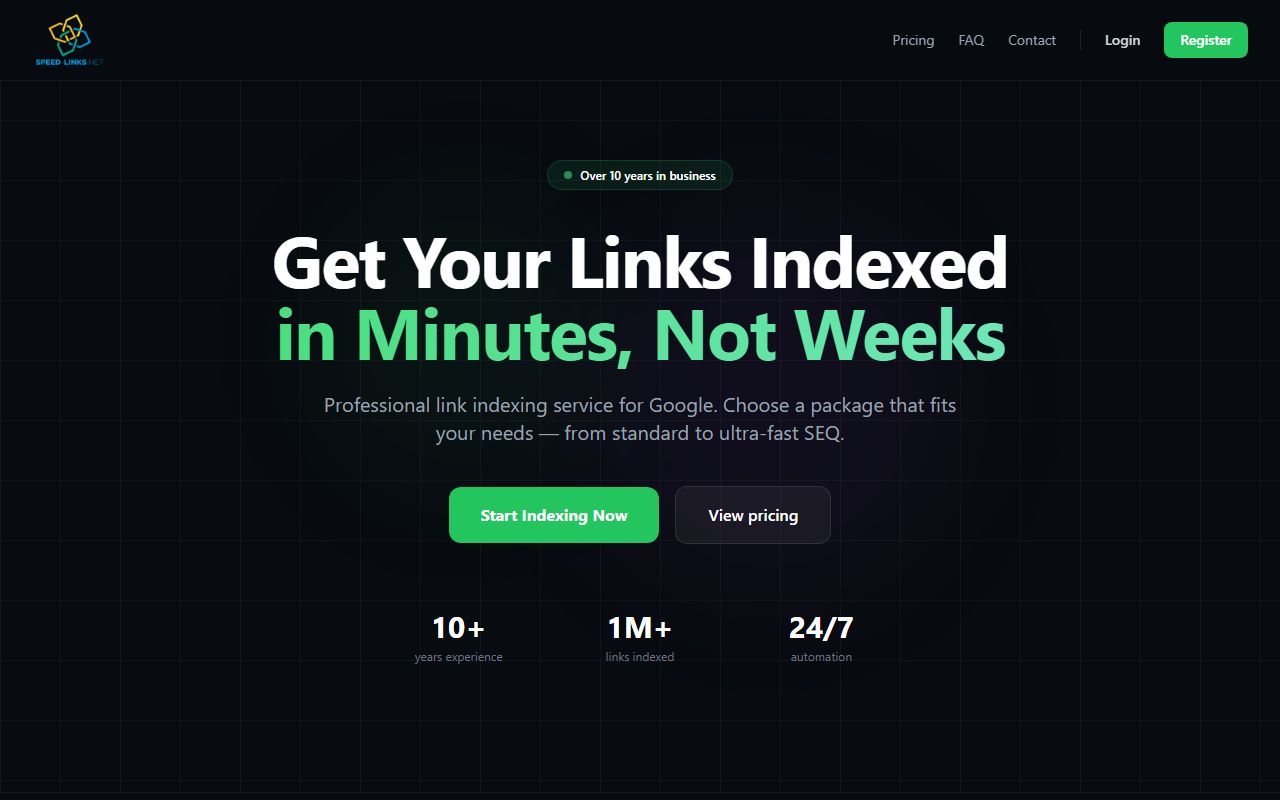
Speed Links promises 'Minutes, Not Weeks' while its own FAQ says 20-30 days for the Regular method. This plan shows how to test that gap with link data instead of faith.
Our index holds 57 referring domains and 233 backlinks for speed-links.net, with a Domain Rating of 24 (our own metric, not Ahrefs DR). Only 76 of those links, 32.6%, are dofollow. The profile is lopsided: openadmintools.com (48 links) and wordpress.org (30 links) together supply 78 of 233, or 33.5%, and every one of them is nofollow. The wordpress.org links are localised copies of a single plugin page, /plugins/seo-monster/, last seen 2025-08-11.
The anchors read like a map of where the tool gets discussed. 'Speed Links' alone is 57 links (24.46%), followed by 'speed-links.net', 'Speed-Links' and 'SpeedLinks'. The referrers include GSA's documentation (gsa-online.de, 13 links), indexcheckr.com (10) and roundup posts in Portuguese, Russian, Chinese and Polish. The one odd block is 16 dofollow links from goldentax.com.pl under the anchor 'Na czym polega outsourcing kadr i płac?' (a Polish payroll question), pointing at /index.php. That may be a mis-pointed link in a blog template rather than an editorial mention. Also, 43 of the 57 referrers sit below DR 30.
Speed Links at a glance
- What it is
- A paid service that submits URLs, usually backlinks, for Google indexing. Site wording: 'Professional link indexing service for Google.'
- Methods
- Regular, VIP and SEQ ('Super Extra Quick'). Only VIP and SEQ have public plans.
- Prices (USD)
- SEQ 50 credits $8.25, SEQ 200 credits $30.80 (credits valid 1 month); VIP 500 links per month $9.99, VIP 2000 links per month $37.99.
- API
- Yes, a submission API with a short PHP sample file. Response format, limits and error codes are not published.
- Refunds
- 'No, we don't offer refunds.' The terms say there is no guaranteed index ratio.
- Age
- Claims 'Over 10 years in business'; the domain was registered on 2015-07-21 (RDAP). Owner, company and HQ are not published.
The homepage says minutes; the FAQ says 20-30 days
Start with the two sentences that sit a few scrolls apart on speed-links.net. The hero reads 'Get Your Links Indexed in Minutes, Not Weeks'. The FAQ answer to 'How long do I have to wait for results?' says that for the REGULAR method, 'Usually after 20-30 days from 100% progress most links appear in Google index'. Both can be true if 'minutes' describes how fast the service processes your submission and not how fast Google lists the page. The site never defines the word, and it publishes no time-to-index figure for VIP or SEQ.
That gap is the reason this page is a plan and not a verdict. We cannot tell you whether Speed Links works for your links. Independent tests disagree: a 2023 test adapted on topvisor.com put 'SpeedLinks VIP' at 72.5% of pages indexed, while an IndexCheckr analysis updated in March 2025 recorded 25.87% (1,041 indexed, 2,983 not) with uneven sample sizes across tools. Different years, different methods, different link sets. Quote both or neither.
What you can do is run your own test, and keep the evidence somewhere other than the indexer's dashboard. The plan below takes 90 days and uses apibacklinks for the evidence side.
Day 0: do the price arithmetic before you register
Speed Links publishes four packages, all in USD. Divide them out and the structure shows itself:
| Package | Price | Quota | Per link |
|---|---|---|---|
| SEQ 50 Credits | $8.25 | 50 links, valid 1 month | $0.165 |
| SEQ 200 Credits | $30.80 | 200 links, valid 1 month | $0.154 |
| VIP 500 per month | $9.99 / 1 month | 500 links, 30 days | about $0.020 |
| VIP 2000 per month | $37.99 / 1 month | 2000 links, 30 days | about $0.019 |
SEQ costs roughly eight times more per link than VIP. The Regular method is named on the site but has no public plan or price. The FAQ warns that a 'large number of links indexed in short time can be harmful' and advises 10-500 links per domain monthly. Plan batch sizes around that sentence.
Also note what the terms say: no refunds, no guaranteed index ratio, and money is 'used at the moment of pay'. With no free tier on the site today, your test is paid from the first link. Budget it small. Fifty SEQ credits cost $8.25 and a month of VIP 500 costs $9.99.
Days 1-30: write down what the crawl sees today
Before any URL goes to an indexer, record the state of the world. Pick the pages you intend to submit, then pull the link data for each target domain with the free overview action. Save DR, referring domains and the date of the last crawl sighting. For the pages that carry the links, backlinks gives you source URL, anchor, rel and a last-seen date; filter it by source domain to see only the placements you care about.
This baseline matters because of a distinction people blur. Speed Links targets Google's index. apibacklinks reports what a public web crawl has found, refreshed roughly monthly and not in real time. A link showing up in our data does not prove Google indexed the page, and a link missing from it does not prove Google ignores it. What the baseline gives you is a repeatable, dated record, and a question for later: do links you submitted appear in link data sooner or more often than the control links you did not?
Use week 1 to sort your URLs. Put at least 100 into a spreadsheet with source domain, placement date and an 'indexed?' column you fill by hand from Google's own tools. Put one in three of them aside as a control that never goes near an indexer. In weeks 2-4, just wait and re-check. Nothing here costs more than a few credits. You can explore any domain in the free explorer to see the report layout before you write a line of code.
Days 31-60: run one batch, change one variable
Now spend the money. The cleanest design uses three cohorts of equal size and quality: no submission, VIP, SEQ. The site's own API sample suggests campaign names, a dripfeed value and a method parameter, so labelling cohorts as separate campaigns costs nothing. Per its homepage, dripfeed spreads indexing over 1-30 days, so the VIP cohort will take longer to finish than SEQ by design. Keep the dripfeed setting identical for every VIP batch you compare.
Submit once, then leave it alone. Resubmitting the same URL to another service halfway through ruins the test. Check progress at fixed days: 3, 7, 14, 21 and 30. For each check, record two columns per URL:
- Google's verdict, which you get from Google's own tools. This is the metric that matters.
- Whether the link appears in apibacklinks
backlinksoutput, with its last-seen date.
The second column is a side signal, not a proof. If a batch shows 70% in Google and 5% in our data, that can happen: our index samples the web and updates monthly. If Google says indexed and our data never sees the page after two crawl releases, the link may sit on a page the broad crawl rarely visits. That is useful to know before you pay for another batch from the same donor.
The site itself lists what lowers indexation chances: 'duplicate content, too many external links, domain flagged by Google, HTTP errors (404, 500)'. Sort your failures by those four causes before you blame the indexer.
Days 61-90: decide per source, then automate the audit
By day 60 you have three cohorts and a handful of checkpoints. Compute the indexed share for each cohort and divide your spend by the pages actually indexed. A VIP batch at $0.02 per link that indexes 30% costs about $0.067 per indexed page; an SEQ batch at $0.154 per link costs about 7.7 times as much per submitted link, so it cannot match VIP on cost per indexed page unless it indexes many more pages; its case rests on speed, not price. The control cohort tells you the baseline rate Google gives those same donors without help. If the control already sits at 60%, an indexer has less to add.
Then decide per donor type, not globally. Blog comments, directory pages and guest posts index at different rates, and the answer for one is useless for another. Write one rule per type in a sentence: 'Guest posts on DR 30+ donors: no indexer. Tier-2 profile links: VIP 500.' That sentence is your result.
The last step is turning the audit into a script. The API docs list backlinks with filters for date range and minimum donor DR, and bulk_dr for up to 2,000 domains per request. A monthly cron job can take the list of donor domains you submitted, run bulk_dr for their DR, run backlinks against your target and write a CSV. Cost: lookups are 1 credit and list calls 2 credits, so the audit is cents per month. The $100 starter credit is far more than this plan needs.
Where Speed Links is simply the better choice
If your job is getting URLs in front of Google, apibacklinks is the wrong tool. We do not index pages, submit URLs or build links. Speed Links does one of those things, has done it since at least 2015 by its own account and by third-party mentions, and offers a submission API that GSA Search Engine Ranker's documentation lists among its supported indexing services. Our index shows indexcheckr.com, gsa-online.de and several Polish, Russian and Portuguese roundups pointing to it, which suggests the tool is in real use.
It also wins on the simple things. Monthly VIP at $9.99 for 500 links is cheap to try. SEQ promises 'Instant link processing' with no dripfeed, which is what you want for a time-sensitive page. Its three API commands (check remaining limit, check VIP limit, submit) are enough for a script that pushes a nightly list. If you already run GSA Search Engine Ranker, staying inside that integration is less work than anything we offer.
Stay with it if you need submission and you accept the terms: no refunds, no guaranteed ratio, a pace advised at 10-500 links per domain per month. Add apibacklinks only when you want an outside record of what happened. For neighbouring tools see the Isindexed comparison or the full indexer hub. For a different kind of indexing service run by our own network, there is IndexJump.
What apibacklinks cannot settle for you
Be clear about the limits so the plan does not mislead you. Our index is built from our web link data across 13 crawls and covers 181,132,097 domains and 2,774,625,913 domain-to-domain links. It is a sample, not a mirror of Google. It has no index-status checker, no alerts, no new-and-lost-links report and no historical charts, so any trend you want, you build by saving snapshots yourself.
Our Domain Rating is our own number, computed from referring-domain counts in our graph. It is comparable in spirit to other tools' scores, not equal to them; for speed-links.net it reads 24 here and 20 in a separate freeserp profile. Treat DR as a way to sort donors and compare cohorts inside one tool.
Finally, the speed-links.net profile is a reminder that link data needs reading, not just counting. Of 233 backlinks, 78 are nofollow copies from two sites, and 16 dofollow ones come from an unrelated payroll blog. A raw count hides that concentration; the anchors and referrers show it. When you audit your own indexed links, open the top referring domains first and the totals second.
The scoreboard you should have on day 90
If the plan went well, you end with a small table and one decision per donor type. Here is the shape of it, filled with a hypothetical example, not real results:
| Cohort | Links | Cost | Indexed (hypothetical) | Cost per indexed page |
|---|---|---|---|---|
| Control, no indexer | 100 | $0 | 40 | $0 |
| VIP 500 | 100 | $2.00 | 55 | about $0.036 |
| SEQ 200 | 100 | $15.40 | 62 | about $0.25 |
In that invented example the extra 15 pages VIP gave you cost $2.00, and the extra 22 pages from SEQ cost $15.40. Whether that is worth it depends on how much a single indexed link earns you, which only you know. The point of the table is that the decision becomes arithmetic. The VIP cost uses 100 links at the per-link rate of the 500 plan; the real fee is a flat $9.99 per month. Your numbers will differ, and they might show that the control already does the job.
Keep the raw sheet. Re-run the baseline calls in six months and you will have a time series that neither tool gives you by itself.
apibacklinks vs Speed Links
| apibacklinks | Speed Links | |
|---|---|---|
| Core job | Backlink and Domain Rating data over JSON | Submits URLs for Google indexing |
| Input | A domain or URL to look up | A .txt file or pasted URLs, with dripfeed and method settings |
| Output | Referring domains, backlinks with anchors and rel, DR, counts | Indexing progress in a dashboard; response format of the API not published |
| Price | From $0.10 per 1,000 lookups; $0.20 per 1,000 list calls | SEQ $8.25 for 50 or $30.80 for 200 credits; VIP $9.99 (500 links) or $37.99 (2000 links) per month |
| Free tier | $100 starter credit on first Google sign-in; free actions cost 0 | None shown on the site today |
| API | 19 actions on one endpoint, JSON, CORS enabled | Three commands in a PHP sample (limit, VIP limit, submit); no documentation page |
| Refunds and guarantees | Pay-per-call, no subscription | No refunds; no guaranteed index ratio per the terms |
| Freshness | Refreshed roughly monthly from our own web data, not real-time | Regular method: results 20-30 days after 100% progress; VIP and SEQ timing not published |
| Tells you if Google indexed a page | No | Not published as a feature; it reports submission progress |
Try it on speed-links.net
Day-30 baseline: list the individual backlinks pointing at speed-links.net to see which donors the crawl has recorded.
curl "https://apibacklinks.com/api.php?action=backlinks&q=speed-links.net&per=100&key=YOUR_KEY"
Speed Links alternative — FAQ
Does apibacklinks replace Speed Links?
Can apibacklinks tell me if Google indexed my page?
How much does Speed Links cost?
Does Speed Links have an API?
How fast does Speed Links index links?
What would this test cost me?
Backlink data for the price of a rounding error
Sign up, keep your $100 of credit, call the API today.
Get started free