

An IndexKings alternative, read as a system diagram
IndexKings is one textarea, one button and a counter stuck at 2147483647. This note walks through what that tiny system does, where it can fail, and how to check its output with link data.
Our index lists 259 referring domains and 17,767 backlinks for indexkings.com, with a DR of 33 on our own scale, first seen 2024-07-12 and last seen 2026-09-09. Those numbers look broad until you read the referrer table. pingfarm.com alone supplies 14,670 links from 12,991 pages, every one dofollow, nearly all with the anchor “Rapid Indexer”. That is the shared top menu of a sister tool, repeated on each result page. Add kerjasendirijb.com with 1,936 links and the two domains hold about 93.5% of the profile.
The remaining 257 domains are where the interesting material lives. onlineoutreach.org and learnseo.pro link to the form endpoint itself, 42 times, with a target site baked into the query string (index.php?action=rapidPing&urls=…). Three .ru domains at DR 40 or 41 (lawhub.ru, samaragrad.ru, zolotayaptica.ru) link with anchors about window repair, building design and an online betting brand. Our data shows the mismatch and nothing about why it exists. Every linked target is an http:// address. The brand is spelled five ways in anchors: Indexkings, IndexKings, Index kings, Index King, Index Kings.
IndexKings at a glance
- What it is
- A free web form titled “The Best Rapid Indexer Online Today!” that takes URLs, one per line.
- Claimed mechanism
- Submits URLs to “various statistic sites” and “over 15,000 sites”, which it says gives that many one-way backlinks.
- Price
- Free. The site says “100% FREE to use”; the only ask is a forum-signature link.
- API
- None published. The form posts
action=rapidPingtoindex.php. - Account
- None. No sign-up, no login, no dashboard or status page visible.
- Owner
- Not published. The footer reads “© 2022 IndexKings”.
The whole system fits on one screen
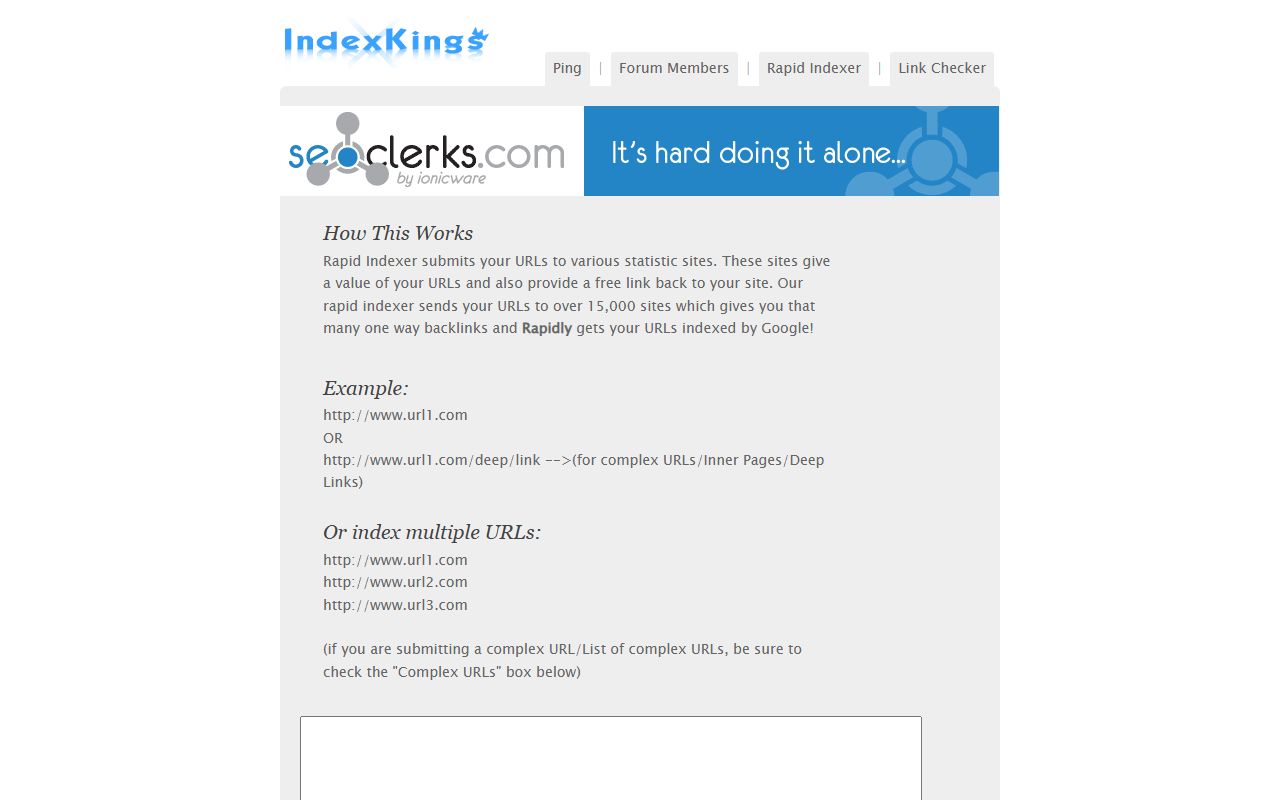
The first thing to know about IndexKings is how little there is to draw. Open the homepage and you see a four-tab menu (Ping, Forum Members, Rapid Indexer, Link Checker), an advertising banner, three short paragraphs and the top edge of a large textarea. Below the fold sit a checkbox labelled “Complex URLs? (Deep links)” and a button that says RAPID INDEX!. That is the full user interface.
I like starting design notes with a system this small, because nothing hides. There is no account service, no billing service, no job queue you can see, no results page that we could find described anywhere. The form posts action=rapidPing to index.php, and third parties also link to the same action as a plain GET URL. So the public surface is exactly one route.
The page’s own explanation is a single sentence of mechanism: the tool “submits your URLs to various statistic sites”, and those sites “give a value of your URLs and also provide a free link back to your site.” Hold that sentence in your head. Every box in the diagram below follows from it.
Components and data flow, as far as the page lets us draw them
Here is the diagram in words, with each box marked by how much we actually know about it.
| Stage | What happens | What is published |
|---|---|---|
| Input | You paste URLs, one per line, and tick the deep-link box for inner pages. | Described on the homepage |
| Fan-out | The service sends each URL to a list of “statistic sites”. | Claimed as “over 15,000 sites”; the list itself is not published |
| Receivers | Those sites render a stats page for your URL, which links back to it. | Mechanism stated; no sample output shown |
| Discovery | A search crawler, in the site’s words Google, finds the new links and visits your URL. | One sentence: “Rapidly gets your URLs indexed by Google!” |
| Return path | Something tells you what happened. | Nothing visible: no status check, report or dashboard |
Notice that the last box is empty. The architecture is fire-and-forget: the input is rich enough (batches, deep links) and the output is silent. That is a legitimate design for a free utility, and it is also the single biggest reason to pair it with something that can observe the result.
Notice also that the discovery step depends on an outside party. The tool does not index anything. It creates crawlable references and hopes a crawler follows one of them. Whether that happens for a given URL is not something the page, or any independent test we found, quantifies.
What “over 15,000 sites” implies for the receivers
Let me walk through the claim the way I would in a design review, because it is the load-bearing number. Fifteen thousand receiving sites would mean fifteen thousand fetchers, each wanting to publish a page about your URL. Two things would follow if the claim holds; they are inferences from the stated mechanism, not observations.
- The receivers generate pages on demand. A “statistic site” that renders a value for any URL it is handed produces a page per submission, so what you get is a page built around your URL.
- The links are one-way. The site itself calls them “one way backlinks”. A reasonable reading is that they work as crawl entry points rather than editorial endorsements.
Third-party lists fit that reading. Ping-site roundups (adirectory.io, yelomarketing.com, problogbooster.com) list IndexKings as one line among many free submission targets, and yelomarketing.com prints it beside pingfarm.com. Nobody in the material we read tested the indexing rate. I did not submit the form either, so I will not claim a success rate in either direction.
Failure modes worth knowing before you depend on it
Every system has a list of ways it can go quiet. For this one, the list is mostly about missing observability.
1. The counter has saturated
The page shows “URLs Rapidly Indexed So Far: 2147483647”. That is exactly 2^31 − 1, the largest signed 32-bit integer. A number stuck there is a ceiling, not a tally, so treat it as decoration. The real volume is not published.
2. Plain HTTP only
On our check date the homepage answered over http:// with no redirect, and a TLS handshake to https://indexkings.com/ failed. Our index agrees: all five of the top linked pages are http:// addresses. If you run URL lists through the form from a corporate network that blocks unencrypted traffic, expect trouble. Don’t paste anything you would not send in the clear.
3. Silent success and silent failure look identical
With no status page, a submitted batch that did nothing and a batch that worked both end at the same screen. Whatever you learn, you learn later, from somewhere else.
4. Limits and ownership are unknown
URLs per request, requests per day and queue time are not published. Neither is the operator. The page carries a third-party marketplace banner and the sister tools share one menu, but nothing on the site says who runs it, so we leave it at “not published”.
What the crawl sees: reading IndexKings through link data
This is where an API earns a place in the diagram. If the tool’s output is a set of links, then link data is the closest thing to a return path. Open the free explorer report for indexkings.com and you can see the same profile we describe above, no key needed.
Two observations come straight from it. First, the profile is dominated by internal-family linking: pingfarm.com’s 12,991 linking pages all point to the tool through a menu. Second, the long tail includes pages that publish the form’s GET endpoint with a specific site as payload. One plausible reading is an attempt to trigger the tool through a crawler; our data does not show the intent. It is the kind of workaround a form without an API invites.
A caution about our own limits, since they matter here. Our data is built from our web link data, refreshed roughly monthly and not in real time, so a link created today can take weeks to appear. We cannot tell you whether a page is in Google’s index. What we can tell you is whether links pointing at a URL were recorded in a public crawl, who they come from, what anchors they use and whether they are dofollow. For checking the effect of a ping batch, that is a slow but honest signal.
Where IndexKings is the better choice
To say this part plainly: for several jobs, IndexKings is the right tool and apibacklinks is not.
- You need to submit URLs and we do not do that. apibacklinks provides data. We do not build links, sell links or index pages. IndexKings at least attempts the submission.
- You want zero setup. No account, no key, no credit balance. Paste, tick, press. For a one-off nudge on a handful of pages, nothing on our side is faster.
- You want it free, always. The site states it is free and asks only for a signature link on forums. Our paid actions are cheap, from $0.10 per 1,000 lookups, but they are not free after the starter credit.
- You are experimenting. If the question is “does a ping-style push do anything for these pages?”, a free form is the right size of commitment.
Stay with IndexKings if your whole requirement is a no-cost submit button and you are comfortable with an unreported result. Add an API only when you start asking what happened afterwards.
Cost model: free, versus the price of finding out
IndexKings costs nothing in money. Its cost is paid in observability, and that is worth putting numbers on. A hypothetical example, clearly invented for the arithmetic: you submit 200 new article URLs and want to know, a month later, which targets gained linking domains.
- One
domainlookup per target: free, 0 credits. - One
refdomainscall per target (up to 100 referring domains each): 2 credits × 200 = 400 credits. - 400 credits × $0.0001 = $0.04.
The $100 starter credit on first Google sign-in is 1,000,000 credits, with no card and no subscription. So the verification step costs a few cents. The point is not the price, it is that the measurement is a separate component from the submission, and you can add it without changing anything about how you submit.
For the indexing job itself, our sister service IndexJump exists. Other submission tools are collected on the backlink indexers hub.
Wiring a verification loop around a free ping form
If I were adding one box to this design, it would be a scheduled check, not a replacement for the form. The loop is short.
- Before: record
domainfor the target host (DR, referring domains, last seen) and save the JSON. - Submit: run your batch through whichever indexer you use.
- After: a month later, call
refdomainsandbacklinksagain and diff the sets. New donor domains with a recent first-seen date are the evidence you are looking for. - Judge: filter donors by minimum DR and dofollow. What survives that filter tells you what kind of links the batch produced.
Parameters and response fields are in the API docs. If the diff shows nothing, that does not prove the pages are unindexed, it only says the crawl recorded no new links. Use a search-console style check for indexing state itself.
apibacklinks vs IndexKings
| apibacklinks | IndexKings | |
|---|---|---|
| Job it does | Returns backlink and domain-rating data about any domain | Accepts URLs and submits them to other sites to prompt crawling |
| Price | From $0.10 per 1,000 lookups; $100 free credit, no card | Free (“100% FREE to use”) |
| Sign-up | Free actions need no key; paid actions need a key via Google sign-in | None; no login on the site |
| API | 19 actions on one JSON endpoint | None published |
| Result reporting | JSON rows: donors, anchors, dofollow, first and last seen | No status page or report visible on the site |
| Limits | 1,000 rows per call; deep pagination capped at 50,000 rows | Not published |
| Freshness | Roughly monthly refresh, not real-time | Not published |
| Transport | HTTPS endpoint | Homepage served over plain HTTP; HTTPS handshake failed on 2026-10-09 |
| Operator | Independent service, apibacklinks.com | Not published |
Try it on indexkings.com
Pull the referring domains that point at indexkings.com, then run the same call on your own target before and after a batch.
curl "https://apibacklinks.com/api.php?action=refdomains&q=indexkings.com&key=YOUR_KEY"
IndexKings alternative — FAQ
Is IndexKings really free?
Does IndexKings have an API?
index.php with action=rapidPing, and other sites link to that action as a GET URL, but no documentation, keys or developer page are published.Can apibacklinks tell me whether my page is indexed?
Why does our DR for indexkings.com differ from other tools?
Who runs IndexKings?
Where do I submit URLs if I want something with reporting?
Backlink data for the price of a rounding error
Sign in with Google, keep your $100 of credit, call the API today.
Get started free