

Spider Indexer alternative: one working day, panel versus API
Spider Indexer sells link-indexing credits through a web panel with no API. Here is a hypothetical hour-by-hour day of evaluating its service and then checking what a public crawl actually sees.
In our index, spiderindexer.com has DR 38 (our own metric, not Ahrefs DR), 590 referring domains and 2,007 backlinks, first seen 2024-07-12 and last seen 2026-09-08. Dofollow is 935 links, or 46.6%, and 99.8% of links land on the homepage.
Four generic phrases, “Backlink Indexer”, “Link Indexer”, “backlink indexer” and “links indexer”, account for 1,584 links, 78.9%. mylifeandkids.com alone sends 274 nofollow links, 13.7% of the profile, and 68 of the top-100 donors first appeared between August and October 2025.
Spider Indexer at a glance
- What it is
- Web panel for submitting backlink URLs for indexing; also sells link building
- Pricing
- $25 / 1,000 links (1 month), $199 / 10,000 (6 months), $399 / 25,000 (12 months)
- API
- None: “only offer Web Based”
- Refunds
- Credit for unindexed URLs after 7 days; no money refunds
- Operator
- Not published
- Domain registered
- 6 June 2023
08:30 — A black spider, a green button, nothing else
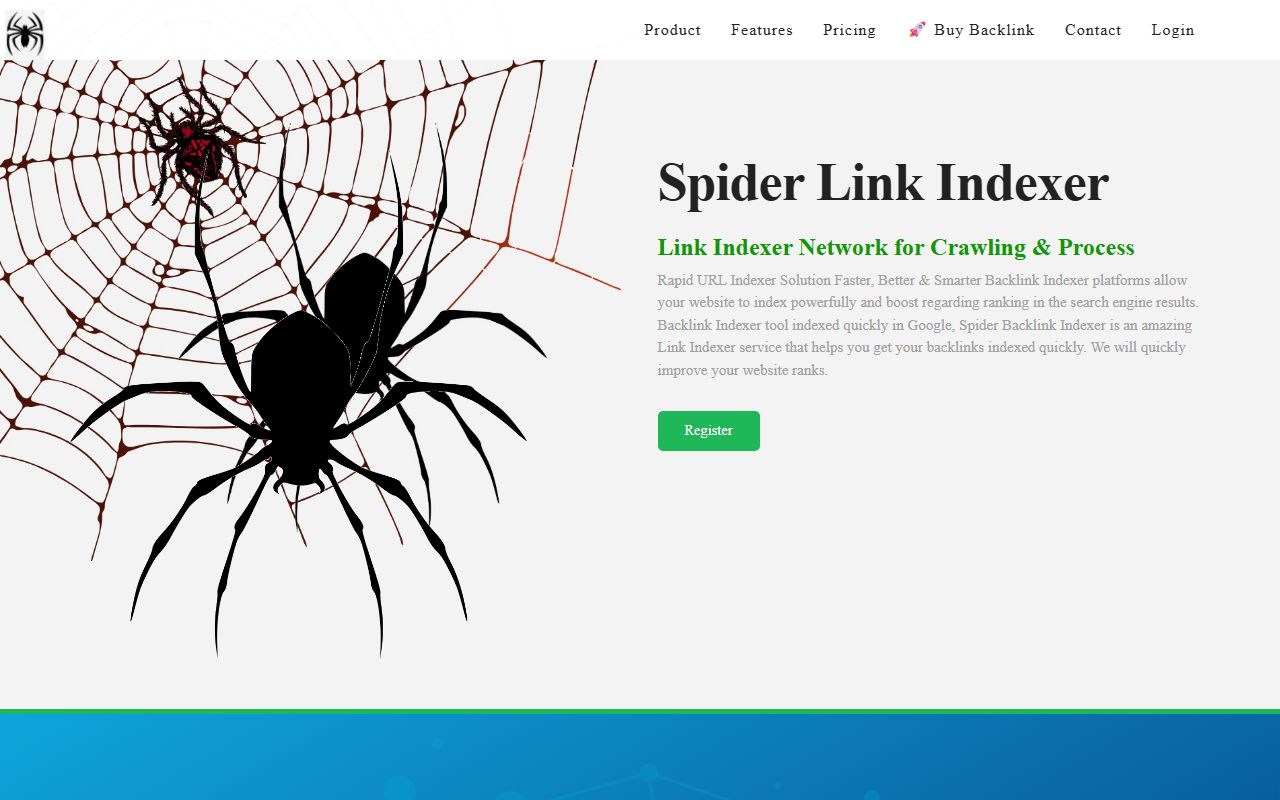
Our hypothetical SEO, Mara, opens the homepage with her first coffee. (Mara is invented for this walkthrough; every number below is real, every action is hypothetical.) The screenshot tells her what she is dealing with: a white bar with a small spider logo and six nav items, a huge black spider hanging in a dark-red web, the headline Spider Link Indexer, a green sub-headline reading “Link Indexer Network for Crawling & Process”, and exactly one button: Register.
No prices are visible above the fold. The company is called Spider Indexer in its footer (“Copyright © 2023-26 Spider Indexer”), Spider Link Indexer in the hero, and plain “Link Indexer” at the front of the page title. Who stands behind it is not published: no legal entity, no address, no names. The only contact is a support mailbox. The domain registry shows the name was registered on 6 June 2023, which is the one hard date available.
Mara's job today is narrow: she has a few hundred freshly placed backlinks that Google has not picked up, and she wants to know whether this panel is the right way to push them, and how she will know afterwards that anything happened.
09:15 — The price list, read with a calculator
Pricing sits on the homepage; /pricing just returns the homepage again. Three one-off credit packs, no subscription:
| Pack | Price shown | Volume | Validity | Per link |
|---|---|---|---|---|
| Bronze | $25 | 1,000 links | 1 month | $0.025 |
| Silver | $199 | 10,000 links | 6 months | $0.0199 |
| Gold | $399 | 25,000 links | 12 months | $0.01596 |
The per-link column is our arithmetic, not the site's. Two details make Mara slow down. The FAQ says you can start with 1,000 links “for only 20$” while the Bronze card says 25$, and the site does not say which is current. And the speed claim moves around: the plan bullets say links index within 2-3 days, while the features block, the footer and the FAQ all say 7 days (“The whole process is manual and takes around 7 days”).
The FAQ also explains the price: the method “involves 100% manual work”, and other indexers are described as “set and forget” systems that no longer work. Whether that is true is not something a pricing page can prove, and no independent measurement of the indexing rate is published. The only figures are the site's own: an 80-90% success ratio and credit back for URLs not indexed after 7 days.
10:40 — Reading the company's own footprints in crawl data
Before spending anything, Mara looks at what a public crawl shows about the vendor's own domain. Our explorer page for the domain is free and needs no sign-in, and it makes one thing obvious fast. The links are overwhelmingly category words rather than a brand.
Of 2,007 backlinks, 654 use the anchor “Backlink Indexer” and 326 use “Link Indexer”. The phrase “Spider Link Indexer” appears as an anchor exactly twice. Then there is the typo: “Backlink Indexe”, missing its last letter, shows up 60 times, every one dofollow, on church and other small sites such as e-zekiel.tv and stalbansanglican.org. The same truncated string on many hosts suggests one piece of text was reused.
The biggest single donor is mylifeandkids.com, a family-recipe blog: 274 links from 103 pages, all nofollow,ugc, one crawled URL carrying a comment-moderation parameter. The only donor above DR 70 is google.com, through /url?q= redirect-notice pages, which says more about how a donor's DR can mislead than about editorial trust. Mara notes it and moves on; none of this is a verdict on the service, only a description of what the crawl recorded.
12:00 — Lunch, and the guarantee that is really two guarantees
Over a sandwich Mara reads the Terms and Refund Policy. The wording matters, so here it is side by side. The plan cards promise “100% Guaranteed Crawling” and an “80-90% Indexing Success Ratio”. The FAQ answers the question “Do you Guarantee 100% indexing rate?” with a plain no, listing noindex tags, robots.txt blocks, 404s, 403s, 500s and redirect links as reasons a URL will never index. The Terms say there is no guaranteed index ratio.
The sensible reading: crawling is guaranteed, indexing is not. Failed URLs earn credits back after 7 days, but the Refund Policy is blunt that no money is returned. A free trial is mentioned once; its size and duration are not published.
The fine print is more specific than the hero, and a buyer who reads it knows what is promised. Mara still wants her own way to confirm results, because the panel's progress preview is the vendor's own account of its own work.
13:30 — The afternoon check, done with an API instead of a dashboard
Say Mara submits 300 links in one wave; in line with the site's FAQ advice to index in waves of a few hundred URLs rather than one big batch. A week later she wants an outside view. The panel offers an index checker included in the price. apibacklinks cannot tell her whether a page is in Google's index, and it never claims to. What it can answer is a different question: does a public crawl see the link, and from what kind of page?
With one call she asks for the backlinks pointing at her client's domain from a specific donor, then repeats it per donor in a loop:
- List the referring domains of the target (up to 100, ranked by links).
- For each donor she submitted, pull the individual backlinks: source URL, anchor, rel, last seen.
- Compare against the submission list. Links present with a recent last-seen date were visible to the crawl; absent links are candidates for a manual look.
our web index is a broad sample, refreshed roughly monthly, not in real time, so a new link can take weeks to appear. Absence is a prompt to check, never proof of failure. Full parameters are in the API docs.
As a test, Mara runs the same query on spiderindexer.com itself. The backlink list endpoint reports 2,030 links with rows dated up to 16 September 2026, slightly newer than the 2026-09-08 overview snapshot, a reminder that two calls into a monthly-refreshed index can disagree by a few dozen rows.
15:00 — What “web based only” does to a workflow
The FAQ asks “Do you have an API to index or update pages on Google?” and the answer is “We not provide api access, only offer Web Based”. For Mara's agency, that decides a lot. Submissions go through a panel; there is no endpoint to call from a publishing script. Whether the logged-in panel offers bulk uploads, webhooks or exports is not published, and it cannot be checked without an account.
So the afternoon splits cleanly. Submitting stays manual, by design, and the site presents manual work as its selling point. Verifying can be scripted on her side, which is where an API with 1,000 rows per call earns its keep. Free actions such as domain and overview cost nothing; list calls cost 2 credits at $0.0001 each, so checking 40 donors costs well under a cent in call fees.
16:30 — Where Spider Indexer is the better choice
Let us be direct: if the job is getting links crawled, apibacklinks is the wrong tool. We do not index pages, submit URLs or build links; we provide data. Spider Indexer does the job, and it has real strengths for the right buyer.
- It is the actual service. You pay, submit, and a vendor works on it. We cannot do that.
- Published, no-subscription pricing. $25 for 1,000 links, valid one month, with larger packs published on the same page.
- Credit back for URLs not indexed after 7 days, per its own FAQ.
- A built-in index checker at no extra cost, which answers the index question we cannot.
- A second product: a link-building page, with links “starting at just $49 (excl. VAT)”.
Someone with a one-off batch, no developers and no wish to script anything should stay with the panel. The use for our data is the audit on top of it, not a replacement for it.
17:45 — Closing the laptop: the end-of-day decision
Mara's log for the day reads: submit a test wave, verify in the panel, and cross-check donors against crawl data after a month. If she wants to compare other indexing services before paying, the backlink indexer hub lists them, and the IndexKings page looks at one with a similar job. For the indexing job itself within our own network there is IndexJump.
Her last note: the homepage shows no customer reviews, and its “Sponsored Reviews” block is text about sponsoring a review, not a review. So the evidence she can check herself is the public trail of links, which takes a minute to read.
apibacklinks vs Spider Indexer
| apibacklinks | Spider Indexer | |
|---|---|---|
| Job | Backlink and domain-rating data | Submitting backlink URLs for indexing |
| API | 19 actions on one JSON endpoint | None; web based only |
| Entry price | $100 free credit on first Google sign-in; from $0.10 per 1,000 lookups | $25 on the plan card for 1,000 links ($20 in the FAQ) |
| Billing | Per call, no subscription | One-off packs valid 1, 6 or 12 months |
| Refunds | Not applicable: $100 starter credit, then metered per call | Credit for unindexed URLs after 7 days; no money refunds |
| Speed claim | Not real-time; index refreshed roughly monthly | 2-3 days on plan cards, 7 days in the FAQ |
| Index checker | None; shows crawl-visible links only | Included, per its site |
| Limits per request | Up to 1,000 rows per call; deep pagination capped at 50,000 rows | No API; upload limits not published |
Try it on spiderindexer.com
List the backlinks a donor domain sends to the target, with anchor, rel and last-seen date.
curl "https://apibacklinks.com/api.php?action=backlinks&q=spiderindexer.com&src=mylifeandkids.com&key=YOUR_KEY"
Spider Indexer alternative — FAQ
Does Spider Indexer have an API?
How much does Spider Indexer cost?
Can apibacklinks index my links?
How can I tell whether a crawl sees my link?
Is the DR in your index the same as Ahrefs DR?
Backlink data for the price of a rounding error
Sign up, keep your $100 of credit, call the API today.
Get started free