

An Isindexed alternative? Six myths worth testing first
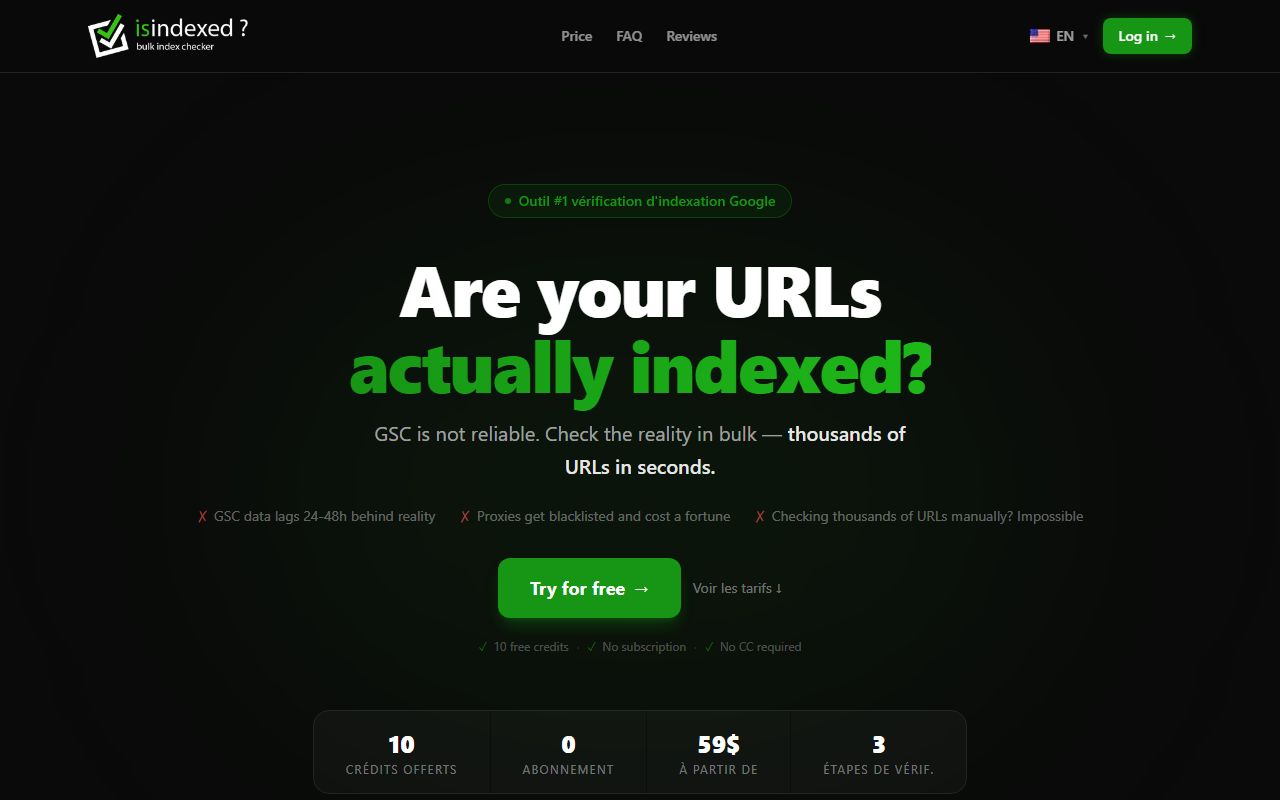
Isindexed asks one question on its homepage, “Are your URLs actually indexed?”, and answers it for $59 per 10,000 checks. Before you look for an alternative, it helps to know which job you are actually hiring for.
We ran isindexed.com through our own index. It scores DR 23 (our metric, not Ahrefs DR) with 45 referring domains and 240 backlinks, 208 of them dofollow. The first thing that jumps out is who sends them: indexmenow.com leads with 27 links from 5 pages, all dofollow, and scrapmenow.com adds 15 more. IndexMeNow is the creator’s own indexing service and says on its homepage that its checker comes “thanks to isindexed.com”, so the top referrer is a sibling, not a stranger. Two sibling-looking tools supply 42 of 240 links, or 17.5%.
The rest of the profile reads like a French practitioner’s tool. Fourteen of the 45 referrers are .fr, and 134 links point at the /fr/ homepage against 10 at /en/. abondance.com sends 20 links from a single page whose top anchor is “J’essaye l’export”: a step-by-step tutorial where every step links to the tool. Brand anchors dominate (160 of 240), spread over at least ten spellings from “IsIndexed” to “ISINDEXED” and even “isidexed?”. Nothing above DR 48 links in, and there are no .gov or .edu referrers. It is a small, niche profile, and a good test subject for the myths below.
Isindexed at a glance
- What it is
- A bulk Google index checker for pages and backlinks. Its footer says it uses the “site:” command, in real time, without proxies.
- Price
- One-off credit packs in USD, excl. VAT: Starter $59 for 10,000 credits, Premium $179 for 40,000, Agency $399 for 120,000, Guru $999 for 500,000. 1 tested URL = 1 credit; credits never expire.
- Free tier
- 10 free credits, no subscription, no card required.
- API
- Described as free and documented, but the docs sit behind a login. Rate limits and per-request URL caps are not published.
- Run by
- QUIRECHERCHE, Nice, France. The terms name Stéphane Madaleno as publication director.
- Search engines
- Google only, according to the official site.
Myth 1: “Isindexed gets my pages indexed”
Start where the name misleads. It sounds like a verb, but it is not one. The official FAQ is plain about it: the tool “specializes in detecting indexed pages”, and credits let you test the status of URLs. A third-party write-up puts it the same way: it informs you about indexation but does not speed it up.
Fact: Isindexed is a thermometer, not medicine. When a URL comes back as not indexed, the product offers a one-click hand-off to its sister service indexmenow.com, and you can add an IndexMeNow API key inside the dashboard. The checking and the submitting are two separate products from the same creator.
That matters for your search, because “alternative” means different things depending on the job. If you want something to submit URLs, you are shopping for an indexer, and our sister service IndexJump exists for that job. If you want something that checks, you are shopping for what Isindexed already is. apibacklinks sits next to both: it does neither. We do not index pages and we do not check Google’s index. We tell you who links to you.
Myth 2: “Search Console already tells me everything”
The homepage says the opposite in bold: “GSC is not reliable. Check the reality in bulk.” It claims Search Console data lags 24 to 48 hours behind reality. The claim is stated strongly, but there is a real point inside it. Search Console is authoritative about your own verified properties, and it is the only place that shows you Google’s own reasons for excluding a page. What it does not do well is answer, quickly and in bulk, a question about URLs you do not own.
Fact: that second case is where Isindexed earns its keep. Its creator lists the uses himself: auditing a client after a crawl, tracking a sitemap, and checking a list of backlinks before buying expired domains, “choosing only indexed ones”, because a link on a page Google never stored has little value. You cannot do that in Search Console, since you do not own those pages.
The webandseo.fr review reported a 251-link sitemap checked in about five minutes, and the official FAQ says a 1,000-URL audit finishes in under four minutes. Both are the vendor’s or a reviewer’s own measurements, not benchmarks we have run, so treat them as indications.
Myth 3: “The API is free, so it costs nothing”
The homepage says: “The API is completely free.” It is a nice sentence, and It is not contradicted anywhere, but it is incomplete. The only thing the site prices is the credit: “1 tested URL = 1 credit”. It does not say whether API checks draw from that same balance. The documentation lives at a dashboard address that redirects to a login page, so we could not read it, and rate limits or per-request URL caps are not published. Third-party code, namely a public WordPress plugin, calls a credits endpoint and handles a “no credits available” case, which suggests that checks do consume credits. That is inference, not an official statement.
Fact: here is the arithmetic that is published.
| Pack | Price (USD) | Credits | Cost of 1,000 checks |
|---|---|---|---|
| Starter | $59 | 10,000 | $5.90 |
| Premium | $179 | 40,000 | about $4.48 |
| Agency | $399 | 120,000 | about $3.33 |
| Guru | $999 | 500,000 | about $2.00 |
For comparison, a lookup on apibacklinks costs 1 credit and a credit is $0.0001, so 1,000 lookups cost $0.10 and 1,000 list calls $0.20. The units are not the same thing: one Isindexed credit is one live Google check, while one of ours is one read from a stored graph. The sensible takeaway is not that one is cheaper but that the two are priced for different work.
Myth 4: “A link in a database is a link that works”
Here is a myth that applies to us as much as to anyone, and the isindexed.com profile gives the best example I have seen. Our index records six dofollow links to https://www.isindexed.com/ru/ and three to /pt/. When we followed them on 2026-10-09, both ended in a 404. The site now declares only French and English. The Russian-language referrers, actualtraffic.ru, web-lesson.ru and pc.uz, all use the anchor “массовая проверка индексации страниц”, bulk indexation check, and they were first seen between April and July 2026. Those links currently point at nothing.
Fact: a crawl records what a page said when it was crawled. Our index refreshes roughly monthly, so it lags the live web, and a link new this week can take weeks to appear. Isindexed has the opposite weakness: it sees today’s Google but knows nothing about who linked to whom.
The practical habit I would teach a newcomer is to use each tool for what it sees. Pull the donor list from the explorer, then check the donors that matter in a live index checker. The first answers “does a link exist in the crawl?”, the second answers “does Google still hold the page?” You need both answers before you call a backlink delivered.
Myth 5: “A checker’s answer is the final word”
Isindexed deserves credit for saying the quiet part out loud. Its method has three levels: a site: query, then a search on the exact URL against another data center, and only if both come back empty is the URL called not indexed. Its own warning says the tool “may detect an indexed URL even though it is not indexed for you”, because data centers are not synchronized equally and a page generally takes 24 to 48 hours to settle everywhere.
Fact: the FAQ also lists the opposite edge case. A site: query can return something that is not identical to the URL you submitted, and then the tool marks the URL as not indexed. A related detail: the tool says it detects and ignores the srsltid parameter from Merchant Center, so that it does not create false duplicates.
I find this reassuring rather than worrying. A checker that documents its edge cases is one you can reason about. My advice to a newcomer: when a result surprises you, test that single URL by hand once, and then trust the bulk run for the other 999. Ours has a different limit: we describe links, and we cannot see Google’s decisions at all.
Where Isindexed is simply the better choice
If you came here expecting a pitch to leave, I would rather be honest. Stay with Isindexed when any of these is true:
- Your question is about Google’s index right now. We have no index-status data at all. Isindexed queries Google live.
- You need to run thousands of URLs from a sitemap or a crawl. It is built for bulk, handles the blocking and CAPTCHAs on its side, and needs no proxies from you.
- You want a stored history and a CSV. It keeps per-URL history inside projects and exports URL, status, title tag and meta description. The privacy policy says tracked data older than 365 days is deleted, so plan your exports around that.
- You want a pre-purchase filter. Checking which expired-domain backlinks sit on indexed pages is a very good use of 59 dollars.
One practical point: credits never expire. The terms also say credit purchases are final and unused credits are not refunded, so start with the 10 free credits and try your own URLs first. None of this is a weakness of the product. It is a clear, narrow tool that says what it does.
Myth 6: “I have to pick one”
The last myth is the one I would most like to retire. Checking and link data are two halves of the same question, and a small workflow joins them. Suppose a hypothetical agency has delivered 40 backlinks for a client. This is a made-up scenario, but the steps are real.
- Pull the client’s backlinks with the
backlinksaction, filtered by donor DR, and keep the source URLs. - Look at the donors’ own profiles with
refdomainsandbulk_dr, which takes up to 2,000 domains per request, to drop the weak ones. - Run the surviving source URLs through an index checker. Isindexed is the obvious one.
- Send the pages that Google has not stored to an indexing service. That is the point at which IndexJump or IndexMeNow comes in.
Steps 1 and 2 are what the API does. Step 3 is Isindexed. If you are still choosing among tools for step 4, the indexer hub lines up the options. Note what we do not offer: no alerts, no new and lost link report, no scheduled exports and no index-status data. You would build those yourself from the endpoints.
Our data comes from our own web data, 181 million domains and 2.77 billion domain-to-domain links, which is a broad sample and not the proprietary crawl of the big vendors. That is the trade for $0.0001 a credit and a free first $100.
apibacklinks vs Isindexed
| apibacklinks | Isindexed | |
|---|---|---|
| Main job | Backlink and domain-rating data from our own index | Bulk check of whether URLs are indexed in Google |
| Data source | our web link data, 13 crawls, refreshed roughly monthly | Live Google queries (site: command, then exact-URL search on another data center) |
| Sees who links to you | Yes: backlinks, referring domains, anchors, top pages | Not published; you supply the list of URLs to check |
| Sees Google index status | No | Yes, its core feature |
| Pricing model | Per call: 1 credit = $0.0001, from $0.10 per 1,000 lookups, no subscription | One-off packs from $59 for 10,000 URL checks, credits never expire |
| Free start | $100 credit on first Google sign-in, no card | 10 free credits, no card |
| API | 19 actions on one endpoint, documented publicly, JSON, CORS enabled | Free per the site, documentation behind login, limits not published |
| Bulk input | bulk_dr up to 2,000 domains per request; list calls up to 1,000 rows | Thousands of URLs per project; per-request API cap not published |
| History and alerts | No history charts, no alerts, no monitoring | Per-URL history stored, 365-day retention; alerting not published |
| Engines | Not applicable | Google only |
Try it on isindexed.com
Pull the individual backlinks pointing at a domain, then feed their source pages to whatever index checker you prefer.
curl "https://apibacklinks.com/api.php?action=backlinks&q=isindexed.com&per=100&key=YOUR_KEY"
Isindexed alternative — FAQ
Is apibacklinks a drop-in replacement for Isindexed?
Does Isindexed index my pages?
How much does Isindexed cost compared with apibacklinks?
Can I use Isindexed through an API?
Why does your DR for isindexed.com differ from other tools?
Which tool should I try first?
Backlink data for the price of a rounding error
Sign up, keep your $100 of credit, call the API today.
Get started free