

A Semrush alternative for backlink data, tested on Semrush itself
We pointed our index at semrush.com and wrote down what came back, then priced the same lookups in Semrush API units. Some entries favour us, some do not, and the notebook says which.
Our index sees semrush.com at DR 69, with 108,876 referring domains and 3,569,767 backlinks, first seen 2024-07-12 and last seen 2026-09-09. Of those backlinks 3,092,354 (86.6%) are dofollow. That is about 32.8 links per referring domain, which is high, and the reason is concentration: the top 100 referring domains carry 50.8% of all links, and the top 10 carry 30.5%.
The profile is lopsided in a way that says more about the brand than the number does. One site, explodingtopics.com, supplies 737,659 links from 17,875 pages. The most-linked URL after the homepage (433,224 links) is not a page at all but an image, static.semrush.com/agency-directory/shared/badge.svg, at 116,474. You can reproduce all of it for free in the explorer.
Semrush at a glance
- What it is
- A brand visibility platform covering SEO, AI search, content and paid media, now part of Adobe (acquisition completed April 28, 2026).
- API access
- Paid plans only; the docs say the Standard API needs a Business subscription, while the pricing page lists “API data integration” under Advanced.
- API metering
- API units, sold in packages of 2,000,000, 5,000,000, 10,000,000 or 20,000,000. Unit price not published.
- Backlinks API
- v4 is in Early Access; v3 is deprecated. Overview costs 45 units per request, backlink rows 45 units per line.
- Limits
- 10 requests per second, 10 simultaneous requests, no caching of results beyond one month without written consent.
- Index size (their claim)
- 43 trillion backlinks and 390 million referring domains, refreshed “at least hourly” per the free checker page.
Entry 0: the hypothesis, and what the homepage forgot to mention
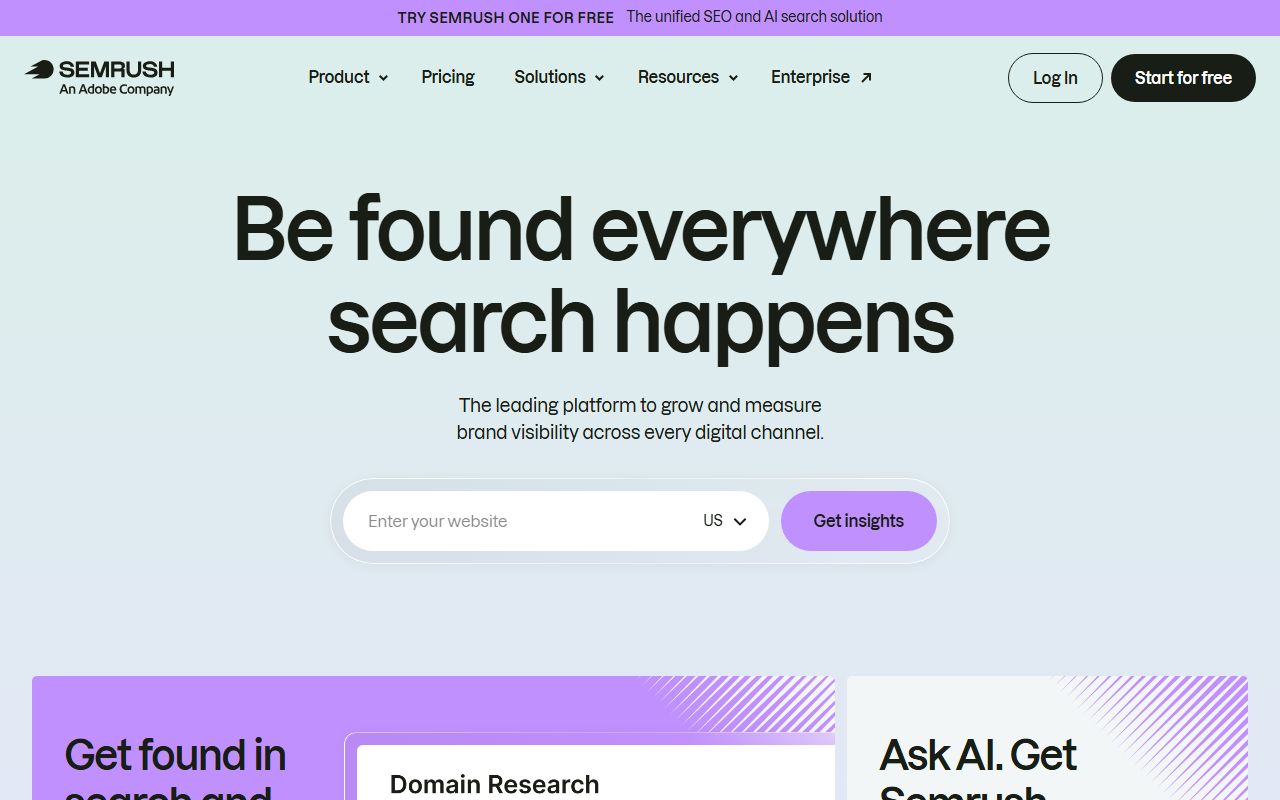
The homepage headline reads “Be found everywhere search happens.” The sub-line promises to “grow and measure brand visibility across every digital channel.” The screenshot has a purple banner, a search box that says “Enter your website” and a button that says “Get insights.” Prices: none on screen. The word “API”: none on screen either. It lives in the top navigation of the full site, one click away, where the developer portal turns out to be a serious piece of work.
So the question for this notebook is narrow. Not “is Semrush good” (it is a very large product with a very large audience) but: if all you need is backlink data in JSON, what does each side charge you in units, dollars and limits, and what do you lose by choosing the cheaper one?
Method: run semrush.com through our own index, read Semrush's published API price list, put the two on the same arithmetic, and keep the results that embarrass us next to the ones that embarrass nobody. Everything about Semrush below comes from its own pages, read on 2026-10-08 and 2026-10-09. Everything about us comes from our fact sheet. Where something is unpublished, the notebook says “not published” and moves on.
Entry 1: two free calls, zero credits, one full profile
Setup: action=domain and action=overview, no key, no sign-in. Both cost 0 credits. Result: the figures in the data story above, plus a top-five of referring domains, anchors and pages, and a DR distribution.
The distribution is the interesting bit. In the sample we compute over the top-100 referring domains, the average referring DR is 27, and the mix by band is 24 domains at DR 0–14, 39 at 15–29, 26 at 30–49, 7 at 50–69 and 4 at 70–100. Government and education domains: none in that sample. Top-level domains: 68 of 100 are .com, then .uk, .au and .net at 3 each, spread over 22 TLDs. Within that sample, the linking sites skew toward marketing sites and tool lists rather than newsrooms or universities.
Caveat, as always: this is DR, our metric, computed from referring-domain counts in our graph. It is comparable in spirit to the score Semrush shows (it calls its own the Authority Score, 0–100, built from backlink quality and quantity, estimated traffic and signs of manipulation), but the two numbers will not match and should not be swapped.
Semrush charges 45 API units for its closest equivalent, the v4 backlinks overview. That brings us to the ledger.
Entry 2: the unit ledger, with the arithmetic shown
Semrush's v4 Backlinks docs print a price next to every method. Here are the ones that matter, with our nearest action beside each.
| Semrush v4 method | Printed price | Our action | Our price |
|---|---|---|---|
| Overview | 45 units per request | overview | 0 credits |
| Backlinks | 45 units per line | backlinks | 2 credits per call, up to 1,000 rows |
| Referring Domains | 40 units per line | refdomains | 2 credits per call, top 100 |
| Anchors | 40 units per line | anchors | 2 credits per call, top 50 |
| Pages | 40 units per line | toppages | 2 credits per call, top 50 |
Worked example. You want 1,000 backlink rows for one target. Semrush: 1,000 × 45 = 45,000 units. Us: one call, 2 credits, $0.0002. Now the part that cannot be completed honestly: converting 45,000 units to dollars. Semrush does not publish what a unit costs. Its Knowledge Base says units come in packages of 2,000,000, 5,000,000, 10,000,000 or 20,000,000, renew with the subscription, and expire if unused. A price of “$50 per million” circulates on third-party sites, and the article we read that mentions it calls it unverified, so we are not using it.
What we can say in units alone: the smallest package, 2,000,000 units, buys about 44,444 backlink rows or 50,000 referring-domain rows, once. At our list-call price, 44,444 rows is 45 calls and 90 credits, or $0.009. The comparison that matters is dollars to dollars, and Semrush has not given us the second dollar figure.
There is also a gate in front of the units. Per the developer portal, the Standard API “is available as an add-on to a Business subscription,” and units are purchased separately; the pricing page lists “API data integration” under its Advanced plan, which the Knowledge Base prices at $549 a month. The plan naming differs between pages, so treat it as: top self-serve tier, plus a unit package. We have $100 of free credit on first sign-in with Google and no card, which is a lower entry point whatever the unit turns out to cost.
Entry 3: who links to Semrush, and why a fifth of it is family
Setup: action=refdomains&q=semrush.com, top 100 by links. The first row is the finding.
| # | Referring domain | Links | Our DR |
|---|---|---|---|
| 1 | explodingtopics.com | 737,659 | 58 |
| 2 | infinium-tech.com | 60,276 | 31 |
| 3 | aklasbela.net | 55,377 | 29 |
| 4 | toponseek.com | 54,704 | 38 |
| 9 | backlinko.com | 25,668 | 61 |
Exploding Topics alone is 20.7% of the whole profile: 737,659 links from 17,875 pages, all but one dofollow, with the call to action “try out Semrush today.” Semrush's own company timeline lists acquiring Backlinko in 2022 and Exploding Topics in 2024. Add Backlinko's 25,668 and the two acquired sites account for 763,327 links, 21.4% of everything we see.
That is a perfectly ordinary thing for a media-owning company to have. It also shows why a raw backlink count is a blunt instrument: take those two sites out and the profile drops from 3.57 million links to about 2.81 million, and the referring-domain count barely moves. A buyer comparing two vendors' totals should ask what is inside the total. A table like this, from refdomains, takes one call.
Entry 4: four spellings, one brand, 17.9% of the profile
Setup: action=anchors&q=semrush.com, top 50 anchors. The four largest anchors are the same word in four capitalisations:
- “SEMrush”: 210,879 links (5.91%), 84% dofollow
- “Semrush”: 185,126 (5.19%), 73% dofollow
- “SemRush”: 156,432 (4.38%), 96% dofollow
- “SEMRush”: 85,948 (2.41%), 48% dofollow
Together: 638,385 links, 17.9% of the profile. Observation: the retired capitalisation still beats the one the company uses today (the logo is all caps, the press releases say “Semrush”). “SemRush” clusters on startup-list sites such as beststartup.asia (30,037 links) and startupill.com (21,621).
Practical consequence for anyone parsing this data, from either vendor: normalise anchors case-insensitively before you count them. Our anchors action returns each spelling as its own row, so a naive top-5 under-reports the brand by a factor of four.
Below the brand names the anchors turn into a site map: “Pricing” (43,130), “Free Webinars” and “Marketing Academy” (both exactly 41,602), “Contact” (41,501), “Customer Login” (27,140). Identical counts like the 41,602 pair are the signature of a sitewide menu on a small number of sites rather than hundreds of editors choosing the same words.
Entry 5: a badge, borrowed domain names and two Telegram ads
The badge. The second most-linked URL is static.semrush.com/agency-directory/shared/badge.svg, with 116,474 backlinks. The anchor “Semrush certified agency partner badge” has 37,265 links, all dofollow, and agency sites such as nettrakett.no and robintek.com carry it roughly 5,000 times each as a sitewide element. Semrush's pricing page lists a “Lead Generation” add-on described with a “Semrush verified badge for your marketing channels.” We cannot tell from crawl data whether that is the same badge; what we can see is that a badge file has become one of the domain's biggest link sources.
Anchors that name someone else. “www.infinium-tech.com” (60,261 links), “aklasbela.net” (55,377), “www.masalabi.com.tr” (28,350) and “www.velkem.com” (26,793) all point at semrush.com, all 100% dofollow, and the pattern repeats across several Turkish sites. We can see the shape (sitewide links whose visible text is a different domain), and we do not know the reason, so we are not going to guess.
Telegram ads. Two anchors advertising link services over Telegram account for about 21,700 links, none of them dofollow. That is ordinary junk aimed at a famous domain, and a useful filter test: with anchor and follow filters on backlinks you can separate it from the 3.09 million dofollow links in one request.
Affiliate fingerprints. The anchor “14-day trial” appears on 12,889 links, while Semrush's own site offers seven days. Whether a 14-day offer exists today is unknown to us; the anchors only tell you what affiliates were writing when the crawls ran.
Entry 6: the control group, where Semrush is the better instrument
An experiment with no control is a press release. Here is where the brand under test should be your pick.
- Size and freshness. Semrush claims 43 trillion backlinks, 390 million referring domains and 10 billion URLs crawled per day, and says its database is refreshed at least hourly. Our index is built from 13 crawl releases: 181,132,097 domains, 2,774,625,913 domain-to-domain links, about 798.6 billion page-level backlinks, refreshed roughly monthly. A link placed this morning can take weeks to reach us.
- New and lost links. Semrush's v4 overview returns
new_countandlost_count, and each backlink row carriesis_newandis_lost. We have no new/lost report, no alerts and no monitoring. - History. It documents a Historical Summary method. Our API has no historical charts.
- Everything that is not backlinks. Keyword research, rank tracking, site audit, AI-visibility tracking, traffic estimates, content tools. We have none of these and do not plan to pretend otherwise.
- A toxicity-style audit. Semrush lists identifying toxic links as a feature. We have no spam or toxicity score and no disavow tooling.
- Humans. A dashboard, reporting, and a dedicated account manager at the Enterprise tier. We return JSON.
If your team already pays for Semrush for the SEO suite, and the backlink API is a side dish you use a few times a day, the bundled allowance may be all you need: Semrush says its Starter, Pro+ and two Classic plans include 50,000 units for MCP use, which is about 1,111 backlink rows or 1,111 overview lookups per renewal. Stay where you are. If you need data fresh to the day, stay as well, and use ours only as a cross-check; our Ahrefs page makes the same kind of argument against another proprietary crawler.
Entry 7: endpoint mapping, and the result
For the developer who wants to run the replacement test, here is the translation table, from the v4 docs to our single endpoint, documented in the API docs.
- Overview becomes
domainoroverview. - Backlinks becomes
backlinks, with filters for follow type, link type, source TLD, anchor text, source domain, target URL, minimum donor DR and date range. - Referring Domains becomes
refdomains; Anchors becomesanchorsoranchor_cloud; Pages becomestoppages. - Summary Comparison (up to 10 targets) becomes
compare(up to 20) orbulk_dr(up to 2,000 domains per request). - Matrix (up to 6 targets by shared referring domains) becomes
intersect(2–10 targets). - No equivalent on our side: Historical Summary, Referring IPs, Competitors, new/lost flags, the score profile.
- No equivalent on theirs, going by the documented methods: full-text
searchover anchors, titles and URLs, exact-phrasekeywordlookup, and keyless free profiles.
Auth and shape differ too. Semrush v4 takes an Authorization: Apikey header and returns JSON by default; v3 puts the key in the query string and returns CSV. We take ?key=sk_... or a Bearer header and return JSON with CORS enabled.
Result. For backlink lookups, ranked lists and prospect screening, our printed per-call prices are tiny next to Semrush's per-line unit counts, though without a published unit price a true dollar comparison is impossible. The $100 starter credit covers a long experiment. For freshness, history and everything outside backlinks, Semrush is the instrument and we are the cross-check. The full list of options in this category is on the backlink API hub.
apibacklinks vs Semrush
| apibacklinks | Semrush | |
|---|---|---|
| Access gate | Free actions need no key; paid actions need a key. $100 starter credit, no card. | Paid subscription required; docs tie the Standard API to a Business plan, pricing page lists API under Advanced; units bought separately. |
| Price of one unit of data | 1 credit = $0.0001; from $0.10 per 1,000 calls | Not published |
| Profile overview | 0 credits (overview, domain) | 45 API units per request (v4) |
| 1,000 backlink rows | One call, 2 credits ($0.0002) | 45,000 API units (45 per line, v4) |
| Rows per request | Up to 1,000; deep pagination capped at 50,000 | Default 100; maximum not published |
| Rate and caching limits | Not covered on this page; see the API docs | 10 requests per second, 10 simultaneous; no caching beyond one month without written consent |
| New / lost links | Not available | Yes (new_count, lost_count, is_new, is_lost) |
| Index and freshness | 181,132,097 domains from our own web data; roughly monthly refresh | 43 trillion backlinks, 390 million referring domains; free tool page says refreshed at least hourly |
| Authority metric | DR 0–100, our own, from referring-domain counts | Authority Score 0–100, proprietary |
| API maturity | 19 actions, one endpoint | v4 in Early Access; v3 deprecated |
Try it on semrush.com
This call reproduces the Entry 3 table and needs a key; the overview and domain actions used in Entry 1 are free and keyless.
curl "https://apibacklinks.com/api.php?action=refdomains&q=semrush.com&per=100&key=YOUR_KEY"
Semrush alternative — FAQ
Does Semrush publish what an API unit costs?
Do I need a paid Semrush plan to use its API?
How much does a backlink lookup cost in Semrush API units?
Is our DR the same as Semrush's Authority Score?
Why is semrush.com's backlink count so concentrated?
Can apibacklinks replace Semrush completely?
Backlink data for the price of a rounding error
Sign up, keep your $100 of credit, call the API today.
Get started free