

Indexsor alternative: what the crawl sees versus what the rocket promises
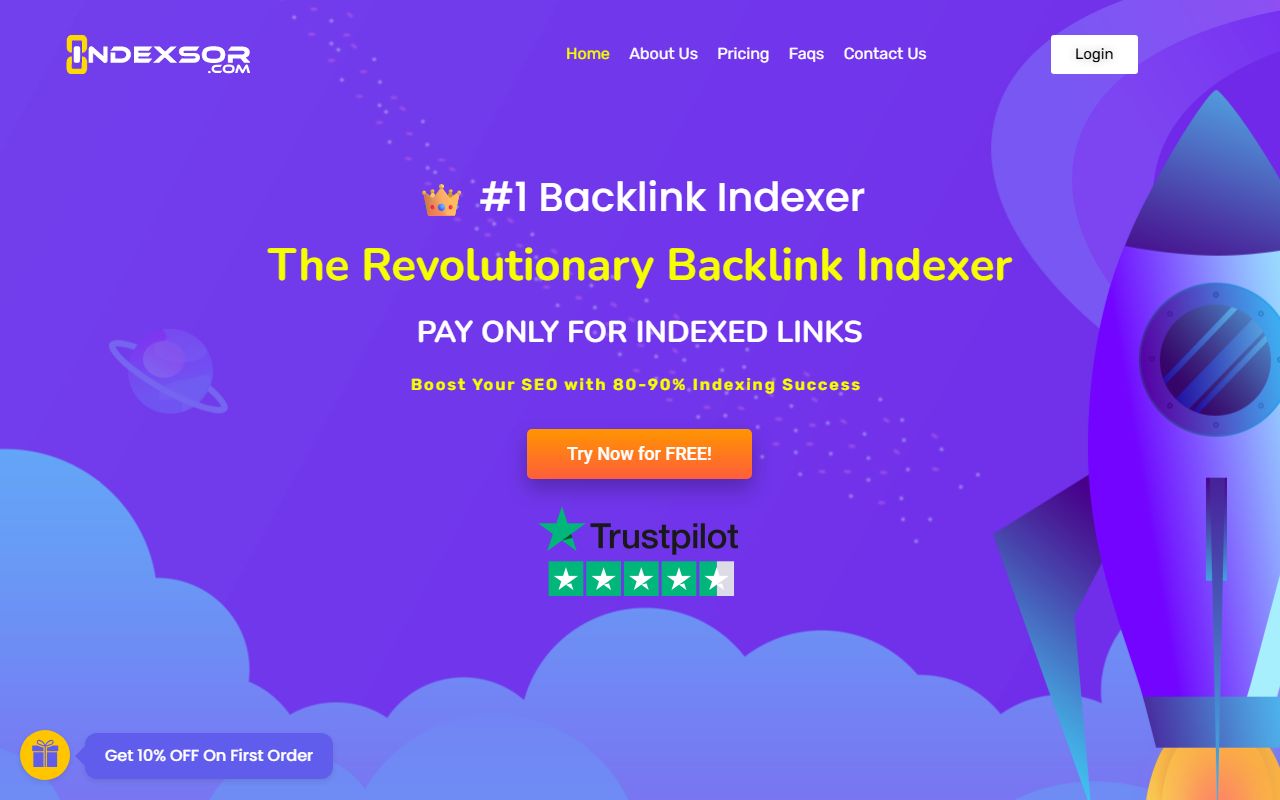
Indexsor's homepage puts “PAY ONLY FOR INDEXED LINKS” in capitals next to a cartoon rocket. We took six common beliefs about it and tested each one against its own pages and the backlinks in our index.
In our index indexsor.com has a DR of 39, 653 referring domains and 10,365 backlinks, first seen 2024-07-16 and last seen 2026-09-09. Of those backlinks, 37 are dofollow, which is 0.36%; only 13 of the 653 referring domains pass a followed link. The DR comes from the number of domains, not from followed editorial links.
The biggest single source is domaindexer.com: 3,747 links from 3,551 pages, all nofollow, all pointing at indexsor.com/?ref=domaindexer, seen between 2025-09-15 and 2025-12-14. That is more than a third of the profile, and the target is a referral URL, consistent with the 20% affiliate program Indexsor advertises. The three top keyword anchors, “Backlink Indexer” (920), “Link Indexer” (888) and “Page Indexer” (844), sit within 9% of each other. The brand name as an anchor appears 6 times. Open the full report in the explorer and check the numbers yourself.
Indexsor at a glance
- What it is
- A paid backlink indexing service: “indexes website links/backlinks on Google”, in the company's words.
- Run by
- Apex Infotech, Pune, Maharashtra, India (per its contact page). No founder or team is named.
- Pricing
- Prepaid credit packs in USD: Starter $29.99 for 1,000 credits up to Titanium $1,309.99 for 50,000. No subscription wording on the pricing page.
- Free trial
- 20 credits on the pricing page, 10 credits in the FAQ and refund policy.
- API
- No public API documented on its website.
- Domain registered
- 2024-03-01 (Verisign RDAP). First link to it in our index: 2024-07-16.
Myth 1: “Pay only for indexed links” means a failed link costs nothing
The sentence is on the homepage, in the meta description and in the hero. The mechanism sits one click deeper. The company says failed links get their credits returned “to your Indexsor Wallet”. That is a credit refund. Cash is a separate, narrow policy: a full refund only if you ask within 24 hours of purchase, with a valid reason and proof of purchase.
Then there is the price list. Every pack shows three per-step charges: Link Checker 0.10 credit, Indexer 0.60 credit, Index Checker 0.30 credit. By our arithmetic, not theirs, a link that passes through all three steps uses 1.00 credit. At the Starter pack ($29.99 for 1,000 credits) that is about $0.03 per link; at the Titanium pack ($1,309.99 for 50,000) about $0.026.
Verdict: mostly fact, with fine print. What the site does not publish is which of the three charges come back when a link fails, or how many days it waits before calling a link failed. To its credit, the refund policy states the wallet rule openly, so nobody has to dig for it.
Myth 2: 80–90% indexing is an industry measurement
It is a sentence on the vendor's own homepage: “80-90% Indexing Success”. The FAQ is more careful than the hero. Asked about a 100% guarantee, it answers that nobody can give one “because the final decision taker is Google”.
The outside evidence is thin and pulls both ways:
- Indexsor's own case study reports 633 links submitted, 633 indexed, for one customer with a 15-day-old domain.
- On Trustpilot, as fetched on 2026-10-09, it shows 4.5 out of 5 from 17 reviews, with reviewers reporting about 91% and 95% indexed.
- FatRank, an independent list of indexing tools, wrote that its team “could not get” the service to index its test URLs and said more tests were needed.
One caution on sources: a review written by a competing indexer of Indexsor quotes a monthly subscription price and claims it offers no refund protection. Both statements contradict the vendor's own pages, so we ignore them.
Verdict: plausible, unaudited. We do not index pages and cannot see Google's index, so we cannot confirm or deny the figure. Treat it as a claim to test on your own batch.
Myth 3: an indexed link is a link every tool will count
Indexsor's checker looks for your URL on Google with three queries: site:URL, “URL” and the bare URL. That tells you whether Google has the page. It does not tell you which tool has seen the link on that page, or whether the link sits in a spot a crawler reaches.
Our index comes from Common Crawl, 13 crawls between 2025 and mid-2026, refreshed roughly monthly. It holds 181,132,097 domains and about 798.6 billion page-level backlinks. It is a broad sample of the public web, so a fresh link can take weeks to appear and some will never appear. That is a limit, and it is also the point: the crawl is a neutral second witness that does not work for the indexer.
A practical check after a campaign: call backlinks on your target, filter by the source domains you submitted, and see which ones the crawl has recorded. The API docs list the filters. Verdict: fact for Google, myth for everyone else. Indexed means Google knows the page; counted is a different question.
Myth 4: every SEO service has an API
On 2026-10-09 the pages /api/, /api-docs/, /docs/ and /developers/ on indexsor.com returned 404, and none of its pricing, FAQ, about or signup pages mention an API. One competitor-written review says Indexsor supports bulk submission by API. We could not verify that, and an account dashboard may well expose something we did not see. The safe statement is: no public API is documented on its website.
What the service does have is a campaign workflow. You put 1,200 links in a campaign, choose a 30-day drip feed, and it sends 40 links a day. For a person at a keyboard that is fine. For a script that wants to ask “did this link show up in the data yet?”, it is the wrong shape.
That second question is the one we answer. A lookup costs 1 credit, which is $0.0001, and a list call costs 2 credits and can return up to 1,000 rows. Verdict: myth, as far as public documentation goes.
Myth 5: a backlink indexer's own link profile must be a showcase
We looked, because the profile is public data and a good test of the belief. It is not a showcase, and it does not need to be: Indexsor sells indexing, not link building.
What the numbers show for indexsor.com:
- One referrer is 36% of everything. The 3,747 links from domaindexer.com, all nofollow, all on a
?ref=URL. - Personal names as anchors. 37 of the top 50 anchors are names: “Camellia Busa” with 397 links, “Alfonzo Crummett” as the top anchor from oldpcgaming.net's 472 links. The hosts include a Polish basketball club, a fire-door supplier and a Berlin restaurant. A name linking to a URL is what a comment form's author field produces, so we call them comment-style links. We see the pattern, not who placed it.
- Four spellings of the blog index. The
/blog/page, in its http, https, www and bare forms, collects 3,306 backlinks, while the 21 individual posts collect almost nothing. - A burst. 91 of the top 100 referring domains first appear between August and November 2025; only 4 first appear in 2026.
Verdict: myth, and harmless. It describes where the links to the site come from, and says nothing about how well the service indexes. Judge the service on campaign results, not on this chart.
Myth 6: an “Indexsor alternative” must do the same thing
If you searched for one, you may want any of three things: another way to get links into Google, a cheaper way, or a way to see whether the links you already paid for exist. We cover only the third.
apibacklinks does not index pages, build links or sell links. It has no new-and-lost-links report, no alerts and no dashboards to hand to a client. It has a JSON API over a link graph, a free explorer, and our own 0–100 DR, which is not Ahrefs DR or Moz DA. If you need a second indexer, our indexer hub and the EliteLinkIndexer page compare others. For the indexing job on our side of the network there is IndexJump, which is a separate service.
Verdict: myth. A swap implies a like-for-like. The honest picture is a pairing: submit with one tool, verify with another.
Where Indexsor is the better choice
If your task is “take these 2,000 URLs and get them in front of Google”, Indexsor does the job and we do not. Concretely:
- It acts. We report; it submits, checks and reports back on a schedule, with an inbuilt link checker and index checker, campaign reports and credit usage history.
- Pricing follows outcome. You top up in packs, with no subscription wording on the pricing page, and failed links return credits.
- Starting small is cheap. A free trial pack exists, and the smallest paid pack is $29.99.
- People answer. Support is by email and Telegram, with a stated 24–48 hour resolution window, and there is a separate INR price list for India.
Stay with Indexsor if you work in a dashboard and your question is “was it submitted?”. Come to us only when the question becomes “does anything else see it?”.
A test you can run on both sides
Here is a hypothetical run, not a customer story. You submit 100 links through any indexer and record the target URL, source domains and date. Four to six weeks later, after at least one new crawl release, you run this:
| Step | Tool | What you learn |
|---|---|---|
| Submit 100 links | Indexer | What the service says it did |
| Index check | Indexer's checker | Whether Google shows the page |
backlinks on your target, filtered by source domain | apibacklinks | Which of your submitted source domains the crawl recorded |
| Compare the two lists | Spreadsheet | The gap between “indexed” and “seen” |
Expect a gap, because the crawl is a sample. What matters is whether the gap is stable from one campaign to the next. A stable gap you can plan around.
Price the experiment too. At roughly $0.03 per fully processed link, the Indexsor side of the 100-link test costs about $3. The apibacklinks side is one list call, 2 credits, or $0.0002, and the free actions such as domain and overview cost nothing. The test is cheap enough to repeat on every batch, which is the only way the gap tells you anything. A single run proves little; five runs start to look like a measurement.
One more habit: keep the submitted list as a file with dates. When a link goes missing from the crawl, you can then say whether it was never seen, seen once or dropped, instead of arguing from memory with a client.
apibacklinks vs Indexsor
| apibacklinks | Indexsor | |
|---|---|---|
| Job | Reports backlinks and DR from our own index | Submits links to Google for indexing |
| Pricing model | Per call: 1 credit = $0.0001, from $0.10 per 1,000 lookups | Prepaid credit packs, $29.99 for 1,000 credits to $1,309.99 for 50,000 |
| Free start | $100 credit on first Google sign-in, no card | Free trial pack: 20 credits (pricing page) or 10 (FAQ) |
| Public API | Yes, 19 actions on one JSON endpoint | No public API documented on its website |
| Backlink data | About 798.6 billion page-level backlinks from Common Crawl | Not offered on its site |
| Refund rule | Free actions cost 0; credits are spent per call | Failed links return wallet credits; cash back only within 24 hours of purchase |
| Freshness | Roughly monthly, not real-time | Daily index checks claimed; campaign data updated in real time |
| Reporting | No reports, alerts or dashboards | Campaign reports and credit usage history |
| Independent success figure | Not applicable, we do not index pages | Not published; 80–90% is the vendor's own claim |
Try it on indexsor.com
After a campaign, ask the crawl which backlinks it has recorded for the target, then filter by the source domains you submitted.
curl "https://apibacklinks.com/api.php?action=backlinks&q=indexsor.com&key=YOUR_KEY"
Indexsor alternative — FAQ
Is Indexsor legitimate?
How much does Indexsor cost?
Does Indexsor have an API?
Can apibacklinks index my backlinks?
Can I check whether my indexed links show up in your data?
Is your DR the same as the DR other tools show for indexsor.com?
Backlink data for the price of a rounding error
Sign in with Google, keep your $100 of credit, call the API today.
Get started free