

A LinkRaptor alternative? First, a checklist for buying any indexer
LinkRaptor opens with "Your backlinks are built. Make sure Google sees them." We ran its public pages through a procurement checklist, then looked for the domain in our own link graph. It is not there yet.
We queried our graph for linkraptor.net before writing anything else. The answer: DR 0, zero referring domains, zero backlinks, no first-seen or last-seen date, no anchors, no linked pages. The domain is absent from our 181,132,097 domains and 2,774,625,913 domain-to-domain links.
The timeline explains it. freeserp's site index first saw the domain on 2026-08-05, and our data comes from crawl releases running from 2025 to mid-2026, refreshed roughly monthly rather than in real time. A site that young has barely had a chance to be crawled, let alone linked from a page that was. There is a small irony in a service that promises to make sure Google sees your links having no inbound link on record in a public crawl, but it says nothing about whether the product works. It says the brand is new and crawl-based link data lags. You can open the empty report yourself and rerun it after a few more crawl releases land.
LinkRaptor at a glance
- What it is
- Bulk backlink and URL indexer: submits URLs through the Google Indexing API, IndexNow, WebSub and XML-RPC pings
- Run by
- Joseph C. Lorenzo, listed as SEO specialist and founder on its About page
- Plans
- Micro $7/mo, Starter $19/mo, Professional $49/mo, Agency $99/mo (homepage cards)
- Daily volume
- 1,000 / 50,000 / 500,000 / unlimited submissions, by plan
- Free tier
- Up to 5 URLs every 24 hours (homepage FAQ)
- Payment
- Crypto (USDT, BTC, ETH, SOL and others); no card option is mentioned
- Public API docs
- Not published; /api and /docs both return 404
The line on the hero, and why we built a checklist around it
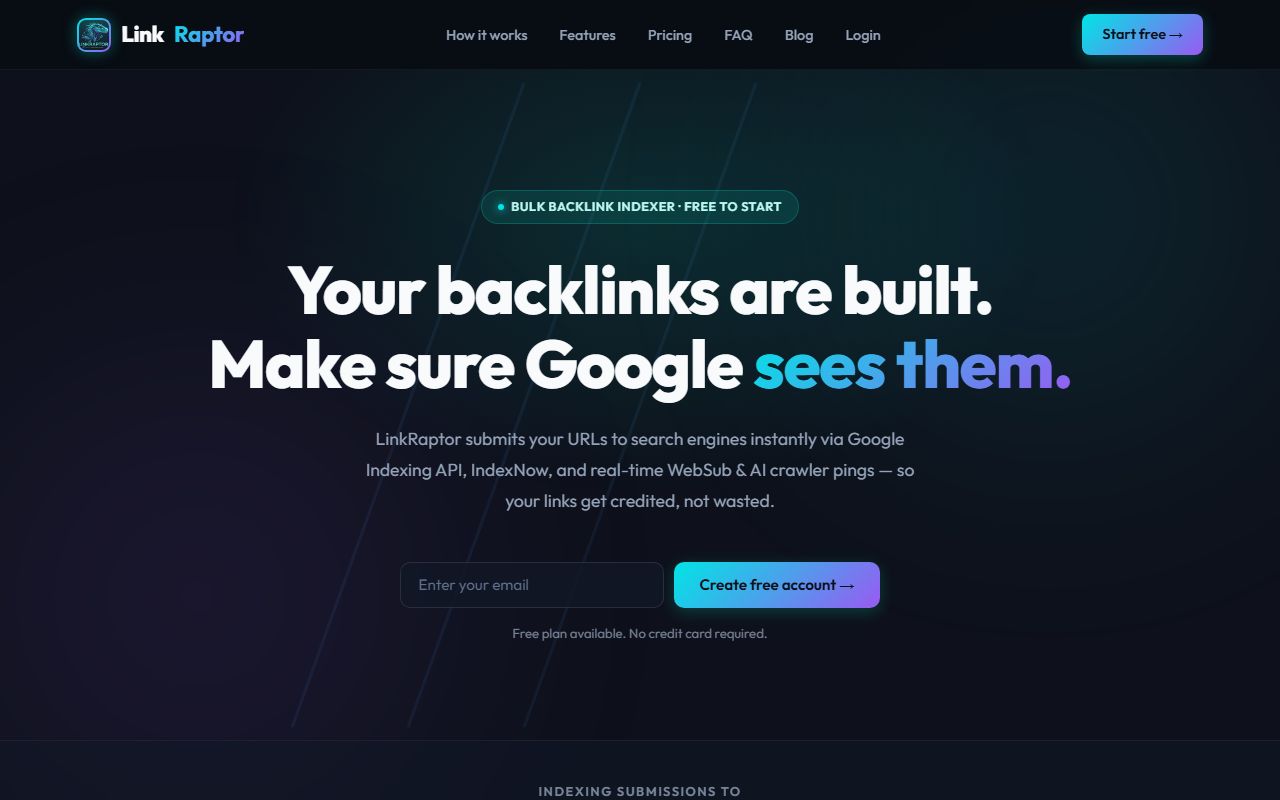
The screenshot is blunt: a dark navy page, a gradient on the words "sees them", and an email box with the promise "Free plan available. No credit card required." The sub-head reads:
LinkRaptor submits your URLs to search engines instantly via Google Indexing API, IndexNow, and real-time WebSub & AI crawler pings — so your links get credited, not wasted.
That is a clear pitch, and it is the reason this page is a checklist rather than a teardown. Indexers are bought on a handful of boring questions: what exactly is submitted, what does it cost at your volume, can you automate it, how do you pay, and how will you know it worked. Each item below gets a verdict: pass, fail or depends, with the evidence beside it. Everything about LinkRaptor comes from its own public pages as read on 2026-10-09. Where the site says nothing, we write "not published" instead of guessing.
One framing point first. LinkRaptor and apibacklinks do different jobs. LinkRaptor pushes URLs toward search engines. We publish link data built from our own web data: who links to whom, with which anchors. If you are shopping for an indexer, apibacklinks is not a substitute for one. It is the instrument you hold next to it. Our hub of backlink indexers lists others you can put through the same checklist.
Item 1: does the vendor say what it does, and what it does not?
Verdict: pass. The most useful sentence on the whole site is a limit: "LinkRaptor itself does not build links; it only helps existing links get found." It sits in the FAQ, where a buyer will find it.
The support center spells out the mechanism too. It names four simultaneous methods: the Google Indexing API, IndexNow, XML-RPC pings to what it calls 50+ search engine servers, and dynamic XML and HTML sitemaps meant as "booster feeds" for crawlers. Each job can also generate a Google News RSS feed, an XML news sitemap and an HTML link feed. There is an optional step, "Verify Backlinks First", that crawls the link before submitting.
It also publishes the caveat a sceptical buyer wants to see: a confirmed dispatch "does not guarantee Google will display the page", and processing takes "a few hours to 48 hours" depending on page quality and crawl budget. That is honest wording. A submission receipt tells you the ping was sent. It does not tell you the page entered the index.
Item 2: can you work out the bill in one minute?
Verdict: depends. The homepage shows four monthly plans:
| Plan | Price | Daily submissions | Support line |
|---|---|---|---|
| Micro | $7/mo | 1,000 | Email support |
| Starter | $19/mo | 50,000 | 24/7 priority support |
| Professional | $49/mo | 500,000 | Priority support + API access |
| Agency | $99/mo | Unlimited | Dedicated support account |
Flat tiers are easy to budget, and the jump from $7 to $19 buys a fiftyfold increase in daily volume. The same site disagrees with itself in several places, and a procurement checklist has to flag that:
- The support center's plan table lists only three plans (Starter, Professional, Agency) and omits Micro.
- The homepage FAQ says AI-search indexing is included in "all paid subscriptions (Starter, Professional, Agency)", while the Micro card also lists it.
- The feature grid tags the rotating Google key pool "Pro & Agency", yet all four plan cards list it.
- There is no /pricing page (it returns 404), and no annual billing is shown.
None of these is serious alone. Together they mean you should screenshot the plan you buy and confirm in writing what it includes before paying. The homepage also advertises a free plan capped at 5 URLs every 24 hours. That is enough to test the mechanism, not enough to test it at scale.
Item 3: how do you pay, and how do you leave?
Verdict: depends on your finance team. The homepage says all plans are paid in crypto: "USDT, BTC, ETH, SOL & 100+ coins". No card or PayPal option is mentioned anywhere we read. For a freelancer with a wallet that is no obstacle. For a company whose accounts-payable process needs a card statement or a purchase order, it may be a hard stop. The affiliate programme, 30% recurring commission, is also paid out in USDT or other crypto.
On exit, the support center is plain: you can cancel at any time, but "No partial refunds are issued for unused days", and there are no refunds for processed links or active subscription credits. With a monthly plan that is fair enough, and it makes the free tier the correct place to do your first test. Subscribe to the paid plan only after a small batch has behaved the way you wanted.
What is not published: company legal name, country, billing entity, and whether invoices are issued. If you need a VAT invoice, ask before paying.
Item 4: is there an API you can wire into a pipeline?
Verdict: fail on what is public, unknown on what is behind login. The Professional card says "Priority support + API access". We found no documentation to go with it. The paths /api and /docs both return 404, and neither navigation nor footer links to a reference. Endpoints, authentication, rate limits and per-call terms are not published, and it is unclear whether Agency includes API access, since that card does not repeat the phrase.
That matters for teams that submit URLs from code, for instance after a nightly link-building run. If your workflow is a person pasting lists into a dashboard, the dashboard is the product and the gap does not bite. If you need to automate, ask the vendor for the reference before you pay for the tier.
Do not confuse this with the Google Indexing API, which LinkRaptor calls on your behalf and which can be fed your own service-account keys. The rotating key pool exists, in the company's words, to bypass the 200 URLs per day quota. The vendor also attaches its own disclaimer to the optional Force Instant Indexing mode, advising use cautiously "on high-quality content only".
Item 5: is there evidence from anyone other than the vendor?
Verdict: fail, for now. We ran five queries on freeserp's web index: pricing, review, API, a "vs indexer" comparison, and the two-word spelling "link raptor". Nothing relevant came back about this product. The only hit using the word is a 2018 zine blog by someone using the same handle. There are no independent reviews, comparisons or forum threads we could find.
The site itself claims "3x Faster than manual submission" and "500K Daily submissions (Pro)". The first has no stated method, and the second is a plan limit, not an observed throughput. Its page markup also contains a 4.9 rating from 1,284 ratings, but nothing visible on the page supports it, so we do not repeat it.
This is not an accusation. The domain's first sighting in freeserp is 2026-08-05; two months is too short for a review ecosystem. It is simply the state of the evidence on the day we checked, and a buyer should price that in. A new vendor with a free tier and monthly billing is a low-stakes experiment, which is exactly how to treat it.
Item 6: how will you know the links actually registered?
Verdict: depends on the layers you add. LinkRaptor gives you three things: a live console, a job history with success and fail counts and per-URL responses, and a Google Index Checker that takes a pasted list. Those tell you what was dispatched and whether a URL appears in Google. They do not tell you whether the link, as a link, is visible to a crawler: which source page, which anchor, which target.
That second question is where a data source helps. After a batch, take the target domain and check its profile with our free overview and domain actions. Pull refdomains to see which donors appear, and backlinks filtered by source domain to confirm a specific placement and its anchor. Be realistic about timing: our index is built from our own web data, refreshed about monthly, and a brand-new link can take weeks to show. Treat it as an audit trail, not a stopwatch. Full call shapes are in the API docs.
The same blind spot applies to linkraptor.net itself. Its own page is a fair example of why indexing speed and link visibility are separate measurements: the vendor quotes a few hours to 48 hours for results to show, while a monthly-refreshed crawl index may take far longer to record that anyone links to you.
Where LinkRaptor is the better choice, and who should stay
Be clear about this: for the job of getting a list of URLs submitted, LinkRaptor is the right shape of tool and apibacklinks is the wrong one. We do not index pages. We do not submit anything anywhere. If your problem is a thousand fresh links sitting unseen, you need an indexer, and a data API cannot change that.
- Low entry cost. A free tier with a 5-URL daily cap, and a $7 plan for 1,000 submissions a day, is cheap enough to test on a Friday afternoon.
- Multi-protocol submission in one place. Google Indexing API, IndexNow for Bing and Yandex, WebSub and XML-RPC pings are normally separate chores. A single dashboard saves real time.
- Volume headroom. The listed ceiling of 500,000 daily submissions on Professional and unlimited on Agency far exceeds what a typical link-building team produces.
- Optional pre-check. Crawling a backlink before submitting it avoids sending dead URLs.
- An honest FAQ. The vendor states plainly that dispatch is not a guarantee of display.
Stay with LinkRaptor if you pay in crypto already, work from a dashboard, and need submission volume more than data. Add apibacklinks if you also want a record of what the crawl recorded. Sibling pages in this series that you can read against the same list: Indexingreviews and IndexingReview. If you want a sister service in our own network for the indexing job, there is IndexJump.
apibacklinks vs LinkRaptor
| apibacklinks | LinkRaptor | |
|---|---|---|
| Core job | Backlink and domain-rating data from our own index; we do not index pages | Submits URLs to search engines via Google Indexing API, IndexNow, WebSub and XML-RPC pings |
| Entry price | $100 free credit on first Google sign-in, then from $0.10 per 1,000 calls | Free plan (5 URLs per 24 hours), paid plans from $7/mo |
| Billing model | Per call: 1 credit = $0.0001, no subscription | Monthly subscription, $7 to $99 |
| Payment methods | Not described on this page | Crypto (USDT, BTC, ETH, SOL and others); no card option mentioned |
| Public API docs | 19 actions on one endpoint, documented | Not published (/api and /docs return 404) |
| Volume ceiling | 1,000 rows per call; deep pagination capped at 50,000 rows | 1,000 / 50,000 / 500,000 / unlimited submissions per day by plan |
| Data source | our web link data, 13 crawls, refreshed roughly monthly | Not applicable; it dispatches submissions rather than collecting link data |
| Proof of results | Counts and URLs you can inspect in the free explorer | Job history with per-URL responses; independent reviews not found |
| Guarantee | No promise of rankings or traffic | States that dispatch does not guarantee Google will display the page |
Try it on linkraptor.net
After a submission batch, check which individual backlinks the crawl has recorded for your target domain.
curl "https://apibacklinks.com/api.php?action=backlinks&q=linkraptor.net&key=YOUR_KEY"
LinkRaptor alternative — FAQ
Is apibacklinks a LinkRaptor alternative?
Does LinkRaptor build backlinks?
How much does LinkRaptor cost?
Why does apibacklinks show no data for linkraptor.net?
Does LinkRaptor have a public API?
Can apibacklinks confirm that my links were indexed?
Backlink data for the price of a rounding error
Sign up, keep your $100 of credit, call the API today.
Get started free