

An IndexingReview alternative, drawn as a block diagram
IndexingReview opens with six scored indexing services and the admission that its scores are "editorial judgments, not measured indexing rates." These notes treat the site as a component, find the gap in the diagram, and fill it with link data.
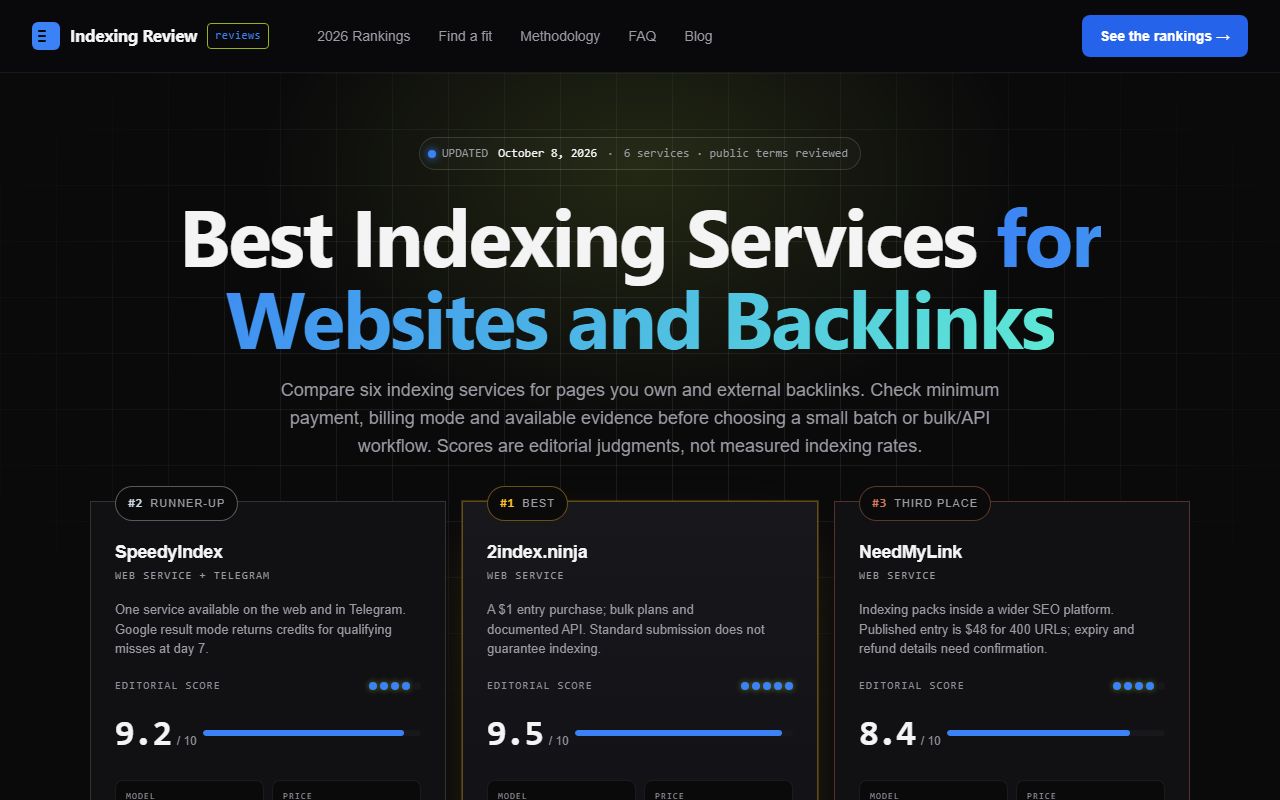
We looked up indexingreview.com in our index and got the cleanest possible answer: not found. DR 0, 0 referring domains, 0 backlinks, no first-seen date, no anchors, empty TLD mix. Our own site crawler first saw the domain on 2026-08-05, while the link graph is built from 13 crawl releases covering 2025 to mid-2026. A site that appeared at the edge of that window can easily sit outside it.
The irony is mild and the explanation is dull. A site about getting links indexed has no inbound links in our open-web sample, which says nothing about links elsewhere and nothing about its quality. It is a demonstration of the limit we state on our own side: the index refreshes roughly monthly, and a new link can take weeks to appear. The explorer will show the same empty report, and it is worth re-running after a few releases.
IndexingReview at a glance
- What it is
- A review and ranking site for URL indexing services, with guides on crawling and indexing problems
- Services scored
- Six, ranked by one method; badge on the homepage reads "UPDATED October 8, 2026"
- Score weights
- Evidence 35%, cost and billing 25%, community track record 20%, transparency and refunds 12%, platform and UX 8%
- Business model
- Affiliate: some links go through /go/ routes and may earn a commission, per its disclosure page
- Own product or API
- None found
- Engines covered
- Google, Bing, Yandex
- Owner and legal entity
- Not published; coverage is attributed to the "IndexingReview Editorial Team"
Component inventory: one ranking, one picker, nine listed posts
Start with what is actually deployed. The site navigation has five entries: 2026 Rankings, Find a fit, Methodology, FAQ, Blog. Behind them sit a ranked table of six services, a four-question picker (what you submit, how you pay, which engines, web dashboard or Telegram), a methodology page, and a blog whose homepage list runs from a July 15 guide on getting Google to index a site to September posts on SpeedyIndex, 2index and NeedMyLink.
Everything is content. We found no login, no queue, no submission form and no endpoint. The one interactive part is the picker, which in the example outcome shown on the page lands on 2index.ninja. The footer calls the whole thing "Reviews, comparisons and practical indexing guides for Google, Bing and Yandex." That description matches what we found.
The architectural consequence is simple: IndexingReview sits upstream of a purchase decision and has no component downstream of it. What happens to your URLs after you pay a partner is somebody else's subsystem.
One more observation from the screenshot: the podium cards carry caveats in the card text itself. The 2index.ninja card says standard submission "does not guarantee indexing," and the NeedMyLink card says expiry and refund details "need confirmation." A ranking that prints its own asterisks on the front page is behaving like a well-documented component, with its preconditions stated next to the output.
Data flow: reader, ranking, /go/ redirect, partner
The money path is easy to trace because the site documents it. Its disclosure page says partner links use /go/ routes and "can appear in rankings, reviews, and calls to action." We followed one: the route for 2index.ninja answers with a 302 to the partner's own domain carrying a referral parameter. That is how affiliate plumbing normally looks, and the site says so in plain words.
reader -> ranking / picker -> /go/<service> (302) -> partner checkout -> partner queue -> ???
The question marks are the point of these notes. After the partner queue, the reader receives the partner's own report. The methodology page is careful on this: it says not to present a provider's report, or a missing site: result, as independently confirmed Google indexing status. So the site itself flags that the final hop is unverified, and it offers no verification step of its own.
Two services on the list, IndexMeNow and Rapid URL Indexer, are labelled "ordinary nonaffiliate alternative," which is a useful detail: the disclosure is item-level, not a blanket footnote.
The scoring function, with its coefficients exposed
A ranking is a function, so here is this one. Five inputs, fixed weights, published on the homepage and the methodology page:
| Input | Weight |
|---|---|
| Quality of available evidence | 35% |
| Purchase cost and billing | 25% |
| Community track record | 20% |
| Transparency and refunds | 12% |
| Platform and UX | 8% |
The weights sum to 100. Note what is absent: a measured indexing rate. The site says "A score is a decision aid, not a measured indexing percentage" and that it does not insert a made-up percentage when comparable, independently checked batches are unavailable. It also says the September 2026 update verified public offers and rewrote supporting articles without being "a fresh controlled comparison of all providers."
That candour changes how to read the 9.5, 9.2 and 8.4: they are rankings of evidence, price and reputation, not of results. Reasonable as a design. Just keep the type of the output in mind when you wire it into a purchasing decision.
Failure modes of a review-driven workflow
None of these are faults of IndexingReview in particular. They are what any workflow built on a ranking inherits.
- Stale inputs. Prices change; the page quotes, for instance, a $1 standard entry for 100 URLs at one service and 400 URLs for $48 at another. Those are the site's statements about third parties, dated to its September terms review. Re-check before paying.
- Unverified output. The partner says a URL was submitted or indexed; nothing in this stack confirms that. The site itself says no billing model guarantees indexing and that credits returned are not automatically cash refunded.
- Wrong job. Indexers move URLs into a queue. If the URL is a thin page with no inbound links, the diagnosis is in the page and its links, which the site's own guide on pages that are crawled but not indexed addresses.
- Missing control group. Without a before-state, an "indexed" outcome might have happened anyway.
Items two and four are the places where link data helps, which is the next section.
A practical mitigation costs little: write down, before any purchase, which URLs you submitted, which engine you care about, and what evidence would count as success. Then pick evidence that does not come from the seller. The review site can help with the first two; the third needs a source outside the whole chain, and crawl-derived link data is one such source, with the cadence caveat attached.
Where IndexingReview is the better choice
Plainly: whenever the question is which indexing service should I use, IndexingReview answers and apibacklinks cannot. We do not index pages, do not submit URLs, and have no opinion about 2index.ninja, SpeedyIndex or NeedMyLink beyond what appears in public link data.
- Choosing a tool. A ranked list, a picker, and public terms collected in one place beat opening six pricing pages.
- Page versus backlink. It has an article titled "Page Indexing vs Backlink Indexing: What to Submit", a question we do not address at all.
- Method on display. Fixed weights and stated limits are easier to argue with than a vendor's own claims.
- No cost to read. Nothing to sign up for, no credit balance to manage.
If you have never bought indexing before, start there. Come back to a data API when you have URLs in flight and want to know what the crawl made of them.
The missing component: a read-only view of the link graph
The block that fits after the partner queue is a lookup that does not trust anybody's report, including ours, but is at least independent of the indexer. apibacklinks is built from our web link data: 181,132,097 domains, 2,774,625,913 domain-to-domain links, about 798.6 billion page-level backlinks. If a crawl in the sample saw a page and its link, a row can exist; the sample is not the whole web.
The checks are small and concrete:
backlinkswith atarget URLfilter tells you whether a given source URL links to your page, with its anchor,reland last-seen date.refdomainslists the top referring domains of a target (up to 100) with donor DR, so you can see which donors carry weight.bulk_drtakes up to 2,000 domains in one request, handy for scoring a whole list of placements before deciding what is worth submitting.
The limit again, because it matters here: the index is a broad sample of the public web, refreshed roughly monthly, not real time. A link submitted yesterday will not appear tomorrow. So this is a check on the weeks-later state, not a progress bar. For the indexing job itself, our sister service IndexJump exists; this page and its data API are about the verification half. More tools of this kind sit in the backlink indexers hub.
Cost model: three line items and a rounding error
The review site costs zero to read. The partners charge what they charge; the page lists examples such as 400 URLs for $48, or 1000 URLs a month on a $20 subscription at another provider, all as the site's statements. We do not price indexing and will not guess at it.
Our side is arithmetic. One credit is $0.0001. Paid lookups cost 1 credit and list calls such as refdomains or backlinks cost 2. A batch of 1,000 paid lookups is therefore 1,000 credits, or $0.10. A thousand list calls is $0.20, and each can return up to 1,000 rows. The free actions, domain and overview, cost nothing and need no key. First sign-in with Google brings a $100 starter credit, which is 1,000,000 credits.
So the verification layer is cheap enough to run on every batch, which is the only way a control group ever gets built. The details of each action live in the API docs.
Wiring it together: before, submit, after
A minimal loop, a hypothetical workflow built from real calls:
- Before. Pull
backlinksfor your target and store the source URLs that already exist in the crawl. That is your control group. - Choose. Use the review site to pick a submission service for the URLs that are not there.
- Submit. Pay the partner. Keep its report as a claim, not as evidence.
- After. Once a newer our web index release has been processed, repeat step one. Rows that appeared are visible links; rows that did not are undecided, not failed, given the cadence.
That last sentence is the whole discipline. The honest state of an unseen link in a monthly sample is "not yet", and the loop is built to keep it there.
apibacklinks vs IndexingReview
| apibacklinks | IndexingReview | |
|---|---|---|
| What it is | A backlink and domain-rating JSON API plus a free explorer | A review and ranking site for six indexing services |
| Sells indexing | No, we provide data only | No, it routes readers to partners |
| Own API | 19 actions on one endpoint | None found |
| Price to use | From $0.10 per 1,000 calls; $100 free credit on first Google sign-in | Free to read; revenue is affiliate commission |
| Backlink data | 181,132,097 domains, 2.77 billion domain links, about 798.6 billion page backlinks | None found |
| Indexing evidence | Link rows with source URL, anchor, rel and last seen, from our own web data | Editorial scores; states they are not measured indexing rates |
| Freshness | Roughly monthly refresh, not real-time | Homepage badge reads updated October 8, 2026 |
| Compares indexing services | No | Yes: ranking, picker, methodology and guides |
| Owner and entity | Independent service | Not published |
Try it on indexingreview.com
Free, no key: the profile of the domain itself, which today returns found: false.
curl "https://apibacklinks.com/api.php?action=overview&q=indexingreview.com"
IndexingReview alternative — FAQ
Is IndexingReview an indexing service?
Does apibacklinks replace it?
Why is indexingreview.com missing from your index?
Can the API confirm that a URL got indexed?
How quickly will a submitted backlink show up?
What does a check cost?
Backlink data for the price of a rounding error
Sign up, keep your $100 of credit, call the API today.
Get started free