

A Linklicious alternative, drawn as a system
Linklicious pings and crawls the links you submit. It does not tell you what the web graph holds about them. These notes separate the two jobs and show where each belongs.
We read linklicious.co as a target in our own index: 45 referring domains, 192 backlinks, 103 dofollow and 89 nofollow, DR 23 on our scale. It is a small footprint for a service that people were discussing on Moz in March 2011.
Three features stand out. The top referrer is moz.com with 30 links from 18 pages, all nofollow, all with the bare anchor "http://linklicious.co/". The next, onehourindexing.co, sends 24 followed links, and hkseo.us and onehourbacklinks.co add 11 and 3: the operator's own sites account for 38 of the 103 dofollow links. And the anchors are almost purely brand: "Linklicious" 71, "http://linklicious.co/" 43, "https://linklicious.co/" 12. Only "ping backlinks" (3) is a keyword. Most links still point at the http:// homepage: 135 against 43 for https. Open the full report to see the rest.
Linklicious at a glance
- What it is
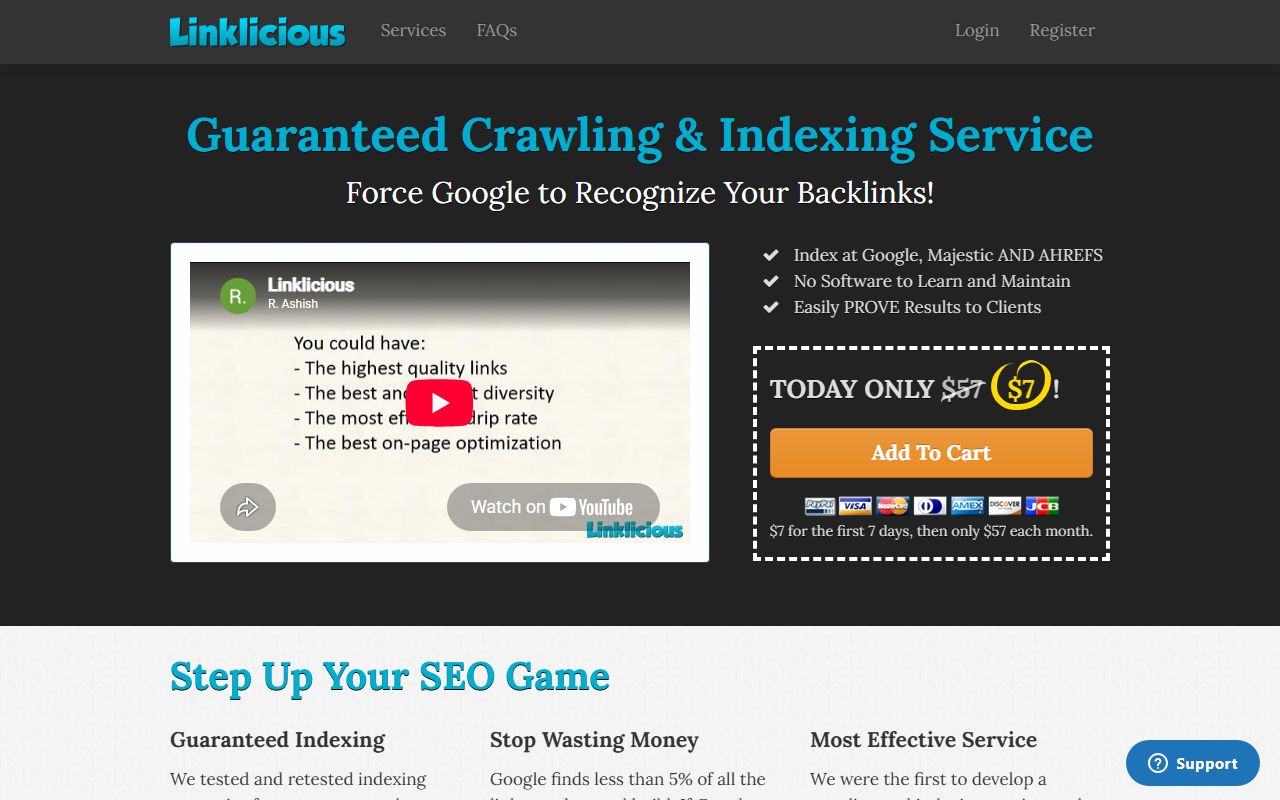
- A backlink pinging, crawling and indexing service. Its homepage: "Guaranteed Crawling & Indexing Service".
- Targets
- Google, Majestic and Ahrefs, fed "on a schedule that you define".
- Plans
- Free (2,500 links/day), Basic $17/month (12,500/day), Pro $57/month (50,000/day).
- Operator
- Footer: "Copyright © 2012-2026 HKSEO.us". Legal entity and HQ not published.
- API
- A posting API for submitting links. Documentation is sent after you register an application. Endpoints and rate limits: not published.
- Guarantee
- Improved indexing rate at the three services "or your money back", measured over two weeks.
Scope: two systems, one edge between them
Draw a box labelled Linklicious. Links go in. Crawler hits come out. The box exists to change what Google, Majestic and Ahrefs fetch.
Draw a second box labelled apibacklinks. It never receives your links. It holds a read-only graph built from our own web data: 181,132,097 domains, 2,774,625,913 domain-to-domain links, about 798.6 billion page-level backlinks. You query it.
The edge between the boxes is a question: after the drip, does the graph show the link? Everything below is about that edge.
Linklicious describes itself as "the original backlink pinging, crawling, and indexing service". That is a write path. We are not a replacement for it. We are the read path you put beside it.
Components: one queue, three crawlers
From the homepage, FAQ and plans page, the system has these parts.
- Intake. Upload a batch of links, or push them through the posting API. Partner imports from Drip Feed Links and LinkPushing.net are pulled once a day; the FAQ says it can take up to 36 hours before they appear.
- Scheduler. "You can set up links to drip out 10 links a day or 1000." The default is "a low and safe value".
- Dispatcher. Drips links to "the three main crawlers - Google, Majestic, and AHREFs".
- Tracker. It tracks Google crawls and "will continually notify them about your links until they visit". Free accounts get a portion of this and no re-pinging.
- Reporting. Crawl statistics for each uploaded batch, plus charts of when links were dripped and crawled.
- Link shortener. The plans page lists "shorten and anonymize your links".
Hosting is stated in the FAQ: a rewrite "in the cloud with Microsoft Azure cloud hosting".
Data flow: submit, drip, ping, report
One link, start to finish:
- You submit a URL you built.
- It waits in your account. Basic and Pro accounts never lose an uncrawled link; free accounts are cleaned "every month or two".
- The scheduler releases it at your chosen rate.
- The dispatcher pings it to the crawlers. Free accounts place it "along side other free customers links".
- Crawl hits are logged per link and rolled up per batch.
Notice what the public description does not include: a step that reads the link graph. The reports tell you a crawler visited. They do not say whether the page now counts in a backlink index.
That is the step you add yourself. Take the target domain, call backlinks filtered by source domain, and see whether the donor appears. Our data lags: crawl releases arrive roughly monthly, so a new link can take weeks to show. Read the result as a slow, independent witness, not a live gauge.
Cost model: allotments, not calls
Linklicious sells capacity. The plans page lists a daily link allotment per tier.
| Plan | Price | Daily allotment | Per 30 days, full use |
|---|---|---|---|
| Free | $0 | 2,500 | 75,000 links |
| Basic | $17/month | 12,500 | 375,000 links |
| Pro | $57/month | 50,000 | 1,500,000 links |
At full use that is roughly $0.00005 per link on Basic and $0.00004 on Pro. Nobody uses a full allotment every day, so treat those as floors. The flat fee buys headroom.
apibacklinks charges per call. 1 credit is $0.0001. A domain lookup is 1 credit; a list call such as refdomains is 2 credits, so $0.20 per 1,000, and one call can return up to 1,000 rows. New accounts get $100 of free credit on first sign-in with Google.
The two meters do not convert. One counts links pushed out. The other counts questions asked. A team that submits 10,000 links a week and checks 200 donor domains pays for both, and the checks are the small line.
Failure modes
Every design has them. Here are the ones visible from public material.
- Low-value inputs. The FAQ says it plainly: if you build "ultra-low quality links, the engines are smart enough to skip most of them". A pipeline cannot fix an input the crawler has judged.
- Crawled is not indexed. A hit in the tracker means a fetch. The guarantee is framed as count changes at Ahrefs Site Explorer, Majestic and Google over two weeks, which you measure yourself.
- Integration friction. A GSA SER forum thread from April 2025 reports a "Database Error" when pasting a Linklicious API key. It is a single report, so we cite it as a data point, not a verdict.
- Closed API docs. You register an application and receive documentation. Rate limits and per-call behaviour are not published.
- Our side. The index is a sample of the public web. Coverage is smaller and less fresh than the proprietary crawlers of Ahrefs, Majestic or Semrush. A link can be real and still absent from our graph.
Run both sides and a link that never shows up has at least two candidate explanations: the crawlers have not processed it, or our sample has not caught it yet. Having two readings to compare beats having one.
Where Linklicious is the better choice
Plainly: whenever the job is getting links crawled, Linklicious is the tool and we are not.
- It is built for the job. apibacklinks does not build links, sell links or index pages. It has no submission endpoint at all.
- Scheduling. Dripping links from 10 a day to 1,000 at a pace you define has no equivalent here. We have no alerts, monitoring or scheduled work of any kind.
- Per-batch crawl statistics. Its reports are made for showing a client that a batch was visited. We have no client-facing dashboards.
- Three-crawler reach. It targets Google, Majestic and Ahrefs directly. Our graph is built from our own web data only.
- A free tier with real volume. 2,500 links a day at $0, with the stated limits: a portion of the functionality and no re-pinging of uncrawled links.
- Time in market. The footer says 2012-2026, and the brand appears on forums from 2011. We have a first-seen date of 2024 in our own index window.
If you buy bulk links and need them crawled on a schedule, stay with Linklicious. There is nothing to replace.
The read path: what the crawl sees
Add the read path in three steps. The first is free and keyless; the list calls need a key.
1. overview on your money site: current counts and DR. Save the number.
2. backlinks with a source-domain filter, plus refdomains for the top referring domains: is the donor in the graph, with which anchor and rel?
3. bulk_dr on the donor list, up to 2,000 domains per request: which donors are worth a second submission.
This mirrors the guarantee procedure. Linklicious asks you to note counts before and after; we give you an independent count to put beside the three it names. Our API reference lists all 19 actions, and the indexer hub places this page among others of its kind.
For a second indexing route the same network runs IndexJump. A comparable page on a different indexer is Backlink Indexing Tool.
Capacity sketch: one hypothetical month
A made-up team, for arithmetic only. It builds 6,000 links a month for three client sites and wants every one crawled.
- Submission. 6,000 links fit inside the free allotment of 2,500 a day in a single three-day window. The question is not capacity. It is pace and persistence: free accounts do not re-ping uncrawled links, and Basic and Pro do. For a team that cares about the stragglers, Basic at $17/month is the first tier that changes behaviour.
- Drip. Spread the 6,000 links over 30 days and the rate is 200 a day, well under the 10-to-1,000 range the FAQ describes.
- Checking. Sixty donor domains per site, three sites: 180 domains. One
bulk_drrequest covers up to 2,000, so DR for all of them is a single call. Pulling the referring domains of each client site is threerefdomainscalls at 2 credits each, which is $0.0006.
Total read-path cost for the month: well under a cent. The submission side costs what the plan costs. The point of the sketch is proportion. The write path is the budget line; the read path is rounding error, and it is the only part that produces a number you did not get from the vendor.
Change the inputs and the shape holds. Ten times the links moves you up a tier. It barely moves the checking bill.
Reading the brand's own graph
As a test of the read path, we pointed it at linklicious.co itself. The headline numbers are in the data story above. Three observations for the design notes.
One. The highest-DR donors send no followed links. moz.com is donor DR 64 and sends 0 followed links; cloudfront.net is DR 83 and sends 0 of its 10.
Two. Translated anchors such as "Linklicious→click here!" in Polish, Armenian, Nepali and Cebuano appear to come from auto-translated copies of one article on internetmarketingblog101.com. That pattern is visible only in the anchor table.
Three. 38 of 45 referring domains sit under DR 30. This is a statement about the crawl sample, not about the service: a tool like this is mostly mentioned in forums, tool lists and comment threads, which tend to link rarely or with nofollow. Our DR is our own metric, comparable in spirit to the well-known ones but not the same number.
apibacklinks vs Linklicious
| apibacklinks | Linklicious | |
|---|---|---|
| Core job | Read backlink and DR data from a JSON API | Ping, crawl and index links you submit |
| Submits links for pinging | No. We do not build links, sell links or index pages | Yes: scheduled drip to Google, Majestic and Ahrefs |
| Pricing unit | 1 credit = $0.0001 per call; lists 2 credits | Monthly plan by daily link allotment: 2,500 / 12,500 / 50,000 |
| Entry price | $100 free credit on first Google sign-in, no card | Free plan; $17/month Basic; $57/month Pro |
| Public API docs | Yes, 19 actions on one endpoint | Not published; sent after application registration |
| API purpose | Query backlinks, anchors, referring domains, DR | Posting links for crawling |
| Per-batch crawl reports | None | Yes: crawl statistics for each uploaded batch |
| Scheduling | None | Yes: drip rate you define |
| Data freshness | crawl releases, roughly monthly, not real-time | Not published |
| Rate limits | Max 1,000 rows per call; pagination capped at 50,000 | Not published |
Try it on linklicious.co
After a drip, list the backlinks to the target and check whether the donors you submitted appear, with which anchor and rel.
curl "https://apibacklinks.com/api.php?action=backlinks&q=linklicious.co&per=100&key=YOUR_KEY"
Linklicious alternative — FAQ
Is apibacklinks a replacement for Linklicious?
Does Linklicious have an API?
How much does Linklicious cost?
Can I check whether my link was indexed using apibacklinks?
Is your DR the same as the DR in Ahrefs?
Where do I start?
domain and overview actions. Paid list actions need a key; first sign-in with Google gives $100 in credit.Backlink data for the price of a rounding error
Sign up, keep your $100 of credit, call the API today.
Get started free