

A Backlink Indexing Tool alternative, in the form of a letter to the person holding the credit card
Backlink Indexing Tool sells one thing: a push for third-party backlink pages, with credits back if they stay unindexed after 14 days. Before you spend, here is what the data says and where a different tool fits.
We read the brand's own backlink profile in our index, because a link tool's profile tells you how its owner behaves. backlinkindexingtool.com shows DR 22 (our metric, not Ahrefs DR), 42 referring domains and 123 backlinks, of which 76 are dofollow (61.8%). First seen in our index data on 2025-08-10, last seen 2026-08-19.
The shape is lopsided. The top referrer is fatrank.com with 16 links, all dofollow, across four pages; the most common anchor is plain "Backlink Indexing Tool" (36 links, 29.27%). Another 42 links carry the naked anchors "www.backlinkindexingtool.com" and "http://www.backlinkindexingtool.com", none of them dofollow, from sites such as dailymail27.co.uk, alwatannews.co.uk and yorkweek.us. Only one referrer sits above DR 50. Open the live report and check it yourself.
Backlink Indexing Tool at a glance
- What it is
- A credit-based service that submits third-party backlink page URLs for Google discovery and reports index status.
- Who runs it
- Backlink Indexing Tool Ltd., London, United Kingdom (per the site footer). Founding year and founders: not published.
- Pricing
- One-time packages in USD: 100 credits for $30, 500 for $135, 2,000 for $510. No subscription.
- Refund rule
- Credits for URLs unindexed after the 14-day final report return as account credits, not money (terms 9.1 and 9.2).
- Reporting
- First index status after 4 days, final status after 14 days; charts and CSV export.
- Free tier
- Not published. The smallest purchase is $30.
- API
- Mentioned in a blog article; public documentation not found.
Dear buyer: the spider on the homepage is making a narrow promise
Dear founder, head of SEO, or whoever is holding the card,
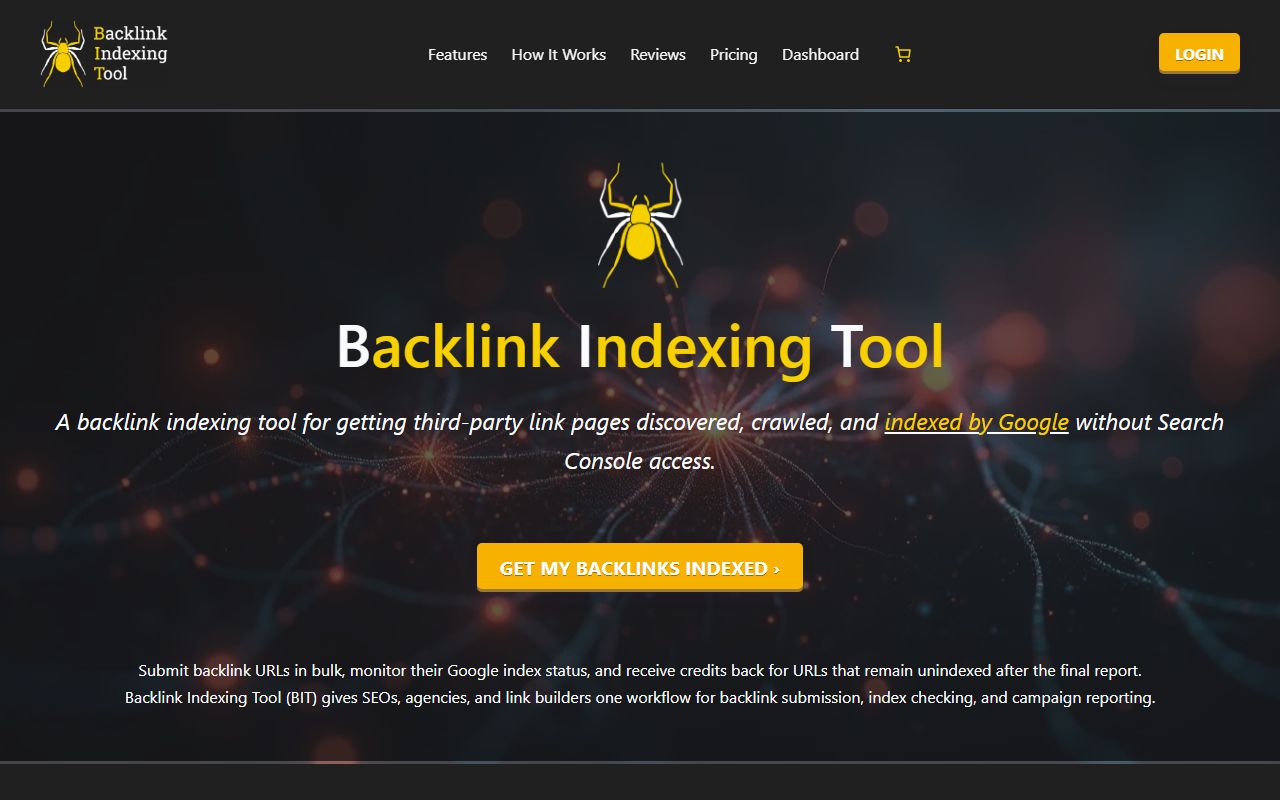
I assume you have the Backlink Indexing Tool homepage open. Dark background, a yellow spider, the logo with its B, I and T picked out in yellow, and one button: "Get My Backlinks Indexed". There is no price above the fold. The headline sentence is a careful one:
A backlink indexing tool for getting third-party link pages discovered, crawled, and indexed by Google without Search Console access.
Read it slowly. It does not say rankings. It does not say links. It says pages that already contain your links get discovered. That is a specific job, and the company is refreshingly plain about its edges: the site says the product does not create backlinks, edit anchor text or promise rankings, and that Google controls the index.
I am writing because you are comparing this to something else, perhaps to a data API. They are different jobs, and half of the confusion in this category comes from treating them as one. This letter walks through what you would be paying for, what the crawl data says about the company itself, and where each tool earns its place.
What a credit is, and what happens on day 4 and day 14
The mechanism, as the company describes it: you paste backlink URLs in bulk into a project. One credit submits one URL. The service "sends crawl and discovery signals" for those pages. The method itself is not published, and the site speaks only about Google, not Bing.
Then two checkpoints. An initial index status arrives after 4 days. A final status arrives after 14 days. Credits for URLs that are still unindexed at the final report return to your account. The terms put it as a 100% credit refund for backlinks not indexed within 14 days, and add that refunds are account credits, not money, and that the process is automated but subject to fair-use policies. The same terms also call the credit system non-refundable and non-transferable, so read the two clauses together before you rely on either.
That is the real product: not speed, but a settlement rule. You pay per URL, you wait two weeks, you keep the credit for each failure. For a link builder with placements on pages Google has not yet visited, it is a practical way to price that uncertainty.
What the site does not state on its product pages is a success rate. Percentages such as 85% and 95% appear on third-party and blog pages, and I treat them as claims, not measurements.
Reading the company's own links: two halves that do not match
I like to check how a link vendor treats its own domain. In our index, backlinkindexingtool.com splits cleanly in two.
Half one is branded and mostly dofollow. "Backlink Indexing Tool" is 36 of 123 anchors, 94% of them dofollow. Variants follow: "Backlink indexing Tool" (5), "BacklinkIndexingTool.com" (4), "Backlink Indexing Tool LTD" (3), plus a few non-brand ones such as "best link indexer" (3) and "this tool" (5). These come from SEO blogs and vendors: fatrank.com (16 links), codemastersinc.com, fatjoe.com, gauravtiwari.org, mexseo.info, t-ranks.com.
Half two is 42 links with naked URL anchors, zero dofollow, all pointing at the old http://www. homepage address, from news-style domains: dailymail27.co.uk, alwatannews.co.uk, yorkweek.us, airnewswire.com, america-insider.net, cryptostudystock.com and bitcryptosolutions.com. That pattern is consistent with syndicated content distribution. Our data shows the links, not who placed them, and it is ordinary marketing.
Two details I found useful. First, fatrank.com is the single biggest referrer, 13% of all links, and the only brand-specific review the web search returned for this company; it is one review, and it is worth reading alongside others. Our data shows only the links, not any relationship behind them. Second, fatjoe.com, a link-building vendor with DR 42 in our index, links to the tool five times from three pages, which fits the audience the site itself names: SEOs, agencies and link builders.
The API that appears in an article but not in the navigation
The homepage and footer have no API link. There is, however, a blog article titled "API Integration for Backlink Indexers" (the URL spells it "intergration"). It speaks of a RESTful infrastructure, up to 100 URLs per call, parallel batches of up to 2,000, 10,000 URLs processed daily, OAuth2, key management and webhooks.
I could not find the documentation it refers to, a base URL, or a page that issues keys. So I will not repeat those numbers as product specifications. They are statements in a marketing post. If an API matters to your workflow, ask for the docs before you pay, and ask what a call costs against your credits.
For what it is worth, that article is the third most linked page on the domain in our index, with five links.
If your actual need is programmatic access to link data rather than indexing, that exists elsewhere: apibacklinks has 19 actions on one endpoint, documented in the API reference, and the first sign-in carries $100 of free credit.
Where Backlink Indexing Tool is the better choice
Let me be direct, because you deserve a straight answer.
- You need pages pushed. We do not index pages, full stop. If a guest post sits unvisited, apibacklinks cannot change that. Backlink Indexing Tool exists for exactly this.
- You do not own the linking site. The product is built for third-party pages without Search Console access, which is the situation of every link builder.
- You want a settlement rule. Credits back after 14 days is a concrete commitment, with the account-credit limits noted above.
- You report to clients. Projects, charts and CSV exports are on the site. We have no dashboards or scheduled reports.
- You want a dashboard, not JSON. A bulk paste box and a status chart suit a non-developer better than
curl.
If that describes you, stay with it and skip the rest of this letter. Our backlink indexers hub lists the other services in this category, and the Gindex page covers one more take on the same job.
What apibacklinks adds: the view from the crawl, before and after
An indexer answers "did Google take the page?" A separate question is "does an independent crawl even see this link, and who is it from?" Our index is built from our web link data: 181,132,097 domains and 2,774,625,913 domain-to-domain links (about 798.6 billion page-level backlinks). It is a broad sample, refreshed roughly monthly, so a brand-new link can take weeks to show. That is the limit, and you should know it.
Used alongside an indexer, it gives you three practical checks:
- Before you submit: call
backlinksfor your target and filter by minimum donor DR to see which placements the crawl has already recorded. Crawl visibility is not the same as Google indexing, so treat it as context for choosing what to submit, not as a verdict. - After day 14: re-run the same call on the next crawl release. A link that shows up both in the indexer's report and in our data has been seen by two separate systems, which is useful context but still not a guarantee of anything in Google's results.
- On the donor:
refdomainsshows donor DR, link count and dofollow counts for the top referring domains, andbacklinkscan be filtered to one source domain. A donor that never appears across several crawl releases may be worth a closer look before you place more links there.
We do not do alerts, new-and-lost reports, rank tracking or toxicity scores, and our DR is our own number computed from referring domains, comparable in spirit to other tools but not the same. For the indexing job itself, our sister service IndexJump exists; the Index Inject and Addnewurl pages cover two more.
Five questions to send them before you pay
Short, answerable and fair. Their replies matter more than any review, including this one.
- What is your measured index rate across the last quarter, and how do you define "indexed"?
- Do credits expire, and what does fair use mean in numbers?
- Terms 3.1 and 9.2 describe refunds as account credits. Is there any case where money returns to the original payment method?
- Is there a public API, with docs, a base URL and per-call credit cost?
- Do you cover engines other than Google?
If the answers are clear, buy the 100-credit pack, submit a mixed batch of strong and weak pages, and compare the day-14 report with what the crawl data shows. A $30 test is cheaper than one afternoon of debate.
Yours, with respect for a narrow product that says what it is,
The apibacklinks team
apibacklinks vs Backlink Indexing Tool
| apibacklinks | Backlink Indexing Tool | |
|---|---|---|
| Core job | Backlink and domain-rating data over a JSON API, plus a free explorer | Submits third-party backlink URLs for Google discovery and reports index status |
| Pricing model | Pay per call; 1 credit = $0.0001, from $0.10 per 1,000 lookups | One-time credit packages: 100 for $30, 500 for $135, 2,000 for $510 |
| Free entry | $100 free credit on first sign-in with Google, no card | Not published |
| Pushes pages into Google | No, we provide data only | Yes, via crawl and discovery signals (method not published) |
| Refund rule | Not applicable; free actions cost 0 | Credits return for URLs unindexed after the 14-day final report |
| Public API | 19 actions on one documented endpoint | Mentioned in a blog post; public docs not found |
| Reporting | JSON and a browser explorer; no dashboards or scheduled reports | Charts and CSV export per project |
| Data freshness | Own index, roughly monthly, not real-time | First status at 4 days, final at 14 days |
| Engines covered | Reads link data from crawl graphs; no search engine coverage claim | Google (other engines not stated) |
Try it on backlinkindexingtool.com
Pull the referring domains of the brand's own domain to see which pages the crawl has seen linking to it.
curl "https://apibacklinks.com/api.php?action=refdomains&q=backlinkindexingtool.com&key=YOUR_KEY"
Backlink Indexing Tool alternative — FAQ
Is Backlink Indexing Tool a replacement for a backlink API?
How much does Backlink Indexing Tool cost?
What happens to URLs that do not get indexed?
Can apibacklinks index my backlinks?
Is our DR the same as the score shown by other tools?
How current is the data on backlinkindexingtool.com in your index?
Backlink data for the price of a rounding error
Sign up, keep your $100 of credit, call the API today.
Get started free