

A Linkdexing alternative, after ten hard questions
Linkdexing says four people index your links by hand, at $0.05 per submission. A sceptical buyer should ask what that number covers, and what proves the work afterwards.
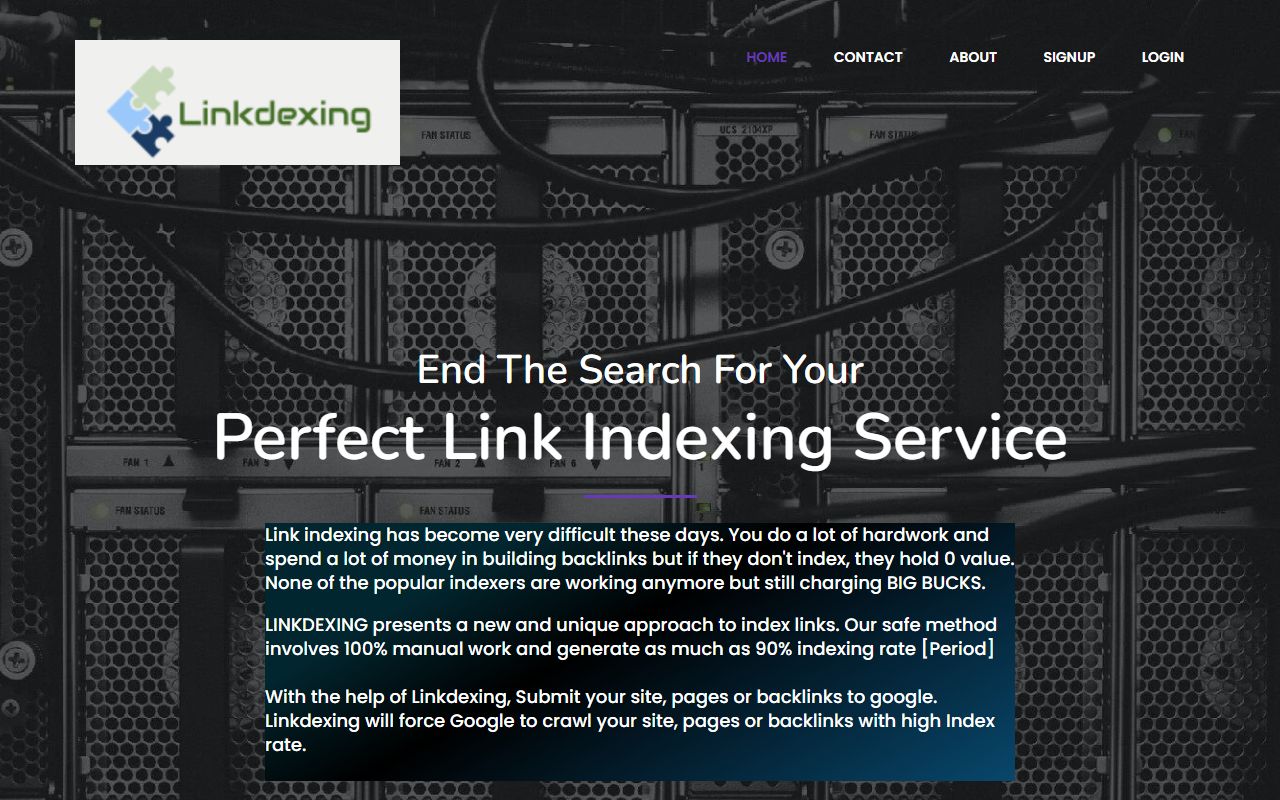
Linkdexing indexes other people's links, so we pointed our index at its own. The result is small: DR 18, 18 referring domains, 26 backlinks, first seen 2024-07-12 and last seen 2026-08-15. The site says it has operated since 2022, so this is two years of visibility at most in a link graph, not a verdict on the business.
The shape is telling. The most common anchor is the bare linkdexing.com (9 of 26 links, none dofollow), largely from domain-listing and stats-style sites. One page on alfieformation.fr supplies 6 of the 26 links and 6 of the 11 dofollow ones. The highest-DR referrer is shopify.com (DR 83), a single nofollow naked URL. The earliest links, from July 2024, are two directories and a nofollow link from blackhatworld.com with the anchor 'SIGNUP NOW.', which suggests a forum thread, though we have not read it. Keyword anchors are nearly absent: 'best link indexer' on telescope.ac and 'link indexing' on justpaste.me.
Linkdexing at a glance
- What it is
- A paid backlink and URL indexing service aimed at Google, run through a web app at app.linkdexing.com
- Operator
- "A service by Economical Network"; headquarters stated as New Delhi, India
- Price
- 1 credit = 1 link submission = $0.05; 200 links for $10; 10 free credits on signup
- Billing
- Credits, no subscription, no expiry until used; no refunds, "indexed or not"
- Method
- Described as 100% manual work by a team of 4; the method itself is not published
- Extras
- Re-index, drip feed up to 30 days, bulk orders
- Public API
- None found on the public site
Question 1: what does one credit actually buy?
A submission. The refund page is blunt about it: 1 credit is 1 link submission "regardless it index or not". The homepage prices that at $0.05, with an INR equivalent of 4.125, and says credits do not expire until fully used. The smallest advertised start is 200 links for $10, and signup adds 10 free credits.
The arithmetic is simple enough to run in your head: 1,000 links cost $50, and 10,000 links cost $500. Linkdexing itself says, in its FAQ, that its prices are higher than other indexers because the method is manual and carries overhead. No volume tiers are published on the public pages, and anything behind the login was not visible to us.
So the first answer is that you are buying effort per URL, not a result per URL. That is a fair model for a service that cannot control Google. It also means the cost of a campaign is known in advance and the benefit is not.
Question 2: which success rate is the real one?
The site gives several. The page title says 'Upto 100% Indexing Rate'. The body says the method generates 'as much as 90%'. The feature block reports a beta test with 'as much as 96%', and adds that many clients saw all their links indexed, with the caveat that this "is not guaranteed". The comparison table says 'Up to 90%' for Linkdexing against 'less than 10%' for cheap indexers.
Timelines wander in the same way:
- The advantage block says results can show 'as soon as 1day'.
- The comparison table says 'Most links index within 1 week'.
- The FAQ says the manual process 'takes around 2 weeks to get best indexing rate'.
None of this is dishonest, since each phrase is hedged with 'up to' or 'as much as'. But a buyer should plan around the slowest and lowest statements, not the headline ones. The testing claim, that results were checked with 'a third party index checker tool we don't own', names no tool, so the rates cannot be reproduced from the outside.
Question 3: what happens if it does not work?
There is no refund in any form, in fee or credits, because no rate is guaranteed. The terms add one safeguard: a campaign that lands under a 40% indexing rate is re-run free, provided it has at least 20 links. The 10 free credits at signup are the official way to test before you pay.
The same FAQ is candid about what will never work: pages tagged noindex, URLs blocked by robots.txt, redirects, and some blacklisted domains. That list is the most useful paragraph on the site, because it tells you to audit your own URLs before spending a credit. The terms also say a submission 'cannot be reversed or pulled back', so check the batch before you press the button.
Question 4: what can an independent crawl tell me afterwards?
This is where apibacklinks fits, and where its limits matter. Our index is built from 13 our web index hyperlink crawls: 181,132,097 domains, 2,774,625,913 domain-to-domain links and about 798.6 billion page-level backlinks. It is refreshed roughly monthly, not live, and a brand-new link can take weeks to appear.
That makes it a poor stopwatch and a decent second opinion. If you submitted 300 guest-post URLs, you can ask whether those pages show up as sources of links to your money site, with their anchors and rel attributes as a crawler recorded them. A link that a public crawl never sees after a few cycles is worth a closer look in Search Console. A link it does see is at least discoverable.
We do not measure Google's index and we never claim to. Absence from our own web data is not proof of non-indexing, and presence is not proof of indexing. It is one more independent signal, and it is priced at $0.0002 for a list call that returns up to 1,000 rows.
Question 5: is there an API, or do I paste into a form?
On the public site we found no API, docs, developer or integration page, and the word 'API' does not appear in the homepage copy. Submission happens in the web app after signup. Whether the app exposes anything programmatic behind the login is not published, so we will not guess.
For a team that runs link building as a pipeline, that matters. A script that adds URLs to a queue, waits, and then reports back needs endpoints on both ends. The reporting end is the part we cover: backlinks with filters for source domain, target URL and date range, and refdomains for the top referring domains, all documented at /api-docs.php. The submitting end remains Linkdexing's, or IndexJump's, or whoever you pick.
Question 6: where is Linkdexing simply the better choice?
Whenever the job is getting URLs in front of Google, because we do not do that job. We provide data. We do not build links, sell links or index pages.
Specific cases where Linkdexing is the right call:
- You need pages crawled. A $0.05 credit is an action taken on your URLs. A backlink report is not.
- You value a human in the loop. The site describes a team of four doing the work by hand. The method itself is unpublished, but a hand-run service is a different product from an automated ping list.
- You want pay-as-you-go. No subscription, no expiry, a $10 entry point, 10 free credits.
- You re-index old losses. Re-indexing previously de-indexed pages and drip feeding up to 30 days are on the menu. Neither exists in our 19 API actions.
- You are a small buyer. A few hundred links at a time is a normal use case for it.
If that describes you, keep Linkdexing and use us only as the audit step. Our sister service IndexJump covers the indexing job too, if you want to price a second option.
Question 7: what is not on the page that I would want to know?
The list is longer than the pitch suggests. Not published: who owns Economical Network beyond the name, any individual founder, the actual method, the identity of the checker used in testing, the real values of the homepage counters (the static page shows placeholders), and any independent review. The site claims both 'over 10k users' and 'thousands of clients', and 'over 5 Million links' indexed in three years. We could not verify any of them.
We looked for third-party commentary and found none we could cite. The one outside signal in our own data is that nofollow BlackHatWorld link from July 2024. We have not read that thread and will not describe it. A sensible buyer would search forums for recent experiences before the first top-up, then use the free 10 credits as a real test: submit ten URLs you can verify yourself.
Question 8: so how do I use both without wasting money?
A small, cheap routine works. First, pull the target's current picture from our free endpoints, which need no key. Second, submit the batch. Third, wait for the next index refresh and compare.
- Record the baseline with
overviewordomainfor your site, and the list of source URLs you are about to submit. - Send the batch to your indexer. Keep the first test to the free 10 credits.
- After a refresh cycle, run
backlinkswith the target URL and a date range, and see which sources have appeared. - Treat unseen sources as a to-do list for Search Console's URL inspection, not as failures.
You can try the browser version of step 3 with the free explorer, which shows what a report looks like using Linkdexing's own domain. For the wider field, the hub of backlink indexers lists the other services in this class, and LinkGX is a comparable page.
Questions 9 and 10: who should buy what, and what is the verdict?
Question 9: who should not use Linkdexing? Anyone who needs an API-driven workflow today, anyone who wants a refund path if results disappoint, and anyone who cannot tolerate a stated range of 'up to 90%' with no named method. Agencies that report to clients will also want something that produces a document, and the public pages describe none.
Question 10: and who should not use apibacklinks? Anyone hoping we will get their links crawled. We do not index pages, we offer no alerts or new-and-lost reports, and we have no spam score. What we offer is a cheap, keyless way to look at a profile such as the one above and to script the same lookup for a thousand domains.
The verdict, kept short: Linkdexing is a fair, transparent-about-its-limits option for the indexing job, priced at a level it openly calls high. The honest way to judge it is the free 10 credits, a batch of URLs you can check, and a second, independent view of what a crawl recorded. For the data half, start with the API reference.
apibacklinks vs Linkdexing
| apibacklinks | Linkdexing | |
|---|---|---|
| Core job | Backlink and domain-rating data over a JSON API, plus a free explorer | Submitting your URLs so Google crawls and indexes them |
| Unit price | 1 credit = $0.0001; lookups 1 credit, list calls 2 credits | 1 credit = 1 link submission = $0.05 |
| Cost for 1,000 items | $0.10 for 1,000 lookups; $0.20 for 1,000 list calls (up to 1,000 rows each) | $50 for 1,000 link submissions |
| Free start | $100 free credit on first Google sign-in, no card | 10 free credits on signup |
| Subscription | None, no monthly minimum | None; credits do not expire until used |
| Public API | 19 actions on one endpoint, JSON, CORS enabled | None found on the public site |
| Result guarantee | No promises about rankings or indexing; data is a sample of the public web | No indexing guarantee; free re-run if a campaign of 20+ links is under 40% |
| Re-index and drip feed | Not offered | Both offered; drip feed up to 30 days |
| Freshness | Refreshed roughly monthly from our own web data, not real-time | Timeline stated as 1 day, 1 week or about 2 weeks, depending on the page |
| Independent verification | Shows which links a public crawl recorded, with anchors and rel | Not published (checker tool unnamed) |
Try it on linkdexing.com
After a campaign, list which source pages a public crawl now records as linking to the page you submitted.
curl "https://apibacklinks.com/api.php?action=backlinks&q=linkdexing.com&per=100&key=YOUR_KEY"
Linkdexing alternative — FAQ
Is Linkdexing a backlink checker?
How much does Linkdexing cost for a typical batch?
Does Linkdexing have an API?
Can apibacklinks tell me whether a URL is in Google's index?
Is the DR on apibacklinks the same as Ahrefs DR?
Where does IndexJump fit?
Backlink data for the price of a rounding error
Sign up, keep your $100 of credit, call the API today.
Get started free