

A LinkGX alternative, explained for people new to indexing
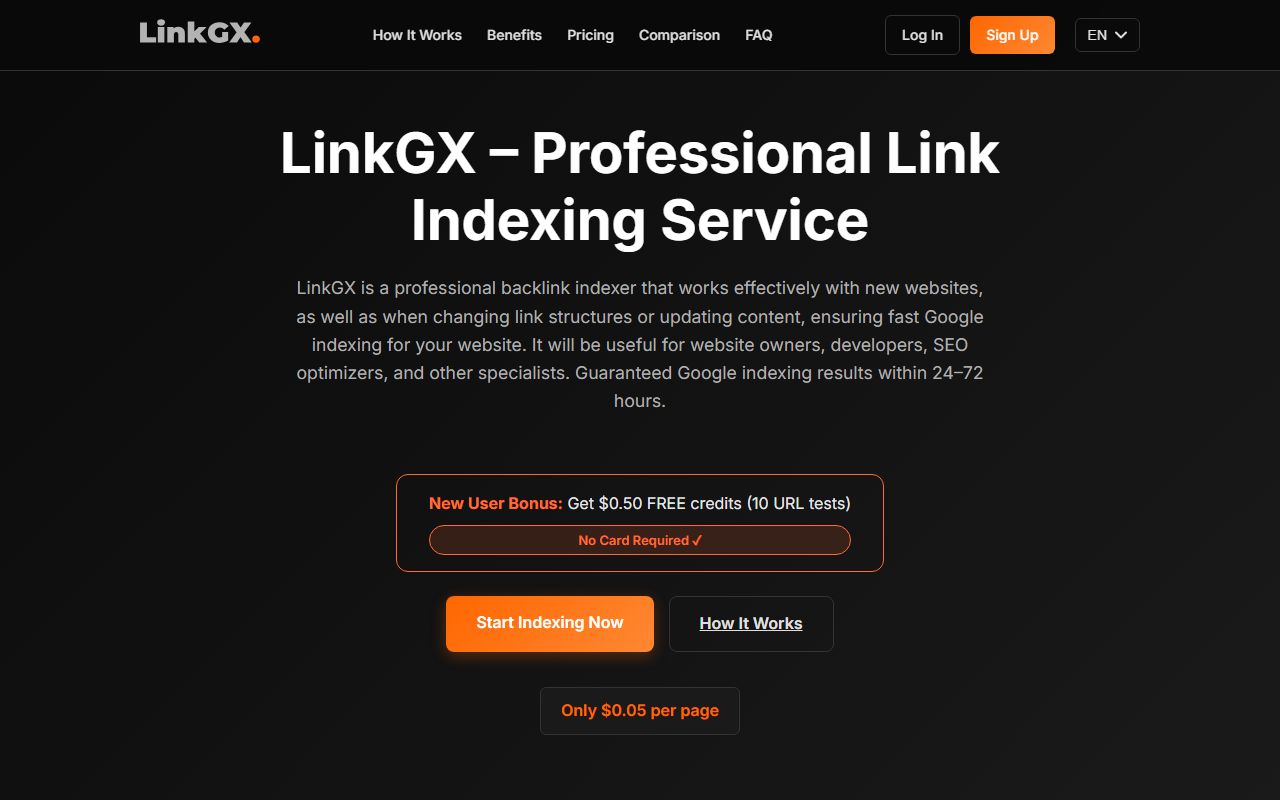
LinkGX files your pages in Google's catalog for $0.05 each. Our index shows who is citing them. Here is the difference, in plain words, with the real numbers.
In our index, linkgx.com has 231 backlinks from 9 referring domains, DR 14, with a dofollow share of 98.7%. Links were first seen on 2024-07-15 and last seen on 2026-08-08. Every link points at the homepage (230 at the https address, 1 at the http version).
One referrer, acystyle.com, supplies 144 links across 130 pages, every one anchored "linkindexer". Together with hilltopfarmaskrigg.co.uk (58) and a co.uk bucket (22), three sources make up 224 of the 231 links. The brand shows up as an anchor on only four links ("LinkGX" and "linkgx.com"). The rest are phrases like "Google index backlinks". It is a sample of the public web, so treat it as a partial view.
LinkGX at a glance
- What it is
- Paid Google URL and backlink indexing service
- Price
- $0.05 per page indexed, pay as you go, no subscription
- Free test
- $0.50 credit (10 URLs), no card required
- Stated speed
- 24–72 hours, 48 hours average (company claim)
- API
- Mentioned on the homepage; public documentation not found
- Search engines named
- Google only
- Company details
- No legal entity, address or founding year published
The card catalog and the bibliography
Picture a town library. Every book on the shelves has a card in the catalog drawer. If a book has no card, nobody finds it by searching, however good it is. That drawer is Google's index, and LinkGX is a paid service whose whole job is to get your cards into it.
Now picture a second thing: the list of other books that cite yours. That is a backlink profile. It tells you who points at you, with what words, and how much those pointers weigh. Different drawer, different question.
This page keeps both pictures in view. LinkGX answers "is the card filed?" apibacklinks answers "who is pointing at the book, and does a public crawl even see it?" You can use one without the other. Many people end up wanting both.
What happens when you hand LinkGX a list
The homepage describes three steps, and they are easy to follow if you keep the library in mind.
- Task setup and URL validation. You create a task from a list of page URLs. LinkGX "checks the links for restrictions."
- Search engine notification. The service names three methods: the Google Indexing API, "use of proxies/bots" and "forced pinging". In library terms, it walks to the desk and asks the librarian to file your card.
- Results tracking. It tracks the status of each URL and shows reports, including graphs and a percentage of successful indexing.
Only Google is named. The pages we read mention no other engine, so treat it as a Google tool. The audience list is broad: SEO specialists and agencies, site owners, digital marketers and administrators.
Notice what is missing from those three steps: any look at who links to you. LinkGX files the card. It does not count the citations.
The bill, in plain arithmetic
This is the easiest part of LinkGX to understand, which is a point in its favour. There is one plan, "Pay Per Page", at $0.05 per page indexed. The page says there are no monthly subscriptions and "no hidden fees". New accounts get $0.50 in free credit, which the site translates as 10 URL tests, with no card required.
| URLs submitted | At $0.05 each |
|---|---|
| 10 | $0.50 (the free credit) |
| 200 | $10 |
| 1,000 | $50 |
| 10,000 | $500 |
The arithmetic is ours, not theirs. What LinkGX does not publish is just as useful to know: a minimum top-up, volume discounts, and whether a URL that fails to get indexed is charged or credited back. The terms promise a refund after a server-side technical error, and say there are no refunds for used credits. Read that before you buy a large batch.
For comparison, a credit on our side costs $0.0001 and a lookup starts at one credit, so a thousand domain lookups is ten cents. The two bills are not the same product, though. One pays for filing, the other for reading.
Reading the promises like a careful newcomer
The hero text says "Guaranteed Google indexing results within 24–72 hours." Lower on the page, the FAQ says indexing takes 24 to 72 hours but that "the exact time depends on several factors", namely the load on the search engine and the quality of the site. A separate line gives an average of 48 hours.
Both statements sit on the same page, and a beginner should hold them together. The window is the typical case. The guarantee has no published definition: there is no stated success rate, and no stated remedy if a page is still missing on day four. That is why a small test batch is the sensible first purchase.
The site also says it works only with legal sites and rejects "blacklisted sites that violate Google rules" or spammy content. Its comparison table sets LinkGX against unnamed "Other Services" and claims 24–72 hours against 48–96, no subscription against a monthly one, and a full API against a limited one. Those are the company's own claims about competitors it does not name, so nothing here can be checked from outside.
What a public crawl sees of LinkGX itself
Here is a fair test of the "two drawers" idea: run LinkGX's own domain through our index. What does a public crawl show of a company in this business?
Our index lists 231 backlinks from 9 referring domains. All of them point at the homepage (230 at the https address, 1 at the http version). The anchors are almost all descriptive search phrases rather than the brand name:
| Anchor | Links | Share |
|---|---|---|
| linkindexer | 144 | 62.3% |
| Google index backlinks | 80 | 34.6% |
| linkgx.com | 2 | 0.9% |
| premier link indexer | 2 | 0.9% |
| LinkGX | 2 | 0.9% |
| index backlinks in Google | 1 | 0.4% |
One domain, acystyle.com, supplies 144 of the 231 links, all with the anchor "linkindexer", across 130 different pages. Add hilltopfarmaskrigg.co.uk (58 links) and a co.uk bucket (22) and three sources account for 224 links. The brand name appears on just four.
This is a sample of the public web, not a verdict. A small crawl footprint does not mean the site is invisible in Google. It does show the gap between the two drawers: being filed and being widely cited are separate facts, measured in separate places. You can open the same report yourself in the free explorer.
Where LinkGX is the better choice
If your problem is "these 400 pages exist and Google has not picked them up", we are not the answer. We do not index pages, submit URLs or ping anything. LinkGX does, and it says so plainly.
- The job itself. Submitting URLs is the product. Ours is a data API.
- Simple, visible pricing. One number, $0.05, and a free test of 10 URLs before you spend anything.
- Per-URL status. The homepage describes tracking and reports for each submitted URL. We have no equivalent, and no dashboards at all.
- Small, irregular jobs. New site launch, restructured links, a batch of fresh backlinks you built last week: pay-as-you-go suits these better than any subscription.
- Languages. The site is available in English, Ukrainian and Russian.
So if you already know your links exist and only need Google to notice them, stay with LinkGX or a similar indexer. Our network's own indexing sister service is IndexJump, and the indexer hub compares the whole category.
Where our data fits in the routine
A newcomer's routine, with both drawers, looks like this:
- Before submitting, look up the page or domain you are about to push. How many referring domains does it have? What anchors?
- Submit the URLs to whichever indexing service you pick.
- Wait. Our index refreshes roughly monthly from our own web data and is not real-time, so a new link can take weeks to appear.
- Look again and see whether the links you built show up in the crawl, and with what anchor text.
Be clear about the limits. Our index is a broad sample, smaller and less fresh than the proprietary crawlers. There are no keyword tools, no rank tracking, no traffic estimates and no per-URL "is this page indexed" check. Our DR is our own 0 to 100 score, computed from referring domains in our graph, and is not Ahrefs DR or Moz DA. Linkgx.com shows DR 14 here.
The 19 actions are documented in the API docs. The first sign-in with Google gives $100 of free credit.
A first week, if you are brand new
This is a hypothetical beginner's plan, not a prescription.
Day 1. Spend the free $0.50 on ten URLs you can easily tell apart: five new pages, five older pages you updated. Note the date.
Day 3. Check which of the ten appear in Google. The homepage's own window is 24 to 72 hours, so this is the fair moment to judge.
Day 7. If most are in, scale up, perhaps to 200 URLs, which would cost about $10. If few are, you have lost fifty cents instead of five hundred dollars.
A page that stays out of the drawer for weeks may have a content problem rather than a filing problem. No submission method fixes that.
Plainly put: treat indexing as a measurement you can repeat. Keep a list of what you submitted, on which day, and what happened by day three and day seven. After two or three small batches you will know your own hit rate, which is the one number the company does not publish. Then compare that rate with the price, and decide whether the next batch is worth it.
If you built the links yourself, add one more column to that list: the donor domain. When you later look the target up in our index, you can match your list against the referring domains it reports and see which placements the crawl picked up.
apibacklinks vs LinkGX
| apibacklinks | LinkGX | |
|---|---|---|
| Main job | Backlink and domain-rating data over an API | Submits URLs to Google for indexing |
| Price unit | $0.0001 per credit; lookups from 1 credit, lists 2 | $0.05 per page indexed |
| Free start | $100 credit on first Google sign-in, no card | $0.50 credit (10 URLs), no card required |
| Subscription | None, no monthly minimum | None, pay as you go |
| Speed claim | Index refreshed roughly monthly, not real-time | 24–72 hours, 48 hours average (company claim) |
| Public API docs | 19 actions documented, one endpoint | Not published |
| Success rate | Not applicable, we index nothing | Not published |
| Engines covered | Not applicable | Google named; others not mentioned |
| Per-URL status reports | None | Yes, per the homepage (reports and graphs) |
| Company details | Independent service on the apibacklinks site | Not published |
Try it on linkgx.com
Check what our crawl sees for the domain, free and keyless.
curl "https://apibacklinks.com/api.php?action=overview&q=linkgx.com"
LinkGX alternative — FAQ
Is apibacklinks a LinkGX alternative?
How much does LinkGX cost?
Does LinkGX have an API?
Does LinkGX guarantee indexing?
Can apibacklinks tell me whether a page is indexed in Google?
Is our DR the same as the DR shown elsewhere?
Backlink data for the price of a rounding error
Sign in with Google, keep your $100 of credit, call the API today.
Get started free