

An IndexChecker alternative, if you first answer one question
IndexChecker's about page says the site: operator lies. Our index says something plainer about IndexChecker itself: 302 backlinks, seven anchors, one homepage. Pick your branch below, because the right tool depends on the question.
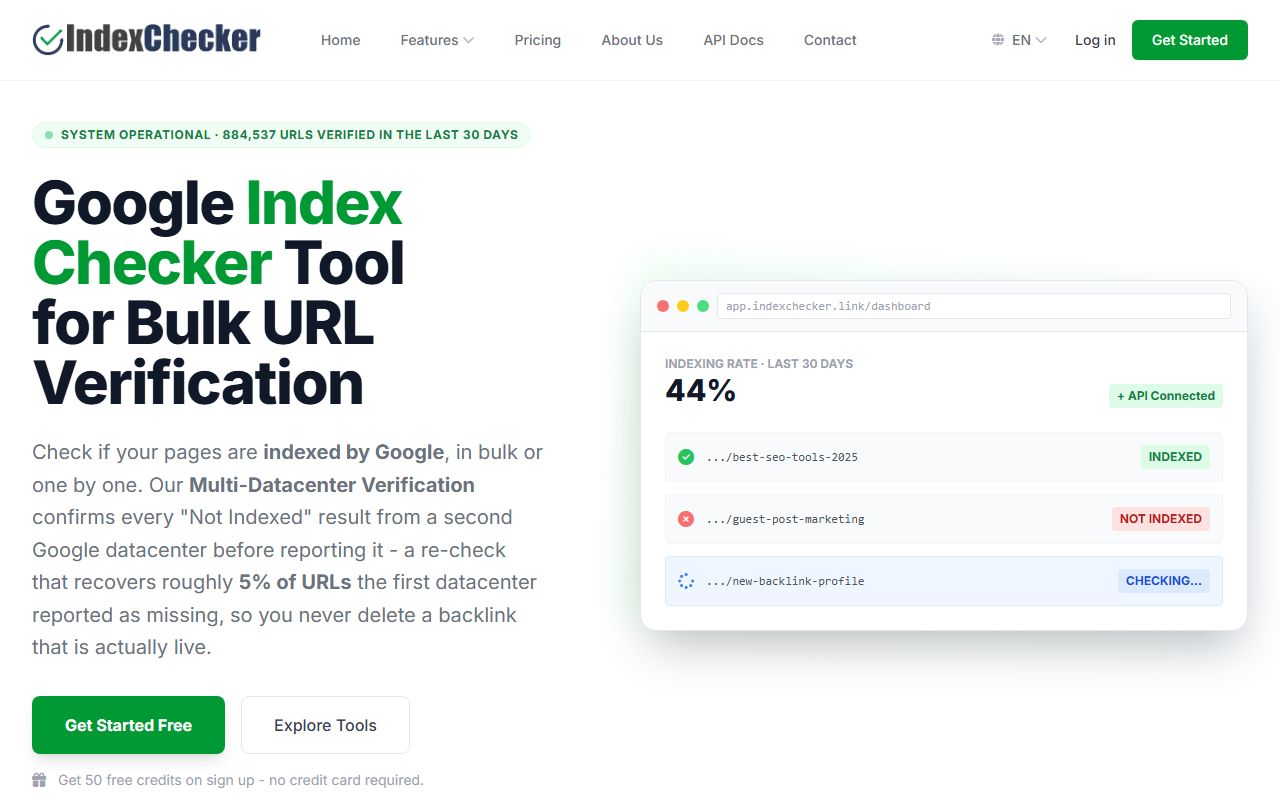
Here is what our web graph holds for indexchecker.link: DR 30 on our scale, 143 referring domains and 302 backlinks, 97.7% of them dofollow. Of those 302 links, 295 point at the homepage, so pricing, API docs and the feature pages have no visible links in our data. There are only seven distinct anchors, and the bare word IndexChecker carries 200 of the 302 links (66.23%).
The profile is also very Polish for a product with a sixteen-language switcher: 95 of the top 100 referring domains are .pl. Several are the maker's own properties (ap2media.com gives 11 links, piersa.pl gives 5), and 87 of the top 100 were first seen between August and November 2025. The single keyword anchor, Google index checker (13 links), comes from gindex.me, itself a Polish link indexer. The strongest donor by DR is dhosting.pl at 37, which names the tool in a technical-SEO audit template. None of this says anything about whether Google indexed those donor pages; that is the question IndexChecker exists to answer.
IndexChecker at a glance
- What it is
- A bulk Google index checker with a dashboard and a REST API, at indexchecker.link.
- Operator
- AP2Media Sp. z o.o., Czerwin, Poland; the site says it has been operating since 2021.
- Batch size
- Up to 50,000 URLs per CSV or TXT file, or per API project; sitemaps are read two levels deep.
- Pricing model
- One-off credit packs from $13 for 2,000 credits to $270 for 200,000; 1 credit = 1 URL check; 50 free credits on sign-up.
- Method
- Each URL is checked against two Google datacenters (USA and Europe) before it is reported as Not Indexed.
- Does not do
- Index pages itself, or discover backlinks; it has no referring-domain data or authority metric.
The root of the tree: do you need the index or the link?
IndexChecker (indexchecker.link) is explicit about its own limits. Its homepage says: “IndexChecker verifies index status - it does not index pages itself.” You hand it URLs, it asks Google from two datacenters, and it tells you Indexed or Not Indexed. That is the entire job, and it does it for up to 50,000 URLs at a time.
apibacklinks starts from the opposite end. You give us a domain, and we return the referring domains, anchors and linked pages that appear in our index: 181,132,097 domains and 2,774,625,913 domain-to-domain links built from 13 crawl releases. We never ask Google anything.
So the first fork is not a feature comparison. It is this:
- If the question is “is this page in Google?”, go to the left branch and stay with IndexChecker.
- If the question is “who links to this site, and with what words?”, go to the right branch and use us.
- If the question is “did the placement I bought actually count?”, you need both, and the branches below tell you in which order.
Every branch ends in a verdict. Some of them end in “do not switch”.
Branch A: you bought a batch of links and want to know what survived
This is IndexChecker's home turf. Its copy argues that a link on a page Google never indexed is a link that does nothing, and it backs that up with its own statistic: of the backlinks monitored in the tool over the last 30 days, 42% were not found in Google's index. That figure is theirs, and the site publishes no methodology for it, so treat it as an indication rather than a benchmark.
The workflow:
- Export the placed URLs from your order sheet.
- Upload the file, or paste the list, or point at a sitemap.
- Read the Indexed and Not Indexed lists, and the Index changes view on the next run.
The arithmetic is friendly. At the published pack prices, 10,000 URLs cost $35 on the Pro pack ($3.50 per 1,000) and about $13.50 at the Agency rate of $270 for 200,000 credits ($1.35 per 1,000). A second-datacenter re-check is included in the one credit.
Verdict for Branch A: stay with IndexChecker. We have no page-level “is it indexed” signal at all. What we can add is the step before the purchase: pull the donor's DR and referring-domain count from the free domain action, or screen up to 2,000 candidate donors in one bulk_dr call, so you do not pay to check pages that were never worth buying.
Branch B: you owe a client a report
Ask what the client will open. If the answer is a link in an email, IndexChecker has a Share button that generates a public report that opens without a login, an optional email notification when a check finishes, and CSV or TXT exports split into indexed, not indexed or all links. Projects can be re-checked on a schedule, and an indexation-over-time chart appears once a project has more than one run.
apibacklinks has none of that. We have no dashboards to share, no scheduled exports, no email reports, no alerts and no new-or-lost-links report. We return JSON. If you want a report, you build it.
There is one place we fit in a client deck: the backlink-profile page. The overview action returns counts, DR, the top five referring domains, anchors and pages, and the DR and TLD distributions, and it is free without a key. The explorer shows the same data in a browser if you want to see the shape before writing code.
Verdict for Branch B: IndexChecker for the deliverable, apibacklinks only if you want to hand-assemble an inbound-link page next to it.
Branch C: you are wiring this into your own code
Here the two APIs are different animals, so a mapping table helps more than adjectives.
| Question | IndexChecker | apibacklinks |
|---|---|---|
| Method | POST to app.indexchecker.link | GET on api.php?action=… |
| Auth | apikey in the POST body | ?key= or a Bearer header |
| Flow | Create a project, then poll /api/project/show | One request, one JSON response |
| Per-item status | 1 Indexed, 0 Not Indexed, -1 pending | Counts, DR and link rows |
| Batch ceiling | 50,000 URLs per project | 2,000 domains in bulk_dr, 1,000 rows per list call |
The asynchronous project model makes sense for their job: Google checks are slow and proxy-bound, so you submit and come back. Our calls return in one round trip because we read from a prebuilt graph, not from a live search engine.
One practical note from their docs: the homepage sample uses a GET to /api/balance, while the reference documents POST /api/check-balance, and the contact-page FAQ names an api.indexchecker.link/v1/ base that did not accept a connection when we probed it on 2026-10-09. Treat the API reference page as the authority and test with the 50 free credits before you build on it.
Verdict for Branch C: use IndexChecker's API to ask Google about URLs, and ours to ask the link graph about domains. They do not compete for the same call.
Branch D: you pay a third-party indexer and want to stop wasting credits
This is the branch where IndexChecker's maths is its strongest argument. Its homepage table prices a 10,000-link batch: sending everything to an indexer unchecked is about $200 at roughly $0.02 per URL, while checking first and indexing only the 5,501 that need it comes to $123. The $0.02 figure and the 5,501 split are IndexChecker's own estimates, so rerun the sum with your indexer's real price and your real indexation rate.
The tool connects to indexers through a universal API connector, and its integration table lists Omega Indexer, SpeedLinks, IndexMeNow, Zapier and Make.com as available. It says nothing is sent in the background; you choose what goes to a paid indexer. If Speed Links is on your shortlist, our Speed Links page covers that side of the pipe, and the indexer hub lists the rest.
If you need a service that does the submitting, that is a separate product from both IndexChecker and apibacklinks. Our sister service IndexJump exists for that job; we mention it once and leave it there.
Verdict for Branch D: keep IndexChecker as the gate in front of the indexer. We can tell you which of your pages have inbound links in a crawl, not whether Google stores them.
Branch E: you want to know what links to the checker itself
A fair test of any link tool is to point it at a product from the same neighbourhood. Pointed at indexchecker.link, our index reports a compact profile. The anchors are almost all the name: IndexChecker (200 links), the bare URL (35), indexchecker.link (32), then Google index checker (13) and IndexChecker.link (7). Two long Polish anchors read like portfolio-card text, for example “Narzędzie SEO / SaaS IndexChecker.link Autorski serwis SaaS do masowego monitorowania indeksacji linków w wyszukiwarce Google.” (2 links); that wording matches how the operator's own agency site describes the product.
The top referrers by link count are gindex.me (18), ap2media.com (11), auto-paulux.pl (7) and piersa.pl (5). Most donors sit below DR 30; the best, dhosting.pl, reaches 37. For a reader building the same kind of profile, the useful reading is mundane. A brand-anchor-heavy profile of small regional donors, mostly dofollow, is simply what our sampled crawl shows for this domain. The English-speaking SEO web barely appears in our data, which may reflect crawl sampling as much as anything about the product.
You can pull the same numbers yourself with refdomains and anchors.
Verdict for Branch E: apibacklinks, and nothing else in this tree competes with us here, because IndexChecker has no referring-domain data.
Leaf: where IndexChecker is simply the better choice
Straight answers, no hedging.
- Verifying index status. We cannot do it. our web index having seen a link is not the same as Google having indexed the page that carries it.
- Volume. 50,000 URLs per file, no daily cap beyond your credit balance, and sitemaps as an input. Our ceiling is a different kind of ceiling.
- Freshness. A check is a live query to Google, with the raw HTML snapshot kept for 7 days so you can audit a result. Our index refreshes with crawl releases, roughly monthly, so a new link can take weeks to appear.
- Packaging. Dashboard, scheduled re-checks, a change history, share links, CSV export, email notification. We offer none of these.
- Pay model for occasional use. Credits are bought once and, per its pricing page, never expire. The minimum top-up is $5.
- The second look. The two-datacenter rule is a sensible answer to false negatives. By their own number it recovers roughly 5% of URLs that the first datacenter reported missing.
If your whole workflow is “paste list, read verdicts”, there is nothing in apibacklinks that improves on that. Do not switch.
Dead ends worth knowing before you pay
Name collisions. Several unrelated products are called IndexChecker, including indexchecker.io and indexchecker.pro. Reviews of those are not reviews of indexchecker.link, and we found no independent rating of this one.
Stated limits. The site itself concedes that occasional false negatives can occur if a URL has not propagated across all Google datacenters, and its terms say results may not match what you see in your own browser. Speed claims differ by page: the marketing copy says 400 to 500 URLs per minute, while the terms describe about 200 links per 5 minutes on average. We did not test either. Run your own 100-URL sample first.
Moving numbers. The homepage carries a live counter of URLs verified in the last 30 days (857,055 when we read it on 2026-10-09). Treat any such figure as a snapshot.
Our own limits. No indexing, no keyword research, no rank tracking, no spam score, no historical charts. Our DR is our own metric, comparable in spirit to other authority scores but not the same number.
All the leaves in one table
| If you are… | Do this |
|---|---|
| Checking whether URLs are in Google | IndexChecker. Start with the 50 free credits. |
| Gating an indexer budget | IndexChecker first, indexer second. |
| Reporting to a client by link | IndexChecker's share link; add our overview output if you want an inbound-links page. |
| Screening donors before buying | apibacklinks bulk_dr, then IndexChecker on what you placed. |
| Reading who links to a competitor | apibacklinks refdomains and anchors. |
| Building a pipeline | Both, each for its own question. |
On cost, the two rarely land in the same invoice. A Pro pack of 10,000 URL checks at $35 buys 10,000 index verdicts. The same $35 buys 350,000 of our lookups, or 175,000 list calls that each return up to 1,000 rows. Neither number is a better deal; they measure different things.
apibacklinks vs IndexChecker
| apibacklinks | IndexChecker | |
|---|---|---|
| Core job | Backlink and domain-rating data from our own crawl graph | Bulk check of whether URLs are in Google's index |
| Input | A domain or a list of up to 2,000 domains | URLs by paste, CSV or TXT, or sitemap; up to 50,000 per project |
| Price per unit | $0.0001 per lookup, $0.0002 per list call (up to 1,000 rows) | $0.0065 to $0.0013 per URL depending on pack |
| Free start | $100 credit on first Google sign-in, no card | 50 free credits on sign-up, no card |
| Subscription | None, no monthly minimum | None; one-off packs from $13 |
| API auth | Key in query string or Bearer header | apikey in the POST body |
| API flow | One GET, one JSON response | Create a project, then poll for status |
| Limits | 1,000 rows per call; deep pagination capped at 50,000 rows | Not published (Agency pack lists a high limit, no number) |
| Freshness | Refreshed with crawl releases, roughly monthly | Live query to Google at check time |
| Backlink discovery | Yes: referring domains, anchors, pages | No |
Try it on indexchecker.link
Pull the profile discussed above, then look at its anchors.
curl "https://apibacklinks.com/api.php?action=anchors&q=indexchecker.link&key=YOUR_KEY"
IndexChecker alternative — FAQ
Does IndexChecker index my pages?
Can apibacklinks tell me if a page is indexed by Google?
Which is cheaper?
Is IndexChecker the same company as indexchecker.io?
Should I use both?
Backlink data for the price of a rounding error
Sign up, keep your $100 of credit, call the API today.
Get started free