

An AddNewURL alternative, tested on AddNewURL itself
AddNewURL says it needs to index 500 to 1,000 URLs a month, so we ran our own index on its domain and wrote down what came back: 38 backlinks, 18 referring domains, and a tag that shows up in 10 of the links.
We pointed our own index at the service's domain. It holds 38 backlinks from 18 referring domains, of which 31 are dofollow and 7 nofollow (81.6% dofollow). Our DR for addnewurl.com is 18; the average referrer sits at DR 21, and the spread is 3 referrers at DR 0-14, 14 at DR 15-29, one at DR 30-49 and none at 50 or above. The single best referrer is kulfiy.com at DR 40, with two dofollow links anchored "Google indexing tool".
The profile is short. 23 of the 38 links use either the brand (addnewurl.com 9 times, Guaranteed Google Indexing - AddNewURL.com 6 times) or the product category (Google indexing service 8 times, all dofollow) as anchor text. Ten of the 38 links point at a URL carrying ?r=bulk, and the top referrer, bulklink.org, accounts for six of them. The first link we saw dates from 2024-07-13; the footer's copyright line starts at 2019, so older links may exist outside our index.
AddNewURL at a glance
- What it is
- A web form that submits third-party URLs for Google indexing, up to 20 URLs per submission.
- Self-description
- "AddNewURL.com is a new guaranteed Google indexing service." Run by an unnamed SEO company "based in Finland".
- Method
- Posts and pings links through "blog networks and social media accounts"; which ones is not published.
- Price
- Homepage on 2026-10-09: "Free for a limited time." The struck-through list price reads $1 per order plus $1 per URL.
- API
- None found; the site is one page with a form.
- Our index
- DR 18, 38 backlinks, 18 referring domains, first seen 2024-07-13, last seen 2026-09-09.
Entry 0: the question, and why a notebook
Most comparison pages are written from the brand's brochure. This one is written from a bench. The homepage is short: it says the service posts and pings your links, that Google removed its submit-URL tool on 25 July 2018, and that the operators themselves need to index 500 to 1,000 URLs a month.
That last detail made a convenient experiment: the service's own domain is a small, public backlink profile we can read in full. If our index shows a sparse profile, that says as much about the index as about the product, and we will say which.
Hypothesis. AddNewURL and apibacklinks are not substitutes. One tries to get a URL discovered; the other reports which links a crawl has already recorded. The experiments below test whether the second is useful to a customer of the first.
Entry 1: the specimen, one screen of it
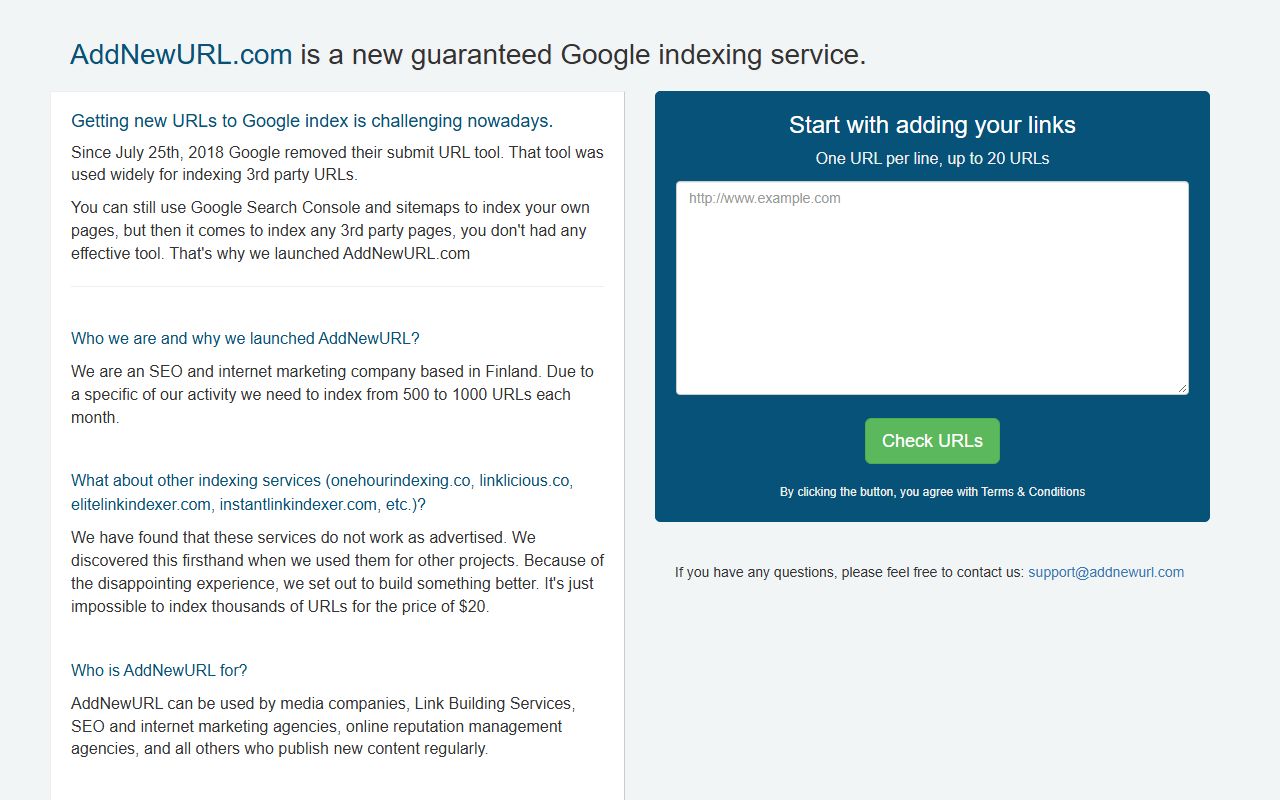
The screenshot is unusually complete for a commercial service. There is no logo, no menu and no login. A grey page, an explanation, a dark-blue box and a green button labelled Check URLs. The textarea hint says "One URL per line, up to 20 URLs".
The page source shows the rest of the flow without us submitting anything: the URLs are checked, a table appears with a checkbox per URL, and a payment step follows. We did not run an order, so what the checkout charges today is not verified. The homepage text says:
Free for a limited time.
followed by a struck-through list price of $1 per order plus $1 per URL. That promotion is perishable, so treat it as what the page said on 2026-10-09 and nothing more. There is no pricing page, no documentation page, no about page and no linked terms. The words "Terms & Conditions" under the button are plain text.
Observation: the homepage names four other indexing services and says of them and similar tools that "these services do not work as advertised", adding that indexing thousands of URLs for $20 is "just impossible". We have not tested those services and do not repeat the claim as ours.
Entry 2: pulling addnewurl.com from the index
Two calls, both free to read in the browser through the explorer: overview and refdomains. The numbers, written down as they came back:
| Measure | Value |
|---|---|
| Domain Rating (ours) | 18 |
| Referring domains | 18 (14 with at least one dofollow link) |
| Backlinks | 38: 31 dofollow, 7 nofollow |
| Average referrer DR | 21 |
| Referring TLDs | 4: .com 15, .org 1, .online 1, .uk 1 |
| gov / edu referrers | 0 |
| First / last seen | 2024-07-13 / 2026-09-09 |
A second tool, freeserp, lists the same domain at DR 13. That is a different instrument with its own formula, and neither number is Ahrefs DR or Moz DA. We use 18 because it comes from the graph we can show you.
Observation: 15 of the 18 referrers are .com, and the top six referrers by link count are bulklink.org (6 links), then 444seo.com, ibusinessangel.com and techmarketbusiness.com (4 each), then techsurprise.com (3). The strongest referrer, kulfiy.com, has 2 links. These are small niche sites, a normal shape for a specialist service, and exactly the detail a single DR number hides.
Entry 3: the ?r=bulk tag
The most interesting row in the top-pages list is not the homepage. Our index records 25 links to https://addnewurl.com/, but also 6 to https://addnewurl.com?r=bulk and 4 to https://addnewurl.com/?r=bulk. That is 10 of 38 links, or 26.3%, carrying a query parameter.
The six on the first variant come from bulklink.org, a site whose own title calls it a "Free BackLink Generator, Pinger and Submission Service", with the anchor Guaranteed Google Indexing - AddNewURL.com. All six are dofollow. The four on the second variant come from 444seo.com; they are naked URLs and every one is nofollow.
What the parameter does on the site is not documented anywhere we could read. It may be a source tag for visitors arriving from bulk-submission tools, but that is a guess. We do not know whether bulklink.org and AddNewURL are related; no page we saw says so.
Why it matters when reading a report: the tagged URLs most likely resolve to the same homepage. A crawl-based report that merges them (by target domain) gives you 38 links. One that counts by exact URL gives you five separate rows. Pick the grouping on purpose.
Entry 4: anchors, including the one that is just the letter s
Eleven distinct anchors across 38 links. In order: addnewurl.com (9), Google indexing service (8), Guaranteed Google Indexing - AddNewURL.com (6), the naked https://addnewurl.com/?r=bulk (4), then a tail of single and double appearances: AddNewURL, https://addnewurl.com/, Google indexing tool, Google displays results, Google Indexer, Add New URL to Google and, once, the letter s.
Observations from the bench:
- All eight Google indexing service links are dofollow and sit on three domains (ibusinessangel.com, techsurprise.com, serversfree.com). That is 8 of 38 links using the product category as anchor text.
- The stray s came from freeadsgroups.com on 2024-07-14, one day after the earliest link in the set. It is one of the earliest links in the set.
- Google displays results appears twice on panasiabiz.com. It reads like a sentence fragment lifted from an article, not a chosen anchor.
The anchors action returns up to 50 per target, so a profile this size fits in one response. For a competitor with thousands of anchors you would use anchor_cloud or keyword instead of reading rows.
Entry 5: what this bench cannot do
Controls matter, and ours are plain. apibacklinks is built from our web link data: 13 crawls, 181,132,097 domains, 2,774,625,913 domain-to-domain links and roughly 798.6 billion page-level backlinks. It is a broad sample of the public web, refreshed about monthly, and a new link can take weeks to show up. It is smaller and less fresh than the proprietary crawlers of the big tools.
So the 38 links above are a floor, not a census. Their last-seen dates (the newest, promodrone.com, was first seen on 2026-09-09) tell us the crawl was still finding new referrers a month before this note. They do not tell us how many links exist today.
Equally important: apibacklinks does not index anything, build links, or submit URLs. There is no alerting, no new-and-lost report, no rank tracking and no spam score. If someone asks us to get a page into Google, the answer is "not us".
For the indexing job itself, the sister service in our network is IndexJump. For comparison with other tools that do the same job as the specimen, the backlink indexers hub lists the field, and the Linkdexing page covers one of them in the same format.
Entry 6: where AddNewURL is the better choice
This is the easy entry to write, because the comparison is mostly about what we do not offer.
- You need URLs submitted. AddNewURL is built to push third-party URLs toward Google's attention. We only report on links; we do not touch the crawler.
- You want a form, not code. Paste up to 20 URLs, press the green button, follow the table. No keys, no HTTP clients, no JSON.
- Your list is other people's pages. The site's whole premise is the gap left when Google retired its submit-URL tool for third-party pages in 2018. Search Console and sitemaps cover your own pages, but not placements you bought or earned elsewhere.
- The cost looks small. At the struck-through list price, a full 20-URL order is $1 + $20 = $21 and a 500-URL month is $525 (25 orders at $1, plus $500 in per-URL charges). That is a list-price calculation for planning, not a quote; the page says the real price is currently "free", and discount terms are not published.
- You are an agency or reputation team that publishes constantly. The audience list on the homepage names media companies, link-building services, SEO agencies and online reputation management agencies.
If that is your week, stay with AddNewURL. Nothing in our API makes a URL appear in Google, and it would be dishonest to suggest a data endpoint can stand in for a submission tool.
Entry 7: using both, with the paperwork to prove it
The workflow that came out of the bench is boring in the right way. Submit through the tool. Wait for the crawl cycle. Then ask the index whether the link exists.
- Take the 20 URLs you submitted. They are source pages, so extract their domains.
- Call
backlinkswith your target asqand the source domain as a filter, orbulk_dron up to 2,000 domains at once to see donor DR first. Each lookup is 1 credit ($0.0001); list calls such asbacklinksare 2 credits ($0.0002). - Compare
first seenandlast seento your submission date. A link first seen after a submission is circumstantial evidence the page was crawled; a link absent after several monthly refreshes is a prompt to look at the page, not proof of anything.
Because the index is monthly and not real-time, the check belongs at the end of a cycle, not the next morning. For one URL with no code, open the explorer. For a batch, the API reference has the full parameter list, and the first sign-in with Google brings $100 in free credit, no card.
That is the honest fit. We cannot confirm Google indexed a page. We can confirm whether a crawl saw a link pointing at your site, how strong the donor looks, and what anchor text it carries.
Entry 8: results, and one open question
Result: the hypothesis holds. The two services do not replace each other, and the second is useful to the first's customers because it supplies the verification step the form does not show. The addnewurl.com profile (18 domains, 38 links, DR 18, a tag in 10 links, a single DR 40 referrer) is small enough to read end to end, and every anomaly in it, the stray s, the nofollow naked URLs, the bulk-submission referrer, was visible within three API calls.
Open question: how much of the picture is outside our index. The footer says 2019, our oldest link says 2024, and our index is a sample. We would not use these notes to judge how well AddNewURL works. They show how to check, and they leave the judging to your own list of URLs and your own submission date.
Notes to self for the next bench: submit a controlled batch of twenty pages with timestamps, wait for two refreshes, and write down how many appear. We have not done that here, so no result is claimed.
apibacklinks vs AddNewURL
| apibacklinks | AddNewURL | |
|---|---|---|
| Main job | Backlink and domain-rating data over a JSON API, plus a free in-browser explorer. | Submits third-party URLs for Google indexing. |
| Interface | REST API (19 actions on one endpoint) and an explorer page; no sign-in for free actions. | A one-page web form: paste up to 20 URLs per submission. |
| Public API | Yes. GET with ?action= and ?q=, JSON, CORS enabled; a key is needed only for paid actions. | None found on the site. |
| Price | From $0.10 per 1,000 calls; $0.20 per 1,000 list calls. $100 free credit at first sign-in, no card. | "Free for a limited time" on 2026-10-09; struck-through list price $1 per order + $1 per URL. |
| Batch size | bulk_dr takes up to 2,000 domains per request; list calls return up to 1,000 rows. | Up to 20 URLs per submission. |
| Data behind it | Own index from 13 crawl snapshots: 181,132,097 domains, 2,774,625,913 domain links. | Not published. Says it posts links through "blog networks and social media accounts". |
| Freshness | Monthly refresh cadence, not real-time; new links can take weeks. | Meta description says "one week"; guarantee terms not published. |
| Shows whether a link is recorded | Yes: source URL, anchor, rel, first and last seen per backlink. | Not published. |
| Indexes your URLs in Google | No. We provide data only. | Yes, that is the product. |
Try it on addnewurl.com
After a submission cycle, list the backlinks our index has recorded for your target and check whether the source domain you submitted shows up.
curl "https://apibacklinks.com/api.php?action=backlinks&q=addnewurl.com&per=100&key=YOUR_KEY"
AddNewURL alternative — FAQ
Is apibacklinks a replacement for AddNewURL?
Does AddNewURL have an API?
What does AddNewURL cost?
Can apibacklinks tell me if Google indexed my URL?
How current is your data?
Is your DR the same as the number other tools show?
Backlink data for the price of a rounding error
Sign up, keep your $100 of credit, call the API today.
Get started free