

A WEB 2.0 INDEXER alternative, or a different tool for a different job? Walk the tree
WEB 2.0 INDEXER sells monthly credits that push your URLs through a blog network. apibacklinks sells read-only link data. Answer four questions and the tree tells you which one you need, or whether you need both.
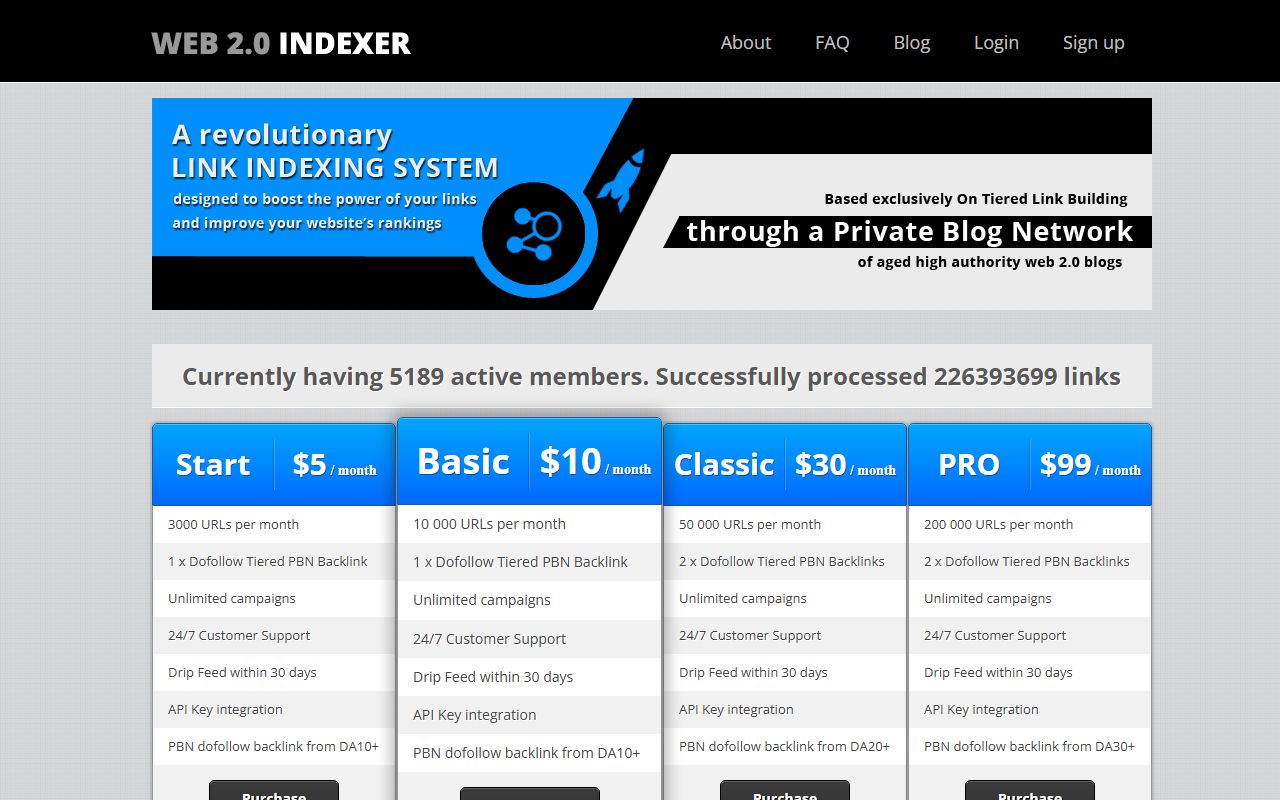
The first thing our index shows about web20indexer.com is how small it is: DR 14, 10 referring domains, 21 backlinks, first seen 2024-07-16 and last seen 2026-07-22. The homepage counter, meanwhile, talks about 226,393,699 processed links. Both can be true, because our web index is a sample of the web and a service that works through other people's blogs leaves most of its footprint on other people's domains, not its own.
The shape is more interesting than the size. gsa-online.de (donor DR 35) supplies 10 of the 21 links from 7 pages, and every one of them points at login-singup.php?ref=41, a sign-up URL with a referral ID. That fits a service that advertises GSA SER integration and a 10% recurring affiliate commission. The other nine referrers are small: sem-home.com (DR 4), newdirectory.org (DR 12), sbookscan.com (DR 14), yavatmal.top (DR 4) and five more. Only two anchors exist in the whole profile, "Web 2.0 Indexer" (12 links) and "web20indexer.com" (9). And all 21 links in our sample are nofollow, a reminder that a data lookup shows the slice of the web a crawl reached, not the whole web.
WEB 2.0 INDEXER at a glance
- What it is
- A subscription link-indexing service built on tiered links from a private blog network of web 2.0 blogs
- Plans
- Start $5, Basic $10, Classic $30, PRO $99, all per month, from 3,000 to 200,000 URLs
- Unit
- "One credit is equal to one URL"
- API
- Yes, POST-only submission API (
remaininglimit,expiredate,submit), plain-text replies; no per-URL status command documented - Payment
- PayPal only; monthly subscription; no refunds offered
- Free tier
- Not published
- Who runs it
- Not published ("a team of SEO geeks")
Four questions before you pick a branch
Most people who type "WEB 2.0 INDEXER alternative" into a search box fall into one of four situations, and the right answer is different in each. So instead of a feature table up front, here is the tree. Start at the trunk and follow your honest answer.
- Do you have URLs that nobody has crawled yet and you want them pushed? Go to Branch A.
- Do you need a number or a list, such as donor DR, referring domains or anchors? Go to Branch B.
- Do you report to clients or a boss on delivered links? Go to Branch C.
- Are you about to buy or have just bought placements? Go to Branch D.
You can sit on more than one branch, and many people do. The reason the tree exists at all is that WEB 2.0 INDEXER and apibacklinks do different work. The first takes a list of URLs and, in its own words, posts them "on a private blog network of authority blogs (DA 10-30)" so that crawlers pick them up. The second takes a domain and returns what our own crawl-derived index knows about its links. One acts on the web; the other only reads.
Branch A: you have a pile of links nobody has crawled
This is the job WEB 2.0 INDEXER was built for, so be straightforward with yourself: we do not do it. apibacklinks does not index pages, does not build links and does not submit URLs anywhere. If your GSA SER or RankerX run produced 40,000 profile and bookmark links and you want them nudged toward a crawler, you want a submission service.
The mechanics are easy to price. A credit is one URL, so a month on each plan costs:
| Plan | Price | URLs | Per 1,000 URLs |
|---|---|---|---|
| Start | $5 | 3,000 | $1.67 |
| Basic | $10 | 10,000 | $1.00 |
| Classic | $30 | 50,000 | $0.60 |
| PRO | $99 | 200,000 | $0.495 |
The per-1,000 column is our arithmetic from their published cards. Notice what it tells you: volume is where the price falls, and the sweet spot for a 40,000-URL batch is Classic. If you want a second opinion on the indexing job from within our network, IndexJump is our sister service for URL and backlink indexing. For the wider field, our backlink indexers hub lists the other services we compared.
What branch A does not give you is a verdict. Their FAQ says the first results appear after 48 hours and the final ones after 30 days, and it advises waiting at least 7 days before checking. Checking is the part you need data for. That is Branch B.
Branch B: you need a number, not a submission
Suppose you submitted 10,000 URLs last month and now someone asks, "did it work?" The indexer's documented API answers a narrower question: remaininglimit returns your remaining credits, expiredate returns the membership expiry, and submit sends links. No documented command returns per-URL status. The documented API stops at submission and account checks.
apibacklinks answers questions about link graphs. For a target domain you can call domain (DR, backlinks, referring domains, dofollow counts, first and last seen) free and with no key, refdomains for the top referring domains, and backlinks for individual source URLs with anchor, rel and last-seen date. If a donor page shows up in our backlinks output with a recent last-seen date, a crawler has fetched that page and seen the link. That is independent evidence that a crawler saw the link, though weaker than a full Google check, because our index is a broad sample refreshed roughly monthly, not in real time.
Your own submitted URLs are the donors, so the target-side lookup is only half of it. Put the pages you submitted through search or filter backlinks by source domain and see which ones the crawl has met. A link that never appears for several refreshes is a reasonable candidate for resubmission or replacement. Our API docs list the 19 actions and their parameters.
Branch C: you report to clients
If you hand clients a report, ask what the report must say. "We submitted 12,000 URLs this month" is a statement about effort, and the indexer's dashboard ("Check submission status / Manage your campaigns") fits it. "Your site now has links from these domains with this anchor mix" is a statement about outcome, and that is link data.
Here is an honest limit for this branch. apibacklinks has no dashboards to share, no scheduled emails, no new-and-lost-links report and no alerts. What you get is JSON. If your reporting is a spreadsheet or an internal page, that is plenty: one compare call puts up to 20 domains side by side, and bulk_dr checks up to 2,000 domains in a single request. If your reporting needs a branded PDF a client can open on a phone, buy a tool that has one and treat our API as a data source behind it.
A practical split many agencies would recognise: the indexing service handles volume, the API handles the monthly sanity check on the handful of targets that matter. Because lookups cost 1 credit ($0.0001) and list calls cost 2, a month of checking even a few hundred targets costs cents.
Branch D: you are buying placements and want to know if they count
Here the indexer sits downstream. You buy a link, then you want it noticed. Before and after, you need to look at the donor, and that is exactly what our data is for. Before buying: pull the donor domain's DR and referring-domain count with domain, and check its top anchors. After buying: look the target up with backlinks, filtered by that source domain, and see whether your link is visible in the crawl data and with what rel.
The web20indexer.com profile is a tidy example of reading a donor list. Look at its referrers: a DR 35 .de site carrying ten links from seven pages, then nine tiny domains with DR between 0 and 14. Judging those nine as placements, you would see in two calls that none has a DR above 14 in our graph and that the profile holds only two anchors. You can browse the same report yourself on our explorer without a key.
One practical note on terms. WEB 2.0 INDEXER's terms say the company "reserves the right to insert up to two links into all content served by our products and services." That is part of how a network-based service operates, and it is worth a read if the pages you submit are client money pages. It is a point to weigh, not a verdict.
Where WEB 2.0 INDEXER is the better choice
Plain list, no hedging, because a decision tree that always ends at our door would be a bad tree.
- It does the job. It submits URLs and apibacklinks cannot. If the task is "push these 50,000 URLs," the right tool is a submission service.
- Cheap at volume. At $0.495 per 1,000 URLs on PRO and $5 as a starting point, trying it costs less than most lunches.
- It plugs into your stack. It names GSA SER and RankerX and also mentions Senuke, with an API key flow. We have no such integration.
- Drip feed. Scheduling up to 30 days ahead, with 7 days as the default, is built in. We have no scheduling because we have nothing to schedule.
- It has a dashboard and an affiliate programme (10% recurring commission on membership plans). We have neither.
- It works on your schedule. Our index refreshes roughly monthly and a new link can take weeks to appear; a submission service acts when you submit.
So if you are on Branch A and nothing else, stay. Do not replace it with a data API; you would be swapping a hammer for a ruler. The service does not publish a free tier, a company name or an independent test, and its own case study is self-run, so measure your own indexing rate on a small batch first and decide from that.
A worked month: submit, wait, measure
Here is a hypothetical month, not a customer story. Imagine a solo SEO with 8,000 tier-two links and a $10 Basic plan (10,000 URLs).
- Day 1. Submit the 8,000 URLs with a 14-day drip feed. Credits left: 2,000.
- Day 8. The indexer's FAQ says to wait at least seven days. Check the
domainaction for each campaign target (free) to note referring-domain counts as a baseline. - Day 20 and beyond. Call
backlinkswith a source-domain filter for the pages you submitted. Count how many appear and with what anchor. - Next refresh. Our index moves roughly monthly, so run the same call again after the next our web index release is processed. The difference is your evidence.
Total apibacklinks spend for a few dozen targets: well under a dollar, and likely nothing if you stay on the free actions and the $100 starter credit. The point is not the money. It is that you now hold a number from outside the service you paid.
What our data will not tell you
A mentor owes you the limits too. Our DR is our own metric, computed from referring-domain counts in our graph. It is comparable in spirit to the scores other tools show, but it is not Ahrefs DR and not Moz DA, so do not compare web20indexer.com's DR 14 with numbers from those tools. We have no rank tracking, no traffic estimates, no site audit and no toxicity score, and no new-or-lost report.
Above all, we cannot tell you whether Google indexed a page. We see what our web index fetched, and that is a broad but incomplete sample. A page missing from our data is not proof of anything. A page present is only proof that a crawler found it. Treat the output as one input into a decision, next to Search Console and your own checks.
The mature setup is boring: a submission service for volume, a data API for the second opinion. That is the tree's final leaf.
apibacklinks vs WEB 2.0 INDEXER
| apibacklinks | WEB 2.0 INDEXER | |
|---|---|---|
| Main job | Read-only backlink and DR data | Submits URLs for indexing via a private blog network |
| Unit and price | 1 credit = $0.0001; from $0.10 per 1,000 calls | 1 credit = 1 URL; $5 to $99 per month |
| Free start | $100 free credit on first Google sign-in, no card | Not published |
| Cost per 1,000 units | $0.10 lookups, $0.20 list calls (a list call can return up to 1,000 rows) | $1.67 on Start down to $0.495 on PRO (per 1,000 URLs) |
| Billing | Pay per call, no subscription | Monthly subscription, PayPal only, no refunds offered |
| API | 19 actions, GET, JSON, key via query or Bearer header | POST only, plain-text replies, commands remaininglimit, expiredate, submit |
| Per-URL status | Backlink last-seen dates from the crawl | No status command documented |
| GSA SER / RankerX | No integration | API key integration named on the homepage |
| Data freshness | Roughly monthly refresh, not real-time | First results after 48 hours, final after 30 days (their claim) |
| Company details | Independent service; no affiliation with brands compared | Owner, country and founding year not published |
Try it on web20indexer.com
Check which donor domains our index shows linking to the indexer's own domain, then see the individual links.
curl "https://apibacklinks.com/api.php?action=backlinks&q=web20indexer.com&key=YOUR_KEY"
WEB 2.0 INDEXER alternative — FAQ
Is apibacklinks a drop-in replacement for WEB 2.0 INDEXER?
Does WEB 2.0 INDEXER have an API?
How much does WEB 2.0 INDEXER cost?
Can apibacklinks tell me if my submitted URLs got indexed?
Why does web20indexer.com have so few links in your index?
What does apibacklinks cost?
Backlink data for the price of a rounding error
Sign up, keep your $100 of credit, call the API today.
Get started free