

An Omega Indexer alternative, written as a postmortem
Omega Indexer promises "Get indexed. Or get refunded." We wrote a blameless postmortem of a made-up campaign to show which part of that job an indexer covers and which part needs link data.
We read omegaindexer.com from our own index of 181,132,097 domains. It shows 87 referring domains, 475 backlinks (70.5% dofollow) and a Domain Rating of 27 on our scale, first seen 2024-07-12. That DR is ours, not Ahrefs DR or Moz DA; another snapshot elsewhere showed 24 for the same domain.
The shape is lopsided. websitedesign.digital alone carries 87 links, all dofollow, all with the anchor "Omega indexer", spread over 31 mostly tag-archive pages. That is 18.3% of the profile from one DR 18 site. Behind it come wordpress.org (30 links, all nofollow, DR 88, last seen August 2025), trysight.ai (24 links) and seoneo.io (20 links). Thirteen of the top 25 linked URLs are affiliate redirects under /amember/aff/go/, which is what a 180-day-cookie affiliate programme looks like in a link graph. About 62% of anchors are some spelling of the brand name.
Omega Indexer at a glance
- What it is
- A paid web service that submits backlinks or pages to Google for indexing, sold as monthly credit packages.
- Run by
- Stealth Code Ltd (legal name in the site's structured data).
- Headline promise
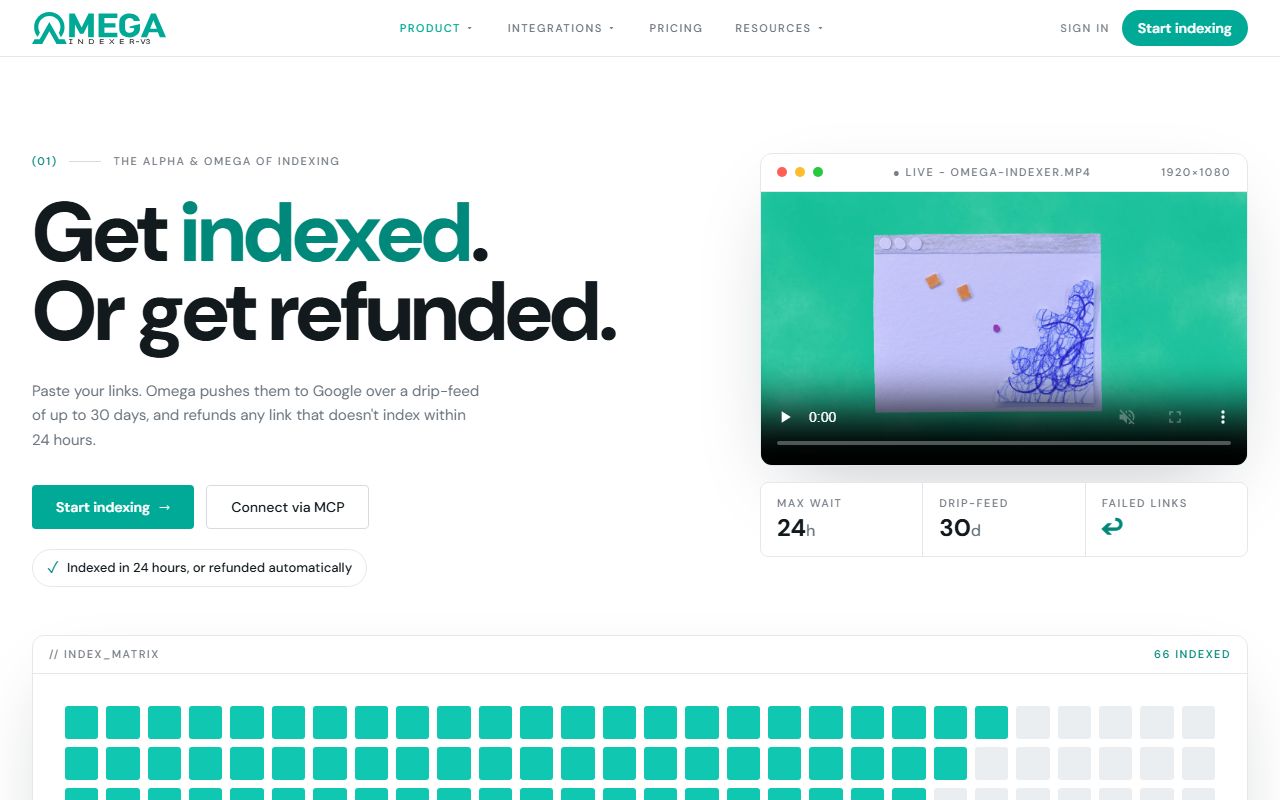
- "Indexed in 24 hours, or refunded automatically", with drip-feed of up to 30 days.
- Price
- From $19/mo for 190 credits (1 credit = 1 link) up to $2000/mo for 50,000; top-up $0.20 per credit.
- Free tier
- None mentioned on the site.
- API
- One documented call to create a campaign; hosted MCP server for status and credits.
- Published success rate
- Not published. Third-party tests exist and differ widely.
Incident summary: 400 links, one confusing report
This is a blameless postmortem of a hypothetical campaign. No real client, agency or person is described. We invented it because the usual question, "did the indexer work?", hides two separate questions, and an incident report is a good way to pull them apart.
The story: a small team buys a block of 400 guest-post and directory links for a client site. The team opens Omega Indexer, pastes the 400 URLs, picks a 14-day drip-feed and submits. A week later the client asks why a handful of the placements still do not appear in Google. The team assumes the indexer failed, opens a ticket and loses two days. The real cause was that 38 of the 400 pages no longer contained the link at all. The indexer was never going to fix that.
Severity: low. No money was lost beyond the team's time. We still write it up, because the same gap shows up in many campaigns, and the fix costs almost nothing.
Timeline of the hypothetical campaign
Times are relative to submission, so you can map them to your own runs.
- Day 0. 400 URLs pasted into the dashboard. Omega's campaign statuses begin: In Queue (filtering), then Indexable, Non-Indexable, Indexed or Not Indexed.
- Day 0, same hour. Non-indexable links are removed and refunded. Say 22 of the 400 fall out here. That is the filter doing its job: dead pages never cost a credit.
- Days 1 to 14. The remaining 378 enter the drip-feed. Omega says links not indexed within 24 hours are refunded automatically; how that window interacts with a 14-day drip is not spelled out on the site.
- Day 15. The report shows most links indexed and some refunded. The team reads "refunded" as "the indexer gave up".
- Day 16. The client points at three placements missing from the SERP. The team files a ticket.
- Day 18. Someone finally fetches the pages. In 38 of them the link has been removed or replaced. Root cause found.
Notice what the timeline shows: for eighteen days everybody looked at the submission side. Nobody looked at the link side.
Root cause: two questions, one dashboard
An indexer answers "does Google know this URL exists?" A link database answers "which pages link to my target, with what anchor, and are they still there?" The first is Omega Indexer's job. The second is not, and Omega does not claim it is.
The team treated one green or red status as the answer to both. A URL can be indexed while the link on it is gone. A link can be live while the page sits unindexed. The statuses Omega describes (In Queue, Indexable, Indexed, Not Indexed and so on) are per submitted URL, so they cannot tell you which of the two situations you are in.
Our own index has the same blind spot in the other direction. apibacklinks cannot tell you whether Google has indexed a page, and its data is built from our own web data, which is a broad sample of the public web, refreshed roughly monthly. It will not confirm a 24-hour result. What it can do is show that a given source domain links to your target, with which anchor and when it was last seen. That is the missing half of the picture.
"Omega filters dead links before they cost you, indexes the rest within 24 hours, and refunds anything that doesn't land."
That sentence is about URLs. It is a fair promise for the job it describes. The incident came from reading it as a promise about links.
Where Omega Indexer is the better choice
If your problem is "I have URLs and Google has not seen them", Omega Indexer is the right tool and apibacklinks is not one. We do not submit, ping or index anything.
- Refunds tied to results. Non-indexable links are refunded immediately and unindexed ones after 24 hours. The refund comes back as credits, not as money to a card, but it still means you are not paying for dead submissions. A 2025 third-party study of the previous version listed Omega among tools that did not offer refunds, so the V3 refund policy is a real change.
- Drip-feed up to 30 days. You can spread a large batch over a month. We have no equivalent, because we do not submit anything.
- Credits do not expire, per the pricing page, and you can cancel any time.
- A hosted MCP server. You can create campaigns and read status from Claude, Cursor or Codex in plain language. Setup is a browser sign-in, with no token to paste.
- Per-URL status. The dashboard shows what happened to each link. Our API has no such view.
On results, be careful with numbers. Omega publishes no success rate. One reviewer's July 2026 test cohort reported 85.3% and ranked it fourth of ten; older tests of the previous version reported roughly 25% to 27%. Those are different versions and different methods, so treat each as one data point, not a promise.
Who should stay: anyone whose bottleneck is getting URLs crawled, who wants pay-for-results billing, and who is happy with a dashboard or MCP as the control surface. If that is you, you do not need an alternative. You may still want a second tool next to it.
What we changed in the pipeline
The fix was small: add a link check before the indexing step and a second one afterwards. Nothing was removed.
- Before submitting, look up each source domain's footprint with
bulk_dr(up to 2,000 domains per request) andrefdomainson the target. Domains that are already known to link are marked as verified, so you spend credits only where you need a push. - After the drip-feed, pull
backlinksfiltered by source domain and read the "last seen" dates. Our data is roughly monthly, so this is an audit, not a live monitor. A link that disappears from the crawl across two refreshes is a candidate for a manual check. - Keep the indexer. Omega Indexer stays as the submission step. For a team that wants a second indexing option from the same network as us, IndexJump is our sister service for URL and backlink indexing. We mention it once because it covers the job we do not.
All of this runs from one GET endpoint. You can also try any domain by hand in the free explorer, no sign-in needed, to see the kind of report the API returns.
What the crawl sees around omegaindexer.com
As a worked example, we ran the audit on Omega Indexer's own domain. Treat it as a demonstration of the method, not a verdict on the company.
| Referring domain | Links | Dofollow | Our DR | What it suggests |
|---|---|---|---|---|
| websitedesign.digital | 87 | 87 | 18 | Looks like a template link repeated across tag archive pages |
| wordpress.org | 30 | 0 | 88 | wordpress.org pages (we did not open them); all nofollow, last seen 2025-08-11 |
| trysight.ai | 24 | 24 | 37 | A blog page on indexing-tool pricing that links to it |
| seoneo.io | 20 | 20 | 18 | Documentation that recommends it as an indexer |
Three more details from the same profile stand out. First, 12 links with the anchor "Omega Indexer TOS" point at /termsofservices/, a URL that now returns 404 while the live page is /terms-of-service. Old links to renamed URLs are common after a redesign. Second, some anchors are calls to action, such as "TRY IT NOW" and "Get Deal", which fits the 180-day-cookie affiliate programme the site advertises. Third, 82% of the 87 referring domains sit below DR 30, with two in the 70 to 100 band.
None of this says the service is weak. A tool that is mostly discussed by indexing reviewers, SEO tool docs and affiliates will look like this. The point is that you can see all of it in a few calls, and you can run the same read on the pages you are about to submit.
The arithmetic of adding the check
Cost mattered, so here are the numbers for the hypothetical 400-link job. Omega's published list prices: the Starter plan is $19 per month for 190 credits, which is $0.10 per credit, and a larger plan such as Pro is $130 for 2,000 credits, $0.065 per credit. One credit is one link. At the Starter rate, 400 links is roughly $40 of credit before any refunds. We did not model refunds, because the refund rate is the one number nobody publishes.
On our side, one domain lookup costs 1 credit, which is $0.0001. A list call such as backlinks costs 2 credits. Checking all 400 source domains once with lookups is $0.04. Pulling the backlinks list for the target ten times is $0.002. New users get $100 of free credit on first sign-in with Google, and there is no card and no subscription.
So the audit costs about a tenth of one percent of the campaign. That is the whole argument: it is cheap enough to run every time, and it would have shortened the incident from eighteen days to one afternoon.
Lessons and follow-up actions
- Name the question. Before a ticket, write whether you are asking "is the URL indexed?" or "is the link still there?". They have different owners and different tools.
- Check the link before you pay to index it. A fetch or a link lookup first saves credits on pages that will be refunded anyway.
- Read refunds as data. A refunded link is information about the page, not a failure of the service. Collect them and look for what they have in common, such as TLD, donor DR or page type.
- Respect the limits of each tool. Omega does not publish an indexing method, a rate limit, a max URLs per call or a status endpoint in its public API. Ours does not show indexing, alerts, new or lost links, or historical charts. Plan around both lists.
- Compare more than one indexer. The backlink indexers hub lines up the field, and pages such as Indexing Expert cover a different service in the same category.
Action items for the hypothetical team: add the pre-check, add the post-drip audit, keep Omega Indexer for submission. That is the whole remediation, and nobody needs to switch vendors.
apibacklinks vs Omega Indexer
| apibacklinks | Omega Indexer | |
|---|---|---|
| Main job | Backlink and Domain Rating data over a JSON API | Submits URLs to Google for indexing |
| Price unit | 1 credit = $0.0001; lookups cost 1, list calls 2 | 1 credit = 1 link; $0.04 to $0.10 per credit on monthly packages, $0.20 top-up |
| Billing model | Pay per call, no subscription | Monthly subscription, cancel anytime; credits never expire |
| Free start | $100 free credit on first Google sign-in, no card | None mentioned on the site |
| Refunds | Not applicable | Credits returned for non-indexable and unindexed links |
| Public API | 19 actions on one GET endpoint, free actions need no key | One documented call (create campaign); status via MCP or dashboard |
| Freshness | Roughly monthly refresh, not real-time | 24-hour indexing window, drip-feed up to 30 days |
| Limits | 1,000 rows per call, 50,000 deep pagination cap | Not published |
| Success rate | Not applicable; we do not index pages | Not published by the company |
Try it on omegaindexer.com
Pull the top referring domains of the target, then compare each against your submission list.
curl "https://apibacklinks.com/api.php?action=refdomains&q=omegaindexer.com&key=YOUR_KEY"
Omega Indexer alternative — FAQ
Is apibacklinks a replacement for Omega Indexer?
Can apibacklinks tell me whether a page is indexed in Google?
How much does Omega Indexer cost?
Does Omega Indexer publish an indexing success rate?
What does one check cost on apibacklinks?
Is your Domain Rating the same as Ahrefs DR?
Backlink data for the price of a rounding error
Sign up, keep your $100 of credit, call the API today.
Get started free