

Link Processor alternative: taking the three circles apart
Link Processor sells link crawling, indexing and pushing in three “circles”. We opened the casing, read the price list, and counted its own backlinks: 192, and 38% of them come from its own login domain.
The homepage headline talks about pushing “more power to your backlinks”, so we looked at the backlinks of linkprocessor.com itself. In our index linkprocessor.com has 192 backlinks from 45 referring domains, a DR of 23 (our metric, not Ahrefs DR), and 135 of the 192 links are dofollow (70.3%). The first link we saw dates from 2024-07-14, which marks the start of our index window for this domain, not the age of the site.
The largest single source is its own second domain. linkprocessor.net, the login and app host, supplies 73 links across 11 pages, all dofollow. That is why the footer words “Privacy Policy”, “Contact Us”, “Terms”, “Affiliates” and “FAQ” each appear exactly 11 times in the anchor list. Take those out and about 119 links from 44 outside domains remain. Several of those come from SEO tool round-ups: gsa-online.de (DR 35), social-hire.com (DR 35), seo-hacker.com (DR 41), marketingtools.net, and anchors such as “SEO backlink sites like Linkprocessor” and “Link building sites”. Only one referring domain sits above DR 50. A few anchors stand out: bruceclay.com links with a person’s name as anchor (6 times, nofollow), a coupon site offers “15% Off At Link Processor”, and “ahrefs free backlink checkers” points at a service that does not check backlinks. Open the full report in the explorer to scroll the lot.
Link Processor at a glance
- What it is
- A paid, automated link indexing, crawling and “link pushing” service (self-description: “a fully automated online link indexing service”)
- Who it is for
- Webmasters, SEO agencies and resellers; the FAQ names Fiverr and webmaster-forum resellers
- Pricing model
- Monthly subscriptions by links per day; the plans listed on 2026-10-09 ran $9.95, $19.95 and $34.95 per month plus a 6-month plan at $94.95, shown against higher “was” prices
- Free tier
- None shown on the homepage; a 30-day money-back guarantee is advertised
- API
- “API and RPC Ping Integration” is claimed on every plan; endpoints and docs are not published on the public pages
- Based in
- San Diego, California (address in the page footer)
- Founded
- Not published; footers carry copyright years 2014, 2018 and 2026
Layer one: the promise on the homepage
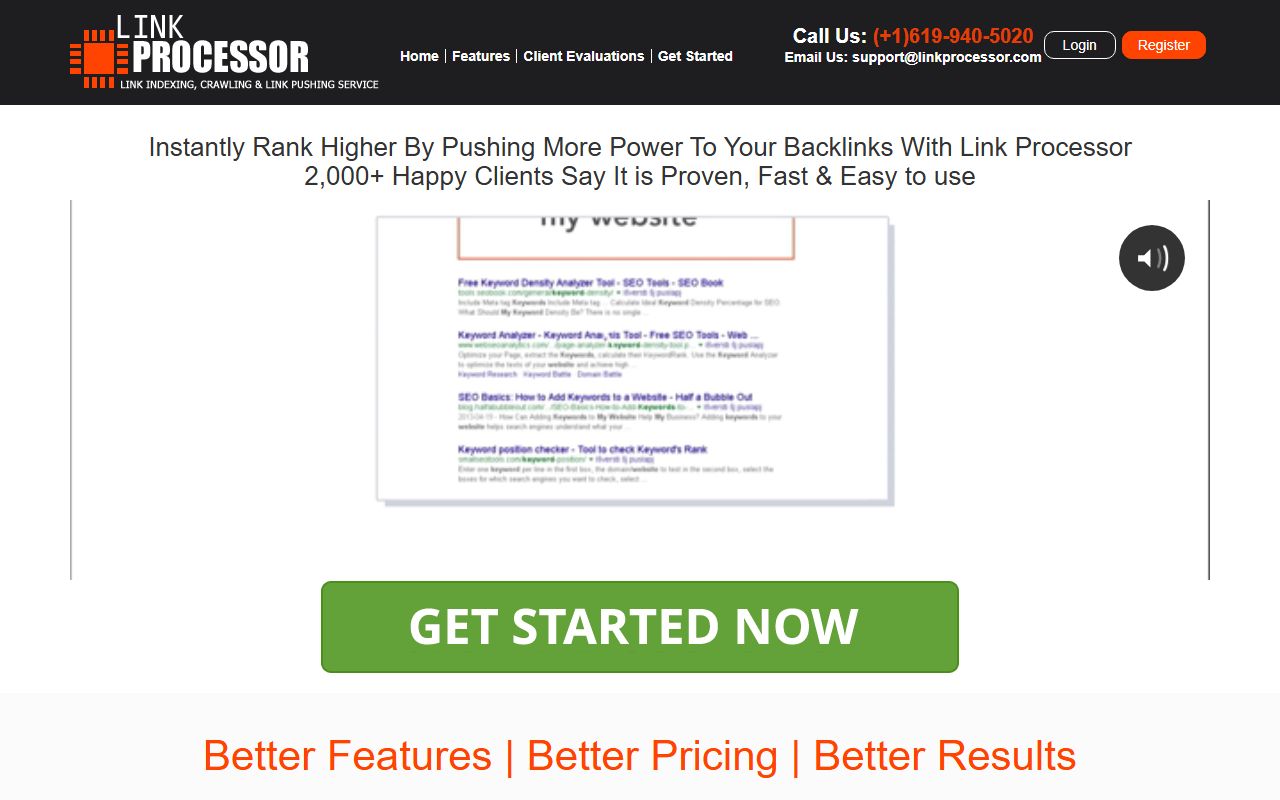
The screenshot is the front panel. A dark header with an orange chip-shaped logo, a phone number and an email address in the corner, Login and Register buttons, then two lines of headline: “Instantly Rank Higher By Pushing More Power To Your Backlinks With Link Processor” and “2,000+ Happy Clients Say It is Proven, Fast & Easy to use”. Under that, an embedded video, one very large green “GET STARTED NOW” button, and the orange strapline “Better Features | Better Pricing | Better Results”. Some inner pages still carry a 2014 copyright line in the footer, while the homepage says 2026.
Read the headline as an engineer and it makes one claim: links go in, something happens to them, and they end up more powerful. “Rank Higher” is an outcome. “Pushing” is the mechanism. The outcome is not something any outside tool can promise, and to its credit the company’s own FAQ says the same: nobody can guarantee indexing, because only search engines control it. What it does guarantee, in its words, is crawling and pushing. That is a sensible thing to promise, since those are actions it takes, not decisions someone else makes.
The rest of the page lists public reports for resellers, servers running 24/7 and copy-and-paste submission. We move on to the parts that can be measured.
Layer two: three circles and a pushing multiplier
The mechanism is described in one sentence: “Each and every link is processed through 3 circles of crawling, indexing and link pushing.” The page adds that pushing “sends each of your links to authority link filters.” That is the whole public explanation. What a circle is, what a filter is, and which search engines are targeted are not published, and we will not guess.
The one concrete knob is the pushing multiplier on each plan: “30 x link pushing to Each Link”, “300 x” and “500 x”. It reads as repetition per link, but the site does not define it, so treat it as a plan label, not a measurement.
Two other features are easy to understand. A campaign can be scheduled as a drip feed for up to 30 days, which suits campaigns where you want submissions spread out. And “Public Reports” give resellers a page to show a client that links were submitted. Note the verb: submitted. A report of what was sent is not a report of what was found.
That distinction is the whole reason a crawl-side data source exists. A submission tool tells you what it did. It cannot tell you what the crawl recorded afterwards.
Layer three: the price list, read slowly
Prices are USD subscriptions, listed on the homepage on 2026-10-09 next to a banner offering a discount for the month. We take the banner as perishable and the list below as a dated snapshot, not a standing price.
| Plan | Shown price | Links per day | Links per month | Pushing |
|---|---|---|---|---|
| Small | $9.95 / month (was $19.90) | 5,000 | 150,000 | 30 x |
| Medium | $19.95 / month (was $39.90) | 150,000 | 4.5 million | 300 x |
| Large (“Popular”) | $34.95 / month (was $69.90) | 300,000 | 9 million | 500 x |
| Medium, 6 months | $94.95 (was $139.80) | 150,000 | 4.5 million | 300 x |
Three observations, all arithmetic. First, the daily quota jumps 30x between the first and second plan while the shown price roughly doubles. Second, if you filled the Medium quota every day you would pay about $0.0044 per 1,000 links, and about $0.066 per 1,000 on the small plan. Those are capacity prices: they assume the quota is used in full, which depends on how many links you actually have to submit. Third, the 6-month plan works out to roughly $15.83 a month, about 32% below the “was” price, which is a smaller cut than the 50% shown on the monthly plans.
All plans list unlimited campaigns and “Unlimited API & RPC requests”. There is no free tier on the page, but there is a 30-day money-back line, which the terms narrow to cases where support cannot fix a problem. Both wordings are public; read the terms before relying on the homepage’s version.
Layer four: what the casing does not say
A teardown also lists the parts that are not there. From the public pages we could not find:
- an indexing success rate, which fits the FAQ’s refusal to promise one;
- a definition of “link pushing” or “authority link filters”;
- the founding year or the legal entity, although a San Diego address and a founder biography are published;
- any independent review. Our web search for the brand name with “review”, “pricing” and “vs” returned nothing about it;
- proof that “2,000+ happy clients” is current. The same figure appears on an About page whose footer says 2018.
None of this is a verdict. Plenty of working tools publish less. It does mean that the numbers you can verify are the ones you generate yourself, by submitting a batch and looking at what happens next. That is the part we can help with.
The API layer: a door that opens inward
The site advertises “API and RPC Ping Integration” so that “any SEO tool” can send links automatically. That is a submission API: links go in. The public pages do not show an endpoint, an auth scheme, a response format or a documentation URL, and the service’s app lives on a separate domain behind a login. Documentation may well be there; we did not sign in and will not claim what we did not see.
Our API points the other way. It returns data about a target instead of accepting URLs for processing. Its 19 actions sit on one endpoint, and two of them, domain and overview, are free and need no key. The paid ones, such as backlinks, refdomains, anchors and bulk_dr, cost from $0.0001 per lookup; list calls cost 2 credits and can return up to 1,000 rows. Full details are in the API docs. A reasonable pipeline uses both: submit through the indexer’s API, then query ours.
Where Link Processor is the better choice
If the job is “get these 40,000 links crawled this week”, apibacklinks is the wrong tool, full stop. We do not build links, sell links or index pages. We hold a graph built from our own web data, refreshed roughly monthly, not in real time. Link Processor is built for the other task: take a list, run it through a pipeline, send pings, report that it was done. Specifically:
- It acts. It submits, schedules and pushes. We only read.
- Drip feed. Spreading a campaign over up to 30 days is a built-in setting. We have no scheduler at all.
- Reseller reporting. Public link reports exist for showing a client what was submitted. We offer no shareable dashboards or reports.
- Automation hooks. If your SEO tool already speaks RPC ping, the integration is the point of the product.
- A fixed monthly bill. A flat subscription is easier to budget than metered calls if your volume is steady and high.
Stay with it if indexing and pushing is what you are buying and you already have a way to check results. The two services do different jobs and are not substitutes for each other.
Checking what the crawl actually saw
After a batch goes through any indexer, three questions remain: did the link exist in a crawl, who is it from, and with which anchor? Those are data questions. A hypothetical worked example: you push 2,000 links pointing at one client page. Query backlinks for that page filtered by source domain, then anchors for the anchor mix, then refdomains for the donor DR spread. If your links show up in a later crawl release, you can see them with their first-seen date. If they do not, you know the crawl did not record them, which is useful whether the cause is the index lag on our side or the links not being found.
Use the same view on the indexer itself. Its own profile shows what outsiders say about it: about 38% of links from its own app domain, a handful of SEO round-ups, and anchors that mix brand names with unrelated phrases. The free overview action gives the summary, and one refdomains call (2 credits) lists the top referrers.
Two caveats about us: coverage is smaller and less fresh than the proprietary crawlers of the large vendors, and a link added last week can take weeks to appear. If you need the indexing step itself, our sister service IndexJump handles URL and backlink indexing. For other tools in the same job, see the backlink indexers hub.
apibacklinks vs Link Processor
| apibacklinks | Link Processor | |
|---|---|---|
| Main job | Backlink and Domain Rating data via JSON API | Link crawling, indexing and pushing for links you submit |
| Does it index pages? | No; we provide data only | Yes, as a service (indexing not guaranteed, per its FAQ) |
| Pricing model | Per call: from $0.10 per 1,000 calls, $0.20 per 1,000 list calls | Monthly subscription by daily link quota; plans shown at $9.95, $19.95 and $34.95 per month on 2026-10-09 |
| Free tier | $100 starter credit on first Google sign-in; no card; free domain and overview actions | None shown; 30-day money-back guarantee advertised |
| API | 19 actions on one endpoint, public docs, CORS enabled | “API and RPC Ping Integration” claimed; public documentation not published |
| API direction | Reads data out | Sends links in |
| Scheduling | None | Drip feed up to 30 days per campaign |
| Reports for clients | No shareable dashboards or reports | Public link reports for submissions |
| Backlink data | Index of 181,132,097 domains and about 798.6 billion page-level backlinks, refreshed roughly monthly | Not published |
| Indexing success rate | Not applicable | Not published |
Try it on linkprocessor.com
To check what our index data holds for the indexer’s own domain, list its top referring domains with this call.
curl "https://apibacklinks.com/api.php?action=refdomains&q=linkprocessor.com&key=YOUR_KEY"
Link Processor alternative — FAQ
Is apibacklinks a replacement for Link Processor?
Does Link Processor guarantee indexing?
How much does Link Processor cost?
Does Link Processor have a public API?
Can I see how many backlinks Link Processor has?
How do I check whether my pushed links were recorded in a crawl?
Backlink data for the price of a rounding error
Sign up, keep your $100 of credit, call the API today.
Get started free