

A Binstantindexer alternative, or a partner? A 90-day roadmap
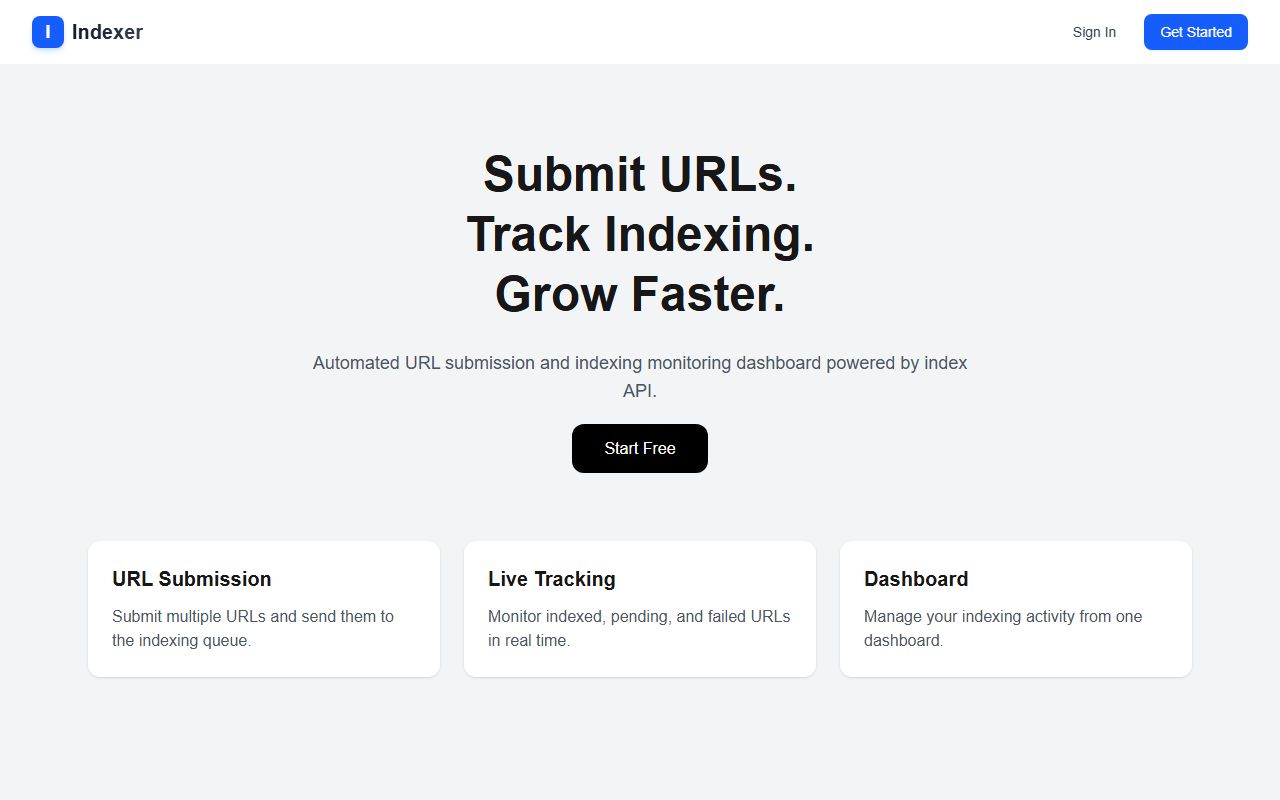
Binstantindexer's public site is one landing page with three feature cards. This plan shows how to pair an indexing queue with crawl-level link data over 30, 60 and 90 days, and what to decide on day 91.
We looked up binstantindexer.com in our own graph first. It returned found: false: no Domain Rating above zero, no referring domains, no backlinks, no first-seen date, and empty anchor and TLD tables. Our index covers 181,132,097 domains and 2,774,625,913 domain-to-domain links from 13 crawl releases running through mid-2026, and freeserp Main first saw this site on 2026-08-05. The likeliest reading is a timing gap: the site appeared about as the data ended. Two separate datasets agree on the zero, since freeserp lists its DR as 0 as well.
That blank is the most useful thing on this page. It is what a brand-new site looks like to a crawl-based index, and it is the state any freshly submitted URL is in on day one. The plan below turns that blank into a measurement you can repeat.
Binstantindexer at a glance
- What it is
- A web dashboard for submitting URLs to an indexing queue and tracking their status
- Official wording
- “Automated URL submission and indexing monitoring dashboard powered by index API.”
- Entry point
- A “Start Free” button and a registration form (name, email, password); what free includes is not published
- Pricing
- Not published; the /pricing path returned 404 at check time
- Public API
- None found; /api and /docs returned 404
- Operator
- Not stated anywhere on the site
- First observed
- 2026-08-05, according to freeserp Main (a crawl observation, not a founding date)
A site that is three URLs wide
Open the homepage and you can read all of it in under a minute. A blue square with a white “I”, the word Indexer, a Sign In link and a Get Started button. Then three lines of headline, in order: Submit URLs. Track Indexing. Grow Faster. Under it sits one sentence about an “index API”, a black Start Free button and three white cards.
The links on that page lead to exactly three places: the page itself, a login form and a registration form. There is no pricing page, no documentation, no terms and no about page; those paths returned 404 when we checked on 2026-10-09. There is no robots.txt or sitemap either. The only technical detail visible is in the HTTP headers: the site runs on Next.js, served from Vercel. Who operates it is not stated.
None of this says the product is bad. A young tool can be a perfectly good queue with the marketing still to come; our first sighting of the site, on 2026-08-05, is a crawl observation, not a launch date. It does mean that anyone evaluating it has to do the evaluating themselves, which is where a plan helps. This roadmap assumes you want an indexing queue, you want proof that your links are visible, and you would rather find out in 90 days than guess in week one.
Two tools, two verbs
The verbs are different, and the whole plan depends on keeping them apart. Binstantindexer's cards say submit, monitor and manage: you hand it URLs, it keeps a list, and the list shows indexed, pending and failed states. That is an operational job.
apibacklinks does the other half. We do not submit anything and we do not index pages. We report which pages on which domains link to your target, with what anchor, whether the link is followed, and when our index data last saw it. It is a JSON API at api.php?action=<action>&q=<domain>, with an in-browser explorer that needs no sign-in.
So a fair way to put it is that apibacklinks is not a replacement for a submission dashboard, and it is not trying to be one. It is the place you go afterwards to ask a different question: not “did the queue accept my URL?”, but “does the wider crawl know this link exists?”. If you only need the first answer, this page is not for you. For a wider map of tools in that first category, see our backlink indexers hub.
Days 1–30: build a baseline you can trust
To make this concrete, imagine a hypothetical freelancer, Maren, who has 60 new placements and wants them noticed. Maren is invented for this plan, but her month is realistic.
- Day 1, pick the test set. Take 60 URLs that carry links and, if you can, 20 more that are untouched controls. Write down their target domains.
- Day 2, snapshot the crawl view. Run a
domainlookup on every target. It is free and needs no key. Save DR, referring domains and backlinks. This is your “before”. - Day 3, open the queue account. Register with Binstantindexer through the Start Free button and submit the 60 URLs. Do not assume what free includes. Note the batch limit, the credit cost, if any, and every status label you see on screen, because none of that is published.
- Days 4–30, watch, don’t tinker. Record how many URLs move from pending to indexed or failed, and when. Do not resubmit anything yet.
The day-2 snapshot costs nothing: the domain and overview actions are free. If you want it in one shot, bulk_dr takes up to 2,000 domains in a request. A paid lookup is 1 credit, and a credit is $0.0001, so even a thousand-domain snapshot is pocket change against the $100 starter credit that comes with Google sign-in.
What you should not expect at day 30 is a flip in our data. Our index refreshes as crawl releases are processed, roughly monthly, so a brand-new link can take weeks to appear. A flat line here is normal, and that is exactly why the plan is shaped this way.
Days 31–60: ask the crawl what it saw
By now the queue has a story to tell: some URLs show as indexed, some pending, some failed. The question for month two is whether that story and the crawl evidence line up.
Run the same targets again. This time use the list endpoints, which cost 2 credits and return up to 1,000 rows each:
backlinkswith a source-domain filter, to see whether a specific placement now appears with its anchor and last-seen date;refdomainsto see whether the number of referring domains moved, and the donor DR of the new ones;anchorsto check the anchor you intended is the anchor the crawl recorded.
Then sort your 60 URLs into four boxes: indexed in the queue and visible in the crawl, indexed in the queue and not yet visible, still pending but visible, and neither. The second box is the interesting one. It is not a failure. our index samples the public web; it does not cover it, so a link can exist and be live and still be absent from our data. Treat it as “not confirmed”, not as “missing”.
The 20 control URLs earn their place here. If the controls show the same movement as the submitted ones, your submissions did not cause the change, and you should know that before paying for anything.
Days 61–90: turn the pilot into a routine
If a further our web index release has been processed by now, you have up to three points on each target: before, month one, month two. That is enough to say something. It is not enough to promise anything, and the plan does not try to.
Use the last month for three decisions.
- Cadence. Decide how often each tool runs. Queue status is something you can look at as often as the dashboard allows. A monthly crawl check is matched to our refresh rate; checking daily would only spend credits on identical answers.
- Automation. Binstantindexer shows no public API, so its submissions stay manual, or whatever the logged-in dashboard allows. Ours can be scripted. A short job that runs
bulk_drandrefdomainsacross your targets once a month and writes the results to a spreadsheet is about twenty lines (see the call below). - Gaps. Write down what neither tool covers. We have no new-or-lost-links report, alerts or dashboards for clients. If you need those, you will use a different product alongside, and day 61 is the time to learn that rather than day 300.
If URL submission is the whole job and you would rather have a dedicated service for it, our sister service IndexJump exists for exactly that purpose. It is a different product, so evaluate it on its own terms.
Where Binstantindexer is the better choice
Be straight about this: for the thing it says it does, Binstantindexer is the better choice, because apibacklinks does not do that thing at all.
- You need to submit URLs. We have no submission, no queue and no indexing of any kind. A dashboard that accepts a list and tracks states is the right shape of tool for that job.
- You need statuses, not link data. Its card promises indexed, pending and failed counts “in real time”. We offer nothing like that; our data is a monthly-ish crawl.
- You want the shortest path to a trial. Registration is four fields and the main button says Start Free. Our equivalent is a Google sign-in and a free $100 credit, but only after you have decided the link data is what you want.
- You want to avoid writing code. A logged-in dashboard needs none. Our API is JSON; the explorer helps, but it is a viewer, not a workflow.
The caveat is everything the public site leaves unsaid: price after the free start, what the index API actually is, which search engines it targets, how big a batch can be, and who runs it. Treat those as questions for the trial, not as assumptions.
What our side of the plan cannot tell you
A roadmap built on one tool’s strengths should say where that tool goes blind. Ours has four blind spots.
It cannot say whether a page is indexed by a search engine. It can say whether crawl data contains links to or from that page, which is related but not the same fact. It is slower than a queue. A queue can report status as it changes, according to its own “real time” wording; a new link can take weeks to reach our graph. Our DR is our own. It is computed from referring-domain counts in our graph, on a 0–100 logarithmic scale. It is comparable in spirit to other tools’ metrics, never the same number; for scale, ahrefs.com scores 67 in our index. We do not build or sell links. We supply data about links that already exist.
If those limits make the plan look thin, that is fair, and it is better said here than discovered in month three.
Day 91: three outcomes and what to do with each
When the three months are up you will have a table, not an opinion. Read it against these outcomes.
| What the table shows | What it probably means | Next move |
|---|---|---|
| Queue shows most URLs indexed; crawl shows new referring domains | Both halves work for your pages | Keep both; schedule the monthly crawl check |
| Queue shows indexed; crawl shows nothing for submitted or controls | Our data has not caught up, or the sample missed those pages | Wait for another release before drawing a conclusion |
| Queue shows mostly failed or pending | The queue is not doing the job for your URL type | Ask the operator what the “index API” is, or test another service |
One more habit is worth keeping: run the free explorer lookup on the indexing service itself every few months. Today it returns nothing. If it starts returning referring domains, that is real evidence the product has a footprint, and a more useful signal than any claim on a landing page. The call format is in the API docs.
apibacklinks vs Binstantindexer
| apibacklinks | Binstantindexer | |
|---|---|---|
| Primary job | Report backlinks and Domain Rating from crawl data | Submit URLs to an indexing queue and show their status |
| Pricing | 1 credit = $0.0001; lookups 1 credit, list calls 2; from $0.10 per 1,000 calls | Not published |
| Free start | $100 free credit on first Google sign-in, no card | “Start Free” button; what it includes is not published |
| Public API | 19 actions on one JSON endpoint; free actions need no key | None found; the dashboard is described as “powered by index API” |
| Account needed | Not for free actions or the explorer; a key for paid actions | Registration (name, email, password) or login shown |
| Data freshness | Monthly-ish index refresh, not real-time | “Real time” status monitoring claimed; method not published |
| Index size | 181,132,097 domains; 2,774,625,913 domain links; about 798.6 billion page-level backlinks | Not applicable to a submission queue; not published |
| Submits or indexes pages | No | Yes, according to its own description |
| Operator and support | Independent service, not affiliated with the brands it is compared to | Not published |
Try it on binstantindexer.com
Run this once a month on the target of every URL you submit, and keep the output next to your queue statuses.
curl "https://apibacklinks.com/api.php?action=refdomains&q=binstantindexer.com&key=YOUR_KEY"
Binstantindexer alternative — FAQ
Is apibacklinks a Binstantindexer alternative?
What does Binstantindexer cost?
Why is binstantindexer.com missing from your index?
Can apibacklinks tell me whether Google indexed a page?
How often should I re-check links with apibacklinks?
Does apibacklinks submit URLs for indexing?
Backlink data for the price of a rounding error
Sign up, keep your $100 of credit, call the API today.
Get started free