

An AddToIndex alternative for the question it never answers
AddToIndex sends your URLs to Google, Yandex and Bing, and its documented API answers with a line of plain text. This is one hypothetical working day with it, and the apibacklinks calls that check the other half of the job.
Our index holds 28 referring domains and 319 backlinks for addtoindex.com, DR 20, with 93.4% of the links dofollow. First seen 2024-07-14, last seen 2026-09-08. The profile is lopsided: websrvcs.com alone supplies 160 links (half of everything), and 273 of 320 backlink rows are on /System/Media/play.asp pages, the media-player pages of a church-website platform. 177 of them point at one sermon video, where a visitor comment carries the link text "addtoindex".
Only nine distinct anchors exist: "backlink indexer" (80), "link indexing service" (70), "addtoindex" (65), "addtoindex.com" (33) and "backlink indexing service" (30) make up 87%. The one editorial referrer, gsa-online.de, links ten times with "Add To Index", nofollow, to a ?ref=2 affiliate URL. Every link lands on the homepage; the API docs and about page have none. our web index is a sample, so a proprietary crawler may show more.
AddToIndex at a glance
- What it is
- A subscription service that submits your URLs to Google, Yandex and Bing through their Webmaster Tools.
- Plans
- Basic $20/month for 1,000 links, Deluxe $50/month for 3,000, Premium $150/month for 10,000; billed monthly.
- Free tier
- None mentioned on the site; refunds are stated as not offered.
- API
- POST-only, plain-text replies, commands
submit,remaininglimitandexpiredate; included in every plan. - Speed claim
- "2-7 days (on average)" on its own site; the ToS says there is no guaranteed index ratio.
- Who runs it
- Not published. The domain was registered on 2021-08-12.
06:50 - A black hero and three pricing cards
Mara is a freelance link builder. She is hypothetical, invented for this page, and so is her day, but every figure below about AddToIndex comes from its public site as read on 9 October 2026. Her first stop is the homepage, because a client asked whether a monthly indexing subscription is worth it.
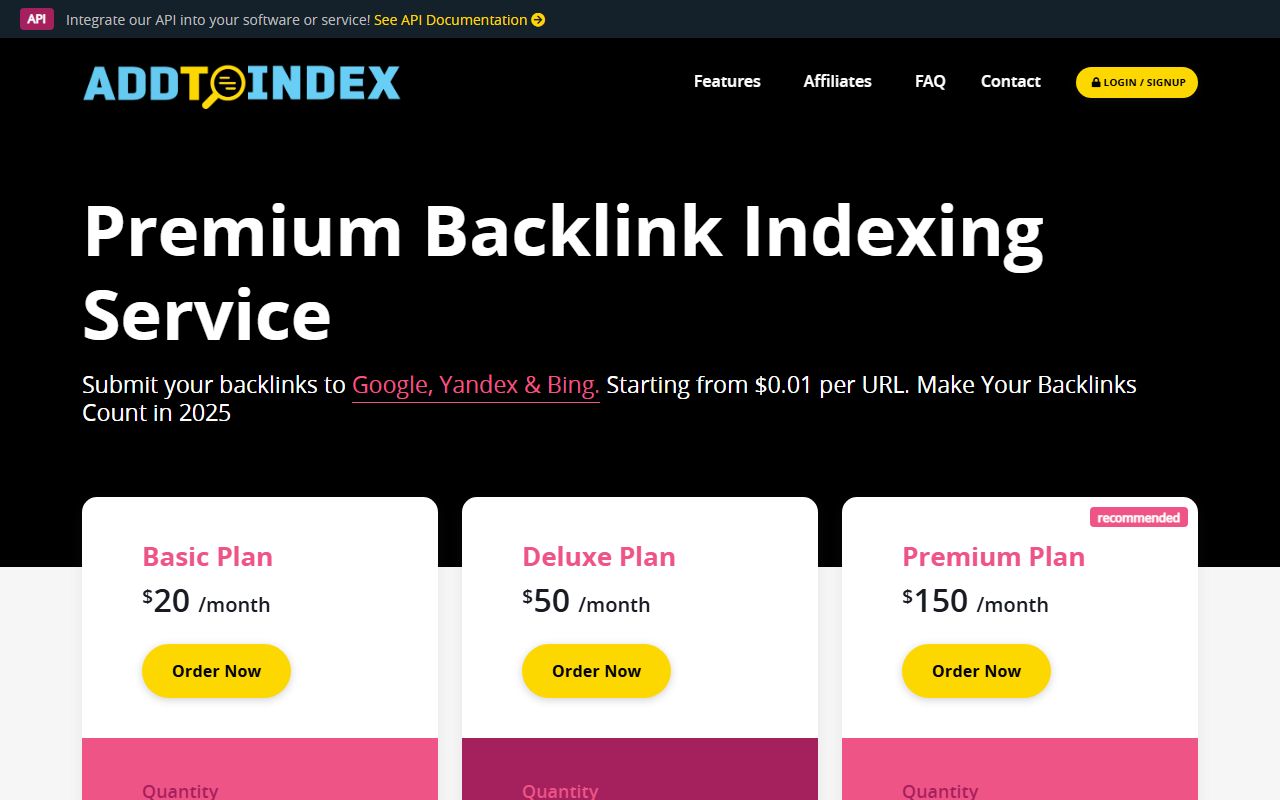
The page opens with a thin bar announcing an API, then a black hero: "Premium Backlink Indexing Service", and under it "Submit your backlinks to Google, Yandex & Bing. Starting from $0.01 per URL." The sub-line ends with "Make Your Backlinks Count in 2025". The three plan cards sit right under the headline, one tagged "recommended": Premium.
Mara reaches for a calculator. $20 for 1,000 links is $0.020 each; $50 for 3,000 is about $0.0167; $150 for 10,000 is $0.015. The cheapest published rate is therefore $0.015, not the $0.01 in the headline. The published plans do not show a $0.01 tier, so she notes $0.015 as the working figure.
There is no free trial, and she cannot even see a checkout without an account: the Order Now buttons lead to a sign-up page. The company behind it is not named anywhere she looks. The About page offers "10 years of SEO experience" and "2000+ Clients" as the site's own claims, with nothing to check them against.
08:15 - Pasting 1,000 URLs into a $20 plan
She signs up for Basic, because the arithmetic of a one-client month fits 1,000 links. Payment is a PayPal subscription that renews every month; each upgrade becomes a separate subscription, and the site says it does not cancel anything on its side. Refunds are stated as not offered, so Mara treats the $20 as spent the moment she pays.
The method is described in one sentence: links go to the three search engines "through their Webmaster Tools", and each engine must answer with an HTTP 200 for the call to count. What that does and does not prove matters. A 200 means the engine accepted the call; by itself it does not tell her whether the page was crawled, kept or shown. The site is open about this elsewhere: its terms say there is no guaranteed index ratio, while the homepage's meta description says "Up to 95% indexing rate". Both are the company's own words, and Mara quotes both to her client.
She pastes the batch, picks a campaign name and leaves drip-feed at its default of seven days. The documented range is one to thirty days. Her pages are a mix of guest posts, a few profile links and some pages on her client's own site. The site says it takes anything, including private blog networks, and that adult links are filtered into a separate, lower-rate process, which does not apply to her.
10:30 - The reply that is one line of text
Mara is a developer at heart, so she reads the API docs next. The endpoint is https://addtoindex.com/api.php, POST only ("HTTP GET Method will end up with ERROR"). Parameters are apikey, cmd, an optional campaign, dripfeed and urls, separated by a pipe or a newline. There are three commands: remaininglimit returns a number, expiredate returns a date, and submit answers "Submission:OK (URL Count:xx)".
All replies are plain text. Errors read like "ERROR:membership expired" or "ERROR:Credit Limit is exceeded". If she sends more URLs than credits remain, only the remaining quota is accepted. One URL costs one credit from the monthly allowance, and there is no separate API price.
What the docs do not show is equally informative. The docs list no command that asks about a URL afterwards, no JSON output, no webhook, and no stated rate limit or maximum batch size. That is not a flaw for a submission tool, because submitting is the job. But it means that after 10:30 Mara has no machine-readable way to learn what happened to the 1,000 links, from this side of the fence.
12:40 - The question the submit button cannot answer
Over lunch Mara turns to the second job: does the web show the links she paid to get indexed? apibacklinks can answer part of that. It is a separate service with no connection to AddToIndex, built on our web link data, 181,132,097 domains and about 798.6 billion page-level backlinks, refreshed roughly monthly. It does not index anything.
Her first call is free and needs no key, a domain summary of her client's site:
curl "https://apibacklinks.com/api.php?action=overview&q=client-example.com"
Then, with a key, she asks for backlinks filtered by the source domains where her guest posts went. If a link shows up with a last seen date, a crawl has met it. If it does not, she learns less than it sounds like, because our index trails the live web by weeks and a brand-new link may take that long. So a missing row on day three is silence, not a verdict.
She notes the cost. A lookup is one credit, which is $0.0001, so 1,000 lookups are ten cents. A list call that can return up to 1,000 rows costs two credits. The first sign-in gives $100 of credit, no card. Next to a $20 monthly plan, the checking side of her day costs cents. Full parameters live in the API docs.
14:20 - Reading AddToIndex's own backlink profile
On a slow afternoon, Mara does what she tells clients to do: she looks at the vendor's own footprint in the free explorer. The numbers are small. Twenty-eight referring domains, 319 backlinks, DR 20 on our scale (our own metric, comparable in spirit to other tools but not the same as them). The domain dates from August 2021 and our first sighting of a link is July 2024.
The shape is less ordinary than the size. Of 320 backlink rows, 273 are play.asp media pages on church-hosting sites such as mylakesidechurch.org (35 links), e-zekiel.tv (25) and valleyviewfwbchurch.org (18). One video page, id 30216, takes 177 of them, and its visible comment ends in the word "addtoindex". Who placed these links is unknown; the data cannot tell her, and she does not guess.
The anchors are as narrow: nine in total. The one product-minded mention, GSA Search Engine Ranker's documentation, lists the service among indexing tools at "20USD/month" and links it nofollow with an affiliate tag. For a service whose pitch is moving pages into an index, Mara finds it striking that no deep page, not the API docs, not the affiliate page, has a single link in our sample. She files it as an observation, not a judgment: a crawl sample is a sample.
| Anchor | Links |
|---|---|
| backlink indexer | 80 |
| link indexing service | 70 |
| addtoindex | 65 |
| addtoindex.com | 33 |
| backlink indexing service | 30 |
16:00 - Where AddToIndex is the better choice
By four o'clock Mara is clear about the split, and she is fair about it. If the task is "get this pile of URLs in front of three engines", apibacklinks cannot do it at all: we do not submit, ping or index anything. AddToIndex does that and has a documented endpoint for it.
- Submission is the whole product. A batch goes in, with drip-feed, campaign names and a resubmission habit (the site suggests retrying non-indexed links every 10 days).
- Flat, predictable billing. $20, $50 or $150 a month, one URL equals one credit, no per-call arithmetic.
- An API on every plan. No extra tier, which matters to people who run submissions from GSA or their own scripts.
- Yandex and Bing alongside Google. That is the site's claim; we cannot test it.
Someone who already has a strong sense of which pages are crawlable and just needs a push should stay with it, and does not need our data to decide that. Our data helps at the other end: deciding whether the pages were worth the push, and noticing, a few crawls later, whether the links stuck.
17:45 - The day's ledger
Mara writes two lines in her client file. Side one: $20 spent, 1,000 links submitted, seven-day drip-feed, outcome not yet known and not queryable through the API. Side two: a handful of free lookups and one list call, a few cents in credit, producing dated rows for the links a crawl has seen.
She sets a reminder for ten days out, the interval AddToIndex suggests for resubmitting what did not take, and a second one in a month to re-run the backlink query once a new our web index release has been processed. The first reminder is about pushing; the second is about proof.
For indexing as a separate job, there is our sister service IndexJump for URL and backlink indexing. For comparing AddToIndex with other submission tools, she leaves the indexer hub open in a tab. She closes the laptop with one clear rule: submit with a tool built for submitting, and check the result with a separate source of data.
apibacklinks vs AddToIndex
| apibacklinks | AddToIndex | |
|---|---|---|
| Main job | Reports backlink and domain-rating data from our own index | Submits your URLs to Google, Yandex and Bing |
| Entry price | $0.0001 per credit; lookups 1 credit, list calls 2; free actions cost 0 | $20/month for 1,000 links |
| Free tier | $100 free credit on first Google sign-in, no card | None mentioned on the site |
| Billing model | Pay per call, no subscription, no monthly minimum | Monthly PayPal subscription, auto-renewing; refunds not offered |
| API format | GET, JSON, CORS enabled; key via query or Bearer header | POST only, plain-text replies |
| API actions | 19 read actions (overview, domain, backlinks, anchors, bulk_dr and others) | 3 commands: submit, remaininglimit, expiredate |
| Per-URL status read-back | Dated backlink rows (source URL, anchor, last seen) as seen in the crawl | Not published |
| Rate limits and batch size | Max 1,000 rows per call; deep paging capped at 50,000 rows | Not published |
| Speed and freshness | Refreshed roughly monthly, not real-time; new links can take weeks | "2-7 days (on average)" on its own site; no guaranteed ratio per its ToS |
| Indexes pages | No. We provide data only | Yes, that is the product |
Try it on addtoindex.com
Look up the vendor's own backlink profile in our index, the same list the explorer shows.
curl "https://apibacklinks.com/api.php?action=backlinks&q=addtoindex.com&key=YOUR_KEY"
AddToIndex alternative — FAQ
Is apibacklinks a replacement for AddToIndex?
What does AddToIndex cost?
Can the AddToIndex API tell me whether a URL got indexed?
Can apibacklinks confirm that Google indexed my page?
How does your DR compare to what indexing tools show?
Do you offer a service to get links indexed?
Backlink data for the price of a rounding error
Sign up, keep your $100 of credit, call the API today.
Get started free