

A Scrapingdog alternative for link data, explained with a courier and a map
Scrapingdog sends something out to fetch a page for you, right now. apibacklinks hands you a map of who links to whom that was drawn earlier. If you are new to both, this page explains which one answers which question, with the real prices and limits on each side.
Our index holds 7,557 backlinks from 813 referring domains for scrapingdog.com, which works out to a DR of 40 on our scale. 69.2% of the links are dofollow, and we first saw the domain linked on 2024-07-12. The part of the profile that reads as editorial mirrors the blog rather than the product. The anchor amazon scraping api (219 links, all dofollow) lines up with the post /blog/best-amazon-scraping-apis/ (229 backlinks). serpapi alternatives (101) and best web scraping API (81) line up with /blog/best-serp-apis/ (150) and /blog/best-web-scraping-apis/ (151). Listicles collect the keyword anchors; the homepage collects the brand ones.
Two details are worth a second look. The single biggest referrer, gptdemo.net, sends 1,066 links from 931 pages and not one is dofollow; aitoolhub.net adds 206 more, also all nofollow, and medium.com (DR 77 in our index) contributes 106 nofollow links from 40 pages. AI-tool directories are a large nofollow block here. The other detail is a small French shop, topprojo.com, whose 61 links with the anchor Acheter maintenant point at api.scrapingdog.com/scrape with an API key in the URL. It is not a statement about Scrapingdog's security; it simply shows what query-string authentication looks like once a link ends up in a public crawl.
Scrapingdog at a glance
- What it is
- A web scraping API plus dedicated APIs for search engines, e-commerce and social platforms; parsed JSON on the dedicated APIs, raw HTML on the general scraper
- Operated by
- OpenData Labs Private Limited; terms governed by the laws of Rajasthan, India
- Launched
- Website launched in April 2020, per its own milestones timeline
- Pricing model
- Monthly subscription with a credit allowance: Free (100 credits), Lite $40 (200,000), Standard $90 (1,000,000), Pro $200 (3,000,000), up to 27 paid plans
- Unit
- Credits per successful request, from 1 (plain page fetch) to 50 (Profile Scraper); failed requests are credited back
- Auth and limits
api_keyquery parameter; 60-second timeout; concurrency from 1 (Free) to 5 (Lite), 50 (Standard) and upward by plan- Backlink data
- No backlink, referring-domain, anchor or domain-rating endpoint in its documentation
The doodle on Scrapingdog's homepage explains the whole product
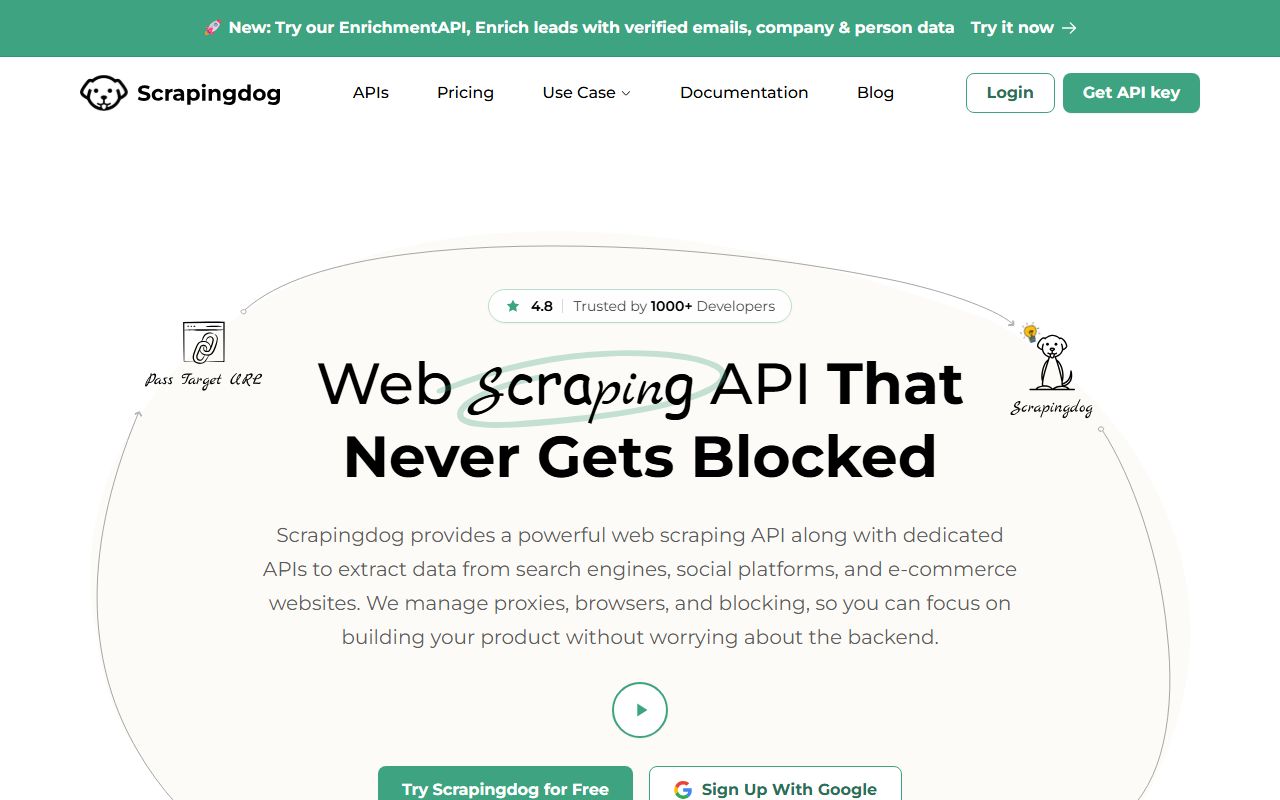
Scrapingdog's homepage has a small hand-drawn diagram in the hero. On the left is a browser icon labelled Pass Target URL. On the right is a sitting dog with a light bulb over its head. A thin arc joins the two. That sketch is the product: you hand over an address, and the dog goes and gets what is there.
If you are new to this, think of Scrapingdog as a courier. You give the courier one address. It travels there now, gets past the doorman, and comes back with a copy of whatever was on the page. The company describes the doorman part like this:
We manage proxies, browsers, and blocking, so you can focus on building your product without worrying about the backend.
apibacklinks is a different kind of object. It is a map. Somebody already walked the streets, wrote down which roads lead to which buildings, and filed the result. You do not send anyone anywhere. You open the map and read it.
People who search for a Scrapingdog alternative for backlink data usually wanted the map from the start. The sections below explain why, and where the courier is still the right call.
What the courier carries, and how the fare is counted
Scrapingdog's website went up in April 2020, according to its own milestones timeline, and the footer names OpenData Labs Private Limited as the company behind it. The catalogue is wide. There is a general Web Scraping API that returns raw HTML, and a long list of dedicated APIs that return parsed JSON: Google Search, AI Mode, Maps, News, Scholar and Trends; Bing, Brave, Baidu and DuckDuckGo; Amazon, Walmart and eBay; LinkedIn profiles, YouTube, Yelp, Indeed. Its SEO page pitches the SERP APIs for rank trackers, SERP monitoring and keyword research tools.
The fare is counted in credits. Harder errands cost more:
- a plain page through a rotating proxy: 1 credit
- a page that needs JavaScript rendering: 5 credits
- Google SERP Light: 5 credits; Google SERP Advance: 10
- Universal Search: 20 credits
- Profile Scraper: 50 credits
Credits arrive in a monthly bucket. Free is 100 credits. Lite is $40 a month for 200,000, Standard is $90 for 1,000,000, Pro is $200 for 3,000,000, and the ladder keeps climbing through 27 paid plans. Failed, blocked and timed-out requests are credited back, so you pay for errands that came home with something.
Two limits matter on day one. A request times out after 60 seconds, and each plan has a concurrency ceiling: 1 on Free, 5 on Lite, 50 on Standard. Go over it and the API answers with a 429.
The one question that has no address to send the dog to
Here is the question: who links to my site?
There is no single page where that answer lives. It is scattered across every other page on the web. A courier visits one address per trip. To answer the question with a courier you would send it to hundreds of millions of sites, read every page, write down every link, and then turn that pile into a table you can query by target domain. That is not an errand. That is drawing the map yourself, and it is a large infrastructure project, not a weekend script.
Scrapingdog does not claim to do this. Its documentation lists no backlink, referring-domain, anchor-text or domain-rating endpoint. The Google SERP API tells you who ranks for a keyword. It does not tell you who links to a domain. Those are separate questions with separate data behind them.
So the word alternative needs a caveat on this page. apibacklinks does not replace Scrapingdog. It replaces the part of your plan where you were going to build a link graph out of scrape calls.
What is already drawn on the apibacklinks map
The index is built from our web link data, 13 crawls covering 2025 to mid-2026. It holds 181,132,097 domains, 2,774,625,913 domain-to-domain links and about 798.6 billion page-level backlinks.
You read it through one endpoint with 19 actions: GET https://apibacklinks.com/api.php?action=<action>&q=<domain>. The ones a newcomer reaches for first:
domainandoverview: DR, backlink and referring-domain counts, top anchors. Free, no key.refdomains: the top referring domains of a target, up to 100, with donor DR and first/last seen dates.backlinks: individual links with source URL, anchor, rel and last-seen date, filterable by anchor text, TLD, minimum donor DR and date range.anchors: the top 50 anchors for a target.bulk_dr: DR and counts for up to 2,000 domains in one request.
DR here is our own 0 to 100 logarithmic score, computed from referring-domain counts in our graph. It is not Ahrefs DR and not Moz DA, and the numbers will differ from those tools.
A map has a weakness a courier does not: it was drawn before you asked. Ours is refreshed roughly monthly as new crawl releases are processed, so a brand-new link can take weeks to appear. Our index is a broad sample of the public web, which means coverage is smaller and less fresh than the proprietary crawlers of Ahrefs, Majestic or Semrush. There is no rank tracking, no keyword research, no traffic estimate, no new/lost report and no alerting. The full action list is in the API docs.
Looking up Scrapingdog's own street on the map
The quickest way to understand a link index is to point it at a site you know. Here is scrapingdog.com, three calls deep.
Call 1, domain, free. DR 40, 7,557 backlinks, 813 referring domains, last seen 2026-09-09. A beginner stops here and thinks: decent profile.
Call 2, anchors, 2 credits. The top anchor is not the brand name. It is interbahis, with 1,970 links, 26.07% of the total. Second is izmir escort with 674. The anchor Scrapingdog comes third with 521. Together the first two make up about 35% of every link we hold for the domain, and all of them are dofollow.
Call 3, refdomains, 2 credits. The dates explain the shape. Eight unrelated domains, including usakhabermerkezi.com, thermocare.ca, fihnechile.cl and a gov.ph host with 190 links, were first and last seen on 5 or 6 June 2026. An earlier burst from moscvichka.ru and ulusalkanalhaber.com.tr sits between February and March 2026.
We do not know who placed those links or why. The anchors name third-party betting and escort terms, not Scrapingdog, and nothing in the data says the company had any part in them. The lesson is narrower and more useful: a raw count like 7,557 tells you little until you read the anchors and the dates. You can browse the same report without a key in the explorer.
Two meters: a monthly bucket versus a per-call tick
Both services call their unit a credit. The meters behind the word work differently.
| Scrapingdog | apibacklinks | |
|---|---|---|
| How you pay | Monthly subscription with a credit allowance | Per call, no subscription, no monthly minimum |
| Smallest paid step | Lite, $40 a month, 200,000 credits | 1 credit = $0.0001 |
| A typical call | Google SERP Light, 5 credits: $1 per 1,000 on Lite, $0.45 per 1,000 on Standard | Lookup, 1 credit: $0.10 per 1,000. List call, 2 credits: $0.20 per 1,000 |
| Free start | 100 credits, no card | $100 credit (1,000,000 credits) on first Google sign-in, no card |
Do not read that table as a price fight. The two rows buy different things. A SERP fetch has to leave the building at the moment you ask and get through whatever is guarding the page. A link lookup reads a table that already exists. That is why the per-call numbers sit so far apart.
A small piece of arithmetic for scale. Say you want the anchor profile of 500 competitor domains. That is 500 anchors calls at 2 credits each: 1,000 credits, or $0.10. Getting the same answer with a courier is not a matter of price, because there is no address to send it to.
Translating Scrapingdog habits into apibacklinks calls
If you have already written code against api.scrapingdog.com, the shape of our API will feel familiar: a GET request, query parameters, a key, JSON back. One difference is where the key can go. Scrapingdog's docs show an api_key query parameter. We accept ?key=sk_... or an Authorization: Bearer header, and the header is the safer habit for anything that might end up in a URL someone else can see.
| You were going to scrape for... | Call this instead |
|---|---|
| Sites that link to a competitor | refdomains, then backlinks |
| An authority score for a long list of domains | bulk_dr, up to 2,000 domains per request |
| The anchor text pointing at a domain | anchors or anchor_cloud |
| Donors shared by several competitors | intersect, 2 to 10 targets |
| Who gets linked with an exact phrase | keyword |
| Who ranks for a keyword on Google | Nothing. Keep the SERP API. |
| The live HTML of one page | Nothing. Keep the scraper. |
The last two rows are the honest part of the mapping. A list call here returns up to 1,000 rows and deep pagination stops at 50,000, so plan large exports around filters rather than brute paging.
Where Scrapingdog is simply the better hire
Plenty of jobs need a courier and nothing else. Stay with Scrapingdog when:
- You need the present tense. A price on an Amazon listing, a Google Maps review count, today's top ten for a keyword. Our index is weeks behind by design.
- You are building a rank tracker or a GEO/AEO tool. Scrapingdog sells Google AI Overview and AI Mode endpoints alongside the classic SERP ones. We have no search-result data at all.
- You must confirm that one specific link exists today. The map may not show a link placed last Tuesday. Fetching the page and reading its HTML will.
- You want client libraries. Scrapingdog publishes Node.js and Python SDKs and an MCP server that exposes 35 tools to clients such as Claude Desktop and Cursor.
- You need heavy parallelism. Concurrency on its plans runs from 50 on Standard to 2,200 on the top plan.
If SERP data is your real need and you are only comparing providers, the map-versus-courier question does not apply to you. Our SearchAPI.io page is a closer starting point for SERP work.
A sensible first afternoon with the dog and the map together
The two tools sit next to each other in a working SEO stack more often than they compete. A newcomer can try the pairing in a few hours:
- Call
domainfor your own site. No key is needed. Note the DR and the referring-domain count. - Sign in, then call
refdomainsandanchors. Read the anchors before you read the totals, the way the scrapingdog.com example above shows. - Pick the ten links you care about most. Send Scrapingdog to those ten source URLs to check that each link is still in the HTML. On a plain fetch that is 10 credits.
- Use
intersecton two or three competitors to get a prospect list, and a SERP call to see which of those prospects also rank for your terms.
Step 3 is the one that shows why both exist. The map told you where to look. The courier confirmed what is there now. For other link-data APIs measured the same way, the backlink API hub lists them.
apibacklinks vs Scrapingdog
| apibacklinks | Scrapingdog | |
|---|---|---|
| Core job | Backlink and domain-rating data read from a pre-built index | Live scraping of web pages and search results at request time |
| Backlink / DR endpoints | 19 actions including refdomains, backlinks, anchors, bulk_dr, intersect | None listed in its documentation |
| SERP and rank data | None | Google, Bing, Baidu, Brave and DuckDuckGo search APIs, plus Google AI Overview and AI Mode |
| Pricing model | Pay per call; no subscription, no monthly minimum | Monthly subscription with a credit allowance; 27 paid plans from $40/month |
| Unit cost | 1 credit = $0.0001; calls cost 0 to 3 credits | 1 to 50 credits per successful request depending on the API; $0.2 per 1,000 credits on Lite |
| Free allowance | $100 credit on first Google sign-in, no card; domain and overview free without a key | 100 free credits, no credit card required |
| Authentication | ?key=sk_... or Authorization: Bearer header | api_key query parameter; header auth not shown on its docs index page |
| Freshness | Roughly monthly refresh; not real-time | Fetched live when you call |
| Limits | 1,000 rows per call; deep pagination capped at 50,000 rows | 60-second timeout; concurrency 1 (Free), 5 (Lite), 50 (Standard), higher by plan; 429 when exceeded |
| Response | JSON, CORS enabled | Parsed JSON on dedicated APIs; raw HTML on the general scraper |
Try it on scrapingdog.com
Pull up to 100 links in our index that point at scrapingdog.com with its own brand name as the anchor text.
curl "https://apibacklinks.com/api.php?action=backlinks&q=scrapingdog.com&anchor=Scrapingdog&per=100&key=YOUR_KEY"
Scrapingdog alternative — FAQ
Does Scrapingdog have a backlink API?
Could I build my own backlink data with Scrapingdog's scraper?
Is apibacklinks cheaper than Scrapingdog?
Is the DR 40 you show for scrapingdog.com the same as its Ahrefs DR?
Why is a betting term the top anchor for scrapingdog.com in your index?
Can I use both services together?
Backlink data for the price of a rounding error
Sign up, keep your $100 of credit, call the API today.
Get started free