

A SearchAPI.io alternative for backlink data: the 90-day plan
SearchAPI.io answers one question very well: what does a search results page look like? It does not tell you who links to whom. Here is how a team adds that second answer in three stages.
We pointed our own index at searchapi.io. It shows 287 referring domains and 4,995 backlinks, DR 34 on our scale, first seen 2024-07-12 (that is our index window, not the company's age). The shape is lopsided. One directory, publicapis.io, supplies 3,042 of the 4,995 backlinks, 60.9%, from 1,491 pages. Its two longest anchors contain the words “Featured” and “SPONSORED” and are 0% dofollow, which reads as a labelled, sponsored directory placement, and it appears in crawl data with the nofollow treatment you would expect.
Remove that one directory and 1,953 backlinks remain, 1,595 of them dofollow (81.7%). The organic part of the profile is the AI-tooling world: pipedream.com (249 links), deepset.ai (100), langchain.com (46), plus langflow, n8n, flowiseai and a run of MCP directories. The second-largest referrer, searchapi.org with 284 links, is a mirror domain serving the same site. There are zero .gov or .edu referrers. Numbers like these only make sense after a human reads them, which is the theme of the plan below.
SearchAPI.io at a glance
- What it is
- A real-time SERP API: Google plus dozens of other engines, one GET endpoint, JSON back.
- Company
- SearchApi, LLC, with a New York address in the site footer. Founding year not published on the official site.
- Pricing
- Monthly plans in USD: $40 for 10,000 searches (Developer) to $5,000 for 5,000,000 (Octo 5M), standard speed.
- Free tier
- 100 free requests, no credit card. Whether they renew is not published.
- Billing rule
- Only successful searches with a 200 status code are charged.
- Rate limit
- Up to 20% of the plan's credits per hour, per its pricing FAQ.
- Backlink data
- None found in its docs or product menu.
The octopus, the curl line and the question it cannot answer
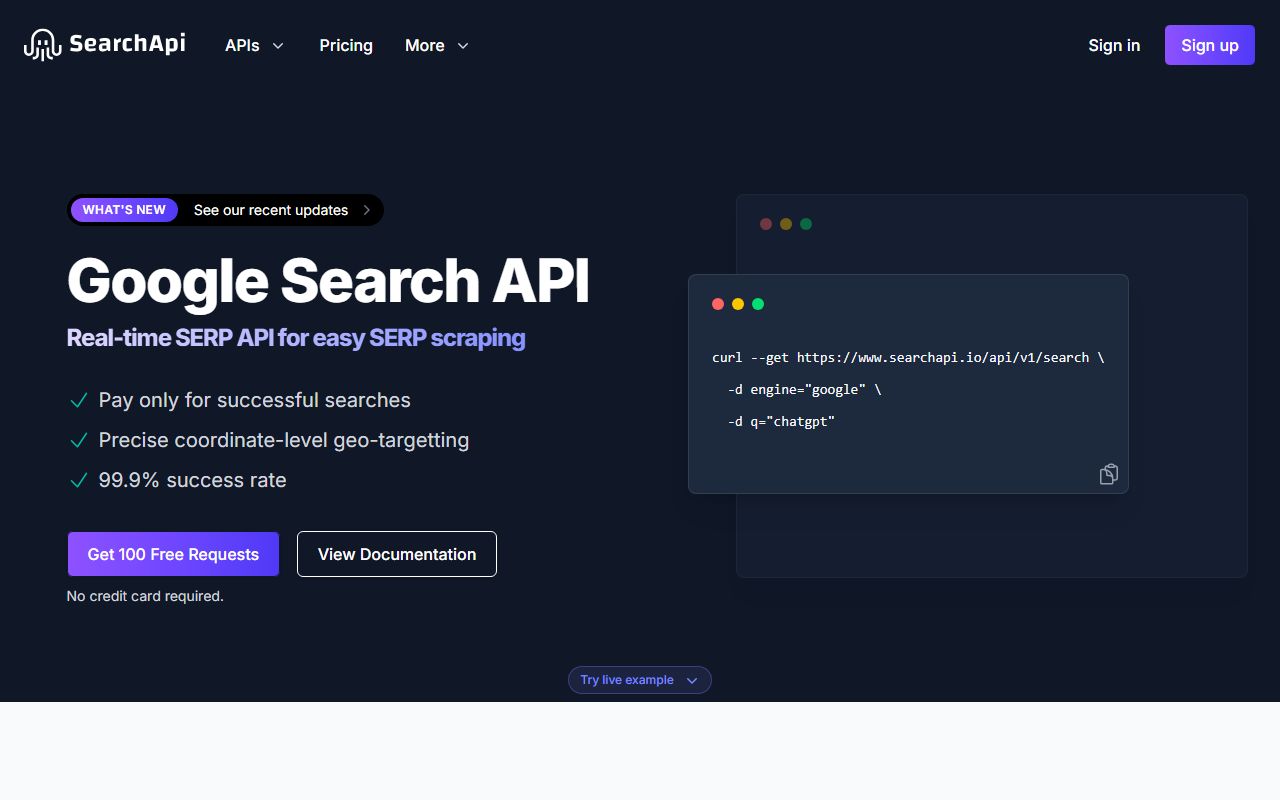
Open the homepage and the first thing you meet is an octopus logo, the words “Google Search API”, and a terminal card: curl --get https://www.searchapi.io/api/v1/search with engine="google" and q="chatgpt". Three ticks sit above the buttons: pay only for successful searches, coordinate-level geo-targeting, a 99.9% success rate. Underneath is a button that reads “Get 100 Free Requests” and the small print “No credit card required.”
It is a confident first screen, and it tells you what the product is. Ask it who links to a domain and there is nothing to call. We checked the homepage, pricing page, Google docs and account docs; the word “backlink” appears on none of them. That is not a flaw. SearchApi sells what a results page contains: organic results, ads, People Also Ask, AI Overview. Links between sites are a different dataset.
So this page is not a story about leaving. It is a 90-day plan for a team that already runs on SearchApi, or is about to, and needs link data next to it. Three stages, each with a deliverable you can show someone.
Day 0: draw the map before you write code
The team in this plan is hypothetical. It has a small SEO tool that pulls ten rankings for each tracked keyword through a SERP API and wants to enrich each ranking page's domain with authority and link counts. On day zero, list what each side owns.
| Question | Where the answer comes from |
|---|---|
| Who ranks for this query, in this city? | SearchApi, the Google engine or its rank-tracking engine (up to 100 organic results) |
| Which AI answer cites whom? | SearchApi, the AI Overview and AI Mode engines |
| How many sites link to that ranking domain? | apibacklinks, domain and overview |
| Who exactly are they, with which anchors? | apibacklinks, refdomains, anchors, backlinks |
Notice that the rows do not overlap. Nothing gets migrated in this plan. Your SearchApi key keeps its job, and the new key does a second one. If you want the full list of what we expose, the API documentation is short: 19 actions on one endpoint.
Days 1 to 30: free calls, then a first join
Week one. No key needed. Call action=domain or action=overview for the ten domains you care about most and read the output. You get DR, referring domains, backlinks, dofollow counts, first and last seen, plus top referring domains, anchors and pages. Our DR is our own 0 to 100 logarithmic score computed from referring-domain counts in our graph. It is comparable in spirit to the scores you know, never the same number, so do not mix columns from different tools in one chart.
Week two. Sign in with Google for the $100 starter credit, which is 1,000,000 credits at $0.0001 each. Take one night's batch of SearchApi results, collect the domain field from each organic_results entry, and send the unique list to bulk_dr, which accepts up to 2,000 domains per request.
Weeks three and four. Store the pair (SERP position, DR) next to each keyword. That is the whole deliverable of stage one: a table where every ranking row has an authority column. It will show you things the SERP alone hides, such as a low-DR page sitting in the top five among stronger names. Those are the pages worth studying.
Cost so far: your existing SearchApi plan, plus a few cents. Lookups start at 1 credit, so a thousand of them at $0.0001 per credit is ten cents.
Days 31 to 60: from a number to the people behind it
A DR column says that a page is strong. It does not say why, and the why is what an outreach or content team can copy. Stage two goes one level down.
For each of the low-DR pages ranking in the top five, call refdomains, which returns up to 100 top referring domains with links, pages, dofollow count and donor DR. Then call anchors for the top 50 anchors. A list call costs 2 credits, so 300 pages with both calls cost 1,200 credits, about twelve cents, and a single list call can return up to 1,000 rows.
Now use intersect, which returns the referring domains shared by 2 to 10 targets. Feed it the top three rankers for one commercial query. The domains that link to all three are your shortlist, found by set arithmetic rather than by guessing.
A caution from our own data on searchapi.io. Its 4,995 backlinks look sizeable, but a single directory supplies 61% of them, and the second-largest referrer is the company's own mirror domain. When you read a profile, look at the first rows of refdomains before you quote the total. Our free explorer shows this one in the browser if you want to see the shape yourself.
Days 61 to 90: make it a habit, and know the limits
Stage three is not new features. It is making the join boring. Schedule one job that reads yesterday's SERP rows, enriches only new domains, caches DR for a month, and writes a short note when a domain's referring count moves a lot between our refreshes.
Plan around what we do not have. The index is built from our web link data and refreshed roughly monthly, not in real time, so a link added last week may take weeks to show. There are no alerts, no new-and-lost reports, no spam score, no keyword research, no rank tracking and no historical charts in the API. If your product needs any of those, you build them on top or buy them elsewhere.
Two details make this stage work. First, SearchApi's pricing page says you can use up to 20% of your plan's credits per hour, so your SERP side has a natural drip rate (on the Developer plan, at most 2,000 searches an hour). Design the join to consume results as they arrive instead of in one burst. Second, keep our key and theirs in separate environment variables, so rotating one never takes down both halves.
At day 90 you should be able to open a page for any tracked keyword and see rank, authority, top linkers and top anchors on one screen, and say what each piece cost. If you also need to get your own new links crawled, our sister service IndexJump handles the indexing job.
Where SearchApi is simply the better choice
If your question is about a results page, use SearchApi and stop reading. We do not have a SERP. Not one of our 19 actions fetches a search result.
Its range is broad: the product menu lists 64 APIs, from Google Shopping, Maps, Trends and Scholar to Bing, YouTube, Amazon and answer engines such as Perplexity and ChatGPT. It supports location by coordinates. It charges only for successful searches. It has an MCP server for AI assistants, listed as available on all plans, and its homepage names open-source integrations with Dify, Flowise, LangChain and Haystack; our index shows links from LangChain and Haystack's maker deepset.ai. Its changelog had an entry on October 6, 2026, so the product is actively updated.
On price, if you need 5,000,000 searches a month, its Octo 5M plan lists $1 per 1,000 searches at $5,000 a month. We could not do that job at any price, because we do not run it. Its Google Rank Tracking engine returns up to 100 organic results per call, and its Google About This Domain API returns an AI-generated overview of a domain. Per its terms, a Legal Protection Guarantee of up to $2M applies from the Production plan upward.
Stay with it if you want SERP data, AI answer data or a wide scraping menu. Add us only for links.
The bill at day 90, with the arithmetic
Assume the hypothetical team tracks 1,000 keywords once a day for a month.
- SERP side: 30,000 searches. That is above the 10,000-search Developer plan and below the 35,000-search Production plan at $100 a month. Check the pricing page for your exact fit; plans are monthly, and we found no pay-as-you-go option published.
- Link side: 300 deep dives with one
refdomainsand oneanchorscall each is 1,200 credits. Add 100intersectcalls at 2 credits each, 200 credits. That is 1,400 credits, or $0.14, before the domain lookups, which are priced from 1 credit each. Even at thousands of lookups the month stays in the low dollars, and the $100 starter credit covers a long first stretch.
One more line item deserves a place on the sheet: your own time. Our first two actions need no key at all, so you can read real output before creating any account. The slow part of this plan is not the integration, it is deciding which of the ranking domains deserve a deep look. Write that rule down in week three, for example “DR under 30 and position five or better”, and the stage-two budget stops being a guess. Revisit the threshold at day 60 with the first month of results in hand.
The point is not that one side is cheap. It is that the two bills scale on different things: SERP cost follows how often you look at results, link cost follows how many distinct domains you care about.
apibacklinks vs SearchAPI.io
| apibacklinks | SearchAPI.io | |
|---|---|---|
| What you get | Backlink and domain-rating data from our own index | Real-time SERP data from Google and other engines |
| Backlink / referring-domain endpoints | Yes: backlinks, refdomains, anchors, intersect and more | None found in its docs |
| Pricing model | Pay per call, no subscription | Monthly plans, $40 to $5,000, standard speed |
| Entry price | From $0.10 per 1,000 lookups | $40 a month for 10,000 searches |
| Free start | $100 credit on first Google sign-in, no card; domain and overview free without a key | 100 free requests, no credit card |
| Auth | ?key=sk_... or Bearer header | api_key parameter or Bearer header |
| Limits | Up to 1,000 rows per call; deep pagination capped at 50,000 | Up to 20% of plan credits per hour |
| Freshness | Roughly monthly refresh, not real-time | Real-time |
| Rank tracking and AI answers | Not offered | Offered (rank tracking, AI Overview and others) |
| Uptime guarantee | Not published | "99.9% SLA" label on plans; terms not published |
Try it on searchapi.io
Day one of the plan: a free, keyless call that reads the domain's link profile from our index.
curl "https://apibacklinks.com/api.php?action=overview&q=searchapi.io"
SearchAPI.io alternative — FAQ
Is apibacklinks a drop-in replacement for SearchAPI.io?
Does SearchAPI.io have a backlink API?
What does SearchAPI.io cost?
How does our DR compare to the scores in other tools?
How fresh is the link data?
Can I try the plan without paying?
domain and overview actions are free and need no key, and the $100 starter credit arrives on first sign-in with Google, no card. The explorer shows the same reports in the browser.Backlink data for the price of a rounding error
Sign up, keep your $100 of credit, call the API today.
Get started free