

SEO API alternative: seven procurement checks before you wire seoapi.com into a link-data job
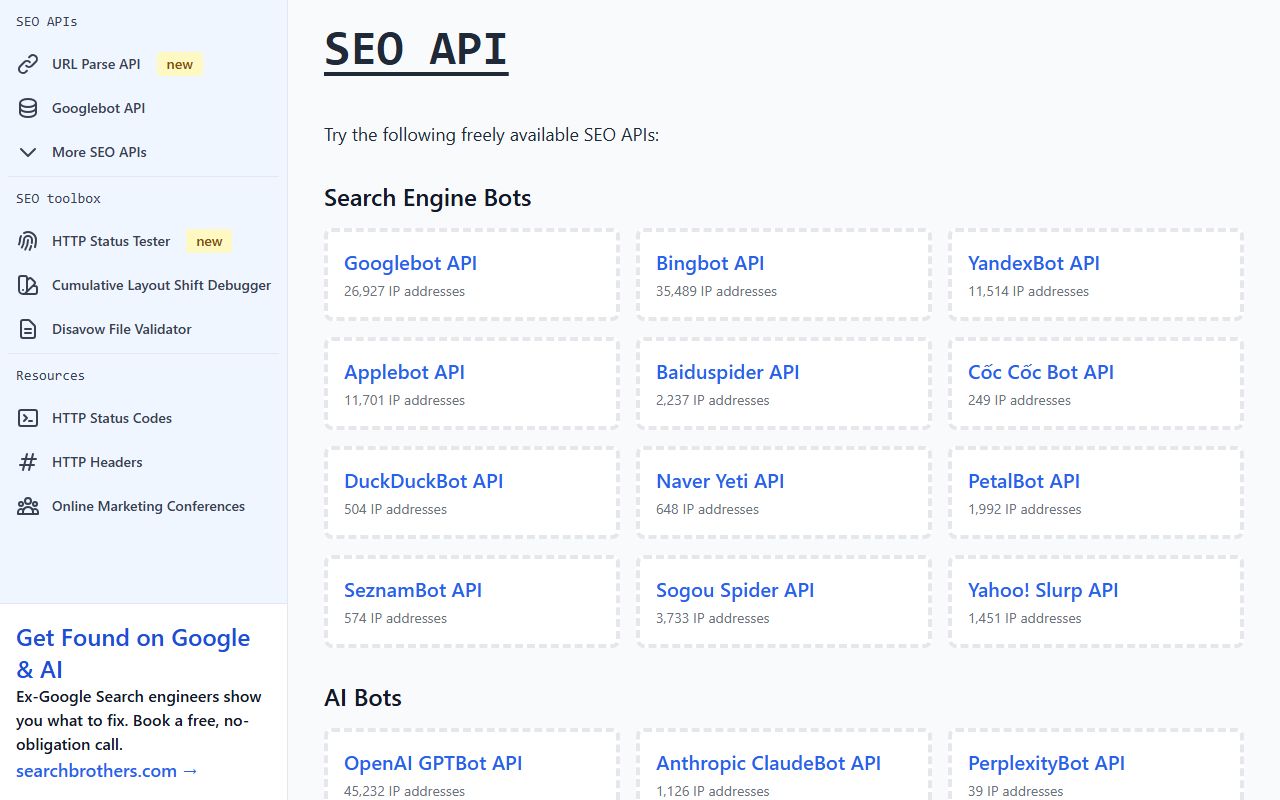
The homepage of seoapi.com shows eighteen API cards and not one price, plan or sign-up button. We ran the name through a procurement checklist to see what is really on offer, and what a team looking for backlink data should call instead.
Our index holds 14,044 backlinks to seoapi.com from only 29 referring domains, which works out at roughly 484 links per domain. That ratio is unusual, and it gives the site a DR of 20 on our scale, with 99.9% of links dofollow and none from .gov or .edu hosts. The top eight referrers (httpcats.com with 1,992 links, httpducks.com with 1,848, httpgoats.com, disavowfile.com, http.fish, http.dog, http.pizza and http.garden) send 12,648 links between them, or 90.1% of the total. Sixteen domains using the identical block of bot-API anchors account for 13,910 links, 99.0%. The two we opened, httpcats.com and http.dog, carry the same author's footer.
The anchors read like a navigation menu. Twelve of them sit between 904 and 1,047 links each ("Googlebot API", "Bingbot API", "Cốc Cốc Bot API" and so on) and another twelve sit at exactly 239 each ("Google API", "Yandex API", "Seznam API"). The words "SEO API" do not appear among the 34 anchors at all. The only brand-style anchors use the old name: "botreports.com" from keycdn.com and "Bot Reports website" from cs-cart.com and simtechdev.com.
SEO API at a glance
- What it is
- A hub of free REST APIs that validate crawler IP addresses, one API per bot (12 search-engine bots, 6 AI bots)
- Who runs it
- One person: technical SEO consultant Fili Wiese, per the site footer
- Price
- Free of charge; no plans, no pricing page
- Auth
- None. The docs say the API "can be accessed without credentials"
- Rate limit
- Rate-limited; the number is not published
- Also offered
- An MCP server per bot with a single tool,
validate_ip - Former name
- botreports.com, which now 301-redirects to seoapi.com
Before the checklist: what seoapi.com actually puts on the shelf
Anyone typing "SEO API" into a search box usually wants data: backlinks, keywords, rankings. The site that owns the exact-match domain sells none of it. Its homepage, under a monospace heading and the line "Try the following freely available SEO APIs:", lists twelve search-engine bot APIs and six AI-bot APIs. Each card names a crawler and a count of known IP addresses. On 8 October 2026 the Googlebot card read 26,927 addresses and the OpenAI GPTBot card 45,232.
That is the whole product. You send an IP address, and the service tells you whether it belongs to the named crawler. The site's own description of the job is precise:
The Googlebot API makes it easy to check if an IP address is officially used by Googlebot to crawl the web, including your website.
So this page cannot be a like-for-like feature fight, and we will not stage one. What follows is the checklist a careful buyer would run on any API vendor, applied to SEO API and to apibacklinks side by side, with a verdict on each line. Where the two do different jobs, we say so.
Check 1. Does the API answer the question you are asking?
Verdict: depends entirely on the question.
We looked for any backlink, referring-domain, authority-score, anchor, keyword or SERP endpoint on the pages we read and found none. Nor is there an account system to hide one behind. The mapping between the two services is short because they barely touch:
| You need to know | SEO API | apibacklinks |
|---|---|---|
| Is 192.178.4.1 a real Googlebot address? | Yes: /v1/validate/?ip= | No such action |
| Was an IP a crawler address in last year's logs? | Yes: status returns current or historic | No such action |
| Which domains link to a site? | Not offered | refdomains, backlinks |
| What anchors point at a site? | Not offered | anchors, anchor_cloud, keyword |
| How strong is a domain, 0–100? | Not offered | domain, bulk_dr |
| Which referrers do several sites share? | Not offered | intersect, compare |
If your ticket says "filter fake Googlebot hits out of the access log", SEO API passes and we fail. If it says "pull referring domains for 400 prospects", the result reverses. The full list of our 19 actions is in the API documentation.
Check 2. What is the unit of work, and what does one cost?
Verdict: pass for both, on different models.
SEO API has no price to inspect. The request for /pricing returns a 404, and the documentation states that querying is "free of charge and anonymous". The unit is one IP address per GET request. No bulk or batch endpoint is documented on the pages we read, so a hypothetical log file with 30,000 distinct client addresses means up to 30,000 calls, minus whatever you cache.
apibacklinks meters in credits at $0.0001 each. A lookup costs 1 credit, a list call such as refdomains or backlinks costs 2, and search or keyword costs 3. The arithmetic for a hypothetical month looks like this:
- 5,000
bulk_drlookups at 1 credit: 5,000 credits, $0.50 - 2,000
backlinkscalls at 2 credits: 4,000 credits, $0.40, each returning up to 1,000 rows - 300
keywordcalls at 3 credits: 900 credits, $0.09
That is $0.99. A first sign-in with Google adds $100 of credit, which is 1,000,000 credits, with no card and no subscription. The domain and overview actions cost nothing and need no key. Free against cheap is not much of a contest, but the two prices buy different things, so the row on a procurement sheet stays open until Check 1 is settled.
Check 3. How much paperwork stands between you and the first response?
Verdict: SEO API passes outright; apibacklinks passes with one step.
There is nothing to register for at seoapi.com. No key, no header, no account. The docs even supply a Google Sheets formula built on IMPORTDATA, so an analyst can validate a column of IP addresses without writing code. The privacy statement is short: submitted data is "only used to verify whether an IP address is associated with a known search bot".
On our side, the free actions such as domain and overview behave the same way: a plain GET with no credentials returns JSON, and CORS is enabled. Paid actions want a key, passed either as ?key=sk_... or as an Authorization: Bearer header. The step in between is a Google sign-in. A team that cannot use Google accounts for vendor access should note that before going further.
Check 4. Are the limits written down, and does anyone stand behind them?
Verdict: SEO API depends on your tolerance for unpublished limits.
The documentation says the API is "rate-limited" and that heavier users should "contact Fili". The number itself is not published, and the live response we inspected carried no rate-limit headers. The only guidance is to cache successful responses locally "for at least 6 hours" before repeating a query. You can build around that, but you cannot capacity-plan against a figure nobody has stated.
The guarantees are stated with unusual frankness:
This is a personal website and for-fun project. Use at your own risk.
The disclaimer adds that "no guarantees can or will be given" and that data "may be incomplete". There is no SLA, no support tier and no paid plan that would buy one. The requests for /about, /terms and /privacy returned 403 when we tried them, and no company name or address appears on the pages we read. None of that is hidden; the author tells you plainly what he is giving away.
Our own limits are fixed and dull: at most 1,000 rows per call, deep pagination capped at 50,000 rows, bulk_dr up to 2,000 domains per request, compare up to 20, intersect from 2 to 10 targets. We publish no uptime figure on this page either, so treat that cell as unproven for both columns.
Check 5. What comes back, and how much parsing does it need?
Verdict: pass for both.
SEO API's answer is about as small as JSON gets. The documented example is four fields:
{"ip": "192.178.4.1", "timestamp": 1615471876.25665, "valid": true, "status": "current"}
We repeated that request on 8 October 2026 and got HTTP 200 with the same four fields, valid: true and status: current. A lookup for 127.0.0.1 returned valid: false with an error string. The status field deserves attention: current means the address was confirmed within the past 12 months, historic means only older confirmations exist, and historic records still validate as true. The docs also describe a compact=1 parameter that should return plain text.
Our responses are larger because the question is larger. A domain call returns DR, backlink and referring-domain counts, dofollow counts and first and last seen dates. A backlinks call returns rows with source URL, anchor, title, rel, link type and last seen, filterable by follow status, source TLD, anchor text, minimum donor DR and date range. One endpoint, one action parameter, JSON throughout.
Check 6. Does the public evidence match the vendor's own account?
Verdict: pass. The trail is thin, and it is consistent.
A buyer should check a supplier against a source the supplier does not control. Our link index is one. It first saw links to seoapi.com on 13 July 2024 and last saw one on 9 September 2026. Nearly all of them arrive from small utility sites that repeat the same list of twelve search-engine bot APIs. The six AI-bot APIs on the homepage, including GPTBot and ClaudeBot, are not named by a single anchor. Either those endpoints are newer than the footer blocks that promote the rest, or nobody has linked to them yet; link data cannot tell us which.
The independent citations are few but on topic. Hosting and developer sites cite the service as a way to verify Googlebot: keycdn.com (DR 50 in our index), cs-cart.com (48), dhosting.pl and acodez.in (37 each), openreplay.com and nytroseo.com (36 each), plus tiny-helpers.dev with 60 links reading "Go to Bingbot API" and "Go to Googlebot API". That is what you would expect for a narrow engineering utility run by one specialist: few mentions, and the ones that exist are relevant. You can read the full profile in the explorer report for seoapi.com.
The caveat belongs to us. Our index is built from a broad sample of the public web, refreshed roughly monthly. A proprietary crawler may see referrers we miss, and a link published last week may not show up for some time.
Check 7. Where SEO API is the right purchase and we are not
Verdict: SEO API wins every line below.
- Log-file analysis. Separating real Googlebot or Bingbot requests from impostors is its one job, and the docs explain that it replaces the forward-and-reverse DNS pair with a single lookup.
- Old logs. The database keeps historical records, so an address that no longer resolves can still be identified in last year's files.
- AI-crawler accounting. Six endpoints cover GPTBot, ClaudeBot, PerplexityBot, Amazonbot, Meta-ExternalAgent and CCBot. If you are measuring how much of your traffic is model training or AI search, this is the relevant tool and ours has nothing to say.
- Agent workflows. Each bot has an MCP server exposing
validate_ipover Streamable HTTP, without credentials, with config snippets for Claude Code, Cursor, VS Code and others. - Zero budget, zero procurement. It costs nothing and asks for nothing.
If your work is server-side crawl forensics, stay with SEO API. Nothing on apibacklinks replaces it, and we would point you there ourselves.
The signed-off sheet, and how the two fit in one pipeline
| Check | SEO API | apibacklinks |
|---|---|---|
| 1. Crawler IP validation | Pass | Fail |
| 1. Backlinks, anchors, DR | Fail | Pass |
| 2. Price | Pass (free) | Pass (from $0.10 per 1,000 calls) |
| 3. Onboarding | Pass (keyless) | Pass (keyless for the free actions, Google sign-in for the rest) |
| 4. Published limits | Depends (number not published) | Pass |
| 4. Guarantees | Depends ("use at your own risk") | Not claimed |
| 5. Response shape | Pass | Pass |
| 6. Evidence trail | Pass | Limited by our web index coverage |
Here is a hypothetical use of both, to make the split concrete. A technical SEO has a month of access logs and a suspicion that a section of the site lost crawl attention. Step one is SEO API: validate the client addresses claiming to be Googlebot, discard the fakes, and count genuine hits per directory. Step two is apibacklinks: pull toppages and refdomains for the domain and see whether the neglected directory also has the fewest inbound links. The first call says who really visited. The second suggests why they might visit less.
What you should not expect from us: new and lost link reports, alerts, rank tracking, keyword research or traffic estimates. If the name "SEO API" led you here looking for search-result data, the sibling write-up on SEO SERP API covers that kind of product, and the backlink API hub lists the link-data vendors.
apibacklinks vs SEO API
| apibacklinks | SEO API | |
|---|---|---|
| Core job | Backlink and Domain Rating data for any domain | Validates whether an IP address belongs to a named crawler |
| Endpoints | 19 actions on one endpoint, selected with action= | 18 bot APIs listed on the homepage, one per bot, one API per bot |
| Unit of work | One call returns up to 1,000 rows; bulk_dr takes up to 2,000 domains | One IP address per request; no bulk endpoint documented |
| Price | 1 credit = $0.0001; from $0.10 per 1,000 calls; $100 free credit on first Google sign-in | Free of charge; larger-scale use by contacting the author, price not published |
| Auth | None for domain and overview; key or Bearer header for paid actions | None |
| Rate limit | Row caps published: 1,000 per call, 50,000 deep pagination | Rate-limited; number not published |
| Response format | JSON, CORS enabled | JSON or plain text (documented compact parameter) |
| Data source | Own index built from our web link data, 13 crawls | Observed crawl activity and IP lists published by bot operators |
| Backlink / DR data | 181,132,097 domains, 2,774,625,913 domain-to-domain links | Not offered |
| MCP server | Not offered | One per bot, single tool validate_ip, no credentials |
Try it on seoapi.com
The referring-domain list for seoapi.com, the same data this page's link analysis is based on:
curl "https://apibacklinks.com/api.php?action=refdomains&q=seoapi.com&key=YOUR_KEY"
SEO API alternative — FAQ
Is apibacklinks a replacement for SEO API?
Does SEO API have a backlink or domain-rating endpoint?
How much does SEO API cost?
What is SEO API's rate limit?
Why does seoapi.com have 14,044 backlinks from only 29 domains?
Is the DR 20 shown here the same as an Ahrefs DR?
Can I try apibacklinks without an account?
domain and overview actions are free and need no key, and the on-site explorer shows a full report in the browser without sign-in. Paid actions need a key, which comes with $100 of starter credit on first Google sign-in.Backlink data for the price of a rounding error
Sign up, keep your $100 of credit, call the API today.
Get started free