

An AvesAPI alternative when your data is links, not SERPs
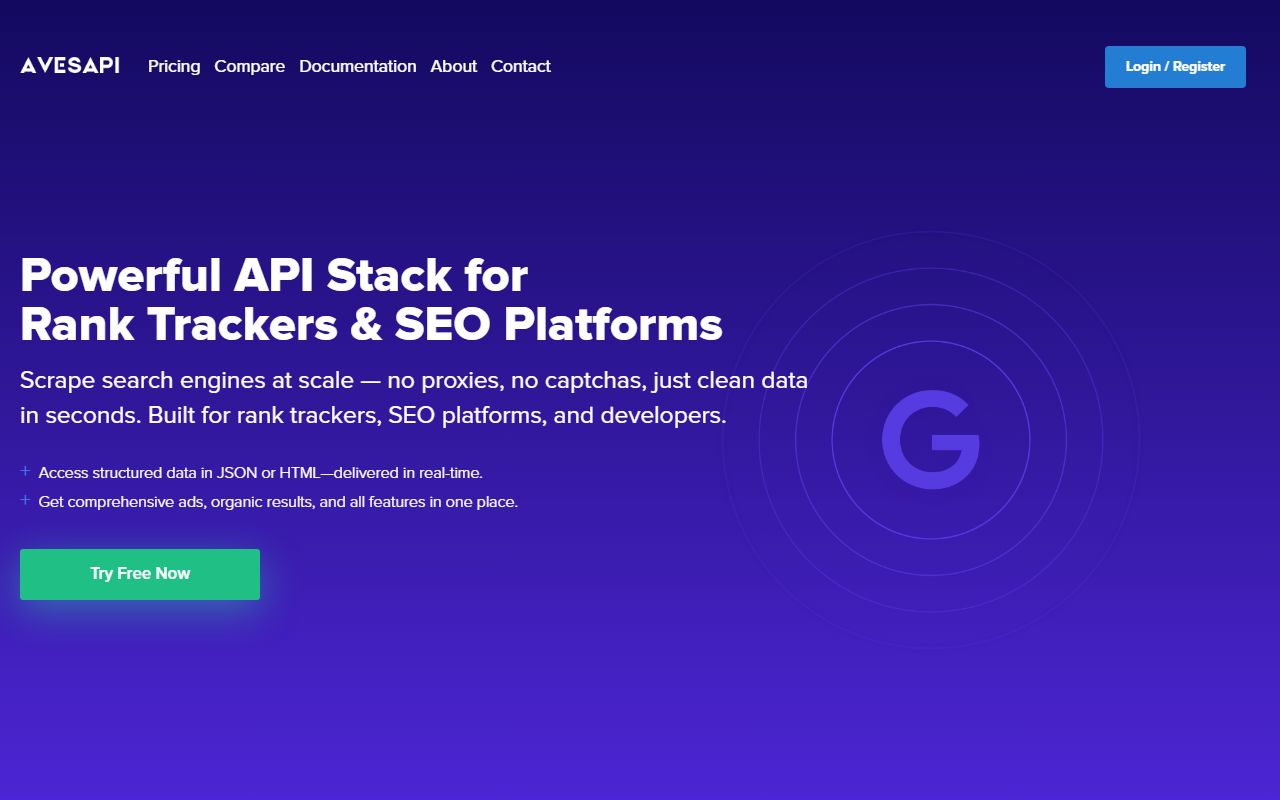
AvesAPI's homepage opens with a big purple Google G and the words 'Rank Trackers & SEO Platforms'. Let's take that promise apart layer by layer, then see what to reach for when the thing you need is backlink data.
Before we judge the product, let's read how the web links to it. In our index avesapi.com has 31 referring domains and 100 backlinks, DR 21, first seen 2024-07-12 and last seen 2026-09-07. 63 of the 100 links are dofollow. The average donor has DR 28, one donor (dev.to, DR 62) sits above DR 50, and nothing comes from .gov or .edu. Our index is a sample of the public web, so the true count is higher, but the shape is clear.
The biggest referrer is webscrapingapi.com: 12 dofollow links from 12 pages, which turn out to be three listicle articles repeated across language subdomains. That is another scraping-API vendor naming AvesAPI in its round-ups. Octoparse does the same from octoparse.com, octoparse.es and octoparse.fr, and the French copy produces the oddly literal anchor '7. AvesAPI', which is simply its list position. The strongest recurring non-rival is smythos.com (DR 38, 8 links) with anchors 'AvesAPI account' and 'profile page': which look like integration docs telling users where to find their key. Anchor text is almost all brand: 'AvesAPI' 38 times, 'Aves API' 9, 'Try AvesAPI' 5. The phrase 'SERP API' as an anchor barely appears. 71 of 100 links land on the bare homepage. You can browse the whole thing in the free explorer.
AvesAPI at a glance
- What it is
- A pay-per-request API that scrapes Google results in real time and returns JSON or HTML
- Built for
- 'Rank trackers, SEO platforms, and developers', in the homepage's own words
- Pricing model
- Prepaid packages, $0 for 1K searches up to $3,500 for 5M; no plan differences besides volume
- Auth
- API key passed as an
apikeyquery parameter; no header auth is documented - Online since
- Domain registered August 2020; the site names no founder, company or address
- Not included
- Backlinks, referring domains, domain metrics, keyword volumes, SDKs
Layer one: the promise on the hero
Open the homepage and you get one sentence that carries the whole business: 'Scrape search engines at scale — no proxies, no captchas, just clean data in seconds.' Underneath sit two bullets, JSON or HTML in real time, and ads plus organic results 'in one place'. A green 'Try Free Now' button sits where the price would be.
Read this way, the hero tells you who the page is written for: not a marketer looking for a dashboard, but a developer building a tool. The product is the removal of proxy and CAPTCHA handling, sold per request.
Notice what the promise does not say. It says 'search engines' in the plural, but the docs, FAQ and pricing page only ever name Google. So treat the plural as marketing, and check the docs for the engine you need before you plan around it.
Layer two: what one call looks like
The mechanism is refreshingly small. One HTTP GET to the search endpoint, with your key appended:
https://api.avesapi.com/search?apikey=YOUR_API_KEY&query=covid19
That example is from their docs. The parameter list is short: query, device (desktop or mobile), location from a downloadable places list, google_domain, gl, hl, num, page (1 to 10), uule, and output for json or html. The type parameter takes web, images, videos, news or shopping.
One gap worth knowing: the docs call web the default, but on the day we checked, a keyless call without type came back with a 400 and the message 'You did not provide search type.' Always send it explicitly. The docs footer also shows 'Last updated 5 years ago'.
The JSON response has three blocks: request (success flag, search URL, time taken in milliseconds), search_parameters, and result with total results, top ads and organic results. Each organic result carries position, block position, title, link and description. Errors use 400 with codes like 405 for a missing key and 429 when you run out of credits. That is a clean, predictable surface, and SmythOS lists AvesAPI as a ready-made integration in its agent builder.
Layer three: the price list, with the column they leave out
AvesAPI sells prepaid packages, not a monthly plan. The cards show no billing period, so please do not write '$50/month' in your budget doc. Here are the six cards, plus the per-1,000 column that the site does not print. That column is my arithmetic.
| Package | Price | Volume | Per 1,000 |
|---|---|---|---|
| Free test | $0 | 1K searches | free |
| Starter | $50 | 25K | $2.00 |
| Premium | $125 | 100K | $1.25 |
| Professional | $500 | 500K | $1.00 |
| Enterprise | $800 | 1M | $0.80 |
| Big-5M | $3,500 | 5M | $0.70 |
Every card lists the same three features: geo-targeted search, JSON or HTML export, live results. Tiers differ only in volume, which makes the decision easy: buy the smallest package that covers your month. The minimum commitment is $50, and only successful requests consume credits. Two independent blog tests also quote about $2 per 1,000 at the entry level, which matches the Starter card.
Compare the unit, too. One AvesAPI credit is one SERP page. One apibacklinks credit is $0.0001, and one call can return up to 1,000 rows, so the units are not interchangeable even before you look at the data.
Layer four: the fine print that changes your bill
Three details move the real cost, and all three are on the official site.
Operator queries cost 25 credits
The docs say operator searches are 'strictly prohibited' and that a query using site:, inurl:, link:, intitle:, cache:, before: or after: deducts 25 credits. The Terms repeat it as 'x25 instead of x1'. At Starter rates that is $0.05 per query, so 1,000 of them cost $50; at the 5M rate it is $0.0175 each. If your plan was to approximate backlink or index checks with link: and site: queries, this is the workload where the price per call is highest.
Credits expire, or maybe they do not
The homepage and pricing FAQ say each package is valid for 6 months. The same pricing page also says unused credits 'will be on your balance until you use them'. We report both because the site does; if the answer matters to your purchase, email them first and get it in writing.
Refunds: two stories
The homepage promises a refund for unused credits 'anytime'. The Terms say a refund is discretionary and only considered within 3 calendar days, with no more than 20% of the credits used. Terms also say a valid credit card is required. Plan on the stricter text.
Layer five: limits and things not published
A teardown has to list the empty slots as carefully as the full ones. Here is what we could not find after reading the homepage, docs, FAQ, Terms and sitemap:
- Rate limits: not published. The homepage invites 'concurrent requests' but gives no figure.
- Uptime or SLA: not published. 'Exceptional success rate' has no number next to it.
- Maximum
num: docs give only the default of 10 and pages 1 to 10. - SDKs: none mentioned, so you write the HTTP calls yourself.
- Company details: the site names no founder, legal entity or address. Third-party directories describe it as Istanbul-based with 1 to 10 employees, which we treat as unconfirmed.
On speed, the site's own table says 2 seconds on average. Two outside tests we read measured a 3.5s median with 9.5s at P95 in one, and a 5.2s median with 13.8s at P95 in the other. Both are single-vendor blog tests, one of which crowns a competitor, so read them as a hint to measure with your own keywords, not as a verdict.
The sitemap holds 259 URLs, 250 of them country landing pages all stamped 2020-02-19. Parts of the marketing site date from then, while the pricing page was changed later: a tracker logged the move from 'searches' to 'requests' in May 2026. Whatever the reason, test with your own keywords before you commit to a big package.
Where AvesAPI is the better choice
Let me be plain, because I would want a colleague to be plain with me. If your product needs to know what Google shows right now, you want AvesAPI or a peer of it, and apibacklinks is the wrong tool.
- Live rankings. A rank tracker needs today's positions for a keyword, device and location. We have no SERP data and no rank tracking.
- SERP features. Ads, images, videos, news and shopping blocks are what the product returns. We return link graphs.
- Freshness. Every call is a live fetch. Our index comes from our own web data and refreshes roughly monthly, so a brand-new link can take weeks to show.
- Pay as you scale. A volume-based package ladder with a one-thousand-search free test is a sensible way to prototype a tracker.
So if the sentence in your spec begins with 'for each keyword, fetch the top 10', stay with AvesAPI. The interesting question is the sentence that begins 'for each domain, tell me who links to it'.
Mapping their one endpoint to our nineteen
Here is the honest map: there is no overlap. AvesAPI has one search endpoint and an Instagram profile endpoint. apibacklinks has 19 actions on a single URL, https://apibacklinks.com/api.php?action=<action>&q=<domain>, and none of them is a SERP query. What the two share is the shape: GET requests, JSON back, a key in the query string. We also accept it as a Bearer header.
Where they meet is a workflow. Take a hypothetical team that runs a tracker on AvesAPI and wants to know why a competitor holds position 3. The SERP tells them who. Our domain and overview calls, which are free and need no key, give the DR and top referrers; refdomains lists up to 100 top donors; compare puts up to 20 domains side by side; intersect finds the referrers two to ten sites share. The API docs list every action, and the backlink API hub shows how we sit among the others.
One caution: our DR is our own 0 to 100 logarithmic score from referring-domain counts in our graph. It is comparable in spirit to other tools' scores and is not the same number. For example, avesapi.com is 21 here.
Pricing the same question on both sides
A hypothetical, so you can check my arithmetic. Suppose you want to size up 1,000 competitor domains. On a SERP API, the closest trick is one link: query per domain: 1,000 queries x 25 credits = 25,000 credits, which is the entire Starter package ($50) for a rough, indirect answer.
On apibacklinks, the same 1,000 domains go through bulk_dr, up to 2,000 domains in one request, for DR and counts. Then you pull 1,000 refdomains calls at 2 credits each: 2,000 credits, or $0.20. The referring-domain lists for all 1,000 targets come to about $0.20 of credit. The $100 starter credit on first Google sign-in (no card) covers that about 500 times over.
If you also need a SERP-side signal, keep AvesAPI for that and use our API for the link side.
apibacklinks vs AvesAPI
| apibacklinks | AvesAPI | |
|---|---|---|
| Core data | Backlinks, referring domains, anchors and DR from our own index | Live Google results (web, images, videos, news, shopping) |
| Backlink or domain-rating data | Yes, DR 0-100 plus 19 actions | None |
| Entry price | $0.10 per 1,000 lookups; $0.20 per 1,000 list calls | $2.00 per 1,000 searches (Starter, $50 for 25K) |
| Cheapest published rate | $0.10 per 1,000 calls | $0.70 per 1,000 (Big-5M, $3,500 for 5M) |
| Free tier | $100 starter credit on first Google sign-in, no card; core lookups free | 1K searches free test; card requirement not published |
| Subscription | None, per-call credits | Prepaid packages, valid 6 months per FAQ |
| Auth | key parameter or Bearer header | apikey query parameter; header auth not documented |
| Freshness | Refreshed roughly monthly, not real time | Live fetch on every call |
| Rate limits and SLA | Max 1,000 rows per call; no SLA claimed | Not published |
| SDKs | Plain HTTP GET and JSON | None mentioned in the docs |
Try it on avesapi.com
The top referring domains of avesapi.com, at 2 credits per call (the free <code>overview</code> action needs no key).
curl "https://apibacklinks.com/api.php?action=refdomains&q=avesapi.com&key=YOUR_KEY"
AvesAPI alternative — FAQ
Is apibacklinks a drop-in replacement for AvesAPI?
How much does AvesAPI cost per 1,000 requests?
Why do site: and link: queries matter?
Can I use both together?
bulk_dr or compare calls.Is the DR here the same as the one in other tools?
How fresh is your data compared with a live SERP call?
Backlink data for the price of a rounding error
Sign up, keep your $100 of credit, call the API today.
Get started free