

A Refstore alternative, tested on Refstore's own backlinks
Refstore sells rented text links by the month. To see what a backlink index can and cannot say about a marketplace, we ran refstore.net itself through ours and wrote down what came back.
We pointed our own index at refstore.net. It returned DR 12, 362 backlinks and only 7 referring domains, out of 181,132,097 domains in the graph. Four of the 362 links are dofollow, a share of 1.1%, and only 2 of the 7 referrers give any followed link at all. The links were first seen on 2025-08-11 and last seen on 2026-08-17.
One domain, rank.ru, supplies 240 of the 362 links (66.3%), spread over 13 pages and all nofollow. The next four are website-pruefen.de (39), dofair.org (36), directorylib.com (32, the highest-DR donor at 46) and valutahosting.it (12). Average donor DR is 23, and nothing sits at DR 50 or above. In other words, the footprint our index sees for this marketplace is made almost entirely of site-review pages that describe it, not of publisher pages that carry its links. You can reproduce all of this in the free explorer.
Refstore at a glance
- What it is
- A two-sided marketplace for static text links, booked per month by advertisers and installed by publishers
- Operator
- Internetservice Thomas Janke, a sole proprietorship in Röbel, Germany, per the imprint
- Pricing
- No price list published. The system scores each site automatically; the FAQ's only figure is an example of 9$ per month
- Billing
- Per link, 30-day months, drawn daily from prepaid credit, first debit after 24 hours
- Publisher rules
- Domain at least 6 months old, English pages, PHP snippet, 500 pages per web presence, manual review
- API
- None found; /api, /docs and /api-docs all return 404
- Domain registered
- 2021-04-09 (RDAP)
Page 1: the question and the instruments
Here is a simple exercise, and you can repeat it with us. Pick one domain. Run it through a backlink index. Write down every number before you form an opinion. The habit matters more than the domain.
Our subject today is refstore.net, a text-link marketplace. It is a good subject because it sits on both sides of the trade. It sells placements, so it should have a visible footprint if its own ecosystem works, and it is small enough that we can list every referring domain instead of sampling. A big site hides its quirks in the averages. A small one cannot.
Instruments: our free overview action, then refdomains and anchors, all against the same index of 13 crawl releases from 2025 to mid-2026. Two reminders before any numbers go in the notebook. The index is a broad sample of the web, refreshed roughly monthly, so a brand-new link can take weeks to appear. And our DR is our own metric, comparable in spirit to other tools but never equal to them.
Hypothesis written before looking: a marketplace that advertises "nofollow and dofollow (follow) backlinks" will show a mixed profile with a visible share of followed links from real sites.
Entry 1: seven doors into refstore.net
The full list of referring domains is short enough to copy by hand, so here it is, with the donor DR next to each:
| Referring domain | Links | Share | Dofollow | Donor DR |
|---|---|---|---|---|
| rank.ru | 240 | 66.3% | 0 | 33 |
| website-pruefen.de | 39 | 10.8% | 3 | 21 |
| dofair.org | 36 | 9.9% | 0 | 21 |
| directorylib.com | 32 | 8.8% | 0 | 46 |
| valutahosting.it | 12 | 3.3% | 0 | 21 |
| webvaluator.co | 2 | 0.6% | 1 | 10 |
| getwebvalue.net | 1 | 0.3% | 0 | 10 |
Notice the shape before the names. Two thirds from one source is a heavily concentrated profile. The TLD spread looks diverse at first (.ru, .de, .org, .it, .co, .com, .net, one each), but diversity of suffix is not diversity of source. Seven domains are seven domains.
Now the names. Rank.ru, website-pruefen.de, dofair.org and webvaluator.co are all automated site-review or valuation pages, and when we searched the open web for what it says about the brand, the same kinds of pages came back: a "Website review" on rank.ru, an "SEO Wert" report on website-pruefen.de, a "Website rating" on dofair.org, an estimated-worth widget on webvaluator.co. Not one forum thread, blog review or comparison article showed up. Observation: the crawl sees this brand through its reflections in checker tools.
Entry 3: counting the dofollow
The hypothesis predicted a visible share of followed links. The data says 4 of 362. Three come from website-pruefen.de with the anchor "refstore.net", one from webvaluator.co. That is 1.1%, from 2 of 7 domains, and the strongest donor in the whole list (directorylib.com, DR 46) gives only nofollow links.
I want to be careful here, because a lazy reader would conclude that the marketplace is failing at its own game. That is not what this shows. A marketplace's customers are the advertisers, and their links live on publisher pages; those publisher pages may well exist and may not have been caught by a monthly sample of the web. The index starts in 2025 and the domain dates from 2021, so "first seen August 2025" says nothing about its age. What the entry does show is narrower: the public, crawlable evidence for the brand is thin, and a buyer cannot read quality off it. Whatever you decide about a marketplace, decide it from the placements you actually receive.
Hypothesis result: not supported by our data. Confidence: modest, because 7 referrers is a small population and the crawl is a sample.
Entry 4: how a placement gets made, and what the billing does to your notes
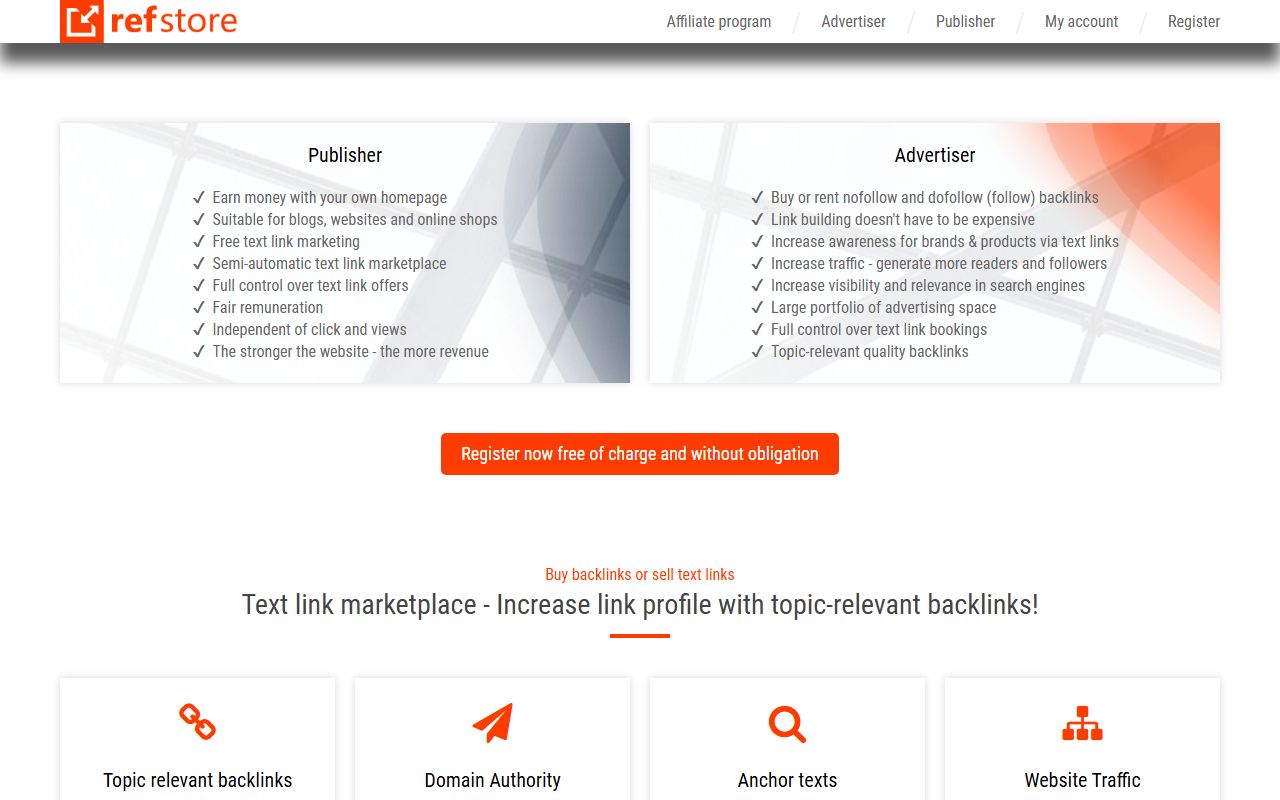
Now the other half of the notebook: the mechanism, taken straight from Refstore's own FAQ pages. The advertiser does not browse a catalogue with prices. They create a campaign, assign a category to their domain, set a cost limit, choose a quality level for the advertising sites, pick home page or subpages, pick topic categories and set a preferred position. Offers then "appear" in the account. The publisher side is a PHP snippet pasted into the page; the system spiders the page and offers it automatically, and each offer waits 7 days for a decision before it is placed on its own.
Prices are computed by the system. The FAQ says plainly that no price or income can be quoted in advance, names the MOZ Rank and Alexa Rank among the inputs, and adds link position, surrounding content, outbound link count and subpage count. We do not know whether those two named metrics are still the ones in use today. The only figure on the whole site is an illustration: a backlink at 9$ a month costs 0.30$ a day, drawn from prepaid credit, with the first debit after 24 hours.
"The prices displayed in your advertiser account for backlinks are per month, which means 30 days."
That 24-hour grace window matters for how you use us, so write it in the margin. Our index is refreshed roughly monthly. It cannot tell you within a day whether a new link exists, and it is not meant to. Use the marketplace's own dashboard for the first-day decision, and use the index for the month-two question: is this donor still linking, is the page one that the crawl reaches, and has the donor's referring-domain count grown or collapsed?
Entry 5: a before-and-after protocol for any rented placement
Here is the procedure I would hand a junior colleague. The numbers below are a hypothetical budget for illustration, not Refstore data: you rent ten links at the FAQ's example price of 9$ a month, so 90$ for a 30-day month.
- Before booking: run
domainon each candidate donor (1 credit each). Write down DR, referring domains and the dofollow count. A donor with a dozen referring domains and DR in single digits is a different purchase from one with thousands. - Look at the neighbourhood: call
refdomainsfor the donor and check who links to it. If its top referrers are all report-style pages like the ones in Entry 2, you are buying a page whose own authority is as thin as the target's. - After 30 to 60 days: run
backlinkswith the donor domain as a filter and your target URL as the destination. If the link is in the list, you have crawl evidence it exists. If not, remember the refresh lag before you complain. - Read the anchors: call
anchorson your own domain. Anything the platform's rules forbid, such as one-word anchors or "click", should not be there. - Repeat monthly and keep the rows in a spreadsheet.
Cost of the whole routine for the ten donors: ten domain calls at 1 credit, ten list calls at 2 credits, so 30 credits, which is $0.003. The starter credit of $100 covers a very large number of repeats. Details of every action are in the API reference.
Entry 6: where Refstore is the better choice
A good notebook records the result that goes against you. For anyone who wants to buy or sell a rented link, apibacklinks is simply the wrong tool, because we do not build, sell or index links. Refstore does the job we cannot do, and several things in its design are sensible.
- It handles the whole transaction. Registration, matching, prepaid credit, daily billing, and payouts with a 25€ minimum are all one account. We offer nothing like it.
- Manual review of publishers. Every publisher site is checked for spam, duplicate content, design and update frequency, and sites younger than six months are excluded. A raw data feed cannot make that call for you.
- Both sides can say no. Offers can be accepted or rejected, and the 24-hour grace period lets you remove a new booking at no cost.
- Self-policing. The platform says it checks the placed URLs at regular intervals and deletes bookings whose link is missing, with no payment for them. We cannot do that: we report what the crawl saw, weeks later.
- Anchor rules. Single-keyword anchors and generic ones like "here" are banned, and links must be readable inside a sentence.
Stay with Refstore if you are a small publisher with an English-language site who wants to rent out slots without negotiating, or an advertiser who prefers a managed marketplace to emailing site owners. Add us only if you want an outside check on the results. Neither of us promises rankings, and Refstore says so itself.
Margin notes: what this notebook cannot tell you
Every experiment has limits. Write them on the last page so you do not forget them.
- No price, so no cost comparison. Refstore publishes no price list, so there is nothing honest to set next to our $0.10 per 1,000 lookups. We compare the jobs, not the prices.
- The dashboard is invisible to us. The metrics an advertiser sees per offered site live behind the login, and we did not open an account. The homepage tiles mention Domain Authority and Website Traffic, but we cannot say what fields are shown.
- Newest dates are old. The most recent dates on the site are from 2023, so we cannot say how actively it is maintained in 2026.
- Small sample, one crawl family. Seven referring domains from a monthly-refreshed sample of our web index is not a verdict on the marketplace.
- No API on their side. If you want placement data in a script, we found no export or programmatic access, so the account dashboard looks like the only route. If your job is data, our overview of link-building tools shows where an API fits, and for a comparison with another link seller see our Pbn-backlinks alternative page.
The practical takeaway of the whole notebook fits in one line: buy where you can, and then measure with something that has no stake in the sale.
apibacklinks vs Refstore
| apibacklinks | Refstore | |
|---|---|---|
| Core job | Backlink and DR data; we build and sell no links | Marketplace for static text links rented per month |
| Price model | 1 credit = $0.0001; from $0.10 per 1,000 calls, $0.20 per 1,000 list calls | Per link per month, scored by the system; no price list published |
| Free start | $100 free credit on first Google sign-in, no card | Free registration, pay only for booked links; minimum deposit not published |
| API | 19 actions on one JSON endpoint, CORS enabled | None found |
| Authority metric | Our own DR 0-100 (refstore.net: DR 12 in our index) | Price formula names MOZ Rank and Alexa Rank; current metrics not published |
| Inventory size | No inventory; 181,132,097 domains in the index | Not published |
| Link verification | Crawl-based, refreshed roughly monthly, not real-time | Checks placed URLs at regular intervals; interval not published |
| Alerts and monitoring | None: no new/lost-link report, no alerts | Low-credit and price-limit e-mails; link reports not published |
| Ranking promise | None | None; the FAQ says nobody can guarantee better positions |
Try it on refstore.net
Start the notebook with the seven referring domains of the marketplace itself, then swap in your own donor candidates.
curl "https://apibacklinks.com/api.php?action=refdomains&q=refstore.net&key=YOUR_KEY"
Refstore alternative — FAQ
Is Refstore a service I can replace with apibacklinks?
Why does refstore.net show so few dofollow links in your index?
Does your DR of 12 match what other tools show for Refstore?
How do I confirm a rented link really exists?
Can I get Refstore prices from your API?
Is there a cost to running the checks in this notebook?
Backlink data for the price of a rounding error
Sign up, keep your $100 of credit, call the API today.
Get started free