

A PBN Backlinks alternative, logged over 30 days of vetting placements
PBN Backlinks sells "homepage backlinks" from custom-built networks and publishes no price. This is a hypothetical team's dated log of how they checked what a placement is worth with crawl data instead of a quote call.
Our index holds 14 backlinks to pbn-backlinks.com and gives the domain DR 7 on our own scale. The referring-domain count reads 2, but that is a parsing artifact: every one of the 14 source URLs sits on www.comestrutyourstuff.co.uk. The July crawl got filed under the bare suffix co.uk (8 links, shown as DR 37) and the June crawl under comestrutyourstuff.co.uk (6 links, DR 19). The honest reading is one donor at DR 19, which itself has 1,467 backlinks from 24 referring domains and was first seen on 2025-08-04.
All 14 links point at the homepage, all are dofollow, and none carries anchor text in our data. The linking pages are the donor's homepage, its category page, its author archive and posts about Thai visas, Turkish AI-SEO firms, LEED consultants in Switzerland and a mobile game. That spread is what a sitewide or homepage-wide placement looks like. First seen 2026-06-14, last seen 2026-07-11.
Pbn-backlinks at a glance
- What it is
- A seller of custom-built private blog networks and "homepage backlinks" built on expired domains.
- Company name on site
- "PBN Backlinks". No legal entity or named owner is published.
- Pricing
- Not published. Four tiers (Starter Network, Professional Suite, Enterprise Empire, Custom Maintenance), quote-based.
- Ordering
- No cart, checkout, form or login found. The "Request a quote" button leads to a services page.
- API
- None found.
- Our index
- DR 7 (our metric), 14 backlinks, 14 dofollow, first seen 2026-06-14, last seen 2026-07-11.
- Checked
- 2026-10-09
Day 0: the promise on the screen
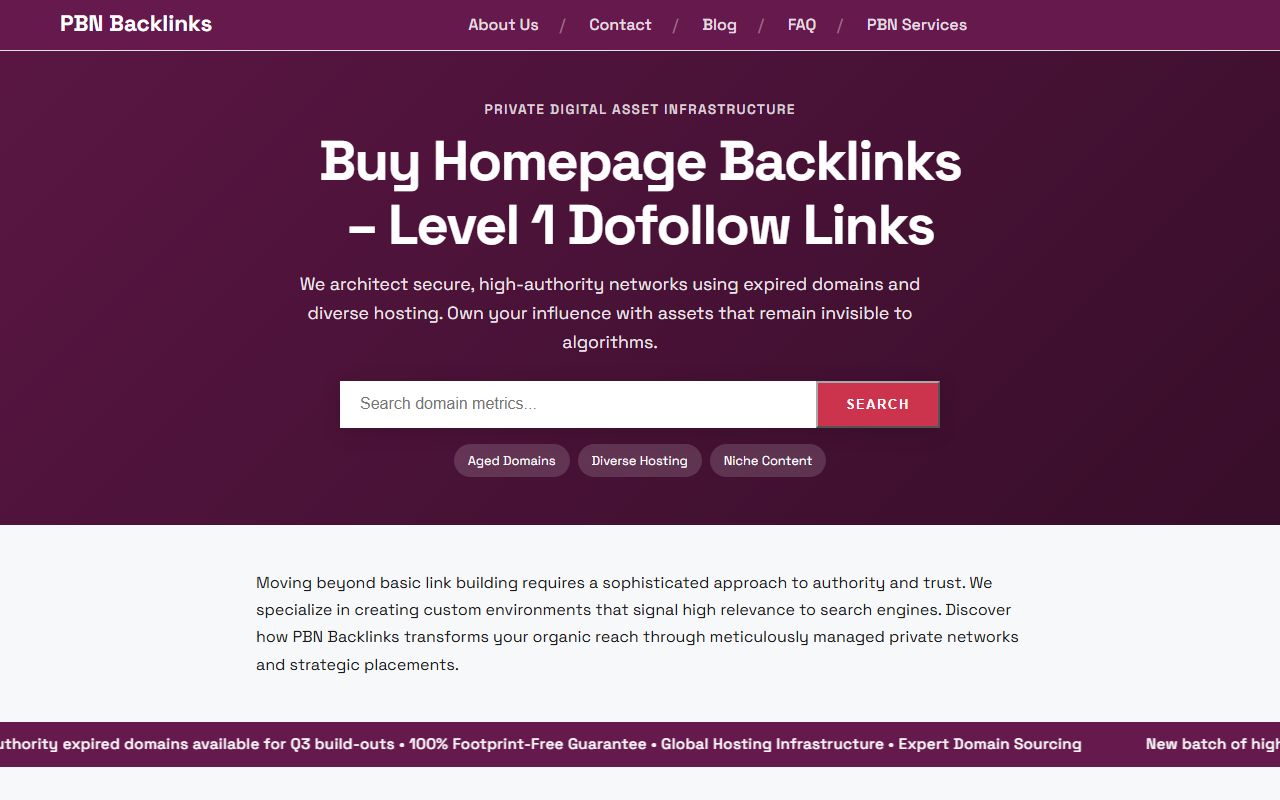
This diary is hypothetical. Picture a four-person agency, call it the team, that has a client in a competitive niche and a budget line for links. Someone pastes pbn-backlinks.com into the team chat. The page loads dark plum, with the headline "Buy Homepage Backlinks – Level 1 Dofollow Links" and a ticker along the bottom that mentions a "New batch of high-authority expired domains available for Q3 build-outs".
The first engineer on the thread, the one who always reads the fine print, notes three things in the log. The hero says the networks are made of "expired domains and diverse hosting". The page promises "assets that remain invisible to algorithms". And there is a search box that says "Search domain metrics...".
She tries the box with a client domain. It returns "No results for your query. Try a different search." That is the stock WordPress site search, not a metrics lookup, which is a useful early fact: whatever numbers the seller uses to pick donors, the site does not let a buyer query them.
The team's question is not whether to like PBN Backlinks. Buying placements is ordinary SEO work. The question is what they can check before and after money moves, and with which tool.
Day 2: the quote that has no number
Day 2 is reading the pricing page, titled "Transparent Pricing Plans for Custom PBN Networks". It names four tiers:
- Starter Network, for small businesses wanting an initial edge with a small cluster;
- Professional Suite, for growing agencies and mid-sized companies;
- Enterprise Empire, a large-scale network for high-competition niches;
- Custom Maintenance, ongoing management for existing networks.
No tier has a price, a currency or a billing period. The page lists cost components instead: "Fixed setup fees for domain procurement", "Monthly hosting and maintenance packages", "Content creation costs per article", "Tiered pricing based on total network size" and "Bulk discounts for agency partners". The contact page offers a "Free initial consultation" and "Custom quote generation based on niche".
The log entry reads: we cannot put this in a spreadsheet yet. Three of the five cost components recur or scale (hosting, content per article, network size), so the real cost depends on a number we only get after a call. The team writes down what they would ask: price per tier, contract length, what "monthly hosting" covers, and what happens to the links if they stop paying.
They also notice a tension the FAQ creates. The homepage says "Full Ownership" with "No monthly rental fees"; the FAQ says that "depending on your plan, you can either lease the authority or own the assets outright". Both can be true for different plans, which is exactly why the question goes on the list.
Day 5: reading the seller's own footprint
Day 5 is the first time the team uses crawl data instead of copy. They run the seller's own domain through the free overview action (or the explorer page, which needs no sign-in) and get the numbers in the box above: DR 7, 14 backlinks, all dofollow.
The log has three observations.
- One donor, not two. The refdomains table has two rows, but both are the same host. Anyone who reads "2 referring domains" without opening the rows would be off by a factor of two, and would also see a "DR 37" that is really the
co.uksuffix. Opening the rows is the whole job. - No anchors. The
anchorsaction returns zero rows for 14 links. Nothing branded, nothing keyword-like. That is consistent with image or bare-URL links. - Gone by today. A live fetch on 2026-10-09 finds no mention of pbn-backlinks.com on the donor's homepage, category page or author page, and one of the linking posts now returns 404. The crawl saw the link in June and July. It is not there now.
None of this is a verdict on what the seller sells to clients. It is one small, young domain with one visible link. But it shows the method: a placement leaves a trace in crawl data, and the trace can be read.
Day 9: the list of things nobody can verify
The research pass finds a thin public footprint. The team keeps a list titled "cannot verify from outside", and it is long:
- Who runs the business. The legal pages say only "the Site operator". The footer gives a Portland, Oregon address; the contact page gives a New York address and a 555 phone number. Those two contradict each other, so the log records both and asserts neither.
- How big the network is. Nothing on the site names a single donor domain, and the "Network Examples" gallery has captions ("Tech Niche Setup", "Health & Wellness Network", "Finance Authority Cluster") but no linked sites.
- Whether links are permanent or rented, how fast an order is delivered, and what the "100% Footprint-Free Guarantee" covers in practice.
- The case studies. The page has four unnamed one-liners; one says an electronics store saw "a 140% increase in organic traffic within 6 months". There is no client, date or chart.
The team also sees that the site's robots.txt blocks AhrefsBot, SemrushBot, MJ12bot, DotBot, rogerbot and a long tail of other SEO crawlers. That controls what those tools see on pbn-backlinks.com itself; it says nothing certain about the network sites. our web index's CCBot is not on the list, which is why our index has anything at all.
The point is not suspicion. A one-page brochure with a quote form is common for services sold by conversation. It just means the diligence has to come from the buyer's side.
Day 12: the audit script we built instead
On day 12 the team stops waiting for a quote and writes the audit they would want from any seller. The seller will propose donors; the script checks each one against crawl data. Four steps:
- Donor profile.
domainreturns DR, backlinks, referring domains, dofollow counts and first/last seen. It is free and needs no key. - Who links to the donor.
refdomainsreturns its top 100 referring domains with donor DR. A donor whose own links all come from three sibling sites reads very differently from one with 24 varied referrers, like the real donor above. - Page-level view.
backlinksfilters by source domain, minimum donor DR, follow type and date range, so the team can ask whether a given donor already links to a long list of unrelated domains. - Overlap.
intersecttakes 2 to 10 targets and returns the referring domains they share, which is how you spot two competitors buying from the same pool.
The arithmetic is small. Checking 200 candidate donors with the free domain action costs nothing. Twenty backlinks list calls cost 2 credits each, so 40 credits, which is $0.004 at $0.0001 per credit. The starter balance is $100 of free credit, so the audit never touches a card. The full action list is in the API docs.
The script has limits the team writes down plainly. Our DR is our own metric, comparable in spirit to other tools but not the same number. The index refreshes roughly monthly, so a link bought this week may not show for weeks. And it cannot tell the team whether a donor is topically right, only what the link graph looks like.
Day 16: where PBN Backlinks is the better choice
Day 16 is the honest entry. The team has an API and an audit script, and still concludes that for some jobs PBN Backlinks, or a seller like it, is the better route.
- You want the work done, not the data. The services page lists eight lines, from "Affordable Starter PBN Network Packages" to "Custom PBN Strategy for Agencies" with white-label solutions. We build no links and sell none. If nobody on your team wants to source expired domains, set up hosting and write content, an API does not help.
- You want setup help on assets you already own. The FAQ says they can "provide the infrastructure and management for domains you have already purchased". That is a service, not a dataset.
- You want a human to talk to. The contact page offers a consultation under a non-disclosure agreement. Some buyers prefer a call to a JSON response.
- You need niche-specific builds. There is a service page for niche networks and one for local SEO. Our index has no topical scoring, so we cannot tell you which donors fit your niche.
The team's rule of thumb: if the shortage is labour, buy from a seller; if the shortage is confidence in what you bought, use data. These are not exclusive. Many teams do both, and the audit script is how they judge the seller's output without asking the seller. The same logic applies to any marketplace; the backlinkmarketplace page walks through it for a listing-style seller.
Day 21: the check after the money moves
Suppose, hypothetically, the team orders three placements from a seller like this one. Day 21 is about proving they exist. The log sets a simple routine:
| Question | Call | What a good answer looks like |
|---|---|---|
| Is the link in crawl data? | backlinks with the target URL and source domain | A row with the source URL, rel and last seen date |
| Is it dofollow? | same, nofollow field | 0, if dofollow was the promise |
| What anchor did it use? | anchors | Matches the brief, not an empty cell |
| Is it still there next month? | repeat after a refresh | Same row, newer last seen |
The pbn-backlinks.com data is the cautionary example. A link that appears sitewide on a multi-topic blog shows up on a homepage, a category archive, an author page and unrelated posts. It was present in two crawls and then absent. If a seller promises a permanent placement, the second crawl is the receipt.
Because refreshes are monthly and not real-time, the team waits at least one cycle before complaining to anyone. A missing row after three days proves nothing; a missing row after two refreshes is a conversation to have with the seller.
Day 30: what the team keeps and what it drops
The diary ends with a short list rather than a verdict.
- Kept: a pre-purchase audit that runs on any donor the seller proposes, and a post-purchase check that runs monthly. Both use the same few actions and cost fractions of a cent.
- Dropped: the idea that a seller's own metrics are the whole story. Their ratings page names "Authority Score", "Trust Flow" and "Niche Relevance" but shows no ratings, so the team treats them as claims until a donor list arrives.
- Still open: the price. Until PBN Backlinks answers on a call, the team has no number to compare, and this page will not invent one.
If the team does talk to them, they take the donor list and run it through bulk_dr, which handles up to 2,000 domains per request, then through the checks above. For other tools in this space, the link building tools hub lists the rest.
apibacklinks vs Pbn-backlinks
| apibacklinks | Pbn-backlinks | |
|---|---|---|
| Price | From $0.10 per 1,000 lookups; $0.20 per 1,000 list calls | Not published; quote-based |
| Free tier | $100 free credit on first sign-in with Google, no card | No trial; a free initial consultation is offered |
| API | 19 actions on one JSON endpoint | None found |
| What you get | Link data: DR, referring domains, backlinks, anchors | Custom-built network placements and management |
| Builds or sells links | No | Yes, per its own site |
| Ordering | Self-serve key, no sales call | Quote request; no cart or checkout found |
| Donor list visible before buying | Any domain, via the free explorer | Not published |
| Freshness | Roughly monthly refresh, not real-time | Not published |
| Authority metric | Our own DR, 0-100; not Ahrefs DR or Moz DA | Names Authority Score, Trust Flow; no values shown |
| Alerts and monitoring | None | Claims weekly health checks of network nodes; no sample shown |
Try it on pbn-backlinks.com
This call lists the backlinks our index holds for the seller's own domain; swap in any domain you want to inspect.
curl "https://apibacklinks.com/api.php?action=backlinks&q=pbn-backlinks.com&key=YOUR_KEY"
Pbn-backlinks alternative — FAQ
Does PBN Backlinks publish its prices?
Does PBN Backlinks have an API?
Is apibacklinks a replacement for buying placements?
How many backlinks does pbn-backlinks.com itself have?
Can I check a seller's donor sites without a key?
domain and overview actions are free and need no key, and the explorer shows any domain's report in the browser. Listing actions such as backlinks and refdomains use credits, covered by the $100 starter balance.Will a link bought today show up in your data right away?
Backlink data for the price of a rounding error
Sign in with Google, keep your $100 of credit, call the API today.
Get started free