

A Domain Authority Checker alternative, after six myths get tested
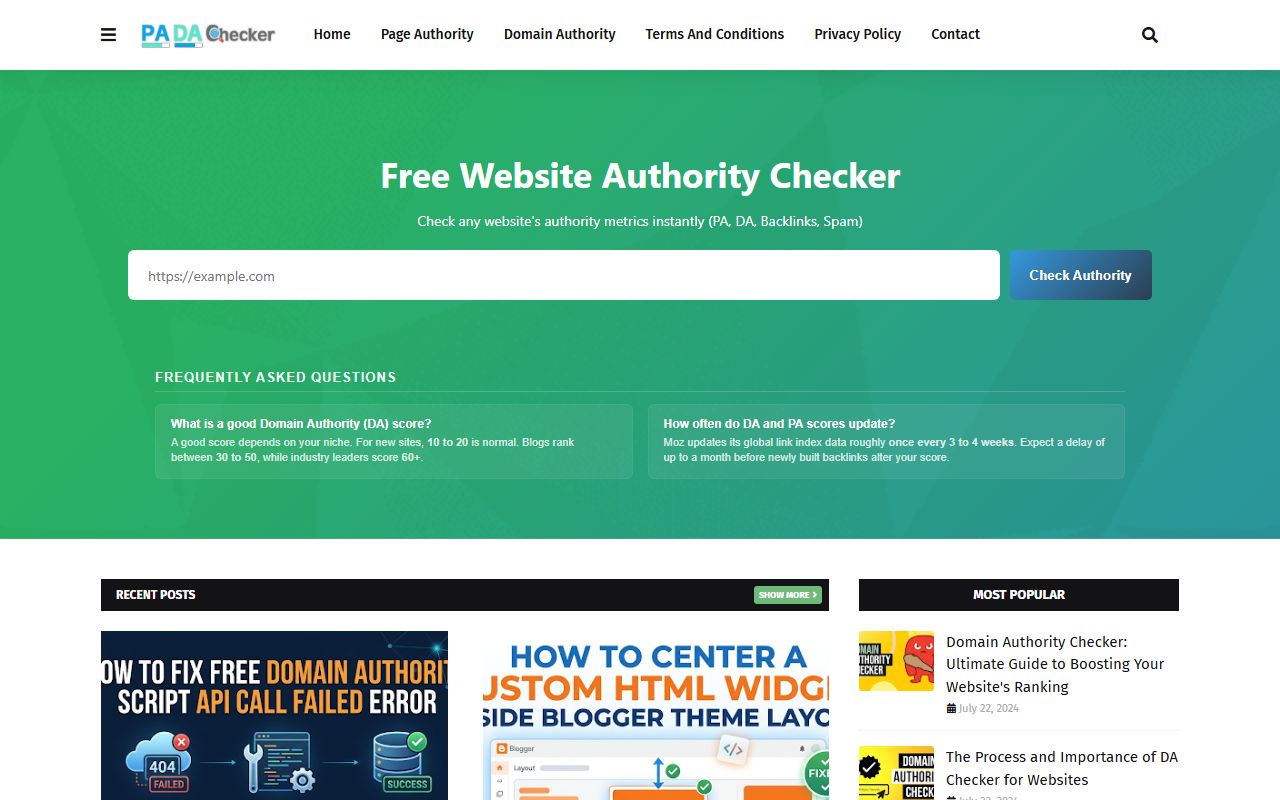
The Domain Authority Checker at padachecker.com reports backlink counts for any URL you give it. In our index, the site itself has exactly one backlink. We used that as a reason to check what people assume about single-URL authority forms.
A site that tells you how many backlinks other sites have is a fair thing to look up in turn. In our index, padachecker.com has DR 4, 1 referring domain and 1 backlink. That backlink is nofollow, so the dofollow share is 0%. The single referrer is blogger.com (donor DR 75), first and last seen on 2026-01-12, which is consistent with the platform's own listing of a blog hosted there, though we cannot confirm that from the data.
The only anchor is "Domain Authority Checker", which is the site's own page title. Nobody in our data calls it "Padachecker", and the one linked page is the homepage. our web index is a sample of the web, so a small site can have more links than we can see. Read this as "in our index", not as a verdict on the site.
Domain Authority Checker at a glance
- What it is
- A free website authority checker form plus an SEO-tips blog, hosted on Google Blogger.
- Output
- Four tiles: Page Authority (PA), Domain Authority (DA), Backlinks, Spam Score.
- Input
- One URL per check, placeholder
https://example.com, button "Check Authority". - Price
- Not published. The page is labelled "Free Website Authority Checker" with no stated daily limit.
- Public API
- None found. The site consumes a third-party API itself.
- Operator
- Not published. The About page is written in the first person singular.
- Earliest dated content
- Posts from July 22, 2024.
Myth 1: it is a Moz tool, so the numbers are Moz's
The page speaks Moz fluently. Its FAQ says "Moz updates its global link index data roughly once every 3 to 4 weeks", and the metrics are the familiar PA, DA and Spam Score. If you skim, it reads like an official Moz front door.
Fact: nothing on the site says it is affiliated with Moz. The homepage source shows the widget calling a third-party RapidAPI endpoint straight from the visitor's browser, with a fallback that opens moz.com in a new tab. That makes it a relay: Moz-style numbers delivered by someone else's API. We did not run a live check, so we cannot say how closely the values track Moz's own.
None of this is a flaw. Plenty of useful tools are thin wrappers. It does mean the form has no index of its own to inspect, and no way to answer "why this number?" beyond whatever the upstream returns.
A practical test for any relay: ask what happens when the upstream changes. A tool with its own index can explain a score drop by pointing at lost links. A relay shows what the upstream returned, and the page itself suggests trying again later if a score fails to display. Both approaches are legitimate and suit different jobs: one is a lookup, the other is an audit trail.
Myth 2: free means unlimited and always on
The headline is "Free Website Authority Checker" and there is no pricing page, no account area and no stated daily cap. It is tempting to read the silence as "no limits".
Fact: "not published" is the honest label for the limits. There is a hint of how the maker sees reliability, though. Under the tool sits this line: "If found any issues on displaying PA DA scores, Please try after few moments later." The blog also carries a post titled "How to Fix Free Domain Authority Script API Call Failed Error", which shows the site's author writes about API call failures.
A free tool that relays someone else's API depends on that API's quotas and availability. We did not research that API's limits. For a one-off look at a competitor's homepage, that is fine. For a report that must run at 9 a.m. every Monday, it is a risk you cannot price, because there is nothing to price.
A sensible habit with any free checker is to run the same URL twice, an hour apart, and note whether the tiles match. If they do, you can trust it for casual use. If they wobble, write the value down with the date and the tool name, so the number never travels without its source. We have not run that test on this form, so we make no claim either way.
Myth 4: one URL at a time is how people check authority
The form has one input and one button, so the workflow it teaches is: paste, click, read four tiles, repeat.
Fact: that is fine for ten URLs and tedious at a hundred. The site's own blog seems to know this. One of its posts is titled "How to Check DA PA for 100+ Websites at Once Without Registration", and another offers a bulk metrics script for PHP. Those are articles; the tool on the homepage itself is single-URL, with no bulk mode, export or history that we could find.
Our side of the arithmetic is simple. The bulk_dr action takes up to 2,000 domains in one request, and compare puts up to 20 side by side. A hundred-domain check is one call, not a hundred clicks. The domain rating tools hub maps the other options if you want to survey the category first.
Here is a worked example, and it is hypothetical. Suppose you keep a list of 250 candidate domains for a guest-post outreach round. With a single-URL form that is 250 pastes and 250 clicks, plus copying each result into a sheet by hand. With bulk_dr it is one request, because 250 fits well inside the 2,000-domain limit, and the JSON drops straight into a spreadsheet import. For 5 domains the form is simpler; by a few dozen, one request is less work.
Myth 5: DA, PA and DR are the same number wearing different hats
People swap these around constantly. A client asks for "DA 40" and an agency answers with a DR screenshot, and everyone nods.
Fact: they are separate metrics from separate indexes. The form reports Moz-style DA and PA. Our Domain Rating (DR) runs 0-100 on a logarithmic scale and is computed by us from referring-domain counts in our own graph. It is comparable in spirit and not the same: ahrefs.com itself shows DR 67 in our index, and you should expect other vendors' numbers for the same site to differ.
Two practical consequences. First, never mix scores from different tools in one spreadsheet column. Second, the form shows Spam Score and page-level PA, and we do not offer either. We have no spam or toxicity score, and no page-level authority. If your process needs those, the form is doing a job we are not.
If a deliverable names a specific metric, quote that metric and its source. If it names none, DR from our index is a reasonable first filter for a prospect list, because it is built from referring-domain counts you can inspect yourself through the refdomains action. That is the real difference: our number comes with the evidence behind it, one call away.
Myth 6: authority scores are live
The result tiles appear within moments of clicking, which feels like a live reading.
Fact: the site's own FAQ answers this: expect "a delay of up to a month before newly built backlinks alter your score." That is the honest cadence of any link-index score.
Ours is no faster, and we say so plainly. The index is built from 13 crawl releases (2025 to mid-2026) and refreshed roughly monthly as new releases are processed. It is not real-time, and a brand-new link can take weeks to show up. If your question is "did the link I placed this morning land?", neither tool is the right instrument. If it is "what does this domain's profile look like over the past year?", both can answer.
One more reading of the same FAQ: a score that moves monthly is a trend indicator, not a stopwatch. Check a domain, check it again next month, and compare. Do not refresh the page ten times and expect the value to move.
Where Domain Authority Checker is the better choice
Three cases favour the form, and we would rather say so than pretend otherwise.
- You need Moz-style numbers. A client, a marketplace or a colleague asks specifically for DA, PA or Spam Score. Our DR is a different metric and cannot stand in for them.
- You need page-level data. The form accepts a full URL and returns PA. We work at the domain level for scoring.
- You want zero ceremony. Open a page, paste a URL, read four tiles. No key, no code, no JSON. For a non-developer doing a quick sanity check, that is hard to beat.
The site also publishes guides on how to read the numbers, including a FAQ that puts "good" DA at 10 to 20 for new sites, 30 to 50 for blogs and 60+ for industry leaders. For someone learning the vocabulary, that is a reasonable starting point. If that describes you, keep using it.
Where a free DR endpoint takes over
The switch point is a list, a schedule or a spreadsheet. The domain and overview actions are free and need no key, so you can try them before deciding anything. Paid actions cost from $0.10 per 1,000 calls, and new accounts get $100 of free credit on first sign-in with Google, with no card and no subscription. The full action list is in the API docs.
What you get beyond a score: the top referring domains for a target, with donor DR; anchors; top linked pages; intersect to find referrers shared by 2 to 10 targets. What you do not get: Spam Score, page-level authority, new and lost link reports, alerts or dashboards. We provide data, not a workflow around it.
apibacklinks vs Domain Authority Checker
| apibacklinks | Domain Authority Checker | |
|---|---|---|
| Metric shown | Domain Rating (DR) 0-100, our own metric | PA, DA, Backlinks, Spam Score (Moz-style) |
| Input | Up to 2,000 domains per bulk_dr request | One URL per check |
| Account needed | None for domain and overview | No sign-up seen on the site |
| Price | Free actions at 0; from $0.10 per 1,000 paid calls | Not published (labelled free) |
| Public API | Yes, 19 actions on one JSON endpoint | None found |
| Own link index | Yes, 181,132,097 domains from our own web data | Not published; the form calls a third-party API |
| Spam or toxicity score | No | Spam Score tile |
| Page-level authority | No | Page Authority (PA) tile |
| Bulk and export | Bulk lookups; JSON for your own export | Not published for the tool |
Try it on padachecker.com
Pull the top referring domains behind padachecker.com, with donor DR, in one call.
curl "https://apibacklinks.com/api.php?action=refdomains&q=padachecker.com&key=YOUR_KEY"
Domain Authority Checker alternative — FAQ
Is the Domain Authority Checker an official Moz product?
Does apibacklinks show Domain Authority?
Can I check many domains at once?
bulk_dr action returns DR and counts for up to 2,000 domains in a single request, and compare handles up to 20 side by side.How fresh are the numbers?
What does apibacklinks cost?
Do you offer spam scores or alerts for new links?
Backlink data for the price of a rounding error
Sign up, keep your $100 of credit, call the API today.
Get started free