

An LRT alternative, explained for someone who has never opened a backlink report
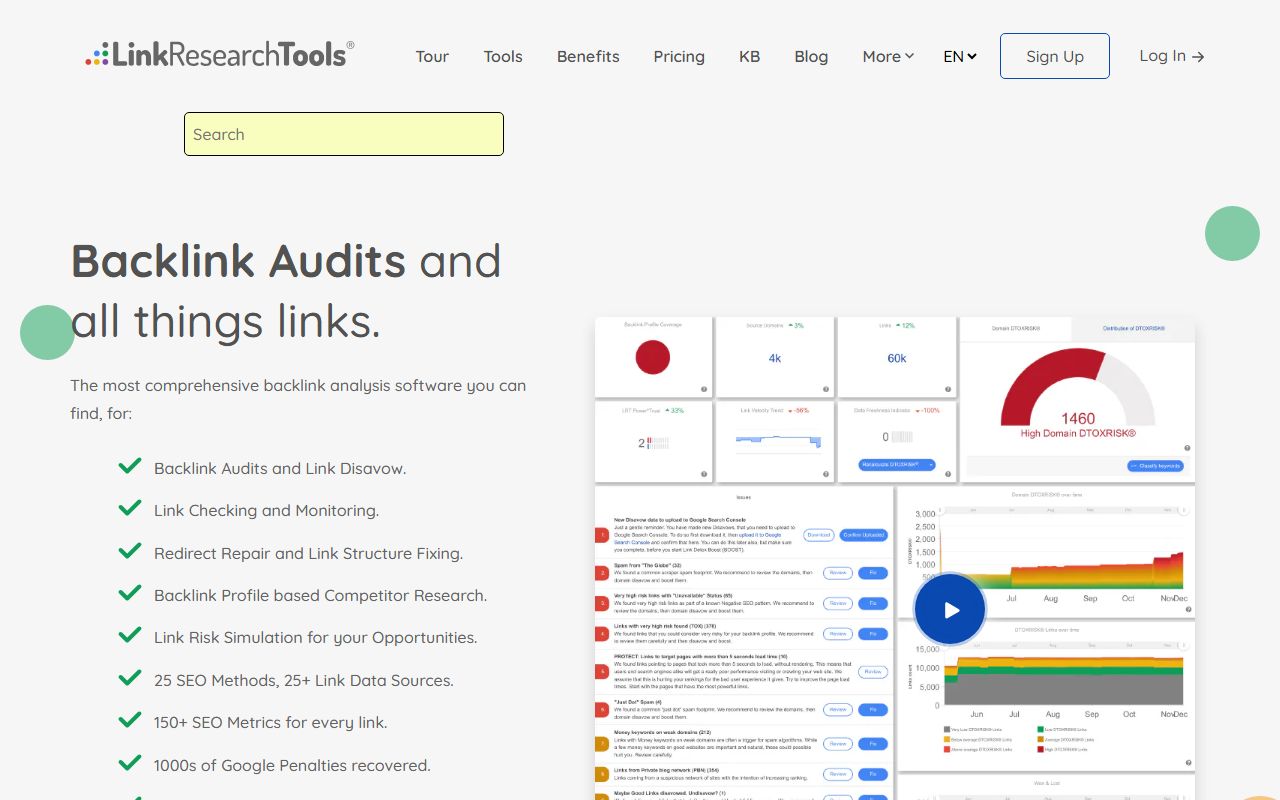
LRT's homepage shows a dial in the red reading 1460 “High Domain DTOXRISK®”. This guide explains, with one long mail-room analogy, what that dial is built from, who needs it, and when a plain JSON call does the job.
Our index knows LRT's own domain as DR 44 (our metric, not Ahrefs DR) with 1,571 referring domains and 8,817 backlinks, 74.7% of them dofollow. The first time our index data saw a link was 2024-07-12; the company itself launched in 2009, so that date is about our data, not about LRT.
The most interesting row in the mailbag is who writes the most letters. toxiclink.com, a small DR 8 site signed by the founder, sends 483 links from 40 pages, 5.5% of everything pointing at LRT. Two Stephan Spencer sites, marketingspeak.com (380) and stephanspencer.com (204), add 584 more, mostly from a 2017 podcast about link building. The top anchor is the three-word “Link Research Tools” (1,115 links), ahead of the official one-word spelling (905). “Link Detox”, the product, ranks third with 276 links.
LRT at a glance
- What it is
- Backlink audit, link monitoring and link-risk software; the homepage headline is “Backlink Audits and all things links.”
- Who runs it
- LinkResearchTools GmbH (Vienna postal address, 100% remote); founder and CEO Christoph C. Cemper; launched to the public in 2009 per its About page.
- Data model
- Combines link data from “25+ link data sources”, then re-crawls it for every report.
- Price
- Superhero Small $599/month, Standard $999, Plus $2,499; Enterprise by quote. Trial: $17 for 7 days, then $599.
- Free tier
- No free plan listed; four small tools are tagged free on its tools page.
- API
- Documented Bulk URL Analyzer API (asynchronous, up to 10,000 URLs per query), for internal use only; no separate API price published.
The red dial, and the mail room we'll use to read it
Open LRT's homepage and your eye lands on a dashboard picture. In the middle sits a half-circle gauge, filled red, with the number 1460 and the words “High Domain DTOXRISK®”. Around it are tiles: source domains, links, a Power*Trust figure, a Link Velocity Trend. Below, a list of “Issues” with small Review and Fix buttons.
If you have never looked at a backlink report, that picture is a lot. So let's slow down and use a story. Imagine every website is a house, and every link to it is a letter someone mailed about the house. A glowing letter from a respected newspaper is good. A pile of identical letters from strangers who clearly never saw the house is odd. A backlink report is simply the contents of the house's mailbox, sorted.
Now picture two very different mail-room services. One sends a detective who gathers letters from many post offices, walks to each return address to check it still exists, and hands you a graded report with a red-amber-green verdict. The other is a big filing cabinet: you ask for a house, and it slides out the letters it has, as rows, and you do the reading. LRT is the detective. apibacklinks is the filing cabinet. The rest of this guide keeps returning to that picture, because it explains almost every difference between the two.
Meet the detective: what LRT does with the letters
LRT describes itself as software for “Backlink Audits and Link Disavow”, “Link Checking and Monitoring”, “Redirect Repair”, “Backlink Profile based Competitor Research” and “Link Risk Simulation”. Its site says it combines link data from “25+ link data sources”, then cleans, re-crawls and verifies it, so that “You get a new crawl with every report you create.”
In mail-room terms: the detective does not own one giant post office. It collects what many post offices report, including ones you can plug in yourself (Ahrefs, Majestic, Semrush, Sistrix and Google Search Console are named in its docs), then visits each address to see whether the letter is still there. Its pitch is that most tools show you stale fragments, while its re-crawl catches links that “have change weeks ago” (its wording).
The company has a long history behind this. It says it started as an internal toolkit for founder Christoph C. Cemper's own link-building agency, opened to the public in 2009, and rebuilt its “Smart” line in 2019. Its home page claims 75,000+ users and 10,000+ recovered penalties; those are the company's own counters, and we have not verified them.
The part a newcomer should learn first is Link Detox. It reads each letter and flags the strange ones, then rolls the result into the red-or-green score you saw on the dial. The plans also include a set of 25 classic tools such as Backlink Profiler, Link Alerts, Link Recover Tool and Bulk URL Profiler. Think of them as separate desks in the detective's office.
Postage stamps: how the monthly bill is built
Detectives who re-visit addresses cost money, and LRT meters that with a Link Crawl Budget. Think of it as an allowance of postage: the more links LRT re-crawls for you, the more of the budget you use (the pricing page does not define the unit more exactly). Here is what the official pricing page shows, read on 2026-10-09 (dollar and euro figures are identical):
| Plan | Per month | Per year | Crawl budget (monthly term) | Support |
|---|---|---|---|---|
| Superhero Small | $599 | $5,799 | 1 million | |
| Superhero Standard | $999 | $9,499 | 6 million | Live chat, email |
| Superhero Plus | $2,499 | $23,999 | 18 million | Live chat, email |
| Enterprise | Bespoke | Bespoke | Bespoke | Phone, chat, email |
Three details trip up beginners. First, domains and users read “Unlimited*”, but the asterisk says the crawl budget is the real limit. Second, unused budget resets and is “lost” at the end of the period, like a phone data allowance. Third, risk scores (LRT Risk™) and PDF reports start at Standard; Small includes disavow file management but not those.
The entry door is a paid trial: $17 for 7 days, then $599. The site says the trial does not allow data export. Paying for twelve months on Small costs $5,799 against 12 × $599 = $7,188 month to month. Price of extra crawl budget (add-ons) is not published.
Where the detective is simply the better hire
A fair guide has to say this plainly: for several jobs, our filing cabinet is the wrong tool and LRT is the right one.
- You have received a manual action or suspect a spam attack. LRT's whole design is audit and recovery: risk scoring, a managed disavow file with version history, and monitoring that, in its words, spots negative-SEO link spikes. We have no risk score, no disavow tooling and no alerts.
- You need freshly verified links. LRT re-crawls on every report. Our index comes from our own web data and refreshes roughly monthly, so a brand-new link can take weeks to appear.
- You hand clients a document. PDF reports with explanations, summary emails and a dashboard are product features at LRT. We return JSON.
- You want several sources merged. LRT lets you upload data from other providers and Google Search Console and blends them. We have one source.
- You want a person to talk to. Higher plans include live chat and, at Enterprise, phone, training and consulting.
If that list describes your week, stay with LRT, or start its trial.
The filing cabinet: what one API call hands you instead
apibacklinks is a JSON API over our own backlink index: 181,132,097 domains, 2,774,625,913 domain-to-domain links and about 798.6 billion page-level backlinks, built from 13 crawl snapshots (2025 to mid-2026). You ask a question in a URL and get rows back. Our metric, Domain Rating (DR), runs 0 to 100 and is computed by us from referring-domain counts; it is comparable in spirit to other DR or DA scores but not the same number.
Here is how the beginner view of LRT's mailbox maps onto calls you can make yourself:
- “How many letters, from how many senders?” is the free
domainaction. - “Who are the top senders?” is
refdomains, up to 100 domains with link counts, dofollow counts and donor DR. - “What do the letters say about me?” is
anchors(top 50 anchor texts) andbacklinks, which filters by follow type, source TLD, anchor text or minimum donor DR. - “Which senders write to my rivals but not me?” is
intersect, which finds referring domains shared by 2 to 10 targets. This is the same idea behind LRT's Common Backlinks Tool. - “Compare ten houses at once” is
compare(up to 20 domains) orbulk_dr(up to 2,000).
You can see the same answers in a browser first, with no sign-in, in the free explorer. The calls are documented on the API docs page.
What you will not get is a verdict. We return no toxicity score, no new-or-lost report and no monitoring. The cabinet shows you the letters; deciding which ones are suspicious is your job, or your script's.
Reading a mailbag yourself: three things LRT's own letters teach
The best way to learn is to read a real mailbag. We pulled LRT's own from our index. Notice what a newcomer can see without any risk score.
One sender can dominate
toxiclink.com, DR 8, sends 483 links from only 40 pages. Seven anchors repeat almost identically, six of them exactly 58 times each (“About Link Detox®”, “Deep Dive into Toxic Links”, “Penguin 2.0 brought Toxic Redirects” and so on). That pattern looks like a menu or footer block repeated down a site, not 58 separate citations. The lesson for a beginner: count links, but also count pages and repeated anchors before you call a number impressive.
A single event can echo for years
A two-part 2017 podcast with the founder is still behind roughly 584 dofollow links across two sites run by the same podcast host. One interview, hundreds of rows. When you read someone's profile, ask which few events made most of it.
Big names do not always pass the same kind of link
moz.com sends 102 links to LRT, only 26 of them dofollow. searchenginejournal.com sends 28, five dofollow. Overall dofollow share is 74.7%, but it drops where the sender's DR is highest, which is common for publishers. And a sidenote on spelling: people mostly write the brand as “Link Research Tools”, three words, 1,115 times, while the company writes one word.
None of this required a score. It required a table of senders, a table of anchors and a minute of curiosity, which is exactly what the cabinet gives you.
The API question, asked in both directions
Newcomers often ask whether LRT has an API they could call instead of using the dashboard. It does, and it is narrower than it sounds. The public docs describe a Bulk URL Analyzer API: you start a report with a list of URLs, receive a report ID, and poll for results. One query can check up to 10,000 URLs, and an API query counts as a report, so it uses credits from your plan. The docs show no endpoint that returns the backlink list of a domain. The documentation also says the API is meant for internal applications and that reselling data in public applications needs a reseller license.
Which plans include API access, the monthly allowance and any separate API price are not published on the pricing page.
Our API works the other way round. It is one endpoint, and the free actions cost nothing. A lookup is 1 credit, a list call is 2, and one credit is $0.0001, so a list call is $0.0002 and 1,000 of them cost $0.20. Each can return up to 1,000 rows. Your first Google sign-in grants $100 of credit (1,000,000 credits, enough for 500,000 list calls) with no card. To compare scale, $599 at our rates is 5,990,000 credits, or 2,995,000 list calls. That is arithmetic, not a like-for-like claim, because the two services sell different things: a graded, re-crawled audit versus rows from a monthly-refreshed sample.
Which door to knock on first
Back to the mail room. Here is a plain way to choose.
- You are new and just curious about a site's links. Start with the free explorer or the free
domainandoverviewcalls. No payment, no trial clock. - You are building a dashboard, a script or a lead list. Use the API. A dashboard that someone else designed gets in the way here.
- You track keyword positions rather than links. That is another job, not covered by either of the two products here. Our SearchEngineReports comparison and Linkody comparison look at other tools in this space.
- You are a team that will audit links every month, produce disavow files and report to clients. Try LRT's $17 trial, and keep our API for quick, cheap lookups alongside it. The two do not overlap much.
- You are comparing several checkers. The backlink checkers hub lays them side by side.
And if you take one idea away: a score is somebody's opinion of the letters, while a row is the letter itself. Newcomers do well to learn to read rows first, because it makes every score easier to judge later.
apibacklinks vs LRT
| apibacklinks | LRT | |
|---|---|---|
| What you get back | Raw JSON rows: counts, referring domains, backlinks, anchors, pages | Dashboard with audits, risk scores and PDF reports; Bulk URL Analyzer API returns metrics per URL |
| Where the data comes from | Our own index built from 13 crawl snapshots (181,132,097 domains) | 25+ link data sources combined and re-crawled per report; index size not published |
| Freshness | Refreshed roughly monthly, not real-time | Re-crawls links for every report you create |
| Entry price | $100 free credit on first Google sign-in, no card | $17 for 7 days, then $599 per month; no free plan listed |
| Ongoing price | From $0.10 per 1,000 lookups; $0.20 per 1,000 list calls | $599, $999 or $2,499 per month (Small, Standard, Plus); Enterprise by quote |
| Risk scoring and disavow | None | LRT Risk™, Link Detox and disavow file management with version history |
| Monitoring and alerts | None | Link monitoring and Link Alerts |
| API access | 19 actions on one endpoint, key or Bearer token for paid actions | Documented Bulk URL Analyzer API, up to 10,000 URLs per query; plan allowance not published |
| Resale of data | Check the API docs for current terms | API for internal use only; reseller license needed for public apps |
| Raw data export | JSON rows, up to 1,000 per call | XLS, CSV, PDF exports; raw source-data export “is not possible” |
Try it on linkresearchtools.com
Start with the free overview, then list the top senders to LRT's own domain.
curl "https://apibacklinks.com/api.php?action=overview&q=linkresearchtools.com"
curl "https://apibacklinks.com/api.php?action=refdomains&q=linkresearchtools.com&per=20&key=YOUR_KEY"
LRT alternative — FAQ
Is apibacklinks a replacement for LRT?
What does the red number on LRT's homepage mean?
Can LRT's API list the backlinks of a domain?
Is our DR the same as the score LRT shows?
Is LRT worth the money for a small site?
How current is your data compared with a re-crawling tool?
Backlink data for the price of a rounding error
Sign up, keep your $100 of credit, call the API today.
Get started free