

A SpyFu alternative for backlink data: notes from the architecture side
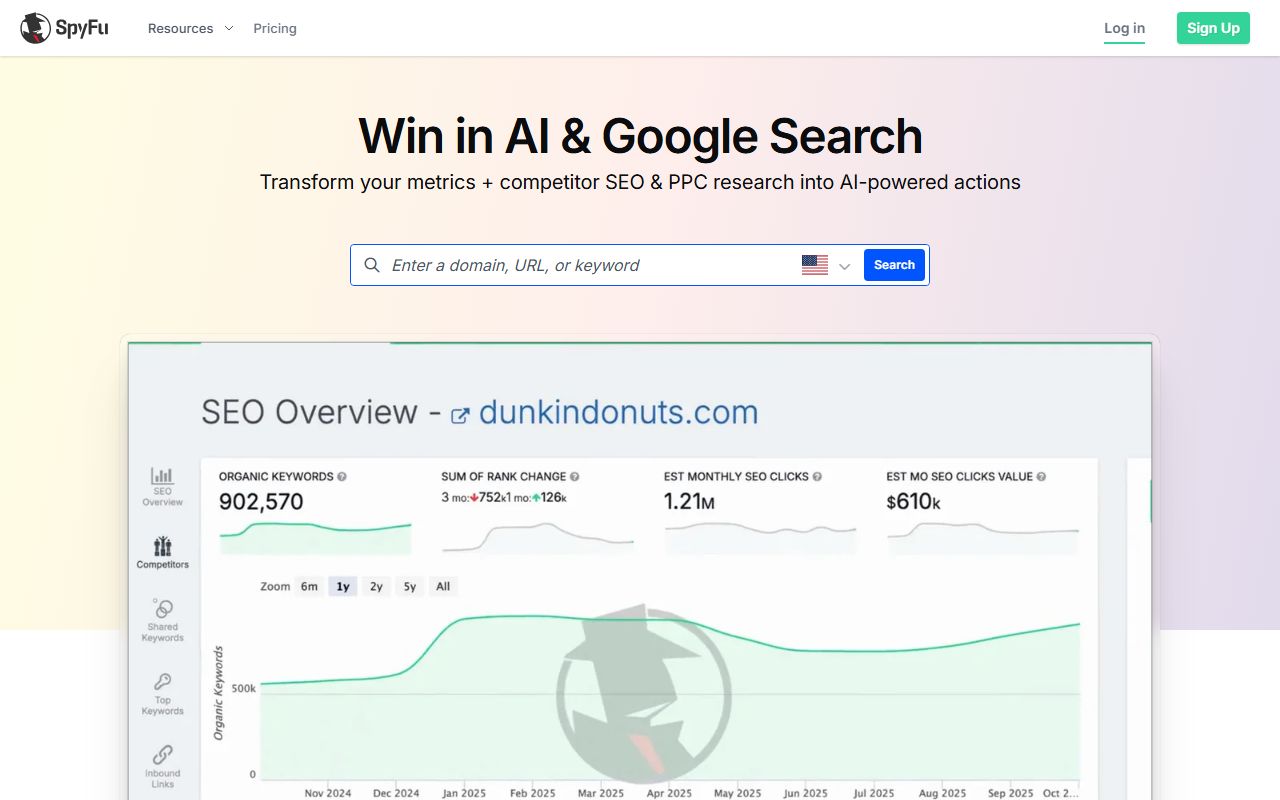
SpyFu's homepage is one search box and a dunkindonuts.com demo with 902,570 organic keywords, and backlinks appear as 'Inbound Links' in the left rail. These notes follow that rail item down to its data source and compare it with a plain JSON API.
We pointed our own index at spyfu.com and the profile says more about SpyFu's product design than about its marketing. It shows DR 55 (our metric, not Ahrefs DR and not SpyFu's Domain Strength), 10,189 referring domains and 221,803 backlinks, 82.9% of them dofollow. The pattern is stranger than the totals. In the 50 most-linked URLs, 43 are /overview/…?query= report pages about other people's websites, and in the top 100 referring domains, 61 use such a report URL as their main anchor. Those links total 75,524, or 34% of all backlinks. A free, crawlable report for every domain works as a link magnet: site owners, and some low-quality networks, point at 'their' SpyFu page.
Dates matter here. Twenty-three of the top 100 referrers (b4closing.com, nutrapia.com, webgomme.com, 824989.com and others) were seen only between 2024-07-12 and 2024-07-18, and together they carry 50,653 links, 22.8% of the profile. A group of 28 Chennai car-rental sites (the grouping is ours, by domain name and identical anchor pattern) adds 12,387 links, and the security site phishdestroy.io links from 10,404 pages with zero dofollow. Editorial mentions are small: moz.com 502 links, thecmo.com 732 with the anchor 'Best for competitor analysis'. Brand anchors (SpyFu, Spyfu, SpyFu.com and variants) are only 18.3% of the total. This is a sample of the public web, so read it as a sketch, not a census.
SpyFu, Inc. at a glance
- What it is
- A competitor-research suite for Google Ads (PPC) and SEO: keywords, ad history, rank tracking, backlinks, site audit, AI tools.
- Company
- SpyFu, Inc., Scottsdale, Arizona. The company says it was founded in 2006 and is self-funded and profitable.
- Backlink source
- Links found on pages that rank in Google results, deduplicated. Index size and refresh rate: not published.
- Plans
- Basic $39/month ($29 billed annually), Pro + AI $119/month ($89 annually), Team/Agency $249/month ($187 annually). Checked 2026-10-09.
- API
- Documented REST API, included from Pro + AI with a $40 monthly credit (Team/Agency: $100). Billed per row returned.
- Free use
- A free version without a time limit; how many rows it shows is not published.
One search box, five rail items, and where backlinks sit
Let me walk you through this the way I would with a new engineer on the team. Open the SpyFu homepage and you see a box that says 'Enter a domain, URL, or keyword', a country selector and a blue Search button. Below it is a demo dashboard for dunkindonuts.com: 902,570 organic keywords, 1.21M estimated monthly SEO clicks, a year-long line chart. Down the left edge runs the app's rail: SEO Overview, Competitors, Shared Keywords, Top Keywords, Inbound Links (the screenshot cuts off below that).
That ordering is the architecture in miniature. The product is a keyword-and-ads engine, and the homepage describes it as 'Win in AI & Google Search'. Backlinks are one view among several, and the vendor's backlink pages are built around keywords: you can filter inbound links by a phrase and focus on pages that rank for it.
If you are choosing a backlink source, start by deciding which of the two things you need: a feature of a keyword product, or a dataset you can query. Everything below follows from that choice.
Data flow: from a ranking page to a row in the table
SpyFu's help centre explains the pipeline clearly, and it is worth reading because it tells you what the table can and cannot contain. The crawler starts from ranking pages: when it discovers a newly ranked page, it crawls that page and collects its outbound links. Anything it records has therefore been seen on a page that Google returned in its top results, and duplicates are removed. A page that never ranks never enters the funnel, even if it links to you a thousand times.
The vendor states the intent in its own words:
It's not an audit. It's more of a discovery system.
The same help text says the tool is not meant for auditing your own link list. I would take that at face value and design around it. For competitor research the filter is a gift: you get links that are alive, indexed and sitting on pages that already earn visibility, plus filters for blogs, news, forums, .gov/.edu and affiliate-link pages, and a two-domain mode (Backlink Kombat) that shows pages linking to both sites. The columns the help glossary lists include domain and page monthly organic clicks, ranked keywords and outbound links.
Our pipeline runs the other way round. It starts from a crawl's hyperlink graph and keeps edges whether or not the source page ranks for anything. Different input, different table.
Failure modes when a discovery table is used as an audit
Every component has a way of failing quietly. Here are the ones I would write on the whiteboard for SpyFu's inbound-links view, each tied to something the vendor published:
- Invisible links. Links from pages outside Google's top results are not in the funnel. The help centre's own example is a page that does not rank in the top 100 and therefore never reaches the crawler.
- Counts that do not reconcile. The glossary says results may be a smaller set than what really sits on the domain, because duplicates are removed and only Google-indexed links are shown. Do not compare its totals with another tool's referring-domain count.
- A score with a different meaning. SpyFu's 0 to 100 Domain Strength is described as rating how consistently a domain ranks on top searches. That is a rankings-based signal. Our DR is computed from referring-domain counts in a link graph. Neither is wrong, but a number from one cannot stand in for the other.
- Unpublished freshness. The homepage promises live SEO and PPC intelligence refreshed every 15 seconds. That claim concerns ranking and ad data. How often the backlink data refreshes is not published, and neither is the index size.
- Inconsistent vendor numbers. The product page and the 2019 help article say links come from the top 5 pages of Google; a 2022 article says the top 100 results. When a spec contradicts itself, ask support before you build on it.
None of this makes the screen bad. It makes it a specific instrument, and you should know its calibration before you quote its readings in a client report.
The same exercise on our side of the table
A fair design note audits both components. Ours is built from our web link data: 13 crawls from 2025 to mid-2026, 181,132,097 domains, 2,774,625,913 domain-to-domain links and about 798.6 billion page-level backlinks. That is a broad sample of the public web, so coverage is smaller and less fresh than a proprietary crawler's. We refresh roughly monthly, not in real time, and a brand-new link can take weeks to appear.
The interface is also thinner by design. We have no keyword filter on links, no new-and-lost report, no alerts, no dashboards to share with clients, no toxicity score and no outreach contacts. What you get is 19 actions on one endpoint, each returning JSON: DR, referring domains, backlinks with anchor, rel and last-seen date, anchor lists, top pages, intersections of up to 10 targets and bulk DR for up to 2,000 domains in one request. If your workflow needs any of the missing items, a script on top of ours will not conjure them.
Cost model: paying for a seat versus paying per call
SpyFu is priced as a membership. On the pricing page (checked 2026-10-09) the plans are:
| Plan | Monthly | Billed annually | Backlink searches | API |
|---|---|---|---|---|
| Basic | $39 | $29/month | 10k | No |
| Pro + AI | $119 (intro $59 first month) | $89/month | Unlimited | Yes, $40 monthly credit |
| Team/Agency | $249 | $187/month | Unlimited | Yes, $100 monthly credit |
So if the job is 'give an analyst a competitive-research screen', $29 to $39 a month for Basic gets a seat with 10k-row search and export caps, which is a modest price for a competitor-research screen. If the job is 'get a key for code', the route starts at Pro + AI. The API bills per row returned, with prices set per endpoint; most Domain Stats endpoints are $0.50 per 1,000 rows, for instance, and the $40 credit covers 80,000 rows at that rate. That is my arithmetic from the published rates. The published reference lists endpoints for domain stats, ads, PPC, SEO keywords, competitors, Kombat, keywords and ranking history, but no endpoint that returns a domain's backlinks (checked 2026-10-09).
Ours is a different shape. One credit costs $0.0001, lookups cost 1 credit, list calls cost 2, and a list call can return up to 1,000 rows. That is from $0.10 per 1,000 lookups and $0.20 per 1,000 list calls. A first sign-in with Google grants $100 in credit with no card and no subscription. If you spend $40 on list calls, that is 200,000 calls, each up to 1,000 rows. There is nothing to cancel because nothing renews.
Rebuilding the Inbound Links view from a handful of calls
Say you want a graph-based version of that rail item for your own reporting. Here is how the pieces map, with spyfu.com as the target:
- Headline.
action=domaingives DR, backlinks, referring domains, dofollow counts and first/last seen. It is free and needs no key. - Who links.
action=refdomainsreturns up to 100 top referring domains ranked by links, with pages, dofollow, donor DR and dates. This is where you would spot the one-week July 2024 burst for yourself. - How they link.
action=anchorsreturns the top 50 anchors;action=backlinkslets you filter by follow type, source TLD, anchor text and minimum donor DR. - Shared referrers.
action=intersectgives referring domains shared by two to ten targets. It is the closest cousin to the two-domain Backlink Kombat mode, minus the ranking filter.
Even with all five calls (domain is free, the other four cost 2 credits each) that is about 8 credits, under a tenth of a cent. What you will not rebuild is the keyword filter, because we do not know which pages rank for which phrase. The keyword action asks something different: which sites are linked with an exact anchor phrase. Both are useful; they are not the same question. You can try the free calls in the explorer before writing any code, and the full parameter list is in the API docs.
Where SpyFu, Inc. is the better choice
I would be doing you a disservice if I let the comparison tilt. Stay with SpyFu, or add it, when any of these describe you:
- You run Google Ads as well as SEO. Ad history, negative-match suggestions and ad rank tracking are not things a link graph has.
- You want links that already rank. Filtering competitor links by keyword and by page type (blogs, news, forums, .gov/.edu) is the core promise of the Backlinks page, and it answers a prospecting question we cannot.
- You need outreach in the same tool. SpyFu's outreach tool finds emails, phone numbers or social profiles for the people behind a site. We do not carry contact data at all.
- Your analysts live in a UI. Rank tracking, automated reports and a Site Audit are included in the plans, and white-labelled reporting from Pro + AI. We offer none of these, and with a seat-based tool there is no integration project.
- You want to try before paying. The vendor offers a free version with no time limit and a 30-day money-back guarantee on paid plans.
My honest recommendation for a small agency is to keep the SpyFu seat for competitive research and keep an API on the side for the repeatable, scriptable questions. The two answer different questions, so the combined cost is rarely the problem.
Hand-off notes: which question goes to which component
If I had to leave a team a one-page routing guide, it would read like this.
Send it to the SpyFu screen
'Which links does our rival have on pages that rank for this keyword, and who do we email?' Also anything involving ads, keyword gaps or rank history.
Send it to the graph API
'How many referring domains does this target have, what is the dofollow share, which anchors dominate, and did a block of links appear in a single crawl window?' Also bulk vetting: a list of 2,000 prospect domains through bulk_dr in one request, or a nightly script that stores top referrers in your own database. Neighbouring pages in this series cover other checkers: SEOptimer is one, and the backlink checkers hub lists the rest.
Check both before you trust either
When a client's link count looks odd, pull the two views side by side. A mismatch is not a bug report; it is a clue about what each system was built to see.
apibacklinks vs SpyFu, Inc.
| apibacklinks | SpyFu, Inc. | |
|---|---|---|
| Main job | Backlink and domain-rating data over a JSON API, plus a free explorer | Competitor SEO and PPC research with AI tools |
| Where backlinks come from | our web link graph, 13 crawls, about 798.6 billion page-level backlinks | Links found on pages that rank in Google results, deduplicated |
| Filter links by keyword | No; only exact anchor phrase search via the keyword action | Yes, on the Backlinks page |
| Authority score | DR 0-100, from referring-domain counts in our graph | Domain Strength 0-100, based on ranking consistency |
| Backlink API | Yes: backlinks, refdomains, anchors, intersect and more | No backlink endpoint in the published reference, checked 2026-10-09 |
| Cheapest way to an API key | $100 free credit on first sign-in, then $0.0001 per credit | Pro + AI at $119/month, or $89/month billed annually |
| Free use | Free explorer and free domain and overview calls, no sign-in | Free version with no time limit; row count not published |
| Freshness of link data | Roughly monthly, not real time | Not published |
| Backlink index size | 2,774,625,913 domain-to-domain links in 181,132,097 domains | Not published |
| Outreach contacts | None | Outreach tool finds emails, phones or social profiles |
Try it on spyfu.com
Pull the top referring domains of spyfu.com, with dates, so you can spot a one-week burst yourself.
curl "https://apibacklinks.com/api.php?action=refdomains&q=spyfu.com&key=YOUR_KEY"
SpyFu, Inc. alternative — FAQ
Is apibacklinks a drop-in replacement for SpyFu?
Does SpyFu have a backlink API?
Why do SpyFu's link counts differ from yours?
Is your DR the same as SpyFu's Domain Strength?
How fresh is your data?
Can I try your data without paying?
Backlink data for the price of a rounding error
Sign up, keep your $100 of credit, call the API today.
Get started free