

A LinkBox alternative, priced one credit at a time
LinkBox sells link checks at 0.1 credit apiece, with 100 credits to the dollar. We rebuild one hypothetical month of usage, show the arithmetic, and mark where a dashboard beats raw data and where it does not.
Our index, pulled on 2026-10-09, gives linkbox.pro DR 32, 210 referring domains and 681 backlinks, of which 508 are dofollow (74.6%). That DR is our own metric, not Ahrefs DR and not Moz DA. The biggest single anchor is the plain brand name: 49 links reading LINKBOX, all from one Russian-language affiliate-program directory and all pointing at a coded registration path. Seven spellings of the brand add up to 178 of 681 links, 26.1%. The same coded-path pattern repeats from an agency-named domain (19 links) and a link-count site (11), which fits the 25% affiliate programme the company advertises.
Two other things stand out. Nine nofollow links carry the anchor linkbpx.pro, a misspelling of the domain that anyone writing anchors by hand can make. And a cluster of adult tube sites sends 60 dofollow links, one per page, to per-domain pages on an analizator. subdomain. We could not see what those pages show, because that subdomain returned HTTP 522 when we tried on 2026-10-09. Our index says nothing about why. The full report is in the free explorer.
LinkBox at a glance
- What it is
- A credit-based web tool for link builders: bulk backlink checker, Google index checker, backlink indexer and backlink monitor, plus an API.
- Price unit
- $1 = 100 credits. Link check 0.1 credit, page index check 0.3, domain trust 0.5, Add URL Google 1 credit (homepage price block).
- Free start
- 100 credits on registration, which the site says is enough to test the software.
- API
- Key-authenticated, asynchronous, up to 5,000 links per task. Monthly tariffs of $20, $55 and $110; rate limits not published.
- Operator
- Terms name UAB Laboratory X LT, Vilnius, Lithuania. LinkedIn lists Kharkiv, UA and 2-10 employees.
- Our index
- DR 32, 210 referring domains, 681 backlinks, 74.6% dofollow.
The 5829.1 cr chip in the hero screenshot
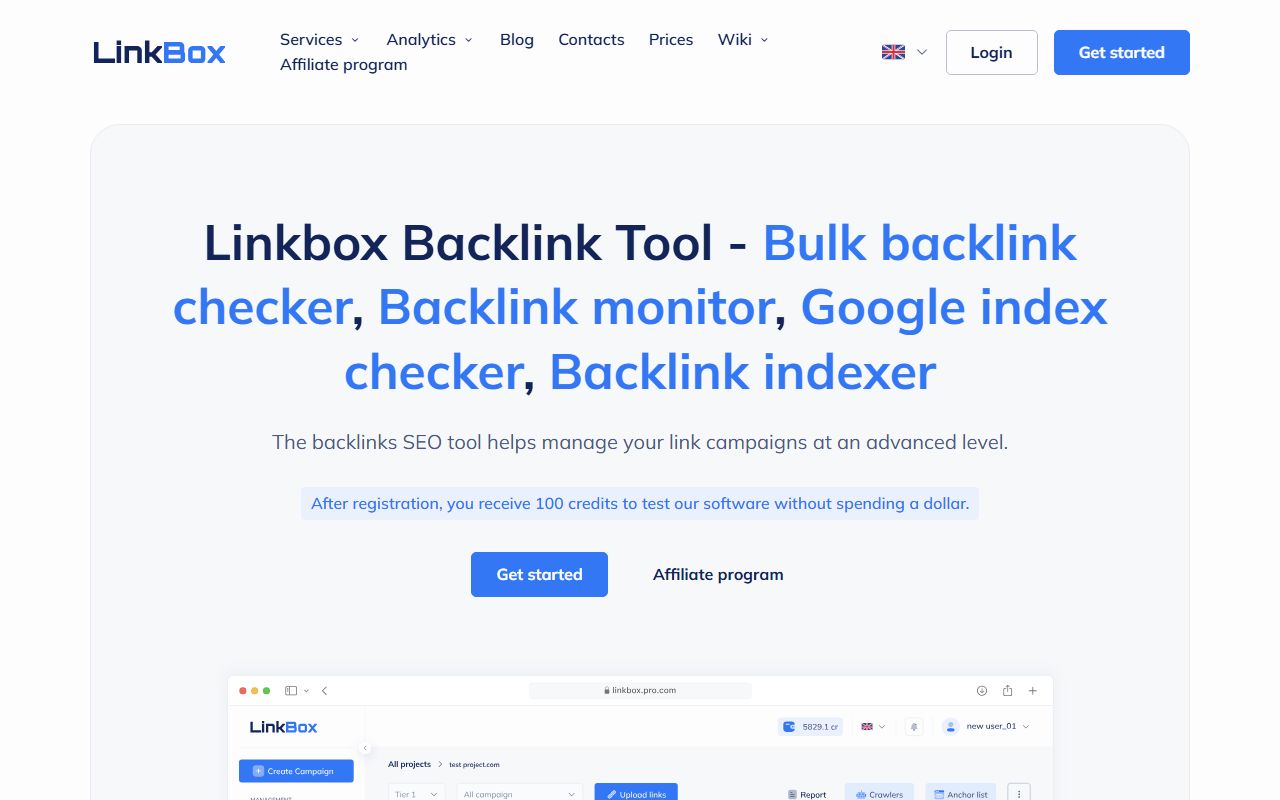
Look at the dashboard preview on the LinkBox homepage and the first number you meet is not a ranking or a link count. It is a balance: 5829.1 cr, next to a user called new user_01, inside a project called test project.com. The product is built around credits, so a fair comparison starts with what a credit buys.
That is what this page does. We take one invented month of usage, price every line at LinkBox's published rates, and then price the nearest equivalent on apibacklinks. The month is hypothetical. It is not a case study and nobody is behind it. Its only job is to give the arithmetic something to chew on.
One caution before the sums. LinkBox and apibacklinks do not sell the same thing. LinkBox takes a list of pages you already know carry your link and tells you what is on them now. We hold a crawl-derived index and tell you which pages we saw linking to a domain. Where the bills line up, we say so. Where they do not, we say that too.
Reading the rate card like an invoice
LinkBox has no separate pricing page. The Prices item in the menu jumps to a block on the homepage, which says: $1 = 100cr, and prices four actions.
| Action | Credits | Dollars |
|---|---|---|
| Link Check | 0.1 | $0.001 |
| Check Page Index | 0.3 | $0.003 |
| Domain / Page Trust | 0.5 | $0.005 |
| Add URL Google | 1 | $0.01 |
The module pages restate this per dollar: 1,000 links, 300 index checks or 100 indexer submissions. The numbers agree with the table, which is a good sign in a rate card.
The API page tells a slightly different story. It lists three monthly tariffs, $20, $55 and $110, still at 100 credits per dollar, with per-action ranges: link checking at 0.3 to 0.1 credit, index checking at 0.5 to 0.25, API indexing at 1 to 0.4. The page does not say which rate belongs to which tariff. It also does not say whether those tariffs govern the web app or only the API. We will not guess a mapping, so the API arithmetic below gives a floor and a ceiling.
One month on LinkBox, line by line
The hypothetical team is a small agency tracking 10,000 placed links across its clients. It verifies every link weekly, index-checks every donor page once a month, runs a domain-trust check on 600 new prospects, and sends 800 stubborn pages to the indexer. All of it is priced at the homepage rates.
| Line | Arithmetic | Credits | Dollars |
|---|---|---|---|
| Weekly link checks | 10,000 x 4 x 0.1 | 4,000 | $40.00 |
| Monthly index check | 10,000 x 0.3 | 3,000 | $30.00 |
| Domain trust on prospects | 600 x 0.5 | 300 | $3.00 |
| Indexer submissions | 800 x 1 | 800 | $8.00 |
| Total | 8,100 | $81.00 |
Two readings of that total. First, the link checks are the cheap part by volume and the index checks are the surprise: 10,000 pages checked once cost three-quarters as much as 40,000 link checks. If your instinct is to re-check indexing weekly, that one line quadruples to 12,000 credits ($120.00).
Second, 8,100 credits is more than a $55 tariff would hold on its own, since $55 buys 5,500 credits at 100 per dollar. Whether that matters depends on how the tariffs map to the web app, and the site does not say. Ask support before you budget around it.
The API column, with the gaps left blank
The same work through the API looks different, because the published ranges are wide. LinkBox's API is asynchronous: you POST a list of donor URLs and the target domains, poll a status call with the task id, then page through results at 20 links a page. One task can carry up to 5,000 links, so our 10,000 links need two tasks per weekly run.
| Line | Floor | Ceiling |
|---|---|---|
| 40,000 link checks, 0.1 to 0.3 credit | 4,000 cr | 12,000 cr |
| 10,000 index checks, 0.25 to 0.5 credit | 2,500 cr | 5,000 cr |
| 800 API indexings, 0.4 to 1 credit | 320 cr | 800 cr |
| Total | 6,820 cr ($68.20) | 17,800 cr ($178.00) |
Domain trust is left out because the API page does not list it. The spread between $68.20 and $178.00 is the honest answer to what will the API cost? when the tariff mapping is unpublished. Rate limits are not published either, nor is a response schema or a standalone docs site. The page's FAQ also mentions total backlinks, referring domains and a toxicity score from the API, but none of those appears among the documented endpoints, so we have not counted them.
The nearest thing on our side, and what it does not do
apibacklinks cannot take a URL and report whether your link is still on the page today. We do not fetch pages on demand. What we have is a crawl-derived index: 181,132,097 domains, 2,774,625,913 domain-to-domain links, refreshed roughly monthly. So the nearest equivalent of the checker's work is a pull of the links we saw pointing at your client domains.
Price that for the same agency, assuming 25 client domains averaging three pages of 1,000 rows each, pulled weekly with the backlinks action at 2 credits per list call:
- 25 domains x 3 calls x 4 weeks = 300 list calls x 2 credits = 600 credits
- One
bulk_drrequest for the 600 prospect domains (up to 2,000 per request), which we assume is billed as a lookup: 1 credit - The
overviewanddomainactions: 0 credits, they are free
That is 601 credits, about $0.06. It is also a much smaller job. You get source URL, anchor, rel, link type and last-seen date for what our index found, with filters for follow type and minimum donor DR. You do not get a live check, an index status, an indexer or a stored history. The comparison table further down puts the two side by side.
New accounts start with a $100 credit and no card, so the sums above can be tried before anything is paid. Query shapes are in the API docs.
Where LinkBox is the better buy
If your question is is the link I paid for still on that page, and is that page in Google?, LinkBox answers it and we cannot. That is most of what a link builder checks after placement.
- Live verification. It fetches the donor page and reports response code, final URL after redirects, title, anchor, rel attributes, link type and indexing directives such as noindex and robots rules. An index of crawl data cannot see a link added last Tuesday.
- Index status. A page can hold your link and still be out of Google. We have no index check.
- Indexing. LinkBox submits pages itself. Its two success figures differ by page, 96% within 48 hours on the homepage and from 71% on the indexer page, and we found no independent test of either. The feature still exists, and ours does not.
- Monitoring. Its monitor sorts links into New, Live and Historical from uploads you give it, with scheduling. We have no alerts or history.
- A finished interface. Reports, tiers, anchor lists and campaign views are already there. Nobody has to write a diff script.
Anyone working a spreadsheet of a few thousand placed links, who wants a report to show a client, should stay with LinkBox or start there. At about $0.001 a link check, the cost is not the argument for switching.
Building a dashboard view yourself
The checker-versus-API question comes down to who does the stitching. LinkBox stitches for you. With raw data you assemble the view, and the pieces are small.
- Run
backlinksfor each client domain on a schedule and store source URL, anchor, rel and last-seen date. - Diff this pull against the last one. Sources present now and absent before are your New. Sources absent now and present before are your Historical.
- Run
bulk_dron the distinct source domains to attach a donor DR, up to 2,000 domains per request. This is our DR, not Moz DA, and the numbers will differ from other tools. - Run
anchorsto catch odd text. A typo likelinkbpx.proshows up instantly in a ranked anchor list.
The result covers discovery and anchors. It still has no live check, because the crawl is a sample refreshed monthly and a new link can take weeks to appear. A sensible split uses both: the API for competitor and prospect research across the whole graph, and a checker for the short list of links you paid for. We compare another checker on a sibling page, and the backlink checkers hub lists the rest.
Line items the invoice does not show
A bill autopsy also looks for what is missing from the statement. Here is what we could not price from public pages.
- Source of link data. LinkBox describes two sources: links you import by hand, and links added via its crawler module, with tabs for Google Search Console and Ahrefs and a temporary tab for others. Its monitor page says it has three data sources. Everything we read describes working on links you import. The price of the Ahrefs or Semrush export you feed it sits on another invoice.
- Tariff mapping. Covered above. The $20, $55 and $110 tariffs are published, and the rate each carries is not.
- Refunds. The terms give a 48-hour window to ask, and reserve the right to decline if the account shows high activity in that time. Test with the free 100 credits before paying.
- Index-check price. 0.3 credit on the homepage, 0.25 to 0.5 on the API page. Both are quoted here with their source.
- Rollover. The API page says unused credits roll over when a plan is activated. It does not say how a pay-as-you-go balance behaves, and we will not guess.
None of this is unusual for a small SaaS. It does mean the $81.00 above is a model, not a quote, and the API ceiling of $178.00 is a bound, not a prediction.
Which bill to pay
Choose by the question you ask most often.
- Are my placed links alive and indexed? Pay LinkBox, at roughly $0.001 per link check and $0.003 per index check.
- Who links to this domain, with what anchors, from what DR? Pull it from our API for a fraction of a cent per list call, free for the profile summary. You can try the explorer on linkbox.pro itself without signing in.
- Both, for a team? Keep a checker for the links you bought and use raw data for discovery.
If you need pages indexed rather than checked, that is a different job again. Our sister service IndexJump exists for that one.
apibacklinks vs LinkBox
| apibacklinks | LinkBox | |
|---|---|---|
| Core job | Backlink data from our own crawl-derived index: who links to a domain | Checks, monitors and indexes links from lists you import or add via its crawler |
| Price unit | 1 credit = $0.0001; lookups 1 credit, list calls 2, search 3 | $1 = 100 credits; link check 0.1 credit, index check 0.3, domain trust 0.5, Add URL Google 1 |
| Cost of 10,000 link checks | Not offered; a 1,000-row backlinks page costs 2 credits ($0.0002) | 1,000 credits, $10.00 at the homepage rate |
| Free start | $100 free credit on first sign-in with Google, no card | 100 credits on registration |
| Live link verification | No; reports what our index saw, with a last-seen date | Yes; fetches the donor page and reports status, anchor, rel and link type |
| Google index status | No | Yes, a Google index checker; method not published |
| Indexing service | No; our sister service IndexJump does that | Yes, 1 credit per URL on the homepage rate card |
| Monitoring and history | No alerts or history; you diff your own pulls | New, Live and Historical link states from your uploads, with scheduling |
| Own authority metric | Domain Rating 0-100, our own, bulk up to 2,000 domains per request | Third-party metrics only: Moz DA and PA, Semrush rank, Alexa rank |
| API limits | Up to 1,000 rows per call, 50,000 rows deep | Up to 5,000 links per task, 20 results per page; rate limits not published |
Try it on linkbox.pro
Pull the top anchors pointing at linkbox.pro, the quickest way to spot typos and partner-coded landing paths.
curl "https://apibacklinks.com/api.php?action=anchors&q=linkbox.pro&key=YOUR_KEY"
LinkBox alternative — FAQ
How much does LinkBox cost per link check?
Does LinkBox have its own backlink index?
Can apibacklinks check whether my link is still live?
Is apibacklinks DR the same as Moz DA?
What does the LinkBox API return?
Which is cheaper for a monthly backlink review?
Backlink data for the price of a rounding error
Sign up, keep your $100 of credit, call the API today.
Get started free