

A Linkatomic alternative for the inspection step: a team's diary
Linkatomic is a Madrid marketplace where you pay publishers for articles with links. Its prices sit behind a login and no public API is documented. This diary follows a hypothetical team that added a data layer to check what each placement is worth.
We ran linkatomic.com through our own index first. It scores DR 35 (our metric, not Ahrefs DR) with 339 referring domains and 14,912 backlinks, of which 5,378 (36.1%) are dofollow. First seen 2024-07-12, last seen 2026-09-09. The headline backlink count is misleading: backlinkdistrict.com, a DR 4 deals directory, supplies 7,671 links (51.4%), nearly all nofollow, under button anchors such as “Ir a la oferta →” and “Go to Deal →”. The top three referrers hold 87.0% of all links.
The dofollow side is even more lopsided. sapo.pt (DR 58) sends 4,024 dofollow links, all to a single referral sign-up URL on app.linkatomic.com. That is 74.8% of every dofollow backlink the domain has. Seventeen of the top fifty linked URLs are /register/r/… referral links, which fits the 5% affiliate offer on its own site. The profile is a marketplace's affiliate programme made visible. You can open the full report in the explorer.
Linkatomic at a glance
- What it is
- A two-sided marketplace for sponsored articles with links in blogs and online newspapers; advertisers buy, publishers sell.
- Operator
- Linkatomic, S.L., Madrid, Spain (named on its legal page).
- Catalogue size
- Its own pages say 20,000 to 30,000 media, depending on which page you read.
- Pricing model
- Prepaid wallet in euros. Each publisher sets its own price, visible inside the app. Minimum top-up €10; PayPal or bank transfer per its FAQ.
- Writing
- A copywriter writes a 1,000-word article from your instructions.
- Public API
- None documented. Its only API mention is its own use of the Ahrefs API to score media.
- Minimum publication
- At least 6 months on the contracted page, per its legal page.
Entry 1: the brief nobody asked for
This diary is hypothetical. The team in it is invented: a four-person content-and-links group at a small software company, buying roughly forty placements a quarter. No real company, quote or order is described. What is real is the marketplace they use and the numbers from its profile in our index.
Their problem is ordinary. Every placement they buy on Linkatomic arrives as a URL, and somebody has to decide whether the donor was worth the price. Until now that was a person with three browser tabs. The brief for the migration was therefore narrow: do not stop buying on Linkatomic; stop judging purchases by hand. Calling that a migration is generous. It is closer to bolting an instrument panel onto a car they like driving.
They start where an investigator would: with the seller's own words. Linkatomic describes itself as “a platform used for the publication of sponsored articles in webs, personal blogs and newspapers in different languages.” Everything that follows is built on that sentence.
Entry 2: what the homepage shows and what the login hides
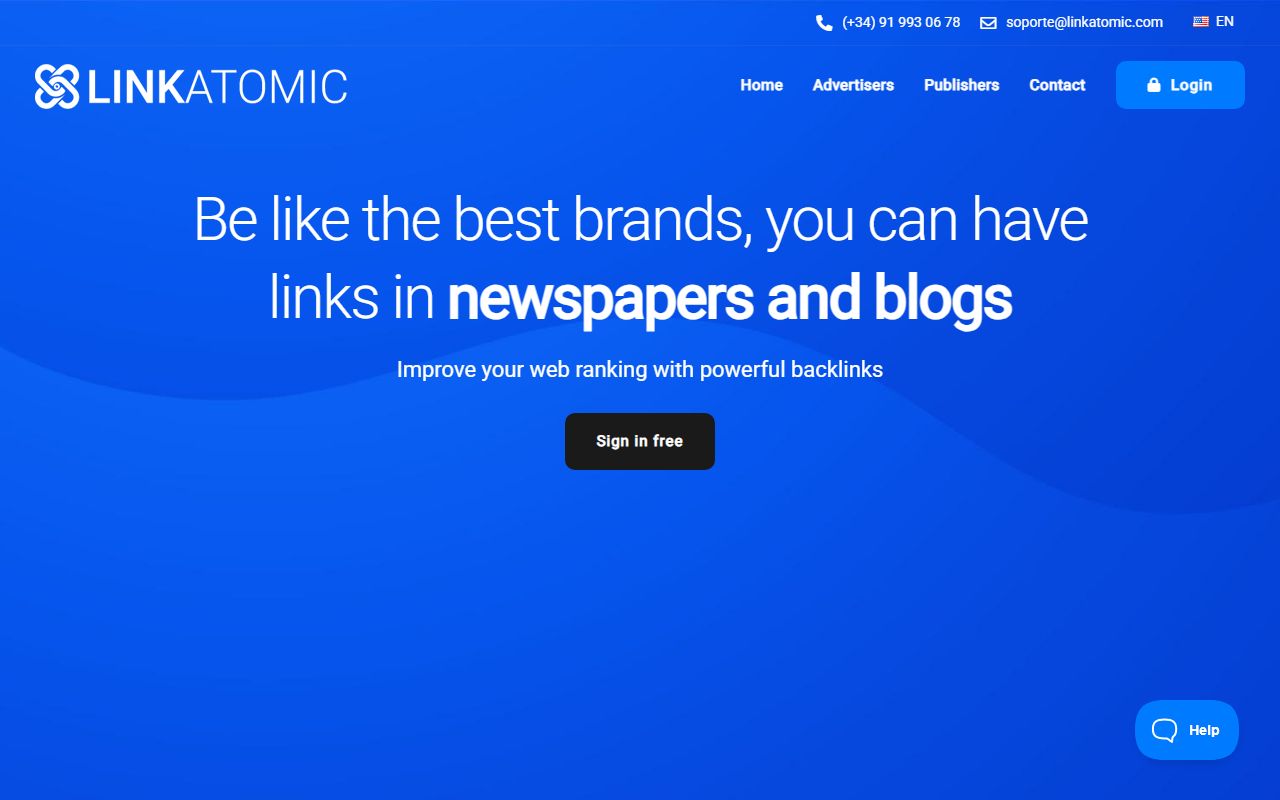
The first task is to see what a buyer can learn before paying. The homepage hero is a royal-blue field, one headline (links “in newspapers and blogs”), one black button reading “Sign in free”, and a Help bubble. No price, no catalogue preview, no screenshot of the product. Spend €0 and you learn the pitch, not the inventory.
The official pages fill in the mechanics. A copywriter writes a 1,000-word article. Up to four backlinks per article, each site owner setting its own cap. The site owner has 48 hours to accept or decline. Link attributes (dofollow, nofollow, sponsored) are chosen per order. Placements stay up for at least six months. Prices are not published: each publisher sets its own, and the minimum top-up is €10.
Two things the team could not find, after looking. There is no price list, so a quote exists only inside the app. And there is no public API: the word does not appear on the advertiser, publisher or guide pages, and an independent Spanish review says the same, so bulk ordering is manual. We read that as “no public API is documented”, which is not the same as proof that none exists.
Entry summary: the inventory and prices sit behind the login. Anything the team wants to measure about a donor has to be measured from outside.
Entry 3: the first call, aimed at the seller itself
Before trusting the index on other people's domains, the team points it at Linkatomic. A free overview call returns the profile in one response, and no key is needed. The result is the data story above: DR 35, 339 referring domains, 14,912 backlinks.
They note a lesson that will shape every later check. Raw backlink count and referring-domain count tell different stories. Of the 339 referring domains, only 110 carry at least one dofollow link. The average donor DR is 23 and there are zero gov or edu referrers. From the top-100 referring domains alone, 29 sit in the 0–14 DR band and 53 in 15–29. Only five reach DR 50 or higher. A reader seeing “14,912 backlinks” would picture something far larger than this.
The anchor table is just as telling. “Linkatomic” is 29.04% of backlinks, and “Ir a la oferta →” is 30.97%. The generic button text is not editorial. It is what a coupon or deals page writes when it links to a merchant. The team's rule from this entry: read anchors before you read counts.
Entry 4: the sapo.pt problem, and why it matters to a buyer
The team spends a day on one number: 4,024. That is how many links sapo.pt sends to one referral URL, on 3,784 distinct pages, all dofollow, seen between 2025-10-05 and 2026-03-15. Page-level counts like this usually indicate a site-wide or template placement: one link repeated across thousands of pages from a single host.
Why does a link buyer care? Because the same pattern can appear in the placements you purchase, and the question changes by purchase type. For a one-off article on a blog, you want one link on one page. If your own check shows hundreds of links from the same host, it is worth asking why: the host may be a directory, a partner footer or a network rather than a single blog post. The backlinks action grouped by domain versus by page makes the difference visible in one call.
The team also meets a smaller curiosity: 29 of the top-100 referring domains link to linkatomic.com with Telegram link-seller ads as the anchor, from throwaway hosts on .online, .space and .xyz. Roughly 90 links in all, every one of them nofollow. These look like unrelated sellers using an SEO brand's name as bait. The team's takeaway is practical: crawl data surfaces junk around any domain, so a donor's crawl footprint deserves a look, not just its DR.
Entry 5: the checks they wrote
By midweek the team has a four-step routine they run on every candidate donor from the Linkatomic catalogue, before ordering and again after delivery.
- Donor strength.
bulk_drtakes up to 2,000 domains per request, so a whole shortlist is one call. They compare the result with the metric the catalogue shows, remembering that our DR is computed from referring-domain counts in our graph and is not the same number as any other tool's. - Donor profile.
overviewandrefdomainsshow whether the site has real referring domains of its own or only a pile of links from one place. - Anchor sanity.
anchorsand thebacklinksfilter on anchor text show whether the donor's existing outbound links look like commercial placements. - Delivery. After the article goes live,
backlinksfiltered by source domain and target URL shows whether the crawl has seen it. See the API reference for the parameters.
The fourth step needs a caveat in bold. Our index is built from our own web data, refreshed roughly monthly and not real-time. A link that went live yesterday is normally absent, so “not found yet” is not proof of non-delivery. The team writes it into their runbook as a rule: do not dispute a placement on index data younger than a crawl cycle.
The same exercise for another brand is on the LinkLifting page.
Entry 6: where Linkatomic is simply the better choice
The diary would be dishonest without this entry. Linkatomic does things apibacklinks does not even attempt, and the team never considers dropping them.
- It sells links. We provide data only. We do not build, sell or index links. If you need an article on a real site, Linkatomic does that and we do not.
- Writing and handling are included. A copywriter produces the 1,000-word piece, the publisher has 48 hours to accept, and an invoice is generated per transaction. Support promises an answer within 24 hours and an account manager is mentioned.
- Languages and markets. The site runs in English, Spanish, French and Italian, with landing pages for 27 country markets. For a Spanish- or Italian-language link campaign that is a large practical advantage.
- Shared articles and old posts. You can split one article's cost, or add a link to an already-published post. Neither is something a data service can offer.
- Catalogue filters. Subject, language, metrics and price filters live inside the buying flow, where the decision is made.
Who should stay put? Anyone whose real job is ordering a few placements by hand. If you buy five links a quarter, a login and a wallet are enough, and an API adds work. The team in this diary only added us at forty placements, when manual checking became the slowest step.
Entry 7: a quarter of checking, priced
The team tallies the cost of the routine for one quarter. The assumptions are hypothetical and stated plainly: 40 purchased placements, 120 candidate donors screened before choosing them, four profile and anchor list calls per placement, and two post-delivery checks per placement.
| Step | Calls | Price per call | Cost |
|---|---|---|---|
Shortlist screening with domain (free action) | 120 | 0 | $0.00 |
Profile and anchor lists (refdomains, anchors, backlinks) | 160 | 2 credits ($0.0002) | $0.032 |
Post-delivery checks (backlinks) | 80 | 2 credits | $0.016 |
That is under five cents for a quarter, against a starter balance of $100 in free credit on first sign-in with Google. No card and no subscription sit in the way. The honest comparison is to the people-hours it replaces, not to anything Linkatomic charges: checking donors from a script is simply not part of what it sells.
Entry 8: what the diary could not settle
The last entry is a list of open questions, because an investigation that ends with false certainty is not worth keeping.
- Exact catalogue size. The marketplace's own pages say 20,000 in one place and 30,000 in another, and third-party reviews quote 13,000 and 21,000.
- Prices. They are visible only after sign-up; a third-party review says the link price includes the platform commission, and another reports typical offers of €50 to €200 for good-DR sites. We treat both as someone else's observation.
- Refunds for rejected or undelivered orders. The legal page rules out a refund only when a publisher later edits a published article.
- Anything about delivery speed beyond the 48-hour acceptance window.
For the same exercise on another brand, read the page on Clairvoyantnearme, or browse the full list of link-building tool comparisons. And if the numbers above should be read at the source, the explorer link in the data story opens the same report.
apibacklinks vs Linkatomic
| apibacklinks | Linkatomic | |
|---|---|---|
| Primary job | Backlink and domain-rating data over a JSON API | Marketplace for sponsored articles with links |
| Sells links | No. Data only. | Yes, from publishers who set their own prices |
| Public API | 19 actions on one endpoint | None documented |
| Price visible before sign-up | Yes: 1 credit = $0.0001, from $0.10 per 1,000 calls | Not published; set per publisher inside the app |
| Minimum spend | $100 free credit on first Google sign-in, no card | Minimum top-up €10 |
| Domain metric | Our own DR, 0–100, from our graph | Not published as one metric; says it uses Ahrefs data to rate media |
| Article writing | Not offered | 1,000-word article by a copywriter |
| Index freshness | Roughly monthly, not real-time | Not published |
| Permanence | Not applicable | At least 6 months on the contracted page |
Try it on linkatomic.com
List the top referring domains of a donor you are about to buy from (a paid list action, so it needs a key; the free <code>domain</code> and <code>overview</code> actions need none).
curl "https://apibacklinks.com/api.php?action=refdomains&q=linkatomic.com&per=20&key=YOUR_KEY"
Linkatomic alternative — FAQ
Is apibacklinks an alternative to Linkatomic?
Does Linkatomic have an API?
Is your DR the same as the figure Linkatomic shows?
Can I check that a placement went live?
Do you offer link buying or monitoring?
Is the team in this diary real?
Backlink data for the price of a rounding error
Sign up, keep your $100 of credit, call the API today.
Get started free