

A LinkLifting alternative, written as a postmortem
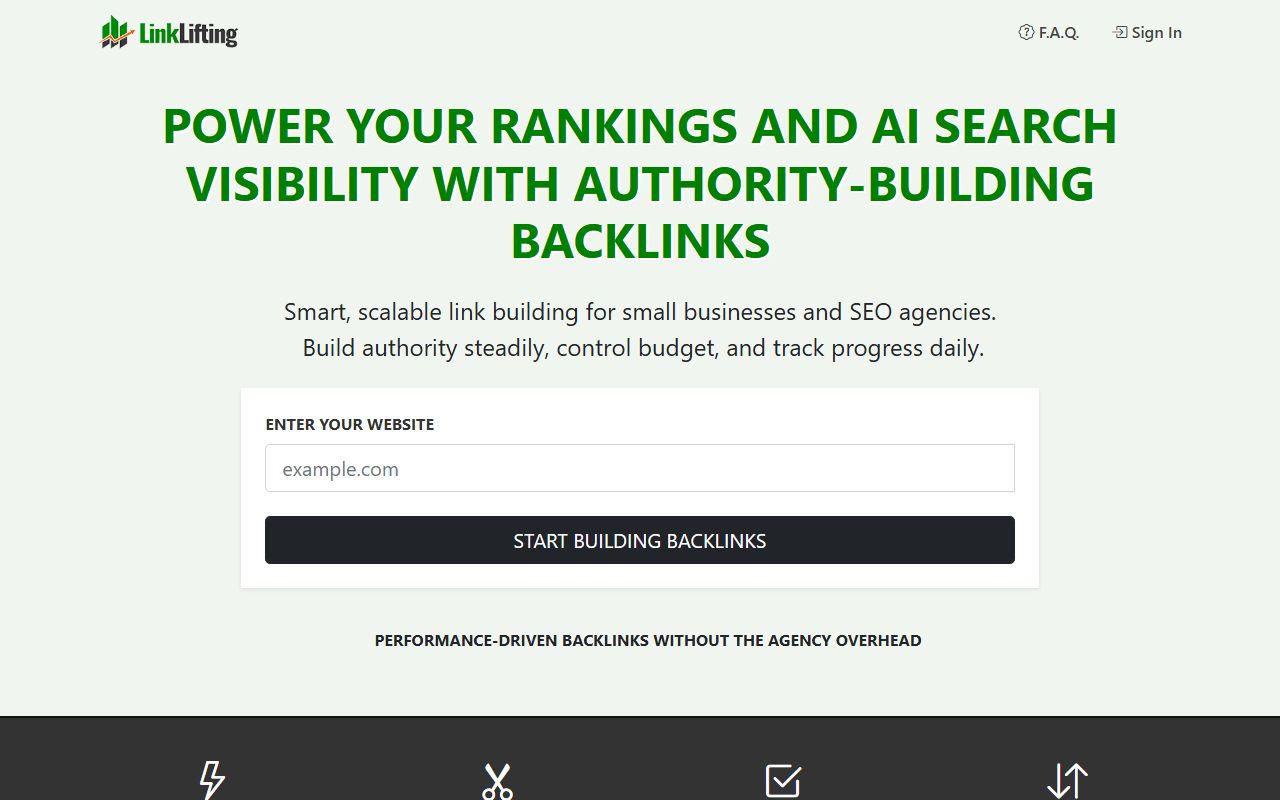
LinkLifting's homepage asks for one thing: a domain in a box that says example.com. This postmortem follows a hypothetical campaign started that way and shows what to verify on your own.
We pulled linklifting.com from our own index. It shows DR 32 (our metric, not Ahrefs DR or Moz DA), 232 referring domains and 716 backlinks, 619 of them dofollow (86.5%). The biggest referrer is seodennis.com with 68 links from 56 pages, all dofollow, DR 21, last seen 2026-02-07. Next is the directory 10seos.com: 48 links from 41 pages, only 3 dofollow, anchor "Visit Website".
The anchors are the tell. "LinkLifting" alone is 127 links (17.7%), and brand or bare-URL variants add up to roughly 324 links, about 45%. Keyword anchors such as "backlinks" or "SEO backlinks service" are about 9.5%. Among the top 100 referring domains, 67 sit in our DR 15–29 band and none is a .gov or .edu. That is a plain profile, close to what the site says it builds for clients.
LinkLifting at a glance
- What it is
- A managed backlink-building service run as a self-serve web app, with daily rank tracking in a dashboard
- Operator
- LinkLifting IMT First Oy, Kotka, Finland (per its Terms); launch in 2015 by its own account
- Price model
- Prepaid monthly budget in USD, minimum $150 per month, 1/30th deducted daily; no price per link published
- Link types
- Leased and permanent; the FAQ says 80% of the backlinks it creates now are permanent
- API
- None found; no API, developer or docs page
- Free tier
- None found; Terms say no refunds for services actually used
Incident summary: the invoice was correct, the evidence was thin
Every postmortem needs an incident, and this one is a composite. The scenario below is hypothetical. No real customer, budget or result is described. It is the shape of problem a buyer of managed links tends to hit, and it is built only from things LinkLifting publishes about itself.
Imagine a small business that types its domain into the box on LinkLifting's homepage, funds a first month at $400, and waits. Ninety days later the owner asks a simple question: are the links I paid for actually out there, and are they the kind I was promised? The invoice is accurate and the dashboard has rank charts. What is missing is a second witness, something that was not produced by the seller.
Nothing in this story is a failure of LinkLifting. The service tells customers to check it, and on its services page it names Google Analytics, SEMrush and Ahrefs for the purpose. The incident is that the buyer never set up the check. So this is a blameless review, and the fix is a routine, not a new vendor.
Timeline of the 90 days, with the dates that matter
These steps follow LinkLifting's own mechanics: prepaid budget, daily deduction, first report after 3–4 weeks, and a typical movement window of 2–6 weeks. The $400 figure is invented; the arithmetic is not.
| Day | What happens | What the buyer can see |
|---|---|---|
| 0 | Account funded with $400, project activated | Dashboard, keywords, daily rank tracking |
| 1–30 | 1/30th of the monthly cost is deducted every day, about $13.33 at $400 | Balance falling in a straight line |
| 21–28 | First backlink report arrives, "usually" 3–4 weeks after start | A list written by the seller |
| 14–42 | The site says many projects see movement in 2–6 weeks | Rank changes, which depend on many things besides links |
| 30–60 | crawl releases are processed into our index, roughly monthly | Nothing yet, or only a few of the links |
| 90 | The owner asks for proof and nobody has a baseline | Charts, but no independent evidence |
The two columns on the right tell the story. Rank movement is the thing everyone wants and the thing least able to prove a link exists. A report from the seller proves the seller's records. Neither tells you what a crawler outside the seller's walls found.
Root cause: a report is a claim, a crawl is a witness
LinkLifting describes its verification honestly. Donor sites are checked by eye, by Moz DA, by SEMrush organic traffic and by the number of indexed pages. A human verifies each placed link and an automatic check runs daily. That is a decent in-house process. It is also all internal.
An independent view needs data the seller does not control. That is the narrow job our index does: for any target it can list referring domains with donor DR, individual backlinks with source URL, anchor and rel attribute, and first and last seen dates. Use the free explorer to look at a real example before you point it at your own domain.
Be exact about what an absence means. Our graph is built from our own web data, a broad sample of the web, and it refreshes roughly monthly. A link that is not in the index may be live and unvisited by the crawler. A link that is in the index is strong evidence that it existed and was crawlable. Treat a hit as a confirmation and a miss as a question, never as proof either way.
Root cause in one line: the buyer had one source of truth and it was the seller's.
What LinkLifting's own link profile shows when you read it as a buyer would
The most useful exercise is to audit the seller on the same screen you will use for your own site. A few things stand out in the linklifting.com data, and none of them is an accusation. They are a reading guide.
Brand anchors dominate
About 45% of links use the brand name or the bare URL. Compare that with its own sentence on the services page: "We also mix anchors and use branded and bare URL anchors." The pattern in its own profile matches the pattern it describes.
Mid-range donors, no .gov or .edu
Average referrer DR is 24. LinkLifting states donors of Moz DA 15 to 45 for leased links and 10 to 95 for permanent ones. Our DR and Moz DA are different metrics, so read this as the same neighbourhood, not the same number. Permanent links are stated to range up to DA 95, so the range is wide; the reported donor list is what tells you where yours landed.
Odd URLs in the public graph
The index holds 17 backlinks to a /project/329278 page that redirects to a login, and 22 links from trustmary.com to a homepage URL that still carries an ad-click query string. These are facts about what is linked, and we draw no conclusion about who placed them. The lesson for buyers is simpler: the target URL in your report should be the URL a crawler records.
One directory explains half the nofollow links
10seos.com supplies 48 links with anchor "Visit Website", only 3 of them dofollow. Without looking at the list, you would think 97 nofollow links meant a nofollow policy. Looking explains it in a minute. Raw counts mislead, and a per-referrer breakdown is the cheap cure.
What changed: a three-check routine around any placement
The fix is small. Add three checks to any managed or marketplace link purchase, whoever the seller is.
- Before buying: baseline the target. Pull DR and referring-domain counts for your own domain with the free
domainandoverviewcalls, and the top referring domains with onerefdomainscall. Save the numbers with a date. - When the first report lands: spot-check donors. Take the donor domains from the seller's report and look them up in bulk. The
bulk_draction takes up to 2,000 domains per request, so a report of 60 donors is one call. - Every month after: look for the links. Query backlinks for your domain, filter by minimum donor DR, and compare first-seen dates against the report. Expect lag of several weeks.
The whole routine at one list call per step costs fractions of a cent, since a list call is 2 credits at $0.0001 per credit. The full action list is in the API docs. A starter call is in the code box below.
One caution on scope. This routine tells you what a crawler saw. It does not score a donor as good or bad, tell you whether a link will move rankings, or flag toxic domains. We have no such score, and we would rather say so than imply it.
Where LinkLifting is the better choice
This is the part a data vendor should write plainly. If your job is to get links placed, apibacklinks does nothing for you. We do not build, sell or index links. LinkLifting does the work.
- You want it done, not measured. You enter keywords, set a budget and the service places contextual links on its donor sites. We provide data only.
- You want rank tracking in the same place. It monitors keyword positions daily and lets you add competitors. We have no rank tracking at all.
- You want budget control without a contract. The site states no long-term commitment and a minimum of $150 per month, drawn down daily.
- You are a small business or a lean agency. That is the audience the homepage names, and the self-serve flow fits it.
- You want a human in the loop. The site says its SEO experts manually check your website and keywords and write recommendations, and an account manager appears in the best-practices help article.
Our advice to such a buyer is to stay and add the audit routine, not to leave. For a team that wants an independent look at what any seller delivers, see how LinkByMe compares from the same angle.
Lessons for the next campaign, mentor to mentor
I would tell a newer colleague these things over coffee.
Read the terms before the dashboard. LinkLifting's Terms say links sit on third-party platforms and the company is not responsible for links prematurely removed by those platforms. The services page says leased links may disappear if the project is no longer active. Neither is hidden, and both change how you plan: a permanent link and a leased link are different assets, and the site gives no guarantee period for "permanent".
Know what the balance does. If funds run out, the help article says current work is frozen and tracking stops, and restoring it within a week or two brings everything back. Top up before the end, not after.
Do not overtrust any single number. The site gives two sizes for its donor network: "more than 5,000" in the FAQ and "tens of thousands" on another page. I would not put either figure in a spreadsheet as fact.
Keep your own record. Whoever you buy from, the habit is the same: baseline, spot-check, re-check. For a wider set of sellers and tools see the link-building tools hub.
apibacklinks vs LinkLifting
| apibacklinks | LinkLifting | |
|---|---|---|
| What you get | Backlink and DR data over a JSON API, plus a free explorer | Managed link building: it places contextual links on donor sites for you |
| Pricing model | 1 credit = $0.0001; lookups 1 credit, list calls 2, search 3 | Prepaid monthly budget in USD, 1/30th deducted daily |
| Entry cost | $100 free credit on first Google sign-in, no card | Minimum $150 per month; no free tier or trial found |
| Price per link | Not applicable; we do not sell links | Not published |
| Contract | No subscription, no monthly minimum | No long-term commitment stated; no refunds for services used |
| API | 19 actions on one endpoint, free overview and domain calls | None found |
| Rank tracking | None | Daily keyword tracking in the dashboard, with competitors |
| Link evidence | Source URL, anchor, rel, donor DR and first/last seen from our own crawl-based index | Human check plus daily automatic check; first report usually 3–4 weeks in |
| Freshness | Roughly monthly refresh; new links can take weeks to appear | Daily link and rank checks, by its own description |
Try it on linklifting.com
Start with the seller's own profile, then swap in your domain: the top referring domains with donor DR.
curl "https://apibacklinks.com/api.php?action=refdomains&q=linklifting.com&per=20&key=YOUR_KEY"
LinkLifting alternative — FAQ
Is apibacklinks a LinkLifting alternative?
How much does LinkLifting cost?
Does LinkLifting have an API?
Can I verify LinkLifting placements with apibacklinks?
Is your DR the same as Ahrefs DR or Moz DA?
Does LinkLifting offer permanent links?
Backlink data for the price of a rounding error
Sign up, keep your $100 of credit, call the API today.
Get started free