

A Backlink Watch alternative for when one text box stops being enough
Backlink Watch is a single field and an orange button on a page whose footer reads “Copyright 2006-2023”. We took it apart layer by layer, read its own backlink profile in our index, and checked what an API call can and cannot replace.
We pointed our own index at backlinkwatch.com, and the result is a profile that says more about its neighbours than about the tool. DR 40, 837 referring domains, 24,648 backlinks, of which 2,279 are dofollow: a 9.2% share. The top referrer, chedominio.it, accounts for 7,668 links from 6,266 pages, all nofollow, all with an empty anchor. It is an Italian catalogue of available domains that puts a small “Backlinks” icon on each card, pointing at Backlink Watch’s form with the domain pre-filled. Nearly half the profile (11,666 links, 47.3%) points at the wildcard URL http://backlinkwatch.com/*, listed in blog sidebars next to hundreds of similar empty entries.
The human links are the quiet part: “Backlink Watch” (676 links, 464 dofollow), “Backlink watch” (222), a Chinese anchor roughly meaning “a site for analysing competitors’ external links — not bad” (388), and links from warriorforum.com (donor DR 52) and seoptimer.com (donor DR 48). Our DR is our own metric, comparable in spirit to other tools’ numbers but not the same as any of them. Browse the full report in the free explorer.
Backlink Watch at a glance
- What it is
- A free web form that lists the backlinks of one URL you type in. Title: “Backlink Watch - Free Real-time Backlinks Checker Tool”.
- Promised columns
- Anchor text, pagerank, total outbound links on the linking page, nofollow flag.
- Sign-up and price
- No sign-up page found; presented as free. No pricing page, plans or paid tier published.
- API
- None found (the obvious API paths return 404). Not published.
- Age signals
- Domain registered 2006-05-02 (.com registry record); footer reads “Copyright 2006-2023”.
- Operator
- Not stated anywhere on the site. Not published.
- Our index, its own domain
- DR 40, 837 referring domains, 24,648 backlinks, first seen 2024-07-12.
Layer one: a promise printed in orange italics
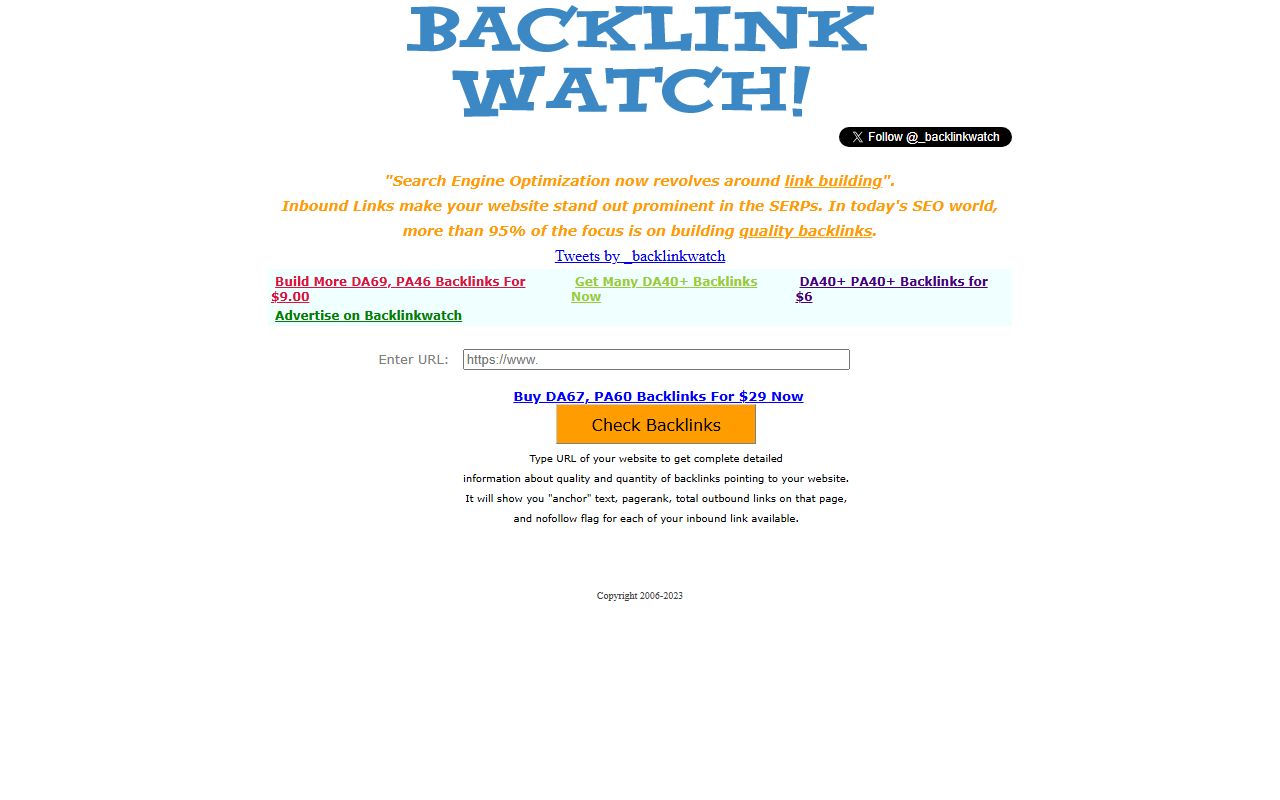
Every teardown starts with the label on the box. Backlink Watch’s label is a quotation about itself, set in orange bold italics under a blue slab-serif logo that ends in an exclamation mark: “Search Engine Optimization now revolves around link building”, followed by the claim that more than 95% of SEO focus is on building quality backlinks. The words “link building” and “quality backlinks” are themselves links, so the tagline doubles as an ad slot.
The functional promise sits in small print under the button. You type the URL of your website, and the tool “will show you anchor text, pagerank, total outbound links on that page, and nofollow flag for each of your inbound link available.” That is four columns per backlink. Nothing else is claimed: no history, no score, no trend, no comparison between sites.
The page title adds one more claim, “Real-time”. The site does not say what that means in practice, how fresh its data is, or where the data comes from, so we will not guess. Two blog roundups from 2017 and 2018 say the tool runs on a well-known commercial index; the site itself never says so, and we treat that as unverified.
Layer two: the mechanism is a form and a POST
Open the page source and you find a build that dates from the era of the domain’s May 2006 registration: HTML 4.01 Transitional, a table layout, roughly 14 KB, and a form that posts to index.php with a hidden salt field. One input, 200 characters maximum, placeholder https://www.. A client-side alert insists on a complete URL with http:// or https:// and a domain name.
What the form does not have is just as telling. There is no bulk box, no file upload, no export button, no login and no navigation menu. A link of the shape /?backlinkurl=https://example.com exists in the wild, but when we followed one it returned the plain form, not a result list; results need the POST. That matters for anyone hoping to script it: the product is designed for a human with a browser and one URL at a time.
One more detail from the markup: Google reCAPTCHA’s script is loaded, and a commented-out fruit puzzle (“Solve: Guava, Orange, Grapes”) sits in the source. No challenge widget is visible in the live form we fetched, and a French review from 2021 describes entering a captcha before the check. Whether you meet one today, we cannot say. We did not submit the form, so we have not seen the result table; everything above about the output is the site’s own description.
Layer three: the strip of ads that pays for it
Look at the screenshot again. Between the tagline and the field there is a pale-cyan strip with four coloured text links, and one more sits directly above the button. They look like a price list: “Build More DA69, PA46 Backlinks For $9.00”, “DA40+ PA40+ Backlinks for $6”, “Buy DA67, PA60 Backlinks For $29 Now”. None of these are Backlink Watch prices. They are third-party advertisers’ offers, tracked by the page’s own scripts, and the fourth link in the strip is “Advertise on Backlinkwatch”, a mailto enquiry. Google AdSense is loaded as well.
This is the business model, as far as the page shows it: free tool, ad inventory around the one field that every visitor has to touch. It is a perfectly ordinary arrangement for a free utility, and it explains the sparse chrome. A 2015 review called it a free site where you type your address and click submit, which remains accurate. A 2011 review of the same product called it ad-heavy, and the screenshot still shows a page full of paid text links.
Layer four: price and limits, mostly blank
Here is what we could establish about cost and constraints, in full:
| Question | What the site publishes |
|---|---|
| Price | The word “Free” in the page title. No plans page (/pricing returns 404). |
| Sign-up | None found. The privacy policy has a template sentence about registering for an account, but no registration page exists. |
| Rows per check | Not published |
| Daily or per-IP limit | Not published |
| Inner-page URLs | Unclear. Two forum users disagree in a 2012 thread, and we will not pick a side. |
| API, export, bulk mode | None found |
| Owner, country, contact | Not published, apart from an advertising mailto |
A table with that many blanks is not an accusation; it is a description of a one-page utility that has never needed a manual. But it does set the ceiling. If your question is “how many links, how fresh, and can I run this on 400 domains tonight”, the page has no answer to give, and neither do we on its behalf. The footer stops at 2023, and the newest independent mention we found is from 2021, so check that it works for your URL before building a habit around it.
Layer five: what the tool’s own backlinks reveal
The best test of any checker is to run it on itself, so we did, with our index. Two observations stand out.
The biggest referrer treats it as a button. chedominio.it lists expiring and available .it domains and links each card to Backlink Watch with the domain pre-filled. That is 7,668 links from 6,266 pages, none dofollow. It is a sensible use of a free tool, and since none of these links are dofollow they pass no link equity.
Hundreds of empty links in sidebars. One Blogger page we opened held 393 empty nofollow anchors with wildcard URLs such as http://*.ru/*, in a widget that looks like a referrer blocklist. The pages do not label it, so that is our reading of the markup. The same pattern covers unafettadiparadiso.it (3,963 links), tatakidsdesign.com (3,186) and vogliounamelablu.it (1,725). Together with chedominio.it, about 78% of the profile, 19,334 of 24,648 links, comes from this kind of source.
A third oddity: 1,315 links, all from complex-berlin.de with the anchor “BackLinkWatch.com”, point to /backlinknotifier.html, a page that returns 404 today. We could not establish what it was. The lesson for anyone reading a raw backlink count: look at the distribution before the total. 24,648 sounds large; 837 referring domains with an average donor DR of 23 describes the profile better.
Where Backlink Watch is the better choice
Plenty of jobs do not need an API, and for those the old form is hard to beat.
- Zero setup. No account, no key, no code. Paste a URL, press the orange button. Our free actions need no key either, but an API still means reading a docs page before the first call.
- The linking page’s outbound-link count. It promises total outbound links on the linking page, a column apibacklinks does not have. If you screen link prospects by how crowded the page is, that column is useful.
- A look at a single site, today. A non-technical colleague who needs one answer once will finish before we have explained what an endpoint is.
- A second opinion. The site does not say where its list comes from, so we cannot compare it with our web graph. But for a sanity check on one URL, a second tool is cheap, and two backlink indexes rarely agree exactly.
If you check a handful of URLs a month and read the results with your eyes, stay. Nothing about an API makes that workflow better.
Rebuilding its four columns from JSON
Here is the promised output, mapped to what our API returns for the same target. The backlinks action gives one row per link with source URL, anchor, page title, rel, nofollow flag, link type and last-seen date. You can filter by follow, source TLD, anchor text, source domain, target URL, minimum donor DR and date range, and group results by domain or page.
| Backlink Watch column | apibacklinks equivalent |
|---|---|
| Anchor text | Anchor field on each row; anchors lists the top 50 per target |
| Nofollow flag | Nofollow and rel fields on each row |
| Pagerank | No equivalent. The nearest thing is donor DR, our own 0-100 metric |
| Outbound links on the page | Not available |
Two of four map one to one, one maps loosely, and one does not exist. We would rather say that here than let you find out at the end of a build. What you gain in exchange is shape: up to 1,000 rows per call, bulk_dr for 2,000 domains per request, and compare for 20 domains side by side. Lists cost two credits, at $0.0001 per credit, and the first sign-in with Google comes with $100 of free credit, no card.
That changes the questions you can ask. “Which of the 837 referring domains give a dofollow link with donor DR above 30?” is a filter in one request, not a morning of scrolling. For comparing against other free checkers, the hub at backlink checkers lays out the alternatives side by side.
What the swap costs you
Fair is fair, so here is our side of the teardown. Our index is built from our web link data: 13 crawls, 181,132,097 domains and about 798.6 billion page-level backlinks, refreshed roughly monthly. It is a broad sample of the public web, not a proprietary crawler, so a link you added last week can take weeks to appear, and some links a commercial index sees will not be in ours.
We have no new-and-lost-links report, no alerts, no emailed reports, no dashboards to share with clients, no spam score and no historical charts. If your reason for using a checker is “tell me when something changes”, an API that returns the current picture on request is not that, and you would build the scheduling and diffing yourself. We found no monitoring feature on the Backlink Watch page either, so this is not something you lose by switching, but it is not something you gain.
One more caveat on the number we keep quoting. DR 40 is our DR, computed from referring-domain counts in our graph. It is not Ahrefs DR or Moz DA, and a different tool will show a different figure for the same domain.
Verdict: pick by how often you ask
The decision is about frequency, not quality. Once a month, one URL, human eyes: use the orange button. Weekly, ten or more domains, or anything you want to put in a spreadsheet: call bulk_dr or backlinks and keep the output. If you are weighing several free checkers, our LinkPopularity.com comparison is a sibling page.
A sensible middle path costs nothing: run the free domain and overview actions on your own site first. They need no key, and the numbers will tell you quickly whether our data covers the part of the web you care about.
apibacklinks vs Backlink Watch
| apibacklinks | Backlink Watch | |
|---|---|---|
| What you get per link | Source URL, anchor, title, rel, nofollow flag, link type, last seen | Anchor text, pagerank, outbound links on the page, nofollow flag (as the site describes it) |
| Interface | JSON over HTTP, plus a free browser explorer | One web form, one URL per check |
| Price | From $0.10 per 1,000 calls; $100 free credit on first Google sign-in | Presented as free; no pricing page |
| Sign-up | Free actions need no key; paid actions use an API key | No sign-up found |
| API | 19 actions on one endpoint | None found |
| Bulk lookups | bulk_dr takes up to 2,000 domains per request | Not published; the form takes one URL |
| Filters | Follow, link type, source TLD, anchor, source domain, target URL, minimum donor DR, date range | Not published |
| Data source and freshness | our web index link graph, 13 crawls, refreshed roughly monthly, not real-time | Not published (the title says “Real-time”) |
| Authority metric | Our own DR, 0-100 | “Pagerank” column; its source is not explained |
| Monitoring and alerts | None | None found |
Try it on backlinkwatch.com
The nearest thing to its result table: every backlink to backlinkwatch.com with a donor DR of at least 30, as JSON.
curl "https://apibacklinks.com/api.php?action=backlinks&q=backlinkwatch.com&min_dr=30&per=100&key=YOUR_KEY"
Backlink Watch alternative — FAQ
Is Backlink Watch really free?
Does Backlink Watch have an API?
Where does Backlink Watch get its data?
Can apibacklinks replace it for checking one site?
Is your DR the same as the number other tools show?
Why is Backlink Watch’s own dofollow share only 9.2%?
Backlink data for the price of a rounding error
Sign up, keep your $100 of credit, call the API today.
Get started free