

Backlink Market alternative: architecture notes for buyers who check
The homepage title of backlinkmarkt.com still reads “Site Name”. Behind it sits a small marketplace with a 30-day link lease and a USDT ledger. Here is how it is built, where it can fail, and how to inspect a placement.
In our index backlinkmarkt.com has DR 12, 7 referring domains and 7 backlinks, all dofollow, first seen 2026-02-11 and last seen 2026-07-11. There is exactly one anchor: the bare domain. Six of the seven linking URLs share the file name page-60b9e2a0f48c1eb4fc5f11cc34d356c9.html on six different hosts, which points to one templated domain-list network rather than seven independent mentions.
This says little about the quality of the sites listed inside the marketplace. It shows a young domain with a thin profile in our index; its first indexed link appeared about ten weeks after the domain was registered. Open the full report in the free explorer.
Backlink Market at a glance
- What it is
- A marketplace where site owners list sites and SEO buyers purchase link placements.
- Link term
- “Backlinks are valid for 30 days”; auto-renewal per order.
- Payment
- USDT only (TRC20, ERC20, BEP20). Minimum deposit 50 USDT.
- Fees
- 10% commission on seller earnings. Buyer fee not mentioned. Per-link prices not published.
- API
- None found.
- Operator
- Not published. Domain registered 2025-12-03 (registry record).
Six boxes, one ledger, no seventh box
The homepage title still says “Site Name - Premium Backlink Marketplace”. Signup and login carry the same placeholder. The footer, logo and FAQ say Backlink Market. That is the right name, so that is what these notes use. The domain is spelled markt, without the e.
Read the product as a diagram. Two roles: Buyer and Seller. One account can do both after upgrading to Seller. Around them sit six components, all taken from the FAQ and terms.
- Site registry. A seller adds a domain under “My Sites” with metrics, price and category.
- Ownership check. Verification by DNS TXT record or meta tag.
- Review queue. The team reviews a listing before it goes live.
- Catalogue. Buyers filter by DA/DR, category, traffic, link type (dofollow or nofollow) and price. It sits behind login, so we did not inspect it.
- Order ledger. A USDT balance. An order opens, the seller has 48 hours, the seller marks it complete, the buyer checks the link URL.
- Support desk. Tickets from the dashboard, reply typically within 24 hours.
There is no seventh box. No step is described that crawls the web to confirm a link exists, and no monitoring afterwards. We found no API, export or webhook. The terms in fact forbid “automated tools or bots without authorization”.
That is a defensible v1. It is also the reason this page exists: the check that the system omits has to live on the buyer’s side.
The registry stores what the seller types
The terms oblige sellers to provide “accurate DA/DR scores and traffic metrics”. The site does not say it measures those numbers. It does not name the tool they come from. It does not say how often they are refreshed. All three are not published.
So the metric column in the catalogue is an input field, not a measurement. The trust boundary sits at the seller’s keyboard. The ownership check shows that the lister controls the domain. It does not prove the number beside it.
This is a normal choice for a young two-sided market. Verifying metrics needs a data source; leaving them to sellers is the simpler build.
The consequence is simple. A buyer who wants more than a claim needs a second reading from an independent source. Ours is a Domain Rating computed from referring-domain counts in our own graph. It is not Ahrefs DR and not Moz DA. It is comparable in spirit, and numbers will differ. Use disagreement as a prompt to ask the seller a question, not as a verdict.
One limit to keep in mind: our graph is built from a broad sample of the public web. A small or new site can be missing or under-counted.
The ledger: 50 in, 30 days, 10 out
The published money terms are short. They fit in a table.
| Item | Published value |
|---|---|
| Currency | USDT only: TRC20 (Tron), ERC20 (Ethereum), BEP20 (BSC). TRC20 recommended for lower fees. |
| Minimum deposit | 50 USDT |
| Seller commission | 10% of seller earnings, deducted when an order completes |
| Minimum withdrawal | 50 USDT, processed “within 24 hours” |
| Link term | 30 days; auto-renewal re-charges the balance each period, switchable per order |
| Per-link price | Not published. Each seller sets it; the catalogue is behind login. |
| Buyer fee | Not mentioned |
| Refunds | “at our discretion” |
The design detail that matters is the unit of sale. It is not a link. It is a 30-day lease on a link. The terms call it a subscription period.
That changes the cost model. A placement priced at p USDT per period costs about 12p over a year, not p. Auto-renewal makes the ledger the thing that keeps the link alive: what happens to the link if the balance cannot cover the next period is not published.
The homepage says funds are “secure until delivery”. No escrow mechanism is described. No mechanism is described, so read the dispute path in the dashboard before you deposit.
Failure modes worth designing around
Five, in order of how likely a buyer is to meet them.
- Delivery window drift. The homepage says links are published “within 24-72 hours”. The FAQ and terms say 48 hours. Plan to the stricter figure and write down the order time.
- Completion is the seller’s event. The seller places the link, then marks the order complete. The buyer then checks the URL. Whether a buyer can contest a completed order beyond the refund clause is not published.
- Metric drift. A number typed on the day of listing may be stale by the day of purchase. Nothing published says the site refreshes it.
- Silent end of lease. Thirty days later the link may simply stop being renewed. Put the renewal date in your own calendar, because no alert or report is described.
- Name collision. “Backlink market” is also a generic Dutch and German phrase. Separate services such as backlinks.market and seo-backlinkmarkt.de exist, and we found no link between them and this site. Check the domain before you deposit.
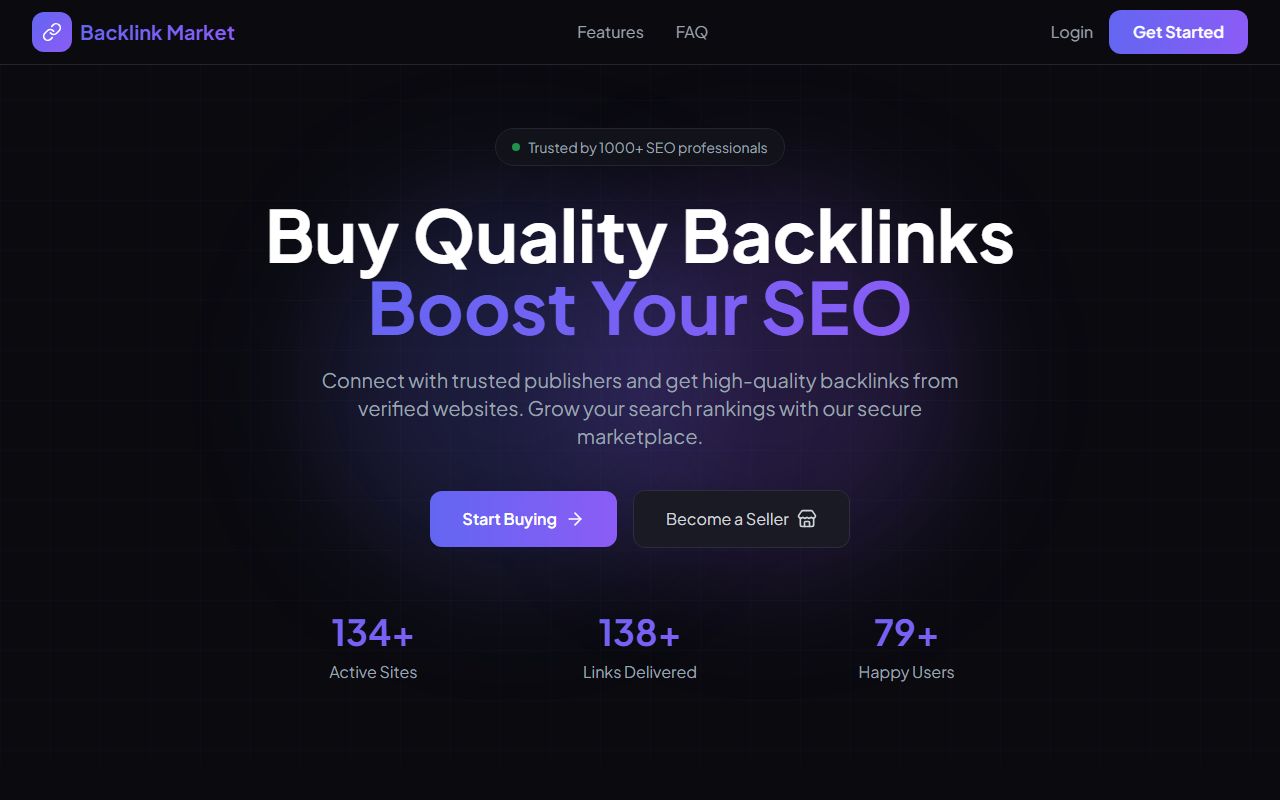
There is also a scale question the page raises itself. A badge reads 1000+ SEO professionals, the closing line says “thousands of marketers”, and the counters beside the hero read 134+ active sites, 138+ links delivered and 79+ users. These are different quantities and may all be true. They are also not reconciled on the page. Ask support what each one counts.
A verification layer built on the side
Since the marketplace has no monitoring box, build one. It is five steps and needs only the public endpoint.
- Collect candidates. Write down the domain, listed DA/DR, price and link type for each site you consider.
- Screen the shortlist.
bulk_drreturns DR and counts for up to 2,000 domains in one request. The single-domaindomainaction is free. - Compare claim to reading. A listed DR 60 against our DR 8 is a question for the seller. A listed DR 20 against our 18 is nothing.
- Look at the neighbourhood.
refdomainsshows the top referring domains of the seller’s site with their DR.anchorsshows what that site is usually linked with. - After purchase, fetch the page yourself first. The URL is in the order. Later, run
backlinkswith your target URL as the filter and read source URL, anchor, rel and last seen.
The last step has a timing rule. Our index follows crawl releases, roughly monthly and not real-time. A new link can take weeks to appear. A 30-day lease can start and end between two crawls. So the index answers “is this donor real and is the link visible in crawl data over time”. It does not answer “was the link live on day 12”. For that, fetch the page.
Endpoint details are in the API docs.
Test fixture: backlinkmarkt.com against our own API
The same checks, applied to the marketplace’s own domain. All seven referring domains in our index:
| Referring domain | DR | Seen |
|---|---|---|
| wallpapers.pro | 18 | 2026-03-05 |
| domainsc.com | 18 | 2026-04-22 |
| sporstcenter.com | 17 | 2026-06-14 |
| read.org.in | 16 | 2026-05-14 |
| carplz.com | 10 | 2026-02-11 |
| linksnatcher.art | 10 | 2026-07-11 |
| com.lc | 0 | 2026-07-10 |
Four readings come out of it.
- Identical file names. Six hosts serve the same
page-60b9…6c9.html. We opened two. Each is a machine-generated alphabetical list of roughly 8,000 domain names, titled around buying aged domains and backlinks. One template, many hosts. - No brand anchor. One anchor,
backlinkmarkt.com, 7 links, 100% of the profile. Neither “Backlink Market” nor any keyword appears. - Homepage only. Four links go to
https://backlinkmarkt.com, three to thehttp://form. No FAQ or signup page is linked. - A ceiling at DR 18. Nothing from gov or edu. The average referring DR is 13. Three referrers sit in the 0-14 band, four in 15-29, none above.
The wallpapers.pro page no longer shows the link when fetched today. That is the crawl-versus-live gap in miniature.
None of this grades the sites inside the marketplace. It describes one young domain, registered 2025-12-03, with a thin profile in our index. The point is the method: the same five columns, applied to any seller on your shortlist.
Cost model for checking
A hypothetical buyer, to keep the arithmetic honest. The buyer shortlists 40 seller domains and buys 10 placements.
| Step | Calls | Credits |
|---|---|---|
Screen 40 domains with the free domain action | 40 | 0 |
refdomains on the 10 chosen sellers (list call) | 10 | 20 |
backlinks on your 10 target URLs a month later (list call) | 10 | 20 |
| Total | 60 | 40 |
One credit is $0.0001, so 40 credits is $0.004. The first sign-in with Google comes with a $100 free credit and no card. Compare that with the marketplace’s own floor: a first deposit of 50 USDT.
The point is not that checks are cheap in absolute terms. It is that they are small next to a single deposit, so there is no cost reason to skip them. Lookups cost 1 credit at most and list calls 2.
Where Backlink Market is the better choice
We do not build, sell or index links. We hand out data. If your job is to place a link on a real site, a marketplace does that and an API does not. On that job, here is what the published terms give Backlink Market.
- Ownership verification. Sellers must prove control of a domain by DNS record or meta tag, and listings pass a review.
- Filters on the buyer side. Link type, price, category, traffic. One place to compare sellers.
- A short lease. Thirty days with renewal switchable per order lets you test a placement for one period before you commit to more.
- Stablecoin settlement. If you or your sellers already hold USDT, it removes card and bank friction.
- Published seller terms. Ten percent commission, 50 USDT withdrawal minimum, 24-hour processing, all stated on the page.
- A seller channel. If you own real sites, the “Become a Seller” path is the reason to be there.
Stay with it if you want links, are comfortable with USDT and will do your own checks. Add our data to it when you want a second opinion on donor DR and a record of what crawls see. For other ways to buy placements, compare it with Guest Post Geek or browse the link-building tools hub.
apibacklinks vs Backlink Market
| apibacklinks | Backlink Market | |
|---|---|---|
| Core job | Backlink and DR data over a JSON API. We do not sell or build links. | Marketplace: owners list sites, buyers rent link placements. |
| Public API | 19 actions on one endpoint, CORS enabled. | None found; /api and /docs return 404. |
| Price signal | 1 credit = $0.0001; from $0.10 per 1,000 calls; $100 free credit on first sign-in. | Per-link prices not published; sellers set them behind login. |
| Payment | Per-call credits; no subscription. | USDT only (TRC20, ERC20, BEP20); 50 USDT minimum deposit. |
| Link lifetime | Not applicable; we place no links. | 30 days per placement; optional monthly auto-renewal. |
| Quality metric | Our own DR, 0-100, from referring-domain counts in our graph. Not Ahrefs DR or Moz DA. | DA, DR and traffic shown; entered by sellers; source not published. |
| Timing | Roughly monthly refresh from our own web data; not real-time. | Delivery 48 hours per FAQ and terms; homepage says 24-72 hours. |
| Fees | Free actions cost 0; lookups 1 credit, lists 2, search 3. | 10% commission on seller earnings; buyer fee not mentioned. |
| Link monitoring | No alerts and no new/lost report; query backlinks on demand. | None described. |
Try it on backlinkmarkt.com
Read what a crawl sees on a seller or target domain; swap in any candidate.
curl "https://apibacklinks.com/api.php?action=refdomains&q=backlinkmarkt.com&key=YOUR_KEY"
Backlink Market alternative — FAQ
Is the brand called Site Name or Backlink Market?
How long does a purchased link last?
What does it cost to buy a link?
Can I check a seller’s DR before I pay?
Does Backlink Market have an API?
Will your index show a link I just bought?
Backlink data for the price of a rounding error
Sign up, keep your $100 of credit, call the API today.
Get started free