

A BacklinkGap alternative, written as an engineer's design note
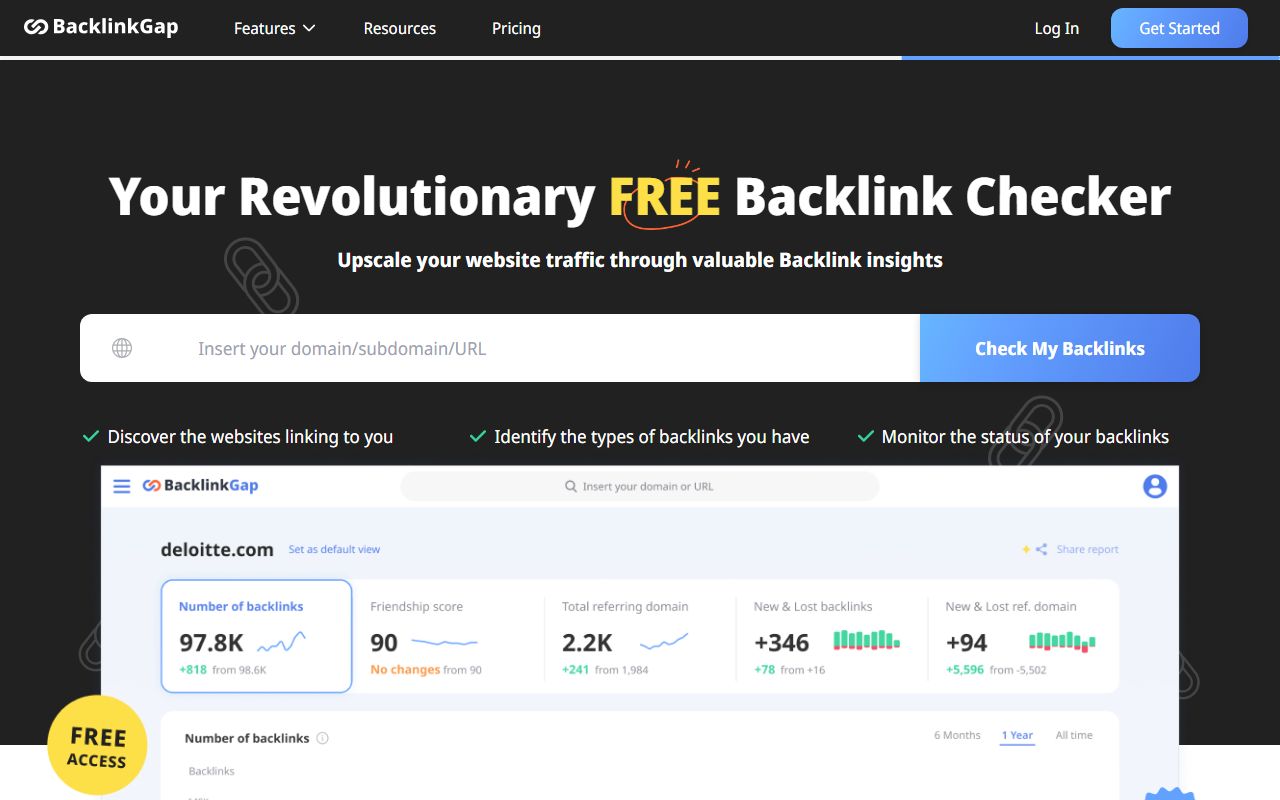
BacklinkGap puts a search box over a backlink dashboard: monitoring, tagging, disavow export, shareable reports. This note takes the dashboard apart, shows which tiles an API can rebuild, and prices both sides.
In our index backlinkgap.com has a DR of 18, 118 backlinks and 19 referring domains, first seen 2024-07-12 and last seen 2026-09-08. Dofollow is 79 of 118 links, 66.9%. That is a small profile for a tool whose top plan sells 4,000,000 backlink rows a month, and it is concentrated: biq.cloud (21 links), xomop.com (21), seopowa.com (16) and seopressor.com (13) account for 71 links, 60% of the total.
The anchors are mostly brand and URL text: "BacklinkGap" 23 times, the bare URL 20 times, "backlink checker tool" 8, and 16 French-language anchors such as "Outil de désaveu de Google", all nofollow. The two strongest referrers are roundups, semrush.com (DR 66) and hunter.io (DR 51). One oddity: aicw.io sends 9 dofollow links to a www host that did not resolve on 2026-10-09, which is 7.6% of everything we see. Browse it in the explorer.
BacklinkGap at a glance
- What it is
- A web backlink checker with backlink monitoring, competitor analysis and a disavow-list helper
- Operator
- Footer: Plentisoft BigData Sdn Bhd; launched February 2022 per its press release
- Pricing
- Starter $19, Pro $39, Business $199 per month, billed monthly in US dollars; a limited free plan exists
- Proprietary metric
- Friendship score; its help text calls 40 to 50 average, 50 to 60 good, above 60 excellent
- Export
- CSV, max 5,000 rows on every plan
- Public API
- Not published; no API or developer link on the site
Components behind the search box
Start with the diagram you would draw if you had to rebuild the thing. The homepage has one input, "Insert your domain/subdomain/URL", and one button, "Check My Backlinks". To rebuild it you would need roughly five parts, inferred from the site's pages and feature list.
- A single-page front end. The site is an Angular single-page app, so a plain HTTP fetch returns an empty shell and the content only appears once the page is rendered in a browser.
- A private backend. The app talks to api.backlinkgap.com. Its root answers 404, and no documentation, key page or developer link appears anywhere on the site.
- A link store holding the backlink rows. Its size, source and refresh rate are not published.
- A state layer per user: tags, remarks, a monitored-links list, a disavow list, search history, shareable reports.
- A scoring step that produces the Friendship score, their own metric, with no formula published.
Notice which of these an API replaces. The link store, and nothing else. The other four are product, and a JSON endpoint ships none of them. Keep that sentence in mind for the rest of the note: it decides who should read on.
Data flow for one lookup, both ways
On BacklinkGap the flow is: type a domain, spend one of your monthly searches, get a dashboard of tiles. The mock-up on the homepage shows deloitte.com with 97.8K backlinks, a Friendship score of 90, 2.2K referring domains and two new-and-lost counters. Everything arrives pre-assembled and pre-formatted. You cannot ask for a different shape, only filter and sort what is there.
On apibacklinks one lookup is a handful of GET requests against one endpoint, each returning JSON you shape yourself:
overviewfor counts, DR, top-5 referrers, anchors and pages. Free, no key.refdomainsfor the top 100 referring domains with donor DR and dates.anchorsandtoppagesfor the top 50 of each.backlinksfor individual rows, 1,000 per call, with filters for follow type, source TLD, anchor text and minimum donor DR.
The trade is plain. The dashboard gives you the finished view and charges per search. The API gives you ingredients and charges per call. Which is cheaper depends on how many times you want the same view, and that arithmetic comes two sections down.
Rebuilding the five dashboard tiles from API calls
The demo dashboard has five tiles. Here is what each one costs you to reproduce.
| Tile | apibacklinks call | Verdict |
|---|---|---|
| Number of backlinks | overview or domain, free | Direct |
| Total referring domain | overview, free | Direct |
| Friendship score | domain returns DR 0 to 100 | Similar in spirit, different formula and numbers |
| New and lost backlinks | None. No new/lost report exists | You build it: store a snapshot, diff it next month |
| New and lost ref. domain | None | Same: diff two refdomains pulls |
The last two rows are the honest ones. We do not track history in the API, so the only way to get "lost" is to keep your own copy of last month's refdomains response and compare. Our index refreshes roughly monthly, not in real time, so the diff cadence is monthly and a brand-new link can take weeks to appear. That is a weekly-alert product's opposite number. If your question is "what did I lose on Tuesday", this is the wrong tool.
If your question is "who links to my competitor and not to me", the intersect action returns the referring domains shared by 2 to 10 targets. Pull the competitor, subtract your own list, and you have a gap report in a dozen lines. Their competitor page describes running the checker on a rival's domain; a side-by-side gap report is not described there. See the API docs for the parameters.
Failure modes, observed on 9 October 2026
Every design note needs a failure section, and this one can be dated and factual. These are observations from a single check, not a verdict on the product.
- Stale freshness signals. The homepage HTML, the main JavaScript bundle and the sitemap carry 2022 timestamps, and the footer reads 2022. The homepage still labels monitoring "COMING SOON" while the pricing page sells monitoring credits. Neither is proof of anything, but they are the reason to test a search before paying.
- An unauthenticated dashboard error. A logged-out visit to the dashboard showed "Something went wrong. Please try again later or contact us." We did not sign in or run a search, so we do not know whether searches complete today.
- A host that does not exist. The www form of the domain does not resolve. Nine links in our index point at it. A broken inbound link like that is the kind of thing a link-monitoring feature exists to surface.
- The export ceiling. CSV export is capped at 5,000 rows on all three plans, while the Business plan advertises 4,000,000 rows. How many rows the interface itself shows per search is not published.
The API's failure modes are different and duller. Pagination stops at 50,000 rows per query. Coverage is a sample of the public web, so smaller than a commercial crawler's. A link crawled last week is invisible until the next release lands. We would rather you read that here than discover it in a client meeting.
Cost model: per search versus per call
BacklinkGap bills by plan, and a plan is a bucket of searches. A search is one website looked up.
| Plan | Monthly price | Searches | Per search |
|---|---|---|---|
| Starter | $19.00 | 10 | $1.90 |
| Pro | $39.00 | 100 | $0.39 |
| Business | $199.00 | 500 | $0.398 |
Those are monthly-billing prices from its pricing page, in US dollars; annual billing shows two months free. Note that Business costs slightly more per search than Pro. You are buying the 4,000,000 rows and 10,000 monitoring credits, not cheaper searches.
Now the API side. A credit is $0.0001. overview and domain are free. List calls cost 2 credits. A deliberately greedy full profile of one site is: overview (0) + refdomains (2) + anchors (2) + toppages (2) + 50 pages of 1,000 backlink rows (100) = 106 credits, or $0.0106. Across 500 sites that is 53,000 credits, $5.30. The same 500 sites on Business are $199. The first $100 of credit is free on sign-in with Google, which is 1,000,000 credits and no card.
The gap is real, but it is a gap in what is sold. The $5.30 buys data. The $199 buys data plus monitoring, tagging, shareable reports and someone else's front end. Whether the extra $193.70 is a bargain depends on how many hours you would otherwise spend building those parts.
When BacklinkGap is the better choice
A fair design note includes the case against its own recommendation, so here it is.
You need alerts. BacklinkGap's monitoring promises notification of new and lost backlinks, with monitoring credits listed as "3 days" on Starter and "daily" on Pro and Business (what exactly a credit covers is not defined on the page). We have no alerts, no monitoring and no email reports. Building a poller is possible, but our monthly refresh caps how fresh it can be.
You work with a disavow file. Its disavow tool lets you add unwanted links to a list and export a CSV for Google's Search Console disavow upload. We have no disavow tooling at all.
You report to people who do not read JSON. Shareable reports, white-label reports and a visual dashboard are all on its feature list. Our output is JSON and an explorer page. If the audience is a client who wants a link they can open, the dashboard is the right instrument.
You want one person to click, once, for free. The free plan exists, with limited rows per search. Its exact limit is not published, but for a one-off look at a single site it is free to sign up and needs no code. We did not run a search, so check that it returns data for you today.
If two or more of those describe you, stay. Replacing a monitoring tool that already does the job with your own API plumbing only pays off at higher volume.
When the API call wins
The other half of the decision is volume and shape. A team that looks up a few hundred domains a month, wants the numbers in its own database, or is feeding a prospecting script does not need a dashboard, and BacklinkGap documents no API, webhooks or bulk upload beyond "Import links". The bulk_dr action takes up to 2,000 domains in one request; compare puts up to 20 side by side; keyword shows which sites are linked with an exact anchor phrase. All return JSON with CORS enabled.
We keep the same split on the other pages in the backlink checkers hub. For a different mix of dashboard and data, the LINKJUICE.NL page covers a different checker.
One caution about scores. Our DR is computed in our own graph from referring-domain counts. It is not the Friendship score, not Ahrefs DR and not Moz DA, and numbers will not match between tools. Pick one metric per workflow and do not mix them in the same column.
apibacklinks vs BacklinkGap
| apibacklinks | BacklinkGap | |
|---|---|---|
| Core product | JSON API plus a free online explorer | Web dashboard: backlink checker, monitoring, competitor view, disavow list |
| Public API | 19 actions on one endpoint, JSON, CORS enabled | Not published |
| Entry price | $100 free credit on first Google sign-in, then $0.10 per 1,000 lookups | Limited free plan; paid plans $19, $39, $199 per month |
| Billing unit | Per call; 1 credit = $0.0001 | Per plan: 10, 100 or 500 searches a month |
| New and lost links | No | Yes, with email notification on its feature list |
| Disavow workflow | No | Yes, with CSV export for Search Console |
| Export | JSON, up to 1,000 rows per call, 50,000 deep | CSV, max 5,000 rows on all plans |
| Authority metric | DR 0 to 100, our own, from referring-domain counts | Friendship score, proprietary; formula not published |
| Data source and size | our web graph, 181,132,097 domains, refreshed roughly monthly | Not published |
Try it on backlinkgap.com
Pull the free overview first, then the top referring domains, for the domain in this note.
curl "https://apibacklinks.com/api.php?action=overview&q=backlinkgap.com"
curl "https://apibacklinks.com/api.php?action=refdomains&q=backlinkgap.com&key=YOUR_KEY"
BacklinkGap alternative — FAQ
Does BacklinkGap have an API?
Can apibacklinks replace its new and lost link reports?
refdomains response and diff it yourself, at the pace of our monthly refresh.Is DR the same as the Friendship score?
What does one site cost on each side?
Which has more data?
Where can I see its own backlinks?
Backlink data for the price of a rounding error
Sign up, keep your $100 of credit, call the API today.
Get started free