

A Backlink EYE alternative, scored round by round
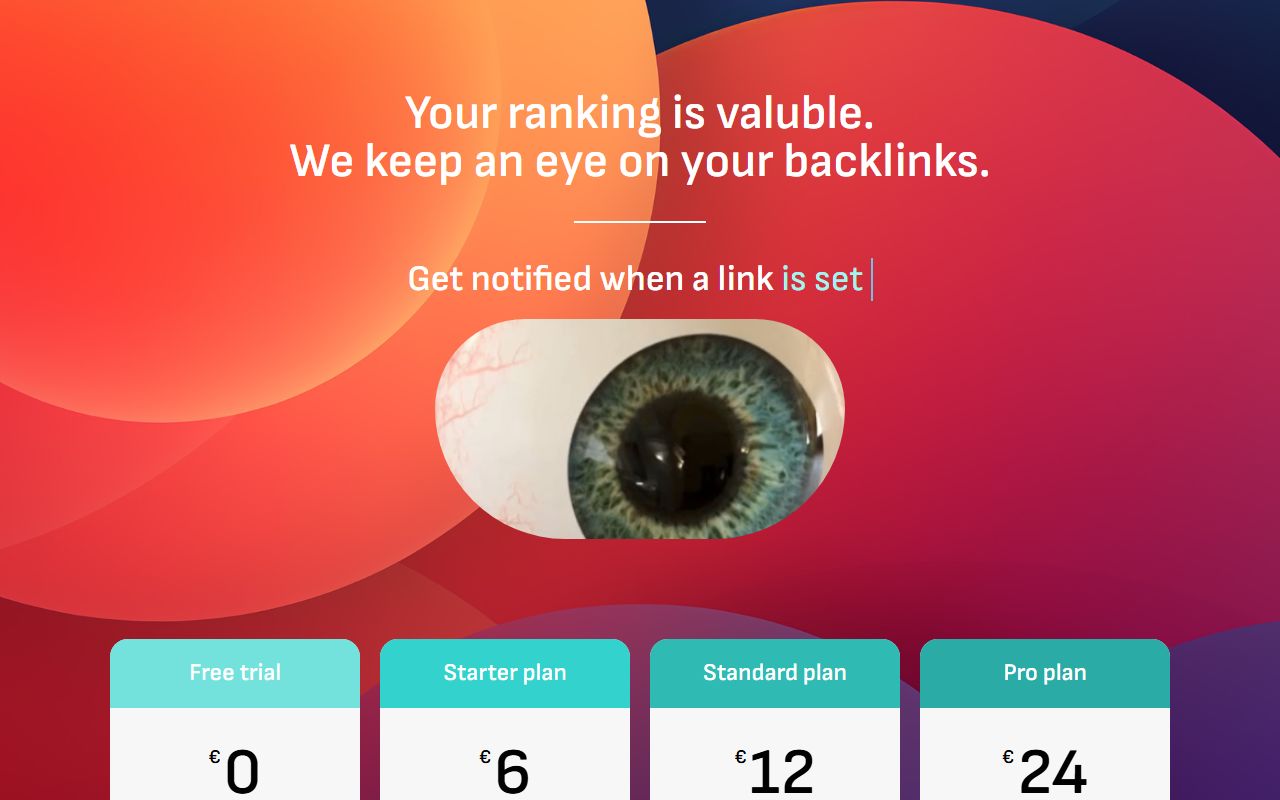
Backlink EYE's homepage shows a large human eye, four euro price cards and a waiting-list form. We put it against a raw backlink API in six rounds and gave the eye every round it earned.
We pointed our own index at backlinkeye.com, and the profile is unusually easy to read. It shows 172 referring domains and 1,532 backlinks, 1,529 of them dofollow, which gives a DR of 31 in our metric (ours, not Ahrefs DR or Moz DA). Only five distinct anchors exist: "Check BacklinkEYE" (1,004 links) and "backlink monitor tool" (522) account for 99.6% of everything.
The donors explain why. The biggest ones, such as rentanigloo.com (18 links), taxmorality.eu (17), bookameetings.com and loeklogman.nl (16 each), point at URLs tagged utm_source=ParkedDomain-<domain>, and the one such page we opened is a "registered with PEPS Media" placeholder that recommends the tool. So most of what we see appears to come from parked domains hosted by the parent company, with an average donor DR of 6. Only six links come from outside that network. This is a tidy illustration of why a DR figure should be read next to the donor distribution.
Backlink EYE at a glance
- What it is
- A backlink monitoring service: "We keep an eye on your backlinks and monitor them."
- Status on 2026-10-09
- Waiting list only: "I'm interested, inform me when live." and "We go live after 50 list-joins."
- Announced plans
- Free trial €0 (stops after 1 month), Starter €6, Standard €12, Pro €24, each labelled Monthly
- Alerts
- By email; link removed, set to nofollow, URL changed, or linking page set to no-index
- Public API
- None found; /api and /docs return 404
- Run by
- "A PEPS Media Project"; the owner's site says Amsterdam, the Netherlands
The rules of this scorecard
Before the first round, a word about what we are scoring. Backlink EYE and apibacklinks sit in the same drawer labelled "backlink tools", but they do different jobs, so a single winner would tell you nothing. I have split the comparison into six rounds, one question each, and the rule is simple: whoever really does the job better takes the round. Where it depends on your situation, the round is a draw, and I will say so.
One more rule, because a good scorecard is only fair when its sources are. Everything about Backlink EYE below comes from its own homepage and from public records, dated 2026-10-09. Where the company has not published something, I write "not published" and move on. Everything about apibacklinks comes from our own fact sheet, limits included.
Round 1: can you use it today?
The homepage greets you with a tidy sentence, "How will Backlink EYE work?", in the future tense, and further down a form: Name, Email, Join list. The only status line is "We go live after 50 list-joins." There is no sign-up, no login and no app link. The sitemap lists one URL, and /pricing, /api, /register and /terms all return 404.
There is a history here that deserves respect. Archived captures from 2015 and 2020 show an earlier BacklinkEYE with a login box and a seven-day free trial, and the owner's parked-domain pages talk about it in the present tense (our translation of their Dutch: "we use BacklinkEYE"). So the product has lived before, and the waiting list may well be a relaunch. But the company does not say whether anything is running for customers today, so I cannot tell you either.
By contrast, you can call our domain and overview actions right now with no key, and the first sign-in with Google brings a $100 free credit, no card.
Round 1 goes to apibacklinks. This is a statement about availability today, not about quality. If the eye opens next month, the round could be replayed.
Round 2: the alert that arrives in your inbox
Here the eye earns its keep. Under the headline, a line types itself out: "Get notified when a link is removed.", "is set to nofollow.", "has the url changed.", "has its page set to no-index." Those are four precise, useful failure modes, and the no-index case is easy to miss by hand. Every plan lists "Alerts by email".
apibacklinks has nothing comparable. We have no alerts, no monitoring, no new-or-lost report and no email reports. Our data refreshes roughly monthly and is not real time, so a link that vanished yesterday may still show as present for weeks. If the thing you need is a message saying "your link on that page is gone", a purpose-built monitor is simply the right shape.
Round 2 goes to Backlink EYE, and it is not close.
Round 3: what the numbers cost
Backlink EYE publishes four cards, in euro, each labelled Monthly:
| Plan | Price | Domains | Links | Automated checks |
|---|---|---|---|---|
| Free trial | €0, stops after 1 month | 1 | 50 | Weekly |
| Starter | €6 | 1 | 50 | Weekly |
| Standard | €12 | 5 | 500 | Bi-weekly |
| Pro | €24 | 20 | 2000 | Daily |
Doing the division, that is €0.12 per tracked link at Starter, €0.024 at Standard and €0.012 at Pro. Those are my arithmetic, not their claim, and the page does not say how "Manual checks" are counted or what "Bi-weekly" means. VAT, annual billing and refunds are not published.
Our model is different: one credit is $0.0001, lookups cost 1 credit, list calls cost 2, so it starts at $0.10 per 1,000 calls, with no subscription and no monthly minimum. But a credit buys you data about links, not a promise to re-check a particular page each week. These prices answer different questions, so comparing them directly would be misleading.
Round 3 is a draw. €6 for a fixed, predictable service is a fine deal if that service is what you want; pay-per-call is better if you want raw rows.
Round 4: who finds the links in the first place?
Simple, you add your domain, plus the URLs of the pages which contain the links you want to track.
That sentence from the homepage tells you where the work sits. With Backlink EYE you bring the list of linking pages; the page does not claim to discover backlinks, crawl the web or hold its own index. That is a reasonable design for someone who bought a few placements and wants to babysit them. It is awkward if you do not know your full link profile, or if you want to see who links to a competitor.
apibacklinks starts from the other end. Our index covers 181,132,097 domains and about 798.6 billion page-level backlinks from 13 crawl releases, so you can ask refdomains for any domain's top referrers, backlinks for individual links with filters, and intersect for referrers shared by up to ten targets. Our limits are real: our web index is a broad sample, so coverage is smaller and less fresh than the large proprietary crawlers, and a brand-new link can take weeks to appear.
Round 4 goes to apibacklinks, on discovery. It would flip if you already know every URL you care about and only want to watch them.
Round 5: can you build the dashboard yourself?
If you are comfortable with a script, you may wonder whether you can skip the monitor and build the view yourself. The honest answer is: partly. You can pull the backlinks for your domain through backlinks, store the rows and the last-seen dates once a month, then diff the result. A link that was in last month's snapshot but not in this one is a candidate for "lost". For a 50-link setup that is an afternoon's work in a spreadsheet, and the API reference lists the filters you can use.
What you will not replicate is the schedule and the attention. The eye promises a re-check of each page weekly or daily, depending on the plan, and email delivery. Our index-based data moves roughly monthly, and we do not run alerts or watch URLs for you. Your homemade view is a monthly audit, not a watchtower.
It does give you something the eye does not mention at all: donor DR, anchors, referring-domain counts, and a way to compare twenty domains side by side. You can see the whole thing for free in the browser explorer, including the odd shape of the monitor's own profile described above.
Round 5 is a draw: the eye wins on rhythm and convenience, the API on depth and control.
Round 6: automation, exports and evidence
Backlink EYE's alerts go by email. I found no API, no webhooks, no export format and no integrations described anywhere on the page, and the page does not mention team seats or reports for clients either. That does not prove they will never exist, only that none is published.
apibacklinks is JSON over HTTPS with CORS enabled, so anything that can send a GET request can use it: a cron job, a spreadsheet script, a client dashboard you build yourself. We have 19 actions, up to 1,000 rows per call, and bulk_dr for up to 2,000 domains in one request. We do not give you a shareable dashboard, exports on a schedule or a toxicity score, so you are building your own views.
There is also the question of evidence. When I searched the open web for independent reviews or comparisons of Backlink EYE, I found none, so there is little third-party reading to lean on. Our own side is easier to inspect: the explorer is open, and the prices are listed.
Round 6 goes to apibacklinks, for programmability.
Where the eye is the better choice
I do not want you to read the tally and conclude that the API is the grown-up option. Stay with Backlink EYE, or put your name on its list, if any of these describes you:
- You bought or traded a handful of links and want a watcher. Fifty tracked links for €6 a month is a sensible size for that, and "set to nofollow" or "page set to no-index" are exactly the changes that quietly cost you value.
- You do not write code and do not want to. A form where you paste URLs is easier than any endpoint, and an email is easier than a cron job.
- You care about days, not months. Our refresh is roughly monthly. A daily check on the Pro plan, when it exists, is a different clock.
- You trade links with other sites. The owner's own parked pages describe that case themselves: swapped links, and whether anyone checks that the link is still there.
The caution is simply timing. Until the list reaches its threshold, you are signing up for a promise, so I would not make it the only safeguard for links that matter. If you want a second pair of eyes in the meantime, our backlink checker hub compares other checker tools, and the LinkChecker alternative page covers another one.
Final tally: pick the job, not the score
| Round | Winner |
|---|---|
| 1. Usable today | apibacklinks |
| 2. Alerts | Backlink EYE |
| 3. Price | Draw |
| 4. Discovery | apibacklinks |
| 5. Build-it-yourself view | Draw, in effect |
| 6. Automation and evidence | apibacklinks |
That is apibacklinks 3, Backlink EYE 1 and two draws. The count hides how much the eye's one win can matter: for a buyer with fifty links and no code, alerts are the whole purchase, so for that buyer the round weighs more than the others.
Choose Backlink EYE if your question is "is my link still there?" and you want it answered in an inbox. Choose an API if your question is "who links to me, who links to them, and how good are those donors?" And if you are wondering how these two could be used together: let the API show you what exists, then hand the pages that matter to a monitor.
apibacklinks vs Backlink EYE
| apibacklinks | Backlink EYE | |
|---|---|---|
| Primary job | Backlink and DR data from our own index, returned as JSON | Re-checks pages you supply and emails you when a link changes |
| Available today | Yes: free domain and overview actions need no key | Waiting list: "We go live after 50 list-joins." |
| Finds your backlinks for you | Yes, from 181,132,097 domains in the index | Not stated; you add the linking URLs yourself |
| Change alerts | None; no monitoring or new-and-lost reports | Email for removed, nofollow, URL changed, no-index |
| Refresh rhythm | Roughly monthly, not real time | Weekly, bi-weekly or daily by plan; "Bi-weekly" is not defined |
| Entry price | $0.10 per 1,000 lookup calls; $100 free credit, no card | €0 trial for 1 month, then €6 per month |
| Public API | Yes, 19 actions on one endpoint | Not published; none found |
| Metrics shown | Our own DR, anchors, referring domains, top pages | Not published |
| Independent reviews | Not claimed | None found on 2026-10-09 |
Try it on backlinkeye.com
A first look at the monitor's own profile from our index: its top referring domains, ranked by links.
curl "https://apibacklinks.com/api.php?action=refdomains&q=backlinkeye.com&per=20&key=YOUR_KEY"
Backlink EYE alternative — FAQ
Is Backlink EYE available to use right now?
What does Backlink EYE actually monitor?
Does Backlink EYE have an API?
Can apibacklinks replace a link monitor?
Is the DR in your index the same as Ahrefs DR?
Why is the backlink profile of backlinkeye.com so uniform?
Backlink data for the price of a rounding error
Sign up, keep your $100 of credit, call the API today.
Get started free