

PBN Haus alternative: a beginner’s guide to what you are buying
PBN Haus is one person, “Zee,” selling blog posts with links from his own network at £14 to £17 each. Here is what that means in plain words, and how to check the result with data.
We looked up pbn.haus in our own index. It has DR 18, 18 referring domains (5 of them dofollow) and 49 backlinks, 14 dofollow, which is a 28.6% dofollow share. Every one of the 49 points at the homepage; /buy and /learn have none. The strongest donors are sthai.xyz (DR 41), upsoccerclub.nl (DR 40, 7 links, all dofollow) and centroasturianodemexico.com (DR 40, 4 links). Nothing is above DR 49 and there are no gov or edu referrers.
The anchors are the surprise: 38 of the 49 links (77.6%) use adult or profanity phrases, the largest group being 11 links, and only 5 use the brand or URL. The four “pbn.haus” links, all dofollow, come from one 2024 newsletter post on davidsoleinh.com, which lists the site among services that sell backlinks. Our data shows that the pattern exists, not who placed the links. One more anchor is a personal name, which appears 4 times and is the top anchor on cambodia-automotive.org.
PBN Haus at a glance
- What it is
- A seller of blog posts with in-content links, published on the seller’s own sites
- Run by
- One person who signs as “Zee”; no surname or company name published
- Pricing
- £17 (1 link), £70 (5), £140 (10); one time, in GBP
- Turnaround
- First post in about 3-5 days; orders complete in about 30 days
- Delivery proof
- Excel spreadsheet with post dates, URLs and anchor texts
- API
- None found
- Not published
- Network size, site metrics, dofollow status
A street of shopkeepers who vouch for you
Imagine you have just opened a bakery on a street nobody walks down. Strangers will not cross the road for bread from a shop they have never heard of. But if five neighbouring shopkeepers each tell their customers “the bakery at number 9 is good,” people start to turn up. A backlink is that sentence, written on a web page: one site pointing at another. Search engines count those pointers the way a street counts recommendations.
A PBN, a private blog network, is a row of shops owned by the same person. Instead of waiting for the neighbours to speak up, the owner writes the recommendation on his own shopfronts. PBN Haus is one person doing exactly that for paying customers. The homepage introduces him in one line: “Hi, I am Zee. People come to me to buy PBN links.” There is no team page, no surname and no company name, only a first name and a price list.
This guide follows that bakery story all the way through. By the end you will know what you are buying when you order from a seller like Zee, what you can and cannot check beforehand, and how to read the recommendation afterwards to see whether it was actually written on the wall.
What a pound buys at number 9
PBN Haus sells one thing in three sizes. Prices are in British pounds, each labelled “one time fee,” so there is no subscription to cancel. The order page lists them like this:
| Package | Price | Per link |
|---|---|---|
| 1 x PBN link | £17 | £17.00 |
| 5 x PBN links | £70 | £14.00 |
| 10 x PBN links | £140 | £14.00 |
Two small observations from the arithmetic. The ten-pack gives no further discount over the five-pack, and the page itself says the five-link package is “ideal for most people, especially if you run a local business.” So the seller points buyers to the middle option rather than the biggest one. No larger pack is published.
What arrives is a blog post of 500 to 750 words with a contextual link inside it, published on one of the seller’s sites. Order ten links and, by his account, you get ten links from ten different websites with unique content. The posts drip out over about 30 days, the first one in roughly 3 to 5 days, and afterwards you receive a spreadsheet with post dates, URLs and anchor texts. In our bakery story, that spreadsheet is the list of shopfronts where the sign now hangs.
Reading the shop window
The order page carries a checklist: “Toxicity Tested,” “500-750 word posts,” “Contextual in-content links,” “Unique IPs,” “Dripfeed links,” “Bad bots blocked.” For a newcomer it helps to sort such a list into two piles: things you will be able to see for yourself, and things you take on trust.
- Visible afterwards: the word count, the link sitting inside the text, the drip schedule and the dates in the report.
- Taken on trust: what “Toxicity Tested” means, which tool measures it, how strong the network sites are. None of that is published.
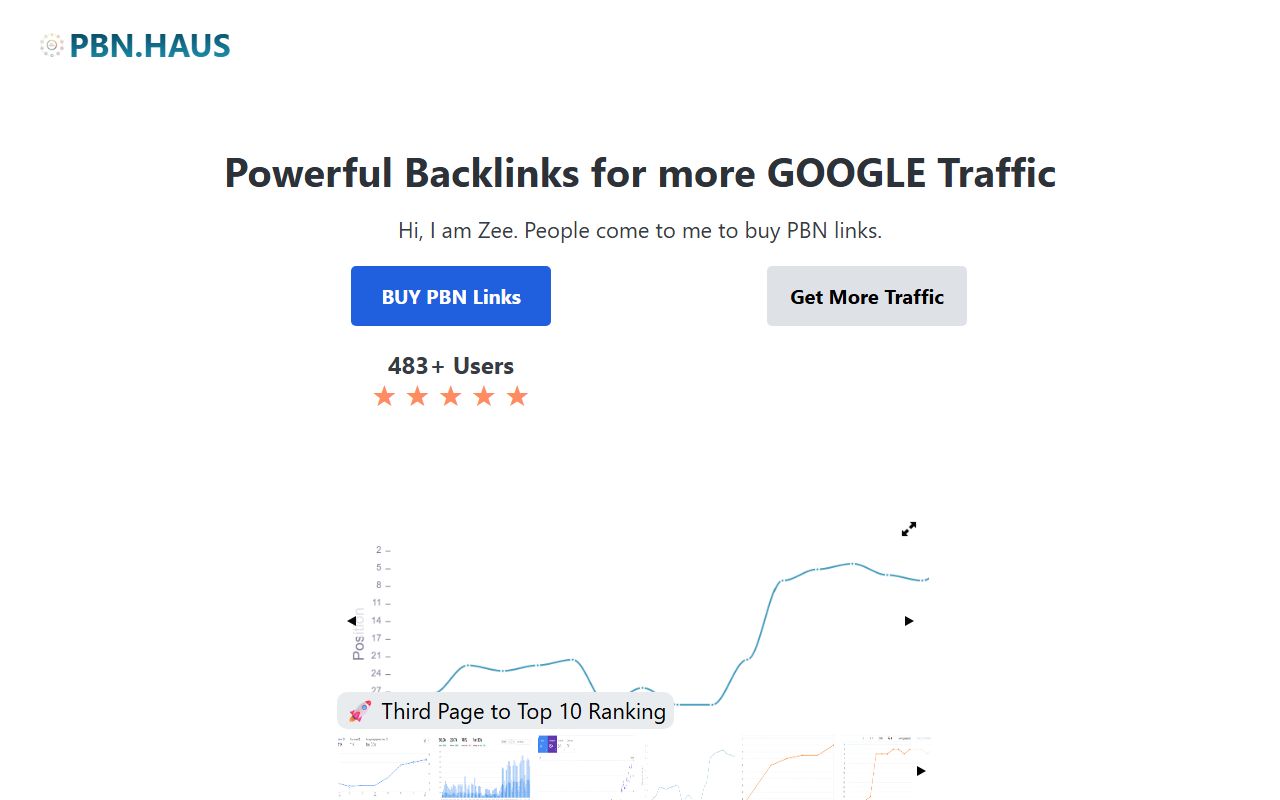
The site is equally frank about what it will not promise. The homepage slider shows ranking and traffic charts captioned “Third Page to Top 10 Ranking” and “234% Traffic Increase,” followed by a disclaimer that these are sample results and that specific results cannot be guaranteed. The order page puts it plainly: there are no guarantees in the SEO game. We would add the same sentence to every link service, ours included, since we sell data and not rankings.
Also not published: how many sites are in the network, whether the links are dofollow, how many outbound links a post carries, and what happens if a network site goes offline. The posts, says the FAQ, “are permanent.” That covers the post itself; it does not say what happens if a network site goes offline. None of this is a criticism; it is simply the list of questions to ask by email before paying. Contact is by email only, and the contact page asks you to read the FAQ first.
How to check a recommendation was really written
Here is the trick a newcomer can learn in an afternoon. After a seller hands you a spreadsheet, you want to know three things about each row: does the page exist, does the link point at you, and is the site known to the wider web. Our index can help with the third and, over time, the second.
Take the first rule: donor strength. Every domain in our graph has a Domain Rating from 0 to 100. It is our own metric, computed from referring-domain counts, and it is not Ahrefs DR or Moz DA, so numbers will differ from those tools. Still, the same yardstick applied to every row in a spreadsheet tells you which placements sit on well-linked sites and which sit on lonely ones. bulk_dr takes up to 2,000 domains in a single request, so a ten-pack fits in one request.
The second rule is anchors. The spreadsheet says what anchor text Zee used. The anchors action on your own domain shows what the crawl later saw. If the two lists agree, the wall carries what the invoice said.
The third rule is presence in the crawl. Our index is built from our own web link data and refreshed roughly monthly, so a new link can take weeks to appear. Set a diary reminder two months after the last post date, then look at backlinks filtered by your target. A link that was delivered but never shows up is not proof of anything, since our web index is a sample, but it is a reason to ask the seller to show you the page. The API reference lists the filters.
Zee’s own wall, read from the street
A fair test of any seller is to look at the seller’s own shopfront. Our index has a profile for pbn.haus, and it is a small and curious one. The numbers are laid out above, so here we only draw the newcomer’s lesson from it: a profile tells you the pattern, not the author.
Seven of the 18 referring domains were last seen in 2025. One example is cambodia-automotive.org, whose 8 links ran from 2025-08-13 to 2025-11-15 and then stopped appearing. For a buyer, that is a live demonstration of why first-seen and last-seen dates matter: a link is not a permanent object, it is a line that a crawler either keeps finding or stops finding. Compare delivery dates in the spreadsheet with last-seen dates in the crawl and you have a tidy way to talk about durability with any seller.
The other lesson is restraint. Most of the links in the pbn.haus profile carry adult or profanity phrases as anchors, on pages that have nothing to do with SEO. Our data shows that they exist; it cannot say who placed them or why, and nothing here suggests the seller did. Read it as a pattern in the data, not as a statement about the seller.
Where PBN Haus is the better choice
Back to the bakery. If what you need is a recommendation written on a shopfront soon, a data API is the wrong tool. We do not build links, sell links or index pages. PBN Haus does the building, and that settles several questions at once.
- You get links, not numbers. The product is a finished post with your link in it. Our product is a table of facts about links that already exist.
- The price is simple and stated. £17 for one, £70 for five, £140 for ten, with no plan and no credits to calculate. A newcomer can read it in ten seconds.
- It is personal. One person, one email address, and by his own account repeat customers make up the majority of his sales. If you like talking to a human who owns the process, that is a real advantage over any API.
- He screens orders. The order page says risky link profiles are turned away and refunded, and lists niches he will not take, from CBD and gambling to payday loans and APKs. If you are in one of those, you now know before you ask.
- A report is included. The finished-order spreadsheet gives dates, URLs and anchors. We have nothing equivalent, because we do not know what you ordered.
So if you already know you want PBN links and have the budget for ten, order from the seller and use us as the check afterwards. The two jobs do not overlap.
Where the data tool fits, and where it does not
An honest map of our own limits, since a newcomer deserves one. The index holds 181,132,097 domains and 2,774,625,913 domain-to-domain links from 13 crawl releases between 2025 and mid-2026. It is smaller and less fresh than the crawlers of the big commercial tools, and updates are roughly monthly rather than real-time. We have no rank tracking, no traffic estimates, no site audit and no toxic-link score, and no new-and-lost link reports or alerts.
What we do have is cheap and open. Free actions like overview and domain need no key; list calls cost 2 credits, and one credit is $0.0001, so a thousand list calls come to $0.20. The first sign-in with Google gives $100 of free credit with no card. For a seller’s customer that means you can check every row of a ten-pack for a tiny fraction of a dollar. Try the free explorer view of pbn.haus to see the profile described above with your own eyes.
If you are comparing sellers rather than data tools, the sibling pages for Blogtownhub and Guestposting are written from the same angle.
A first stretch for a complete beginner
This is a hypothetical plan, not a promise of any result. Suppose you run a small local shop site and you have decided to try the five-link package.
- Day 1. Run
overviewon your own domain and write down DR, referring domains and top anchors. This is your “before” photograph. - Day 2. Email the seller with the questions from the shop-window section: which anchors, which target pages, whether links are dofollow. Order only when the answers satisfy you.
- Days 3 to 35. Posts go live. Keep the spreadsheet and note each date.
- Day 40. Run
bulk_dron the donor domains from the spreadsheet. Look at the spread, not any single number. - Day 90. Run
backlinkson your domain again and compare against the spreadsheet. Missing rows are a question for the seller, not a verdict.
Three months, a handful of calls and a spreadsheet: that is the entire method. The street keeps changing, and the diary entry is what lets you notice.
apibacklinks vs PBN Haus
| apibacklinks | PBN Haus | |
|---|---|---|
| What it is | A backlink and domain-rating JSON API plus a free online explorer | A seller of blog posts with a link, published on the seller’s own network |
| Product delivered | Data about links that already exist in our index | Posts of 500-750 words with a contextual link |
| Price | From $0.10 per 1,000 lookups; $0.20 per 1,000 list calls | £17 for 1 link, £70 for 5, £140 for 10 (one time) |
| Free tier | $100 free credit on first Google sign-in, no card | None mentioned |
| API | 19 actions on one endpoint, JSON, CORS enabled | None found; ordering by Payhip checkout and email |
| Report | Live lookups per domain; no scheduled or emailed reports | Excel spreadsheet of post dates, URLs and anchors after completion |
| Turnaround | Live lookups; index refreshed roughly monthly, not real-time | First post in about 3-5 days; orders complete in about 30 days |
| Network size and site metrics | 181,132,097 domains in the index, DR for each | Not published |
| Dofollow status of links | Dofollow flag per backlink in the data | Not published |
| Guarantees | None on rankings or traffic | No guarantee of results; no refunds once services have begun, per the Terms |
Try it on pbn.haus
Pull the referring domains of pbn.haus, then check each donor the same way.
curl "https://apibacklinks.com/api.php?action=refdomains&q=pbn.haus&key=YOUR_KEY"
PBN Haus alternative — FAQ
What is a PBN link in plain words?
How much does PBN Haus cost?
Does PBN Haus have an API?
Can apibacklinks tell me if my purchased link is live?
Is our DR the same as the DR other tools show?
Who should stay with PBN Haus?
Backlink data for the price of a rounding error
Sign up, keep your $100 of credit, call the API today.
Get started free