

A LinksThatRank alternative is not a replacement: design notes for the data layer beside it
LinksThatRank says it blacklists 84,285 publishers, and 79 backlinks point at the free tool that does it. This note treats the agency as a pipeline and asks where a raw link-data API fits around it, or instead of it.
In our index linksthatrank.com has a DR of 31 (our own metric, not Ahrefs DR), 623 backlinks from 181 referring domains, and 67.7% of those links are dofollow (422 of 623). The most-linked page is not a service page. The homepage leads with 282 links, but second place goes to /backlink-blacklist/ with 79, ahead of /casino-backlinks/ at 46. Anchors tell the same story: "LinksThatRank" alone is 178 links, 28.57% of the profile, and "Backlink Blacklist" adds 20 more.
The top referrers are names the agency lists as press: respona.com (30 links), rankmath.com (26) and wpx.net (20), with its sister site searchlogistics.com at 18. Three nofollow-only anchors, "@SEO_CARTEL IN TELEGRAM", "TG @BHS_LINKS" and "TG @LINKS_DEALER", add 32 links, about 5%. Those are third-party drops of the kind many SEO domains collect, and a raw crawl reports them without comment. Zero referring domains are .gov or .edu.
LinksThatRank at a glance
- What it is
- A UK-based link building agency, founded 2019 by Matthew Woodward; done-for-you guest posts, link inserts, listicles, reviews
- Packages
- Six All-Round tiers, $697 to $19,997 per month (3 to 86 links); one-time prices run higher
- One-off prices
- Guest posts and link inserts from $177, listicles from $247, reviews from $277
- Quality gate
- 23-point quality control, an 84,285-site blacklist, DR bands measured with Ahrefs
- Guarantee
- 1-year replacement (stated for listicles and reviews in the package list)
- API
- None found; orders go through a cart and account
System boundary: a cart on the front, an editorial desk behind it
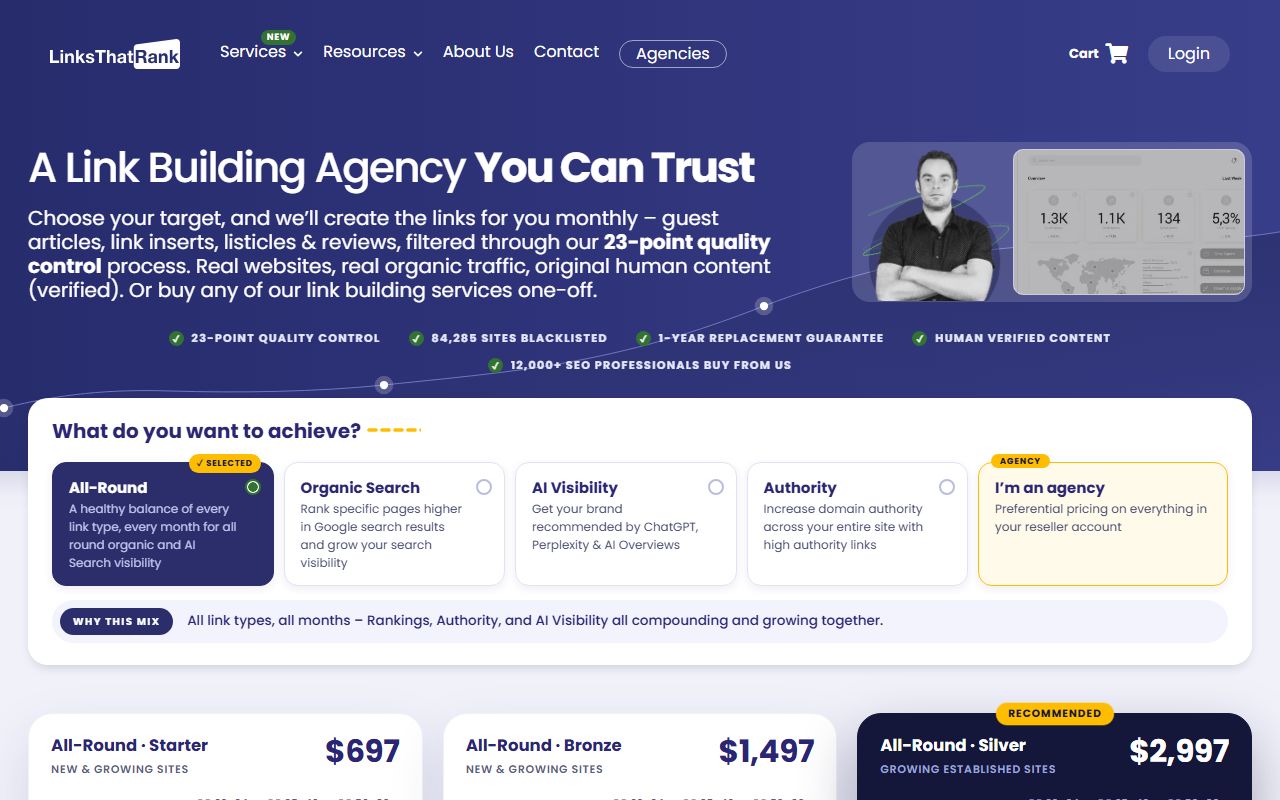
Start by drawing the box. LinksThatRank describes itself as "a UK based link building agency founded in 2019 by award winning SEO Matthew Woodward". You choose a goal on the homepage (All-Round, Organic Search, AI Visibility, Authority, or the yellow agency card), pick a tier, and pay through a cart. Nothing public suggests an API, a developer portal or a data export. That is not a criticism; it is the boundary of the system. Inputs are a target URL and a card. Outputs are live links and a report.
An API like ours sits outside that box. We do not build, sell or index anything; we read the public web as our web index saw it, across 181,132,097 domains and 2,774,625,913 domain-to-domain links. So the useful question is not which of the two to use. It is which interfaces on the agency's pipeline are opaque enough that you want your own instrument pointed at them. There are three: the inventory (which sites?), the filter (what survives?) and the output (is the link there?).
Components: inventory, filter, blacklist, order form
Reading the homepage as a component diagram gives four parts.
- Inventory. Publishers sourced and screened by the agency. The About page claims 50,000+ active publishers; no list is public, so you cannot inspect it.
- Filter. A "23-point quality control" with checks such as "Publisher metrics match order - Ahrefs", "500+ organic visitors a month", "No PBNs, no 'write for us' pages" and "Dofollow - no sponsored or ugc tags", plus "+15 more checks".
- Blacklist. "84,285 publishers we refuse to work with", split into 35,819 PBN networks, 24,012 cold-outreach resellers, 19,582 public marketplaces and 4,872 that failed quality control. (The About page says "60,000+", so treat the exact figure as soft.)
- Order form. A link count plus a DR budget: Starter promises 3 links with a minimum total DR of 105, Enterprise 86 links and 3,550.
The order form is the interesting part of the design. Selling a minimum total DR alongside the link count means the DR is a sum across the package, not a floor per link (our reading of the pricing cards; the per-link split is not published). Authority-goal packages add a floor, "nothing below DR 35". Everything about these numbers is measured in Ahrefs terms, which is why our DR will not match them. Ours is computed from referring-domain counts in our own graph and is comparable in spirit only.
Data flow: from a Silver order to a link in a crawl
Follow one worked example (hypothetical, not a real customer). You buy All-Round Silver ($2,997 a month, "RECOMMENDED", 13 links, minimum total DR 485), name a target page, and wait. The agency says "most orders delivered in under 21 days, express 10 day delivery available". The site describes human-verified content checked with Originality.ai, and white-label reports for agencies; the steps in between are not published.
Now add the second pipeline, ours, running on public data. crawl releases are processed roughly monthly, so a link that went live on day 9 of an order can take weeks to appear in our index. This is the design constraint to plan around: the crawl is a lagging witness. It cannot tell you on delivery day that a link exists. It can tell you a month later that the link is visible to a crawler that does not know who paid for it, which is a different and sometimes more useful fact.
| Stage | Agency pipeline | Data-layer check |
|---|---|---|
| Before ordering | Choose goal and tier | compare your target against rivals; intersect to see who links to them |
| Delivery | Publisher report | backlinks filtered by source domain and date range |
| Weeks later | Replacement window open | Crawl visibility, anchor text, rel attributes |
The blacklist is the load-bearing component, and it is free
The backlink profile in our explorer suggests where a good share of its links come from. The Backlink Blacklist page, a free checker where you "paste upto 1,000 links" to screen a profile or another supplier, collects 79 backlinks, and the anchors are blacklist-flavoured: "Backlink Blacklist", "online blacklist search tools", "The Backlink Blacklist", even a direct link to a zip file of the list. Referrers include vazoola.com, clickass.io and myprofitengine.com. A tool that audits other people's links has become the agency's own link magnet.
As architecture this is neat: the same asset serves as a quality gate for orders, a lead generator and a source of citations. It also marks the limit of our overlap. The blacklist answers "is this publisher on a known-bad list?". Our refdomains action answers a different question: who links to this domain, with what donor DR, how many links, how many dofollow, when first and last seen. Use both. One is a verdict from the seller's side; the other is raw evidence.
Failure modes, and which ones a crawl can see
Every pipeline fails somewhere. Here are the plausible places for a managed link order, and whether public crawl data helps. These are generic failure modes of the model, not reports about this company.
- Link goes live, then disappears. The agency's answer is a one-year replacement guarantee (listicles and reviews are named explicitly; scope for the other types is not published). Our
last seenfield gives you independent evidence of the disappearance. - Link is live but tagged. The agency promises dofollow without sponsored or ugc tags. Our
backlinksaction returnsreland nofollow per link. - Anchor drift. You asked for a branded or partial-match anchor and got something else.
anchorsreturns the top 50 anchors per target. - Publisher DR is not what the order said. Their DR is Ahrefs DR; ours will differ. You cannot reconcile the two numbers, but you can compare donors against each other using one consistent yardstick.
- Crawl never sees it. The one failure we introduce. A thin or orphaned page may not be in our web index at all, so absence in our data is a prompt to check, not a verdict.
What we cannot do: no alerts, no new-and-lost report, no monitoring. If you want a scheduled diff you write it yourself against the API and store the snapshots.
Cost model: the per-link price is nearly flat
Dividing each published monthly price by its link count gives the unit economics.
| Tier | Monthly | Links | Per link | Per min. DR point |
|---|---|---|---|---|
| Starter | $697 | 3 | $232.33 | $6.64 |
| Bronze | $1,497 | 6 | $249.50 | $6.65 |
| Silver | $2,997 | 13 | $230.54 | $6.18 |
| Gold | $4,997 | 21 | $237.95 | $5.84 |
| Platinum | $9,997 | 43 | $232.49 | $5.68 |
| Enterprise | $19,997 | 86 | $232.52 | $5.63 |
Per link the line is almost flat, between $230 and $250. What falls with size is the price of each DR point, from about $6.65 to $5.63, so bigger tiers buy higher-authority placements, not cheaper ones. Our price model is a different shape entirely: 1 credit is $0.0001, so 1,000 lookup calls cost $0.10 and 1,000 list calls $0.20, with up to 1,000 rows per call. A new account gets $100 of free credit, which is 1,000,000 credits and no card. Auditing delivered links costs cents; the links themselves cost what the table says. The two numbers are not substitutes, they are different line items.
Where LinksThatRank is the better choice
Plenty of cases do not need an API. If you want links built, and not just measured, apibacklinks is the wrong tool, because we do not build, sell or index links. LinksThatRank does the work: sourcing publishers, commissioning 1,000+ word articles, placing them, and, per its site, handing agencies unbranded client-ready reports at up to 15% off with a dedicated account manager. We offer no dashboards to share with clients and no reports to white-label.
It also wins on coverage of the job. Four package goals, from Organic Search to AI Visibility (listicles and reviews), one-off products from $97 for content, a published replacement guarantee, and two free tools, the blacklist checker and an AI visibility checker that tests 33 crawlers in about 15 seconds. We have nothing like those. Our data is also a broad sample of the web, smaller and less fresh than a vendor crawler, so it will under-report fresh placements.
Who should stay: teams whose constraint is time rather than budget, agencies reselling links under their own name, and anyone who wants one invoice and a human to email. Who should add an API: anyone who wants to check the output independently or plan the order with evidence of what a competitor's link profile looks like.
Bolting the data layer on: a 3-step integration
The smallest useful design is three steps, none of which touches the agency.
- Plan. Run
intersecton two to ten rivals to find referring domains they share. That shortlist tells you which sorts of sites your category links to, and what donor DR is realistic. Ourbulk_drchecks up to 2,000 domains per request if you have a longer prospect list. - Order. Place the LinksThatRank order as usual, choosing the tier for volume rather than unit price (see above).
- Verify. A month or two later call
backlinksfor your target with a minimum donor DR and date range. Compare against the report you received. Anything missing is a question for the agency; check its published terms on what the replacement guarantee covers.
For other seller-side comparisons see the link building tools hub; the sibling note on Good-backlink takes the same approach to a different kind of vendor. Our sister service IndexJump handles the separate job of getting delivered URLs indexed.
apibacklinks vs LinksThatRank
| apibacklinks | LinksThatRank | |
|---|---|---|
| Core job | Backlink and domain-rating data over a JSON API | Done-for-you link building (guest posts, inserts, listicles, reviews) |
| Builds links | No | Yes |
| Entry price | $0.10 per 1,000 lookups; $100 free credit on first Google sign-in | $697 per month (Starter, 3 links) or $177 for a one-off guest post |
| Pricing shape | Pay per call, no subscription | Monthly tiers, $697 to $19,997; no contract, cancel anytime |
| Public API | 19 actions on one endpoint, JSON, CORS enabled | Not published |
| Metric | Own DR, 0-100, logarithmic; not Ahrefs DR | Ahrefs-measured DR bands (20-34, 35-49, 50-80) |
| Client reporting | No dashboards or white-label reports | Unbranded white-label reports for agencies |
| Speed | Roughly monthly index refreshes; not real-time | Most orders delivered in under 21 days; express in 10 |
| Guarantee | None; we provide data | 1-year replacement (named for listicles and reviews) |
Try it on linksthatrank.com
After delivery, list the top referring domains the index has seen for a target; here it is pointed at the agency's own domain so you can see the response shape first.
curl "https://apibacklinks.com/api.php?action=refdomains&q=linksthatrank.com&key=YOUR_KEY"
LinksThatRank alternative — FAQ
Is apibacklinks a replacement for LinksThatRank?
Does LinksThatRank have an API?
Why is our DR different from the DR the agency quotes?
Can I verify that a delivered link is live?
backlinks action shows source URL, anchor, rel and last seen for what our web index found. Because releases arrive roughly monthly, a fresh link can take weeks to show up, and a missing link is a reason to look, not proof it is gone.What does checking a month of delivered links cost?
Where is LinksThatRank clearly the better option?
Backlink data for the price of a rounding error
Sign up, keep your $100 of credit, call the API today.
Get started free