

A Linkslab alternative, drawn as a system: components, data flow and the parts that fail quietly
Linkslab calls itself a "PBN links service with automated posting" and publishes eight key numbers about its network. We drew the system on a whiteboard, priced it, and checked what a backlink index can and cannot confirm about it.
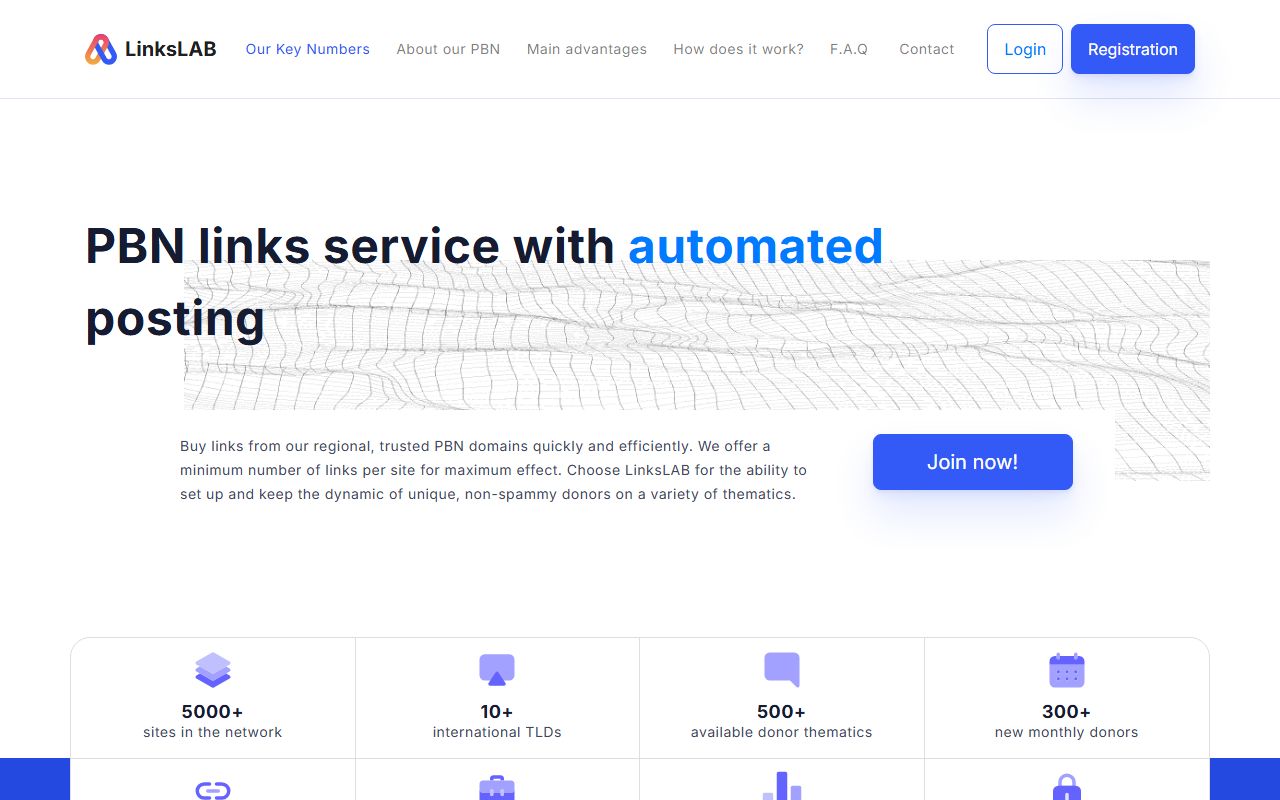
A network advertised as 5000+ sites has, in our index, 4 referring domains, 332 backlinks and DR 10, first seen 2024-07-14 and last seen 2026-08-08. Of those 332 backlinks, 321 are dofollow (96.7%), which sounds healthy until you read the anchors. Eleven of the twelve anchors are the site's own menu: "Our Key Numbers", "About our PBN", "Main advantages", "How does it work?", "F.A.Q", "Contact", "Login", "Sign in", "Registration", "Register" and "Terms and Conditions", each exactly 29 times. 11 x 29 = 319 links, 96% of the profile, and they come from two review-style sites, freeseotesting.com (154 links, DR 36) and tools.org.ua (132 links, DR 30), which copy a site's navigation onto report pages (same URL pattern in several languages).
The only editorial link is a portfolio card on netsolidinvest.com: 13 observations, anchor "LinksLab", pointing at the homepage. The org.ua row (33 links, DR 18) is the same review tool counted under a second registrable-domain key, so there are really three linking sites. No blog, forum or directory links to it in our data. That fits a seller whose homepage promises "No footprints at all levels of site creation": we see no donor pointing back at the shop. You can open the full report in the explorer and read the same rows.
Linkslab at a glance
- What it is
- A self-service platform selling placements ("PBN links (guest posts)") on its own private blog network
- Claimed network
- "5000+ sites in the network", "10+ international TLDs", "500+ available donor thematics" (company's own figures, unverified)
- Price
- "starts at $50 and goes up to $300" per link; "100$ the average price of one link"; year 2 renewal at 50%
- Billing
- Prepaid USD balance; USDT automated, PayPal or card through support
- Public API
- None found; everything is described as done in the web interface
- Company and founding year
- Not published. The domain was registered 2023-09-19 (RDAP), which is not a founding date
Components: one landing page, two forms, one balance
Start with the inventory, because it is short. The public surface of linkslab.io is a single landing page plus /login, /register and /terms. Paths such as /pricing, /api, /docs and /blog return 404. Registration asks for four things: email, username, Telegram and password. Support is an email address and a Telegram account, advertised as "24/5".
Behind the login, going by the company's description, sits the real product. That is a donor catalogue with filters (it mentions Ahrefs data, indexing information, thematic information and number of links placed), a shopping cart, a content step, a scheduler and a posting worker that writes the link into the donor site. It also says it has a content generator, though the slide carries a "SOON" label, so we treat it as unreleased.
The state of the system is one number: a prepaid USD balance. There are no published plans, tiers or seats. If you are used to SaaS pricing pages, the architecture here is closer to a prepaid phone card with a catalogue attached.
Data flow: seven steps from sign-up to a live link
The company lists the pipeline itself, in this order: sign up, create a project, top up the balance, choose a donor, buy links, create content, post a link automatically. Drawn as a diagram it is a straight line with one gate in the middle.
- Project. A container for your target site. The homepage claims "250+ created projects".
- Balance. Payment is in advance. USDT is automated; PayPal or card needs a conversation with support first.
- Donor choice. You see metrics but, by default, not the domain. The names appear in the cart only after a single top-up of $1000 or more.
- Content and placement page. You upload your own text, pick the placement page and plan the time. Delayed placement lets you schedule any future date.
- Automatic posting. The link goes live without a human on the donor side, which the company presents as saving you "unnecessary conversations with anyone".
The gate is step three. Metrics before names is a sensible way to protect an inventory, and an awkward way to buy something you will have to defend in a client report. We come back to that below.
The hiding layer, and why it makes outside measurement hard
Two design decisions on the homepage matter more than any feature slide. First, the network list includes the line "Hiding from Ahrefs and other SEO services", and the FAQ answers "Do you block sites from Ahrefs bots and other search engine crawlers?" with "Yes, we do." Second, a link can be hidden after posting so that, in the company's words, it gives "active visibility exclusively to the original Google bot".
Read as engineering, that is a visibility filter on the donor side: serve the link to one client, withhold it from the rest. It is coherent with the brand's pitch of low footprints. It also changes what any outside index can tell you. Our data is built from our web link data, 13 crawls from 2025 to mid-2026, and our web index is its own crawler with its own fate on any given donor. Whether Linkslab donors block it is not published, so we will not claim either way. What we can say is narrower: a purchased link that is absent from our index proves nothing, and a link that is present tells you it was visible to the crawl our index is built from.
That asymmetry should shape how you use us. Treat a hit as evidence, treat a miss as silence.
Cost model: placement price, a one-year term, a half-price renewal
The published terms are unusually specific for a site without a pricing page. A link "starts at $50 and goes up to $300", depending on site parameters, donor country and page type; the average is stated as $100. Links are "paid for and valid for 1 year from the moment of publication", and renewal for year two and later is 50% of the first-year cost.
Here is a worked example for a hypothetical buyer, using only the company's own numbers:
| Line | Arithmetic | Result |
|---|---|---|
| 10 placements at the stated average | 10 x $100 | $1,000 |
| Year-2 renewal of all ten | 50% x $1,000 | $500 |
| Two-year total | $1,000 + $500 | $1,500 |
| Weekly check of each placement for a year, with us | 10 targets x 52 weeks x 2 credits x $0.0001 | about $0.10 |
Note the first row: ten average placements come to the same $1,000 as the top-up that reveals donor names, so a modest campaign is also one that can reveal the names.
The verification line is not a typo. A refdomains call is a list endpoint at 2 credits, 1 credit being $0.0001, so the whole year of weekly checks costs about ten cents. The measuring instrument costs roughly one ten-thousandth of the thing being measured.
Failure modes: five ways a placement goes quiet
Every system has a section like this. These are drawn from the published terms and the structure above, not from reports of incidents; we found no third-party reviews to cite.
- Removal on abuse report. The FAQ says removal happens only if an abuse report on the content cannot be resolved by their legal department, in which case you get a full refund of the placement. The Terms add that written refund requests may carry a commission.
- Claim window. Quality complaints must be raised within 14 days of payment, per the Terms. Set a calendar entry; the clock starts at payment, not at publication.
- Idle balance. Accounts inactive for 365 consecutive days may be blocked and the balance reset. A prepaid model means money can sit there and expire.
- Term lapse. The link is valid for one year. Without renewal, the placement is outside the deal. Diarise month eleven.
- Silent invisibility. The hiding feature, once switched on, takes the link out of what most tools would see on the page you audit. This is the one that only a recurring check catches.
One more oddity for the engineers: the Terms read like a generic advertising-network agreement, with clicks, impressions, conversions and bids. They contain no dollar amounts and do not mention links or PBN at all. The commercial terms live on the homepage; the legal terms live in a different genre. If a contract matters to your project, ask support for the governing document in writing.
The verification layer: what to log before and after a purchase
This is where apibacklinks fits, and where it stops. We do not sell links, build links or index pages; we hold a backlink graph of 181,132,097 domains, 2,774,625,913 domain-to-domain links and about 798.6 billion page-level backlinks, refreshed roughly monthly. It is not real-time, so a new link can take weeks to appear.
A sensible log has three entries per placement:
- Before: the donor's DR and referring domains from
domain(free, no key). Our DR is our own 0 to 100 logarithmic metric and not the number another tool shows, so compare donors with each other inside one scale, not across scales. - At purchase: the target page, anchor and date, in your own sheet. Donor names may be hidden until the $1000 threshold, so record whatever the cart shows.
- After: a
backlinkscall filtered by the source domain, or ananchorscall on the target, to see whether the link appears and with which anchor, rel and last-seen date.
Compare this with how Linkslab's own domain looks. An anchors read on it returns a menu, not a story, which is a reminder that anchor lists need interpretation. If your target's anchors look like "Register" repeated 29 times, you are reading a mirror.
For batch work, bulk_dr takes up to 2,000 domains per request, which is how you would score a donor shortlist once names are revealed. The rest of the endpoints are in the API reference.
Where Linkslab is the better choice
We cannot place links, so for placing links Linkslab wins by default. More usefully, here is what it does that we deliberately do not.
- It owns the inventory. It sells posts on a network it describes as its own, 5000+ sites by its count. We hold no inventory and never will.
- It automates the posting. Upload text, choose the page, schedule it. Our API returns JSON about links that already exist.
- It publishes numeric limits. Three to seven links per donor, no more than one from the homepage, a two-week pause between placements, fewer than three outgoing links per donor, as its key numbers put it. These are the company's own stated limits.
- It supports tiered links. Second-tier links are allowed up to 5, or 10% of the referring domains where that is smaller; third and later tiers have no stated limit. We have no feature that touches this.
- It names the niches it accepts. Gambling, essay writing, crypto and dating are named; adult, loans and pharma are the stated exceptions.
If your job is "get a PBN link on a regional donor next Tuesday, scheduled, from a prepaid balance", you want Linkslab and not an API. Keep us for the other half of the job: knowing what you bought.
Open items we are leaving open
A design note should say what it could not read. The following is not published, and we did not guess.
- The legal entity, founder, team, headquarters and founding year. The domain was registered on 2023-09-19; an investor's site (NetSolid Investments) lists the product in its portfolio, which says nothing about who runs it.
- Donor names before the $1000 top-up, real donor metrics, indexation rates and traffic.
- Whether links are dofollow, what anchor rules apply and how fast a post goes live.
- Whether the content generator has launched, and whether any private API exists behind the login.
- Customer numbers or third-party reviews. Our web-search lookup was unavailable when we checked, so absence of reviews in this note is not proof that none exist.
The "key numbers" (3000+ links posted, 250+ projects, 300+ new donors a month) are claims, quoted as claims. If one of them matters to your decision, ask for a sample of random donor sites, which the FAQ says support will provide on request. If you are shopping around, our GoRank page looks at a different vendor in the same space.
apibacklinks vs Linkslab
| apibacklinks | Linkslab | |
|---|---|---|
| What it is | Backlink and Domain Rating JSON API plus a free explorer | Self-service marketplace selling PBN placements (guest posts) |
| Does it place links? | No, we neither build nor sell links | Yes, automated posting on its own network |
| Public API | 19 actions on one endpoint, JSON, CORS enabled | None found; web interface only |
| Price unit | 1 credit = $0.0001; lookups 1 credit, list calls 2 | $50 to $300 per placement; average stated as $100 |
| Term | Pay per call, no subscription or minimum | Link valid 1 year; renewal at 50% of first-year cost |
| Free start | $100 free credit on first Google sign-in, no card | Not published as a permanent offer |
| Data source | our web link data, 181,132,097 domains, roughly monthly refresh | Own donor network, 5000+ sites (company claim) |
| Donor visibility before buying | Any domain's DR and counts are free to look up | Names hidden until a single top-up of $1000 or more |
| Crawler policy | Reads public crawl data; does not hide anything | States it blocks Ahrefs and other crawlers on donors |
| Company and founding year | Independent service; no affiliation with the brands it is compared to | not published |
Try it on linkslab.io
Check what the index holds for a domain before and after a placement: top referring domains first, key required for list calls.
curl "https://apibacklinks.com/api.php?action=refdomains&q=linkslab.io&key=YOUR_KEY"
Linkslab alternative — FAQ
Is apibacklinks a Linkslab alternative for buying links?
Will a Linkslab placement show up in your index?
How much does one placement cost?
Is your DR the same number as the one Linkslab shows for donors?
Does Linkslab have an API?
What does checking a placement with apibacklinks cost?
Backlink data for the price of a rounding error
Sign up, keep your $100 of credit, call the API today.
Get started free