

A LinkDaddy® alternative, or a 90-day way to check its work
LinkDaddy® sells backlink packages from $69 and reports 13,587 orders. apibacklinks sells data. This plan shows an agency how to put an independent measurement next to the supplier in 90 days.
Our index lists linkdaddy.com with DR 33, 272 referring domains and 6,644 backlinks, 6,333 of them dofollow. Our index first saw the domain on 2024-07-12, and its biggest sources, sansstandards.co.za (1,106 links), a co.za group (746), aiverified.io (229) and esprregistry.com (198), mostly appeared in 2026.
Anchors are overwhelmingly branded: "LinkDaddy LLC" 4,153, "linkdaddy.com" 675, "linkdaddy.com/regulatory-infrastructure" 555. About half of the top-100 referrers are .co.za local-news domains with our DR between 7 and 17. We cannot tell from crawl data who operates those sites or why they link, so we draw no conclusion from the pattern.
LinkDaddy® at a glance
- What it is
- A seller of backlink packages, cloud mini-sites, press releases and AI visibility audits, with wholesale credit packs for agencies.
- Entry price
- DoFollow SEO Backlinks $69, one-off per order (USD); Cloud Mini-Sites from $297.
- Agency credit packs
- $250 buys $275 of credit, up to $10,000 buys $13,500; credits "never expire" per the site.
- Company
- LinkDaddy® LLC, incorporated in Florida on June 17, 2020; Clearwater, FL and Sandton, South Africa.
- Public API
- None found on the pages we read.
- In our index
- DR 33, 272 referring domains, 6,644 backlinks, 95.3% dofollow, first seen 2024-07-12.
A badge that says 13,587 and an anchor that says LinkDaddy LLC
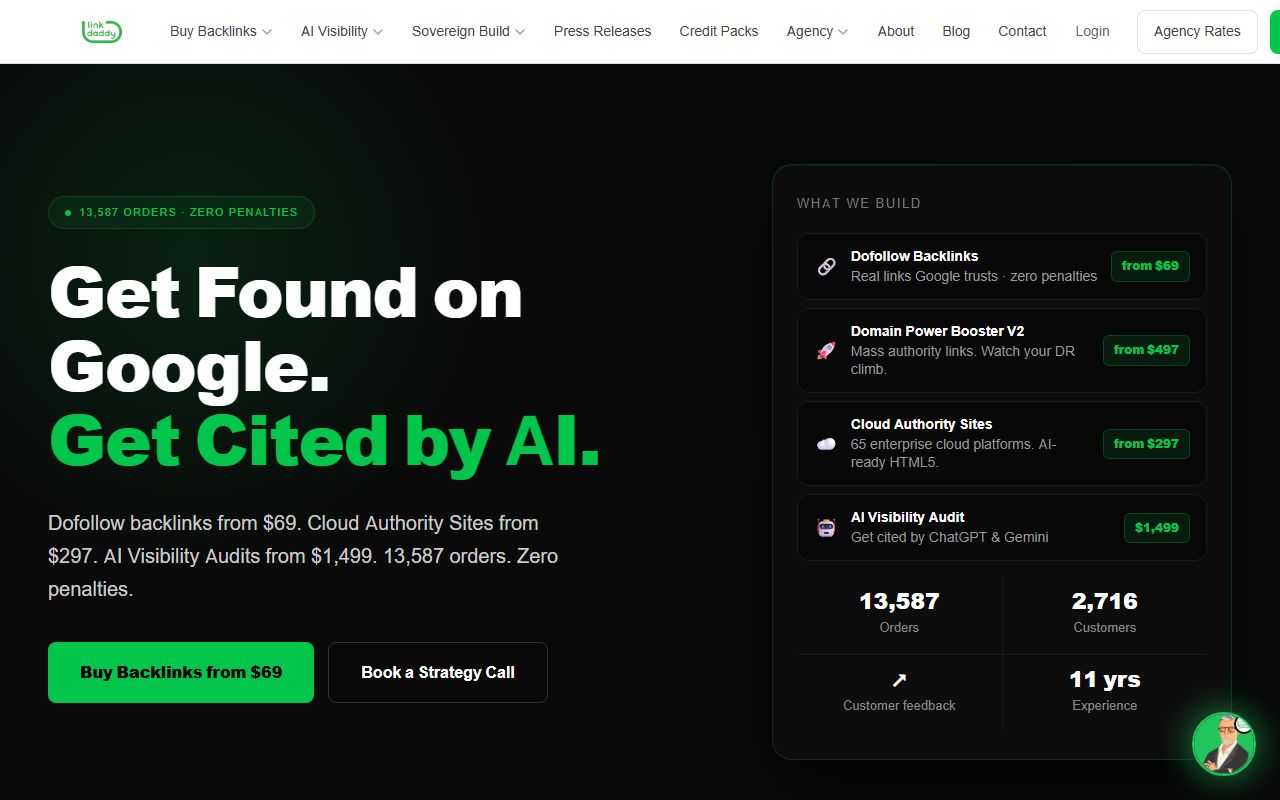
Open the LinkDaddy® homepage and the first thing in the green pill above the headline is a count: "13,587 orders · zero penalties". Open our index for linkdaddy.com and the first thing in the anchor list is another count: 4,153 of its 6,644 backlinks read "LinkDaddy LLC". One number is the company's own count of its client work. The other is a count from our index of how the domain is linked.
This page is a 30-60-90 day plan for a hypothetical marketing agency, which we will call Marlow & Finch. It is invented, along with everything it does, and it exists to make the plan concrete. Marlow & Finch is already a LinkDaddy® customer. It buys packages, resells them under its own name, and wants a way to look at the results that does not depend on anyone's order counter, ours included.
The plan is not "leave LinkDaddy®". LinkDaddy® sells link work and apibacklinks sells link data, so the two products are not rivals in the usual sense. The plan adds a measuring stick next to a supplier. Ninety days is enough to find out whether you still need the stick.
Day zero: what is actually on the shelf
Before any calendar, Marlow & Finch writes down what it buys. LinkDaddy® describes itself as a wholesale source for agencies, and the homepage price list is plain about the entry points. All prices are USD and one-off per order, with no subscription shown:
- DoFollow SEO Backlinks, $69; Keyword Backlinks, $99; Local SEO Backlinks and Mass Page Backlinks, $147 each.
- Cloud Mini-Sites from $297, built on what the site calls "65 enterprise cloud platforms".
- Domain Power Booster V2: Core Booster $497 for sites at DR 0-25, Platinum Hammer $797 for DR 26 and above.
- Press releases from $137, and an AI Visibility Audit at $1,499.
Agencies can pre-load credit packs: $250 buys $275 of credit, and the top tier turns $10,000 into $13,500. The site says credits never expire. What the pages we read do not say is what a $69 order contains in links, donor quality or turnaround. That gap is the whole reason for the first thirty days.
One more thing goes on the sheet: the Booster tiers split at "DR 26", and the company does not say whose DR. Our DR is our own metric, computed from referring-domain counts in our graph. It is comparable in spirit to the DR and DA numbers you know, never identical to them. linkdaddy.com is a handy example: our index scores it 33, while the freeserp site profile stores 28.
Days 1-30: build the ledger
Month one is bookkeeping, and it is the least glamorous part of the story. Marlow & Finch exports every LinkDaddy® order it placed in the last year into a spreadsheet: client, target URL, package, price, date, and whatever delivery report came back. Then it fills in a column the supplier does not provide, which is what an independent crawl sees.
That column comes from a single endpoint. For each client domain, the free domain and overview actions return DR, backlink counts, referring domains and first and last seen dates, with no key. For a roster of fifty clients, bulk_dr takes up to 2,000 domains per request. Four weeks later the same calls run again, and the difference between the two snapshots is the first honest delta in the file.
Two rules keep the ledger fair. First, we crawl a sample of the public web from crawl releases, so a link that exists may not appear for weeks, or at all. A missing row is a question, not a verdict. Second, every row gets a "seen in crawl" flag with three values: yes, not yet, still missing. Only a link still missing after two crawl releases goes back to the supplier as a question. LinkDaddy® advertises a 98.7% indexation rate, which is the company's own figure and unverified; the ledger tells you what your orders look like against it.
By day 30 Marlow & Finch knows two things it did not know on day one: the price it really pays per link that shows up in crawl data, and which packages show up least in crawl data.
Days 31-60: read the profile before you promise
Month two moves from the ledger to the plan. The question changes from "did it arrive" to "what will this look like to someone who checks". The best practice run is the supplier's own domain, because it is public and it is the thing LinkDaddy® says it uses on itself: "We use this exact same system to rank LinkDaddy itself."
So the team reads linkdaddy.com the way it would read a prospect's profile. The numbers in our index: 272 referring domains, 240 of them dofollow, 6,644 backlinks, 95.3% dofollow, first seen 2024-07-12. The two biggest referrers are sansstandards.co.za, with 1,106 links from 549 pages, 555 of them pointing at one landing page, and a co.za cluster with 746 more. The top two sources alone account for roughly 28% of all backlinks, and almost all of the big ones first appeared in 2026.
The anchors are the loudest signal. "LinkDaddy LLC" is 62.5%, the bare domain 10.2%, "linkdaddy.com/regulatory-infrastructure" 8.4%. Commercial phrases barely register: "buy backlinks" shows 4 links, "free backlink provider" 5. About half the top-100 referrers are locality-named .co.za news titles such as pretoriatimes.co.za, houtbaynews.co.za and fishhoekherald.co.za, mostly with our DR between 7 and 17. The site lists Sandton, South Africa as a location, but crawl data cannot tell us who runs those news sites or why they link, so we leave the pattern as an observation.
The lesson for Marlow & Finch is not about LinkDaddy® at all. It is a template: run anchors and refdomains on a client before the first order, run them again after, and describe the profile in the report in those terms. A profile that is 90% branded anchors tells a client very different things from one built on exact phrases, and both are legitimate tools. Use intersect to see which referrers a client's competitors share, and decide which package to order from that, not from the price tier.
Days 61-90: report on what the crawl can see
Month three is where the work becomes something a client can read. The supplier's side covers the order: what was bought, when, at what price. The data side covers the aftermath. A monthly report for one client now has four lines, each one a single call:
- DR and referring-domain count, from
domain, compared with the day-30 snapshot. - New referring domains, found by comparing the first-seen dates in
refdomains(top 100 per target) with the day-30 snapshot. - Anchor mix from
anchors, including the share of branded text. - Donor quality from
backlinkswith a minimum donor DR filter, so that a package of 40 weak links can be separated from 4 strong ones.
There is no built-in "new and lost links" report on our side, no alerts and no shareable dashboard, so the diff lives in the agency's own spreadsheet or script. That is more work than clicking a button. It is also cheap: a credit is $0.0001, list calls cost 2 credits, and a first sign-in with Google brings $100 of free credit.
A worked example, hypothetical like the rest of Marlow & Finch: 50 clients, one overview and one refdomains call each per month, so 50 free calls and 50 two-credit calls, or 100 credits, roughly one cent. When measuring costs that little, the argument about whether to measure disappears, and the argument about what to do with the numbers begins.
By day 90 the agency can answer three questions in writing: which packages show up in crawl data, which clients' profiles have shifted, and where a supplier question is justified. If you want to see a profile before building any of this, the free explorer shows the same report in a browser.
Where LinkDaddy® is the better choice
Honest accounting matters in a plan like this, so here is the list on the other side. If you need links built, LinkDaddy® is the right product and apibacklinks is not. We do not build links, sell links or index pages. We provide data. Nothing in our API puts a link on a website.
LinkDaddy® also covers ground we deliberately do not: press releases (distributed, by the company's account, to "AP News, Yahoo Finance, Google News, and 600+ outlets", although its about page says 500+), cloud mini-sites, local SEO packages, Google Maps ranking, an AI visibility audit, HTML5 site builds, and white-label work with pre-loaded credits that add up to 35% extra. It has a human behind it: the about page names Tony Peacock as founder and says the company was incorporated in Florida on June 17, 2020. And it offers a strategy call, which a JSON endpoint will never do.
Stay with LinkDaddy® if you do not have a developer, do not want to read raw data, or want the delivery handled for you. Pair it with a measuring tool only if you also report to clients who ask for proof. If nobody ever asks, the plan above is optional.
What the ninety days will not tell you
Three limits are worth saying out loud, because a plan that hides them is just a pitch.
It cannot see everything. Our graph holds 181,132,097 domains and 2,774,625,913 domain-to-domain links from 13 crawl releases, refreshed roughly monthly and not in real time. The proprietary crawlers of the large SEO suites are bigger and fresher. A new link can take weeks to appear in ours.
It cannot judge quality alone. We have no toxicity score, no topical scoring, no keyword or rank tracking and no traffic estimates. Donor DR is a number about the donor's referring domains, not a verdict on whether a link is good for a particular client. That judgment stays with a person.
It cannot confirm the supplier's claims. The 13,587 orders, 2,716 customers, 4.2M+ live links and 98.7% indexation figures on linkdaddy.com are self-reported. We did not verify them, and we found no third-party reviews to cite either way. What the plan gives you is evidence about your own orders, which is the only evidence that affects your clients.
The same measuring stick works for other suppliers too. See the hub of link-building tools, or compare how the same exercise would look for ESBO LTD. or SEOPush.
The whole plan on one board
| Window | Task | Calls | Output |
|---|---|---|---|
| Days 1-30 | Export orders, snapshot every client domain | bulk_dr, overview | Ledger with a seen-in-crawl column |
| Days 31-60 | Read anchors and referrers before and after each order | anchors, refdomains, intersect | Package-by-package profile notes |
| Days 61-90 | Monthly client report and supplier questions | domain, backlinks | Four-line report per client |
At the end of day 90 you have a decision, not a document: keep buying the same packages, change the mix, or ask the supplier about a specific gap. In every case the decision rests on a spreadsheet you own.
apibacklinks vs LinkDaddy®
| apibacklinks | LinkDaddy® | |
|---|---|---|
| Core job | Backlink and domain-rating data over a JSON API | Done-for-you backlink packages, cloud sites, press releases, AI visibility audits |
| Builds or sells links | No | Yes, from $69 per order |
| Public API | 19 actions on one endpoint, CORS enabled | None found on the pages we read |
| Entry price | $0.0001 per credit; free actions cost 0; $100 free credit on first Google sign-in | $69 for DoFollow SEO Backlinks, one-off per order |
| Billing model | Pay per call, no subscription | Per-order prices; optional credit packs with up to 35% bonus |
| Free tier | Free domain and overview actions, no key | Not published |
| Metric | Our own DR, 0-100 (not Ahrefs DR or Moz DA) | Booster tiers split at "DR 26"; which metric is not published |
| Data freshness | Roughly monthly crawl releases, not real-time | Not published |
| Reports and alerts | No alerts, dashboards or new/lost link reports | Not published |
Try it on linkdaddy.com
Snapshot a domain for free, then pull its top referring domains for the day-30 comparison.
curl "https://apibacklinks.com/api.php?action=refdomains&q=linkdaddy.com&key=YOUR_KEY"
LinkDaddy® alternative — FAQ
Is apibacklinks a replacement for LinkDaddy®?
Does LinkDaddy® have an API?
Is your DR the same as the DR LinkDaddy® uses?
How fast will a new link show up?
What does the plan cost to run?
Can I check the 13,587 orders figure?
Backlink data for the price of a rounding error
Sign up, keep your $100 of credit, call the API today.
Get started free