

A field guide to BulkLink.org, and the alternative for checking what it did
BulkLink.org is a one-page free tool that submits URLs to search boxes, ping services and “pseudo backlink” lookup sites. This guide shows how to recognise it, when to use it, and how to check the outcome.
In our index, bulklink.org has 99 referring domains and 272 backlinks, a DR of 27 (our own metric, comparable in spirit to other tools but not the same number), and an average referring-domain DR of 19. 150 links (55.1%) are dofollow and 122 are nofollow. The DR spread of its referrers is 34 at 0–14, 47 at 15–29, 17 at 30–49 and just one at 50–69.
The largest source is internetmarketingstar.com, with 28 links from 14 pages (donor DR 37), all nofollow and all anchored “Massive Backlink Generator”, which alone makes up 10.29% of the profile. Next come summit-e.com (17 links, all dofollow, “Bulk Backlinks”), gpttweaks.com (14) and hybridtraffic.net (11). Branded anchors such as “bulklink.org” (41) and “Bulklink” (19) dominate, plus the phrase “bulk ping service” (9, all dofollow). A few unrelated anchors from blog-comment-style hosts also appear; those are third-party additions, not anything the site chose. Almost every link points at http:// addresses, split between the www and bare host.
BulkLink.org at a glance
- What it is
- A free backlink generator, URL submitter and ping service on one page
- Price
- Free of charge, per the site; no plans published
- Account
- None visible; no login or sign-up on the page
- API
- None found; only the form handler
- Last dated site news
- July 2017 (“BulkLink database is updated”)
- Earliest outside trace
- A forum thread dated 3 August 2015
- Operator
- Not published
Field marks: how to recognise BulkLink.org at a glance
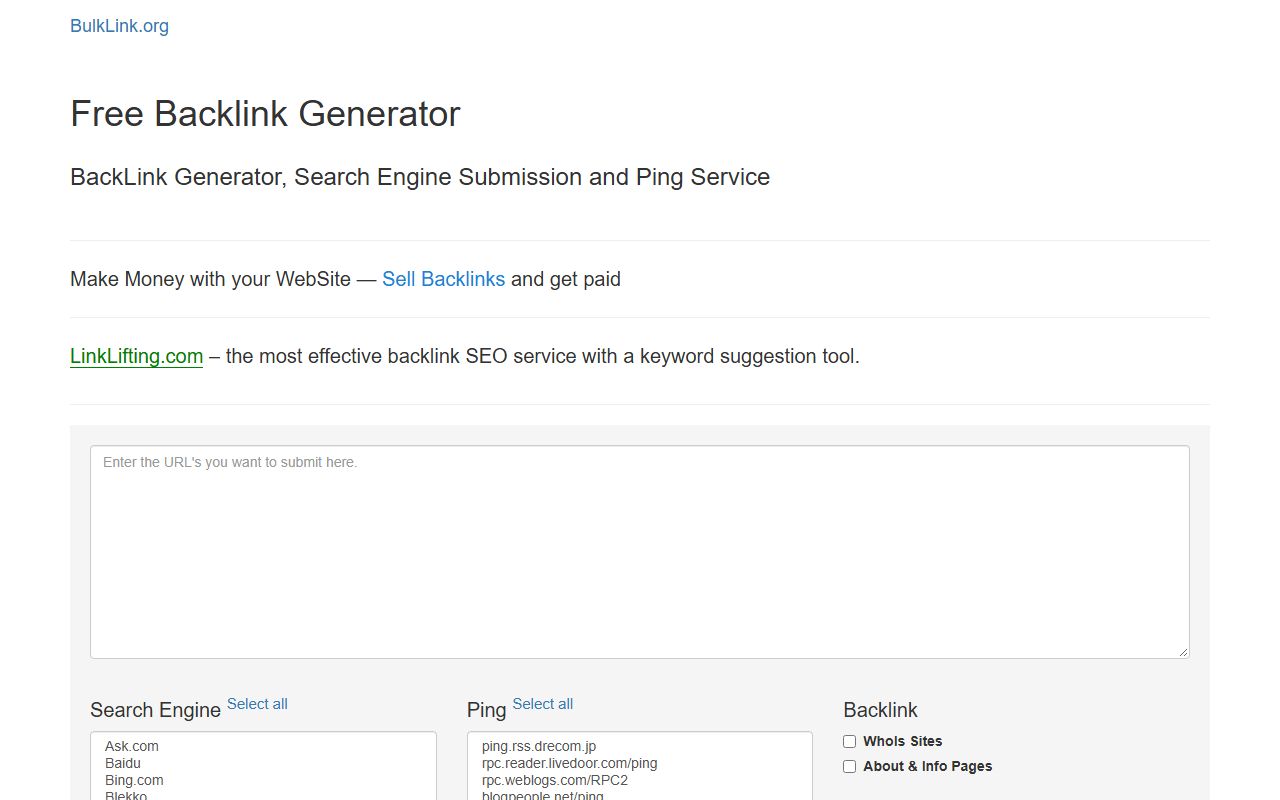
Some tools announce themselves with a logo, a pricing grid and a demo button. BulkLink.org does none of that. The first thing you see is a text link in the top-left corner reading “BulkLink.org”, then a plain white page with the headline “Free Backlink Generator” and the subhead “BackLink Generator, Search Engine Submission and Ping Service”. Below sits a very large empty textarea that says “Enter the URL's you want to submit here.”
That is the whole animal. Three columns follow the textarea: a Search Engine list (Ask.com, Baidu, Bing.com, Blekko, DuckDuckGo, Seznam.cz, both Yandexes, a YouTube entry, around forty Yahoo country versions and a long run of Google country domains), a Ping list of 17 addresses, and a Backlink column with two checkboxes: “WhoIs Sites” and “About & Info Pages”. There is no menu, no login, no cookie banner and no price.
Two promotional lines sit above the form, one inviting you to sell backlinks for money and one recommending LinkLifting.com. The site does not say whether those belong to the same owner or are simply advertisers, and we do not guess. Like any good field guide, this one describes only what we saw.
Habitat: one page, plain HTTP, no named operator
BulkLink.org lives on a single page. We checked /about, /contact, /pricing and /api on 2026-10-09 and all four returned 404. We found no terms page, no privacy page and no named operator. The page source shows Bootstrap 3.3.7 and jQuery 3.1.0, and the server header reads Apache/2.4.18 (Ubuntu).
The oldest independent trace we found is a forum thread titled “Please Review - BulkLink.Org”, dated 3 August 2015, so the site has been around for more than a decade. The last dated entry on the page itself is a “Service news” line from July 2017: the database was updated, old sites removed, new sites added.
One habitat detail matters if you are going to send it your client work: on the day we checked, the site answered on plain http:// for both the bare and the www host, and https:// did not connect at all. We do not know whether that is a missing certificate or a temporary outage. Either way, a plain-HTTP form is no place for anything sensitive.
Behaviour: what happens when you press submit
The site describes its own routine in the third person, and it is worth reading closely, because it plainly says what each step does. It calls one submission to one service a “Bulk”, and says it does Bulks in three categories:
- Pseudo Search Engine submission, which “enters your URL's in the respective search engine search bar”. The site's own wording is that entries typically get stored in an internal database and evaluated later.
- XML-RPC Ping submission, which sends your URL to blog-listing services that track what is new on the web.
- Pseudo Backlinks, which are lookup requests on whois, about, info and statistics sites. After submission, the site says, the URL usually gets added to an internal database that search spiders crawl at short intervals.
Operationally, it is a small machine. It says it has capacity for “on average ~5 parallel users”, that it reconnects and resumes after the last successful entry if your connection drops, that URLs are checked before submission, and that you receive a PDF report at the end with summary and detail. We did not submit the form, so we have not seen the report or measured any speed. Treat all of this as the site's stated behaviour, not our observation.
Diet: what it feeds your URL, and what comes out
A tool like this is easiest to understand by asking what it hands to the world. BulkLink.org is open about it: its “backlinks” are pseudo backlinks. They are not editorial links on pages that people read; they are requests that make a third-party lookup site record your address. The site's hope, in its words, is that such a database is “crawled in short intervals by search spiders”. Whether that ever turns into a crawlable, indexed link, there is no published evidence either way.
The ping side is a different food group. XML-RPC pings are old blog infrastructure: you tell a list of services that something changed. Seventeen targets are listed, such as rpc.weblogs.com/RPC2, ping.blo.gs and rpc.twingly.com. Pinging is a notification, not a link, and the site says as much when it states that it passively assists indexing: it “assists you in the first step, namely notifying the SE spiders to crawl your site”.
Put simply, the diet is attention, not authority. That distinction is the one to keep in your notebook, because it decides which numbers you should use to judge a run. Counting how many boxes you ticked tells you effort. Counting how many distinct, crawlable domains now point at your page tells you outcome, and that is a question for link data.
Look-alikes: telling it apart from its cousins
Beginners often file every “backlink” tool in one drawer. Three quick tests separate the species.
| Question | Submitter / pinger (BulkLink.org) | Outreach or link-building service | Link data API |
|---|---|---|---|
| What does it produce? | Submissions and pings, plus “pseudo” lookup entries | Placed links on third-party sites | Records of links already seen on the web |
| What do you check afterwards? | Its PDF report | The live page and anchor | Whether the crawl sees the link |
If you are comparing it with other entries in this directory, our link-building tools hub sorts them the same way, and the sibling guide to Backlink up covers another product in the same directory for contrast. By its own description, BulkLink.org belongs in the first column.
Where BulkLink.org is the better choice
A mentor who only told you about the weaknesses of a tool would not be much use. There are real jobs where BulkLink.org is the right pick and apibacklinks is not.
- You want to submit and ping, and we do neither. apibacklinks does not build links, sell links or index pages. If your task is to send a batch of URLs to ping services in one go, BulkLink.org does that and we cannot.
- It is free and needs no account. No sign-up, no login and no price are visible on the page. For a one-off nudge on a handful of fresh URLs, that is hard to beat.
- It has a ready-made report. The site says you get a PDF with summary and detail. We have no reports, no dashboards for clients and no email digests.
- No code needed. Paste URLs, tick boxes, submit. Our product is a JSON API plus a browser explorer for reading link data, so there is nothing to paste URLs into for pinging.
Who should stay: webmasters and marketers who want a quick, free, low-ceremony ping and submission pass, and who already judge results by whether pages get crawled. Who should add us: anyone who needs to know afterwards what the link graph actually shows.
Tracking the spoor: what our index says about bulklink.org itself
The best way to learn how a link tool lands in the wild is to look at its own tracks. We pulled bulklink.org from our index, and its profile is a useful teaching specimen.
Notice the size first: 99 referring domains and 272 backlinks, DR 27 in our scale, with an average donor DR of 19. For a tool that has appeared in “ping sites” roundups for years, that is a small footprint. Now notice the top referrer: internetmarketingstar.com, with 28 links from 14 pages, all nofollow, all anchored “Massive Backlink Generator”. That forum is also where the 2015 review request lives, so the biggest single source is likely a decade-old community post.
This is the kind of reading you can do for any client. Pull the referring domains, sort by links, look at the donor DR and the dofollow flag, and ask whether the largest source is a page someone could actually click through. It takes one call and no sign-in for the summary; see the free explorer report for bulklink.org to follow along, or the API docs to script it.
A hypothetical routine for a submitter user
Imagine, hypothetically, an agency that runs a ping and submission pass on twenty new client URLs every Monday. The cheap way to close the loop: keep the target list, then use refdomains and backlinks on each client domain a few weeks later to see what the crawl recorded, and bulk_dr to score any new referrers in one request. Our index refreshes roughly monthly, so a new link can take weeks to appear. Absence after a week means nothing; absence after two refreshes is worth a note.
Field notes: a small checklist before you send URLs
- Decide what success is. Crawled by a spider, listed in a database, or linked from a crawlable page. They are different outcomes.
- Do not send anything private. The page was served over plain HTTP when we checked, and we found no privacy policy.
- Keep the report. If you rely on the PDF, save it with the date; the site's last news entry is from July 2017 and behaviour could change without notice.
- Measure from the outside. A few weeks later, look at your domain's referring domains and anchors in a link index rather than trusting a count of submissions.
- Remember our limits. Our data comes from our own web data, which is a broad sample, smaller and less fresh than the proprietary crawlers of the large vendors. We have no new/lost-link reports, no alerts and no rank tracking.
That last point cuts both ways. If a link you expect is missing from our index, it may simply be outside the sample. Check another source before drawing conclusions.
apibacklinks vs BulkLink.org
| apibacklinks | BulkLink.org | |
|---|---|---|
| Main job | Read backlink and DR data from our index | Submit URLs, ping services and create “pseudo backlinks” |
| Price | From $0.10 per 1,000 calls; $100 free credit on first Google sign-in | Free of charge, per the site |
| Account | Free actions need no key; paid actions use an API key | No login visible |
| API | JSON API, 19 actions on one endpoint | Not published |
| Builds or places links | No; data only | Pseudo backlinks and pings, by its own description |
| Report | JSON responses and a browser explorer; no PDF reports | PDF report of results, per the site |
| Freshness | Roughly monthly refresh, not real-time | Not published; last site news July 2017 |
| Operator and terms | Independent; not affiliated with any brand compared here | Not published |
Try it on bulklink.org
To see what our index records for the domain itself, ask for its top referring domains.
curl "https://apibacklinks.com/api.php?action=refdomains&q=bulklink.org&key=YOUR_KEY"
BulkLink.org alternative — FAQ
Is BulkLink.org really free?
Does BulkLink.org have an API?
Can apibacklinks submit or ping my URLs?
How can I check whether a submission led to links?
Is our DR the same as the DR other tools show?
Backlink data for the price of a rounding error
Sign up, keep your $100 of credit, call the API today.
Get started free