

A Build Niche Links alternative, told as a migration diary
Build Niche Links sells link building by quote, in three tiers from “Domain Authority with 30+” to “Wall Street Journal, Forbes, Inc”. This diary follows a hypothetical team that kept the outreach mindset but moved the planning, vetting and reporting onto an API.
Before the hypothetical team in this diary signs or cancels anything, they do what the API makes cheap: they look at the agency's own backlink profile. In our index buildnichelinks.com has DR 20 (our own metric, not Ahrefs DR), 28 referring domains and 63 backlinks, 47 of them dofollow. First seen in our data is 2024-07-13, last seen 2026-09-07; those are crawl dates, not the age of the links.
The shape is distinctive. The top five referrers (techwyse.com with 7 links, entrepreneur.com and smallbizclub.com with 6 each, sociable.co and tripwire.com with 5 each) hold 29 of the 63 links, about 46%. Four spellings of the brand plus the bare domain make up 50 of the 63 anchors. The oddest anchor is entrepreneur.com's “According to a Marketing company”, six dofollow links from a DR 66 site that name nobody. And 44 of the 63 links still point at the http:// homepage, which is consistent with placements made years ago (the web mentions we found date from 2016 and 2017). You can open the same report in the free explorer.
Build Niche Links at a glance
- What it is
- A done-for-you link building agency: enterprise link building, custom outreach and a white-label agency partnership program.
- Packages
- Three tiers: Standard (30 days, “Domain Authority with 30+”), Advanced (45-60 days, 50+) and Enterprise (60-90 days, 80+).
- Price
- Not published. The site offers a quote form instead.
- API or dashboard
- None found on the homepage, packages page or beliefs page.
- Operator
- The footer reads “NetApe Technology”; no founder, founding year or address is stated.
- Our index
- DR 20 (our metric), 28 referring domains, 63 backlinks, 47 of them dofollow.
Entry 1: the hero said “organically created”
A word before the log starts. The team in this diary is hypothetical: a four-person SaaS marketing group we invented to make the steps concrete. Nobody quoted here is a real customer, and no real invoice stands behind the numbers.
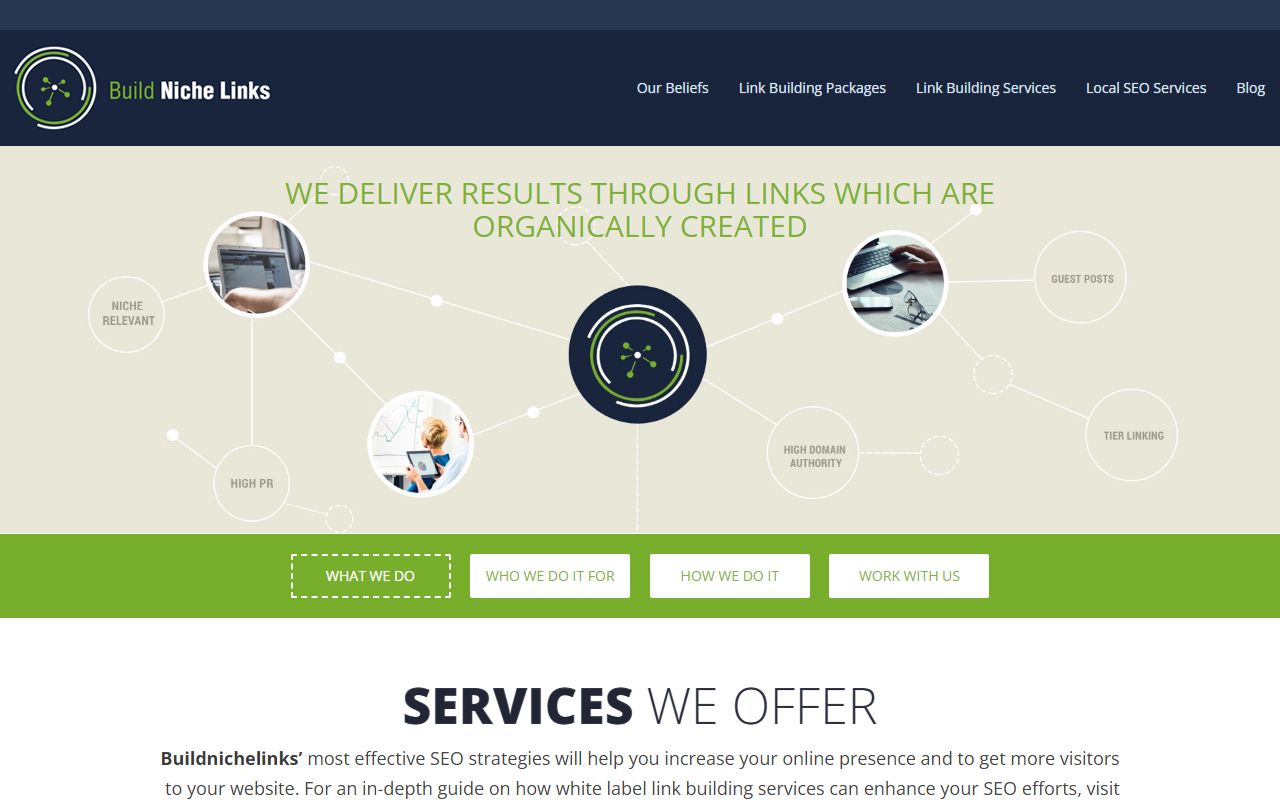
Day 1. Our team lead opens the Build Niche Links homepage and reads the hero out loud: “We deliver results through links which are organically created.” Around the headline floats a diagram with five bubbles: Niche relevant, High PR, High Domain Authority, Guest posts, Tier linking. It is a clear pitch. You hand over a goal and a quote request; researchers research and writers write, and the site promises that they “never stop” until the goals are met.
The team has used an arrangement like this for a year. What bothers them is not the work. It is that every number they see comes from the agency. Hours, articles, placements: all reported by the agency, and the team has no second source to compare them with. So the migration they plan is small. Keep the outreach mindset. Add a second set of eyes that costs almost nothing.
The homepage itself shows the same pattern in miniature. Its counters list “Link Building Hours 108,535” and “BLOG Posts 9,738”, undated and self-reported, and the newest blog posts shown are from July 2016 while the footer says 2024. We draw no conclusion from that. A stat block is simply a claim, and a claim is something you can compare against a crawl.
Entry 2: three tiers, no prices, one measurable promise
Day 2. The packages page lays out the menu. Standard Link Building: delivery in 30 days, an average of 800 words per article, placements on “Domain Authority with 30+”, tier 3 content distribution, a minimum of 40 outreach hours. Advanced: 45-60 days, 1,000 words, “Domain Authority with 50+”, tier 2, 80 hours. Enterprise: 60-90 days, 1,500 words, “Domain Authority with 80+” and premium placements named as “Wall Street Journal, Forbes, Inc”, 180 hours.
Two things are missing, and the diary records them as open questions rather than complaints. Prices are not published, only a quote form. And the number of links per package is not stated either. Without both, the team cannot compute a cost per link, which is the first number any planning spreadsheet wants.
| Tier | Delivery | Stated DA floor | Outreach hours |
|---|---|---|---|
| Standard | 30 days | 30+ | 40 |
| Advanced | 45-60 days | 50+ | 80 |
| Enterprise | 60-90 days | 80+ | 180 |
What the table does give is a measurable promise: a floor on authority. The team cannot verify the agency's DA figure, because that metric belongs to whichever tool the agency uses. They can, however, check donor strength in a second scale and see whether the picture holds. That is the whole use of the API in this story: a cross-check, not a replacement.
Entry 3: the first call costs nothing
Day 4. An engineer on the team runs the first two requests against the agency's own domain. domain and overview are free and need no key. Within a minute the team has DR 20, 28 referring domains, 63 backlinks and the top five referrers. Nobody has signed up for anything.
The team treats the result as a baseline for judging the agency's craft, and it teaches them how to read a profile. Entrepreneur.com, tripwire.com, wishpond.com, smallbizclub.com, techwyse.com: these are business and marketing blogs that take contributed articles. The web hits we found for the brand are guest-post author bios from 2016 and 2017 that describe a content marketer working at the company. In other words, the agency's own links look like the product it sells: contributed articles with a byline. That is consistent, and it is a fair thing to say in its favour.
It also shows a limit the team must keep in mind. Our index is built from a broad sample of the public web, so it is smaller and less fresh than a proprietary crawler. A profile of 28 referring domains is what our graph sees. A larger tool may see more.
Entry 4: vetting a prospect list before the outreach hours are spent
Day 9. Here the diary turns practical. The team has 140 candidate sites for a guest-post push, collected from a spreadsheet. Under the agency model somebody else would pick. Under the new model the team picks, and the API does the sorting.
bulk_drtakes up to 2,000 domains in one request and returns our DR plus link counts. The team drops everything under their cutoff.refdomainson survivors shows who already links to them, up to 100 referrers per target, so the team can see whether a site's authority comes from one bulk source.intersecttakes 2 to 10 targets and lists referring domains they share. Run on three direct competitors, it produces the sites that link to all of them: the shortlist an outreach person actually wants.
The cost is the interesting part. A credit is $0.0001. Lookups cost 1 credit and list calls such as refdomains and intersect cost 2, so a list call is $0.0002, and a new account starts with $100 of free credit. The team's whole vetting exercise stays well under the starter balance. The full action list sits in the API docs.
One caution carried over from the profile above: our DR is computed from referring-domain counts in our graph. It is comparable in spirit to the metric an agency quotes, never the same number. The team writes “our DR” in the sheet header so nobody mixes the columns.
Entry 5: checking that a delivered link exists
Day 21. A placement lands. Under the agency model, the proof is a URL in an email. The team wants a second confirmation, so they query backlinks for their own domain, filtered by source domain and minimum donor DR, and look at the link type, rel and anchor the crawl recorded.
Two honest points. First, our index refreshes roughly monthly, so a brand-new link can take weeks to appear; absence on Day 21 means little. The team re-checks on a schedule they set themselves, because there are no alerts or monitoring in the API. Second, the anchors they see are a useful audit of strategy. The agency's own profile is nearly all brand-name anchors (“BuildNicheLinks” 17, “Build Niche Links” 17), with only four links carrying a commercial phrase, such as “techniques for link building” and “link building service”. The team notes the mix and uses it as one reference point when planning anchors for its own campaigns.
For a client-facing report, the team exports rows and formats them. The API has no shareable dashboards, email reports or scheduled exports, so the report is a script plus a spreadsheet. If that sounds like too much plumbing, it is, and the next section says who should stop there.
Where Build Niche Links is the better choice
The diary has a plot twist that is really just arithmetic. A data API produces no links. Everything the team did in entries 3 to 5 prepared or checked work that somebody still had to do: find the editor, pitch the idea, write 800 to 1,500 words, handle the revisions, follow up. Build Niche Links does that, and says it includes writers, researchers and an outreach process, plus a white-label partnership program for agencies that do not want to hire a link building team.
If you have no in-house outreach person, stay with the agency. If your problem is hours, not information, an API will not give the hours back. The same goes for premium placements: an Enterprise-tier promise of names like those on the packages page rests on relationships, which are not a dataset. And if you resell to clients, a white-label arrangement fits that model in a way an API does not.
The honest summary for a buyer: use Build Niche Links when you want links delivered. Use the API when you want to decide and verify. Many teams will do both, and the vetting layer is a few cents.
Entry 6: what the team still did not have
Day 30. The retrospective is short. Things the API does not do, and the team confirmed it by trying: no keyword research, no rank tracking, no traffic estimates, no site audit, no spam score, no new-and-lost links report, no disavow tooling, no alerts. It does not build or sell links, and it does not index pages. A team that expected a full SEO suite would be disappointed.
What it did give was a habit: look at the profile first. When the lead pulled up the agency's own report, the conversation about vetting, anchors and donor strength became concrete, because everyone was looking at the same numbers. If the team later needs the links they build to get crawled, IndexJump handles that job; it is a separate service from ours.
One more pattern surfaced from the data. Because the agency's profile is top-heavy (46% of links from five domains), the team set an internal rule for its own campaigns: no single referring domain above a set share. That rule exists only because a profile was easy to read. A related comparison, for a different outreach product, is on the Saasgains alternative page.
Last entry: the rule the team wrote down
Day 35. The log closes with a rule short enough to pin above a desk.
Buy delivery from people. Buy numbers from the API. Never take the same vendor's word for both.
That rule is the team's, written for this hypothetical diary, not a quote from any company. The practical version: keep the agency if it delivers, put the free calls in front of every brief, and keep the paid calls for list work. Browse other tools in the link building tools hub if you are comparing options, and start with the free explorer if you want to see how a profile reads before writing any code.
apibacklinks vs Build Niche Links
| apibacklinks | Build Niche Links | |
|---|---|---|
| What you get | Backlink and DR data through a JSON API plus a free explorer | Done-for-you link building: outreach, writing and placement |
| Pricing | $0.0001 per credit; $0.10 per 1,000 lookups, $0.20 per 1,000 list calls | Not published; quote form |
| Free start | $100 free credit on first Google sign-in, no card | Not published |
| API | 19 actions on one endpoint, JSON, CORS enabled | None found on the pages we read |
| Links built for you | No. We provide data only | Yes: three package tiers with delivery in 30 to 90 days |
| Authority metric | Our own DR, 0-100, computed from our graph | Quotes “Domain Authority” floors of 30+, 50+ and 80+ by tier |
| Reporting | Raw rows you format yourself; no dashboards or email reports | Not published |
| Data freshness | Roughly monthly index refresh, not real-time | Not applicable |
| White-label | No | White-label agency partnership program listed |
Try it on buildnichelinks.com
Start with the free profile of the agency's own domain, then pull its referrers with a key.
curl "https://apibacklinks.com/api.php?action=refdomains&q=buildnichelinks.com&key=YOUR_KEY"
Build Niche Links alternative — FAQ
Is apibacklinks a direct replacement for Build Niche Links?
Does Build Niche Links publish its prices?
How big is Build Niche Links' own backlink profile?
Can the API tell me whether a placement is live?
Is your DR the same as the Domain Authority an agency quotes?
Who is the team in the diary?
Backlink data for the price of a rounding error
Sign up, keep your $100 of credit, call the API today.
Get started free