

Backlink Generator alternative: six myths about a shop that is not a generator
The first screen of Backlink Generator shows one price, $25, and one promise: five .edu and .gov profile links with login details. We took six beliefs about the shop and checked each against its own pages and our backlink index.
In our index, backlinkgenerator.info has DR 24, 53 referring domains and 222 backlinks, first seen 2024-07-12 and last seen 2026-09-08. Of those 222 links, 194 (87.4%) are dofollow. The biggest anchor is not the brand but a product phrase: "buy high DA backlinks" appears 20 times (9.0%), ahead of the bare URL at 18.
The donor list reads like a directory crawl. alabamaindex.com sends 25 links, sister site free-backlinks.net sends 23, and abicloud.org and hotelyolac.com send 14 each. By DR, 17 donors sit at 0-14, 34 at 15-29 and only two above that: ionos.com at DR 60 and astroempires.com at DR 50. The number of .gov or .edu referring domains is zero. Browse the full report in the explorer.
Backlink Generator at a glance
- What it is
- An online shop selling link packages, press-release distribution and social media services
- Catalogue
- 54 products: profile, contextual, blogroll, country and local-citation packs, DA/DR packages, press releases, social
- Current prices
- One-off, in USD, from $15 to $299 on 2026-10-09; every product shows a crossed-out list price beside the current one
- Ordering
- Shop cart, or phone, text and email; no API or developer page found
- Guarantee wording
- A site-wide notice of a "30 days warranty" with refund; terms say rankings cannot be guaranteed
- Domain registered
- 2015-12-19 (RDAP); no founding year or legal entity is stated on the site
- In our index
- DR 24, 53 referring domains, 222 backlinks, last seen 2026-09-08
The setup: six beliefs, one storefront, one scoring rule
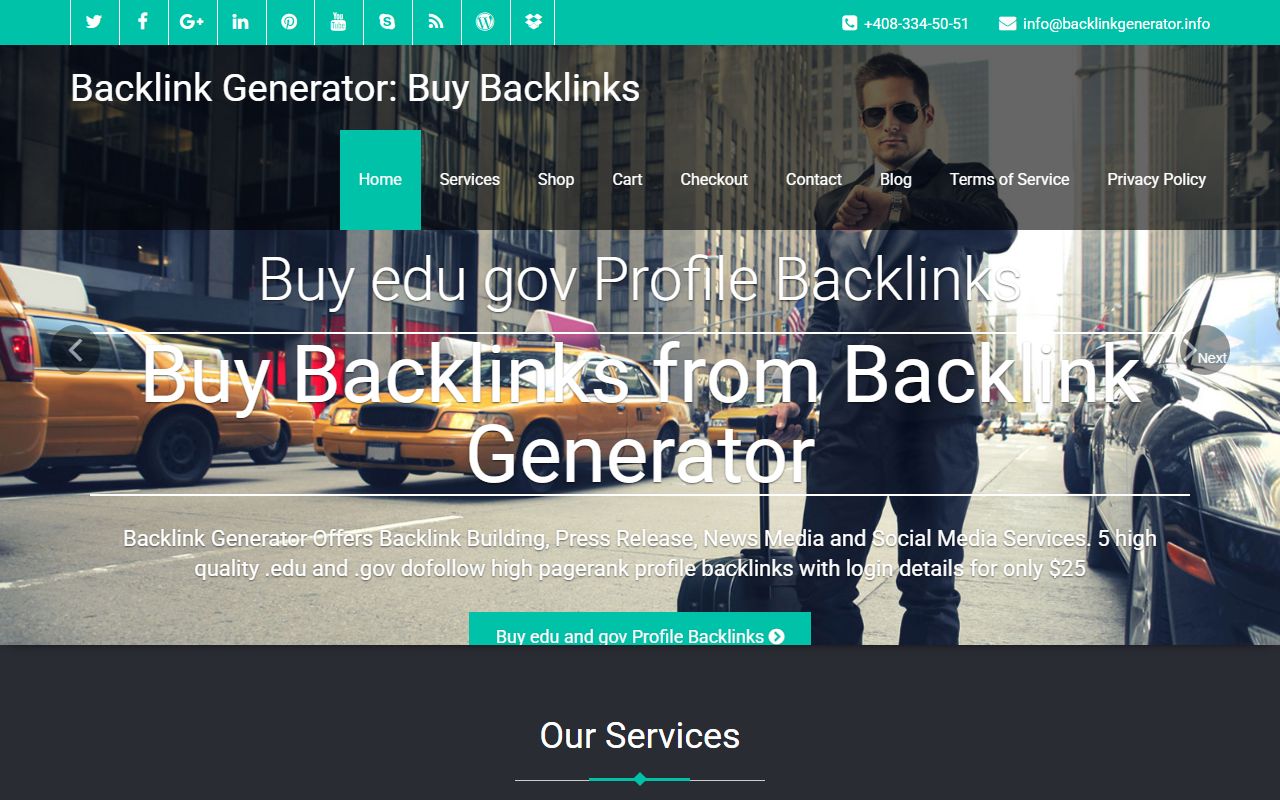
Backlink Generator is a WordPress and WooCommerce shop with a teal header, a hero slider and a services block. It sells link packages by the bag: profile links, contextual links, blogroll links, country packs, local citations, press releases and social followers. The site's own footer says it "builds free backlinks" and that you can "buy backlinks, too". Its domain was registered on 2015-12-19, and the oldest posts in its blog archive date from the same month.
Names invite beliefs, and this one invites more than most. Below are six, each followed by evidence and a verdict: fact, myth or depends. The evidence comes from the shop's own pages and from our index of the public web. Where the shop does not say something, we write "not published" and move on, because guessing about a seller is unfair to the seller and useless to you.
The scoring rule is simple. A belief survives only if a page, a price or a row of data supports it. Admiring the logo does not count.
Myth 1: a tool called Backlink Generator generates backlinks
Verdict: myth. The homepage HTML contains no form and no input field, so there is nothing to type a URL into. What exists behind the name is a catalogue. The 54 products in the shop run from "Buy Blogroll Backlinks PR7" to "Press Release Writing and Distribution to 500 Plus Media Sites", and checkout is a normal cart.
The "free" half of the name lives in a blog post. /45000-free-backlinks, dated 26 December 2015, lists third-party tools, and it is still the most-linked inner page in our index: 20 links, while the homepage takes 133. The business is the shop, and the shop is a service desk: orders are placed in the cart or by phone, text or email.
None of this is a criticism. A shop that sells done-for-you packages is a legitimate product, and many buyers want exactly that. The only mistake is expecting software. If you wanted a function you can call from your own code, the shop publishes no API, and our API reference is the other kind of tool entirely: it returns data, it does not place links.
Myth 2: a seller of .edu and .gov links must have .edu and .gov links of its own
Verdict: myth, with a footnote. The hero slide offers "5 high quality .edu and .gov dofollow high pagerank profile backlinks with login details for only $25". It would be natural to look at the seller's own backlink profile and expect the same ingredients. We did. Across 53 referring domains in our index, the count of .gov or .edu donors is zero. Fifty-one of the 53 sit below DR 30, and the average donor DR is 19.
The footnote matters. A seller's own profile and a seller's inventory are different things. The $25 pack is built from, in the shop's words, "our own private list that is updated monthly", and that list is not published. Our graph describes who links to the shop's homepage. It says nothing about the accounts created on other sites for a customer. Treat the zero as a fact about the shop's own profile, and no more.
What the profile does show is how the shop promotes itself: mostly through web-directory listings. The donors alabamaindex.com, abicloud.org, caida.eu, unamenlinea.info and productselectoren.com are directory sites. Their anchors are the shop's product names: "buy high DA backlinks" (20), "buy edu backlinks" (13), "buy gov backlinks" (7) and "buy contextual backlinks" (7). The number two donor, free-backlinks.net, with 23 dofollow links, is credited in the shop's own footer as a site-design partner.
Myth 3: PR7 and PR8 on the label tell you how strong the link is
Verdict: depends, and mostly myth. Much of the catalogue is still sold in Google PageRank tiers: blogroll packs at "PR7" and "PR8", bundles of "3xPR5" and "2xPR6", and an "8 PR7 & 8 PR8 .gov" pack. The About page tells buyers that after a purchase their PageRank will increase, and points to a PageRank checker on a sister site.
Two things follow. First, a label is a claim about the donor, and the shop does not publish a donor list or donor metrics for any package, so you cannot check the claim before paying. Second, the newer products in the same shop are labelled in other metrics instead: "DA30 Plus", "DA40 Plus", "DR 40 Plus". The catalogue spans several eras of how SEOs scored links, which is why you should not read one label as a grade for the whole shop.
A label is a starting point. What replaces it is a list of real donors with real numbers, which is exactly the kind of table you can pull for any domain from our index. Ask for sample placements, look the donors up, and compare their referring-domain counts and DR with what the label promised. A PR8 claim that resolves to a donor with a handful of referring domains is useful information, and it costs a fraction of a cent to find out.
Myth 4: the price list tells you what a link is worth
Verdict: myth. Every product in the shop is marked "Sale!" with a crossed-out list price and a current one. On 2026-10-09 the current prices ranged from $15.00 to $299.00, charged once, in USD, with no subscription. A few rows, to show the shape:
| Package | Crossed-out | Current |
|---|---|---|
| Blogroll backlinks PR7 | $79.00 | $15.00 |
| 5 edu/gov dofollow profile backlinks with login | $99.00 | $25.00 |
| 350 niche related contextual backlinks | $499.00 | $55.00 |
| Increase Domain Rating (Ahrefs) to DR 40 plus | $299.00 | $79.00 |
| Press release to 500 plus media sites | $3,999.00 | $299.00 |
We cannot say how many customers ever paid a list price, and the shop does not publish that, so we quote the current price and date it. These numbers can change, and a price on a shop page is not a measurement of anything.
The useful unit is cost per link you can verify. At $25 for five profile links, the arithmetic is $5 per link, and the real question is how many of the five survive and show up in a crawl. The shop's terms promise a report of links, and its notice promises a 30-day warranty. Neither tells you in advance what the donors are. So price the package, then price the check: a lookup costs 1 credit, $0.0001, so checking five donors costs a fraction of a cent.
Myth 5: the delivery report is proof that the links work
Verdict: depends. The shop's terms say that after completion you receive a "complete as well as comprehensive report" with the links and screenshots, and profile packs come with login details. That is a real deliverable and better than no report. It is also a report written by the seller, about the seller's own work, at the moment of delivery.
A crawl sees a different thing: whether a donor page is publicly reachable, what anchor and rel value it carries, and when it was last seen. That is the second opinion. Here is a hypothetical afternoon with the $25 pack, a made-up buyer and a made-up domain:
- The report arrives with five profile URLs. You extract the five donor domains.
- You run them through
bulk_dr, which takes up to 2,000 domains per request, and note each DR and referring-domain count. - A few weeks later, after the next crawl release, you pull
backlinksfor your own domain and filter by source domain. Links that appear show their anchor,rel, nofollow flag and last-seen date. Links that do not appear are not proof of failure, because our index refreshes roughly monthly and is not real-time, but they are a prompt to ask the seller.
Compare that with the shop's own profile in our data. The brand-name anchor "backlinkgenerator.info" appears 15 times and only 2 of those are dofollow, so even a seller's own links differ in what they pass on. Same method, any seller, including this one.
Myth 6: DR 40 plus is a number everyone reads the same way
Verdict: myth. The shop sells packages named "Increase Domain Rating Ahrefs DR 40 Plus" and "Domain Rating Increase to DR 50 Plus". The DR 40 product page promises an increase "in just 30 days", links "from DR50+ websites" and a money-back guarantee. That is the shop's wording about a metric owned by another company, measured by that company's crawler, whose numbers we cannot see.
Our DR is a different calculation. We compute it from referring-domain counts in our own graph, on a 0-100 logarithmic scale. It is comparable in spirit to other DR and DA scores and it is not the same number: ahrefs.com itself shows DR 67 in our index. For this shop, our figure is DR 24, and the freeserp site profile shows 18, so even two of our own services give two readings of one domain. Neither is a verdict.
The practical consequence: if you buy a metric-lifting package, define the success test before you pay. Say, "the referring-domain count in the tool I already use rises by X". We can tell you what our index sees, and we do not promise rankings or traffic from any of it. The shop itself says in its terms that it cannot guarantee that a package will improve your results. Read that sentence as honest rather than as a flaw.
Where Backlink Generator is the better choice
Plenty of readers should close this tab and place an order. The shop does things we do not do and will not:
- It does the work. We provide data. We do not build, sell or place links, and we do not index pages. If you want five profile links created and a report back, the shop is the only one of the two that can do it.
- It has a person on the phone. Orders can go through the cart, or by call, text or email, and the site says texting is faster. An API cannot answer that kind of question.
- It is one-off pricing. From $15 to $299, no subscription, in USD. For a single small project that is easier to approve than a metered key.
- It covers more than links. Press-release distribution, news-media placement, local citations, country packs and social followers are all in the catalogue. We offer none of them.
- A refund notice is on its store pages. The 30-day warranty wording is plain and visible. We do not sell anything you could refund.
Stay with the shop if you do not write code, buy occasionally and want a done-for-you package. Come to apibacklinks if you want to look at any donor, any seller or any competitor before you spend, or if you check placements in bulk. The two can sit side by side: buy at the shop, inspect with us. For other sellers see Backlinksys, and for how the data tools compare overall see the link-building tools hub.
apibacklinks vs Backlink Generator
| apibacklinks | Backlink Generator | |
|---|---|---|
| What it is | A JSON API plus a free online explorer for backlink data | An online shop selling link packages, press releases and social services |
| Sells or places links | No. Data only | Yes; 54 products, $15 to $299 on 2026-10-09 |
| Public API | 19 actions on one endpoint, JSON, CORS enabled | None found |
| Pricing model | 1 credit = $0.0001; from $0.10 per 1,000 calls | One-off package prices in USD, no subscription |
| Free starting point | $100 credit on first Google sign-in; domain and overview actions are free | No free tier for the paid services |
| Proof after purchase | Crawl data: source URL, anchor, rel, nofollow flag, last seen | A report of links and screenshots; logins for profile packs |
| Donor metrics before you buy | Donor DR and referring-domain counts for any domain | Not published |
| Delivery time | JSON over HTTP; the index refreshes roughly monthly, not real-time | Not published for most packages; DR packages state 30 days |
| Guarantee wording | No rankings or traffic promised | 30-day warranty notice; terms say results cannot be guaranteed |
Try it on backlinkgenerator.info
Look up the shop's own profile in the same index we used above; the domain call is free.
curl "https://apibacklinks.com/api.php?action=domain&q=backlinkgenerator.info"

curl "https://apibacklinks.com/api.php?action=refdomains&q=backlinkgenerator.info&key=YOUR_KEY"
Backlink Generator alternative — FAQ
Is Backlink Generator a tool or a service?
Does Backlink Generator have an API?
Can apibacklinks replace Backlink Generator?
How can I vet a package before I buy it?
bulk_dr or compare for DR and referring-domain counts. Check the anchors and rel values of existing links with backlinks. Our DR is our own metric and not Ahrefs DR or Moz DA.Why does the shop's own profile show no .gov or .edu donors?
How fresh is your data compared with a seller's report?
Backlink data for the price of a rounding error
Sign up, keep your $100 of credit, call the API today.
Get started free