

BackLink Africa alternative: how to check a paid placement when you are new to links
BackLink Africa sells press placements and authority backlinks in African media, and its whole site is one page with no prices. Here is what that means for a beginner, and how to check the result with data you can read yourself.
We looked up backlinkafrica.com in our index of 181,132,097 domains and 2,774,625,913 domain-to-domain links, built from 13 crawl releases between 2025 and mid-2026. The answer is empty: found:false, DR 0, zero referring domains, zero backlinks, no anchors, no top pages. The domain was registered on 2021-07-06 according to the public registry, so this is not a case of a brand-new name that crawlers have not met yet.
Read this carefully. our web index is a broad sample of the web, not a full copy, so “none visible in our index data” is a narrower statement than “has no links anywhere”. Still, it is a useful number for a beginner, because it is the very check you would run on a seller. The homepage is a single page with no outbound links except an email address, which gives a crawler little to work with, and the site changed form recently (see below). The freeserp site index also lists the domain at DR 0. Our own DR is a separate metric from Ahrefs DR or Moz DA, so treat 0 as a reading of our graph only.
BackLink Africa at a glance
- What it is
- A managed service for press placements and “authority backlinks” in African publications
- Who it is for
- “Ambitious brands. And the agencies behind them.” Agencies get white-label campaign support
- How you order
- Fill in a brief on the page, copy or download it, and email it to the founder mailbox. The form sends nothing by itself
- Price
- Not published. A scoped proposal arrives before you commit
- Publication list
- Not published. A shortlist is agreed per campaign
- API
- None found
- Operator
- Not stated. No company, person, address or country appears on the site
The sign, the road and the shop: what a backlink is
Picture your website as a shop on a side street. Nobody finds it unless there are signs pointing to it. A backlink is one of those signs, and it lives on someone else’s road. The sign on a busy national road, put up by a respected authority, tells travellers and the people who draw maps that your shop is worth a visit. A sign on an abandoned lane tells them nothing.
Three words come up constantly in this trade, and the sign comparison covers each of them.
- Donor: the road the sign stands on, meaning the website that links to you.
- Anchor: the words printed on the sign, such as the name of your brand or a phrase like “African fintech news”.
- Nofollow or sponsored: a small label under the sign that says “paid for” or “do not use this as a recommendation”. Search engines may still see the sign, but they are told not to count it as a vote.
BackLink Africa sits in the business of getting signs put up, specifically on African roads: publications in the markets you care about. The rest of this guide explains what it offers, what it does not say, and how a beginner can walk down the road afterwards to see whether the sign is really there.
What BackLink Africa says it sells
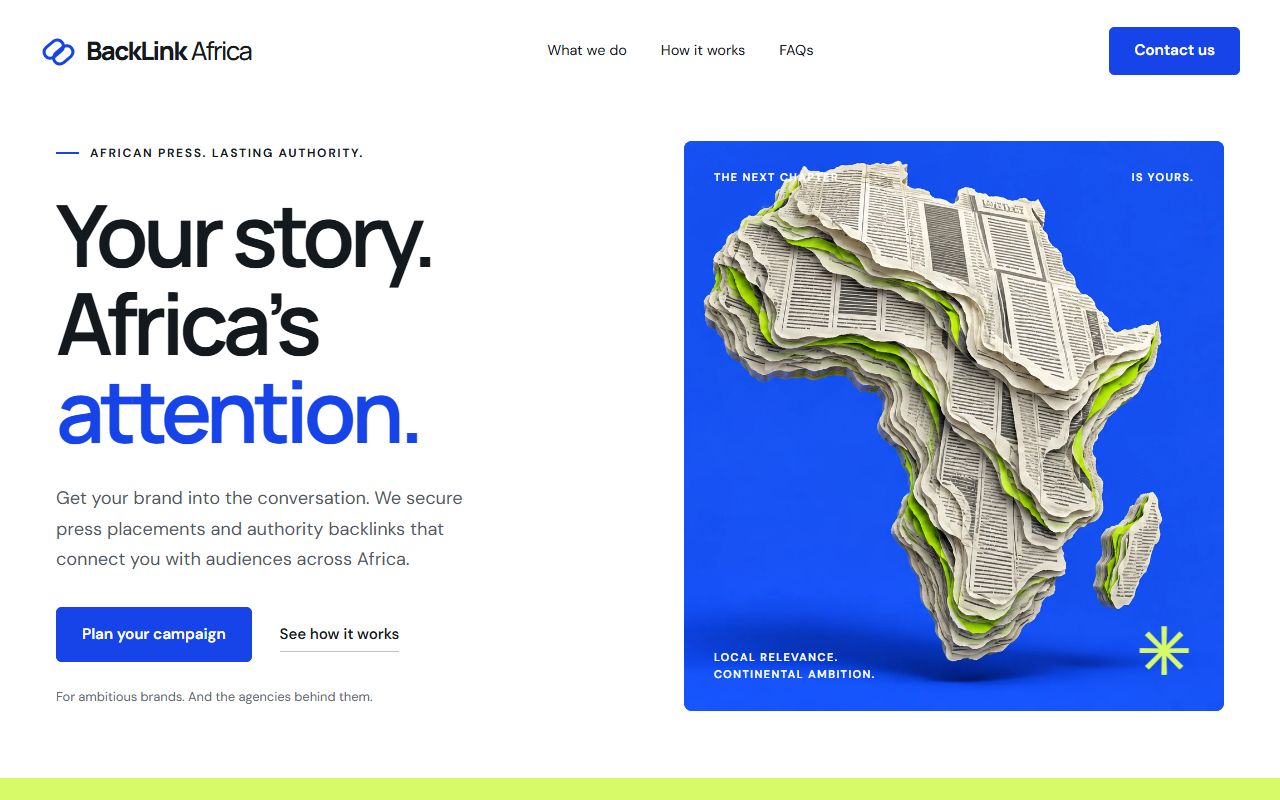
The homepage opens with the line “Your story. Africa’s attention.” and, above it, the kicker “AFRICAN PRESS. LASTING AUTHORITY.” That wording matters: the product is presented as press first and links second. It lists three services.
- Press placements: shaping an angle for a launch, milestone or point of view and coordinating publication in African media. Examples on the page include brand features, founder perspectives and product news.
- Authority backlinks: contextual links inside quality content, with the destination page agreed in advance and “clear link terms for each placement”.
- Agency partnerships: white-label campaign support for PR, marketing and SEO agencies, with “publication links for your reporting”.
The process has four steps: you share your website, story and priority markets; you review outlets, terms, timing and pricing before committing; you write the article or work on it with the team and review it before submission; and the team shares the live URLs once the piece is published.
For a newcomer, the useful picture is a travel agent rather than a shop. You do not walk in and pick a sign off a shelf. You describe the trip, and the agent comes back with a plan and a quote.
What the page does not say
Newcomers often assume a site that sells links shows a catalogue with prices. This one does not. We read the entire site, which is a single 13 kB page, and these items are not published:
- any price, currency, package or minimum order;
- the names of the publications, or how many there are;
- any site metric such as DR or traffic for those publications;
- turnaround times, guarantees, replacement terms or how long a link stays up;
- clients, case studies or testimonials;
- the company behind it, its country, or a founding year.
The only price statement is the FAQ answer: “Pricing depends on the publications, number of placements, and content support you need. You receive a scoped proposal before deciding to move forward.” That is a normal way to sell a custom service. It does mean you cannot compare cost until you have a proposal in hand.
One detail is easy to miss. The “Create my campaign brief” button does not send anything. The page says so: “Nothing is sent automatically.” It builds a text block that you copy or download, and then you email it to the contact address yourself. Nothing in this is a flaw. It is simply how the business works, and a beginner should know the form is a notepad, not an order.
The site that changed in two months
This is the part that took a little digging. A snapshot of the homepage captured in our freeserp site index on 2026-08-07 carried the title “BackLink Africa | Marketplace for African websites & Blogs” and was summarised as a place to buy links from hand-picked sites or sign up as a seller. The page we read on 2026-10-08 is different: a static one-page site for a campaign service, with no seller sign-up, no login and no marketplace. The registry shows the domain record last changed on 2026-10-06.
We cannot say why. Maybe the marketplace was dropped, maybe it moved behind a login we could not see, maybe it was an earlier draft. Nothing public answers the question. What we can say is that the brand describes itself today as a managed service, so this guide treats it as one. If you read an older description elsewhere that calls it a marketplace, check it against the live page.
For a beginner, the lesson is practical: with a young or recently rebuilt seller, your best protection is evidence you gather yourself, which is what the next sections cover.
Reading the label under the sign: dofollow, nofollow, sponsored
The page asks itself the question every newcomer asks: “Are all links do-follow?” The answer is plain and worth quoting in full: “Link attributes depend on the publisher and placement. We confirm the terms beforehand. Paid placements may carry sponsored or nofollow attributes; we do not promise a particular search ranking or domain score.”
Translated into sign language: some of your signs may carry the “paid for” label, and the seller will tell you which ones before you pay. Nobody is promising a rise in rankings. Plenty of buyers still want such placements, because a well-read article in a relevant outlet sends readers, builds brand recognition and, depending on the label, may pass some link value too. Buying coverage and buying link value are two different goals, and this brand is open that it sells the first with a possible side of the second.
Here is what to ask for, in order of importance for someone new:
- The live URL of each article.
- The
relvalue on your link: empty,nofollow,sponsoredorugc. - The destination page you agreed on.
- The anchor text used.
The brand says it will share the live URLs, the agreed destination page and the link terms, and those are fields that a crawl-based backlink API also returns, alongside the anchor text. That overlap is the reason a data tool can double-check a seller without knowing anything about the deal.
Where BackLink Africa is the better choice
apibacklinks does not build links, sell links or index pages. It provides data. So if what you need is a person who gets your story into African media, BackLink Africa is the better choice and an API is not a substitute. Stay with it, or at least send it a brief, when:
- You need the work done for you. Angle, outlet shortlist, editorial coordination and publication are all part of its process. We offer none of that.
- You are entering African markets and have no contacts. The page organises campaigns by region (East, West, Southern, North and Central Africa) and by sector, and it says a story that lands in Nairobi may need a different angle in Lagos. That local judgement is a service, not a dataset.
- You are an agency that wants white-label delivery and a list of publication links for client reports.
- Your goal is press coverage first and link value second. Our data cannot place an article; it can only show what the crawl found afterwards.
Where it is weaker for a beginner is transparency before purchase: no price, no outlet list and no operator details are published, so you carry the checking work yourself. That is where the next section helps.
Walking the road afterwards: a worked example
Say you are a hypothetical founder, and the seller sends you three live URLs. The example below is invented, but the steps are real. You can read the API docs or click through the free explorer with no sign-in.
- Look up the donor. Call
domainfor the publication’s domain. It is free and returns DR, referring domains, backlinks and dofollow counts. A news site with thousands of referring domains is a busy road. One with a handful is a quiet lane. - Check who else links to it.
refdomainslists up to 100 top referring domains with their own DR, which shows what kind of neighbourhood the donor lives in. - Find your sign. Call
backlinkswith your own domain as the target and filter by source domain. You get the source URL, anchor,rel, nofollow flag and last-seen date. - Wait. Our index follows new crawl releases, roughly monthly. A link live this week can take weeks to appear, so an empty result on day three means “not yet”, not “missing”.
Cost is small. A lookup is 1 credit and a list call is 2 credits, with 1 credit equal to $0.0001, so checking three placements takes pennies of the $100 starter credit that comes with a first Google sign-in. Our DR is computed in our own graph from referring-domain counts. Use it to rank donors against each other, not to reproduce another tool’s number.
A beginner’s list before you email the brief
Because the site publishes so little, the first email does most of the work. Ask these before agreeing to anything, and keep the answers in writing.
- Which publications are on the shortlist, and may you see a recent article from each?
- Will each link be dofollow, nofollow or sponsored, and is that confirmed per placement?
- How long will the article stay online, and what happens if it is removed?
- Who is the contracting company, and in which country?
- What is the total cost, including content support, and what does the proposal cover?
Then run the donors through the explorer. A donor with zero referring domains in our data may simply be too new or too small for the crawl, which is a reason to ask questions rather than to walk away. If you are comparing several sellers, the link-building tools page and the Best PBN Links page cover other options.
One last habit: keep a clean list of every URL you receive, with the date, the agreed anchor and the link terms. It makes the later crawl check a ten-minute job.
apibacklinks vs BackLink Africa
| apibacklinks | BackLink Africa | |
|---|---|---|
| What you get | Backlink data over a JSON API plus a free online explorer | Managed press placements and links in African publications |
| How you start | Open the explorer or call the API; no sign-in for free actions | Build a brief on the page, then email it to the contact address |
| Price | From $0.10 per 1,000 calls; $100 free credit on first Google sign-in | Not published; scoped proposal per campaign |
| Can it place a link for you? | No. We do not build or sell links | Yes, that is the service |
| Publication list | Any domain in the index can be inspected | Not published; shortlist agreed per campaign |
| Link attributes | Reports rel, nofollow and link type for links in the crawl | Depend on publisher and placement; confirmed beforehand |
| Own backlink profile | 181,132,097 domains indexed; refreshed roughly monthly, not real-time | backlinkafrica.com: 0 referring domains in our index |
| API | 19 actions on one endpoint | None found |
| Company details | Independent service; see the site for contact | Operator, country and founding year not published |
Try it on backlinkafrica.com
Once a placement is live, list who links to the domain in your data and read the rel and anchor fields.
curl "https://apibacklinks.com/api.php?action=backlinks&q=backlinkafrica.com&key=YOUR_KEY"
BackLink Africa alternative — FAQ
Is BackLink Africa a marketplace where I can browse sites?
How much does BackLink Africa cost?
Are the links dofollow?
Why does your index show nothing for backlinkafrica.com?
Can apibacklinks replace BackLink Africa?
How quickly will a new link show up in your data?
Backlink data for the price of a rounding error
Sign up, keep your $100 of credit, call the API today.
Get started free