

An AnchorText.ai alternative for the data half of link building: a migration diary
AnchorText.ai finds the exact paragraph on a partner site where your anchor could live. The hypothetical agency in this log keeps it for that and moves everything else (vetting, proof, reporting) to an API. Here is the log.
Before the diary starts, here is how anchortext.ai looks from the outside. In our index it has 59 referring domains and 165 backlinks, 141 of them dofollow (85.5%), first seen 2025-08-04 and last seen 2026-09-09. Our DR for it is 24; freeserp, our keyless search API, showed 20 in a snapshot from 2026-08-07. Average donor DR is 34 and there are no gov or edu referrers.
The odd part is the shape. The most-linked URL is not the homepage but /bfcm-deal with 48 backlinks, and /blog/bfcm-saas-deals/ adds 20 more: 68 of 165, or 41%. The anchors read like a deal roundup: "Get the deal" (13), "Visit" (9), "Get The Offer" (5), even the Italian "Ottieni l'offerta ora" from pixpa.com. The brand name itself is a minority: "AnchorText.ai" 7 times, "AnchorText" 6. Meanwhile the in-article placements the product sells the search for are visible too: "content trends and generate ideas" on influencer-hero.com, "Meta description generators" on gracethemes.com. These are crawl-data observations, not statements about the company. You can read the same profile in the free explorer.
AnchorText.ai at a glance
- What it is
- A web app plus Chrome extension that scans a partner domain for contextual backlink placements; the site calls it an "AI-powered link building tool".
- Core limit per search
- Anchor texts per search by plan: 10 (Starter), 15 (Standard), 30 (Scale), 50 (Ultimate).
- Free tier
- Starter at $0 with 10 free credits every day; lapsed credits are not carried forward.
- Paid plans
- $49.99 for 2.5k credits, $199 for 15k, $999 for 120k (USD). Billing period is not published.
- Unit
- 1 credit = 1 anchor text search per partner domain, or 1 AI suggestion.
- Public API
- None found on the site.
Entry 1, 2026-09-01: the hexagon page and the question nobody had asked
This diary is hypothetical. The agency, its people and its dates are invented to show a workflow; every number about AnchorText.ai and about our index is real and dated 2026-10-09.
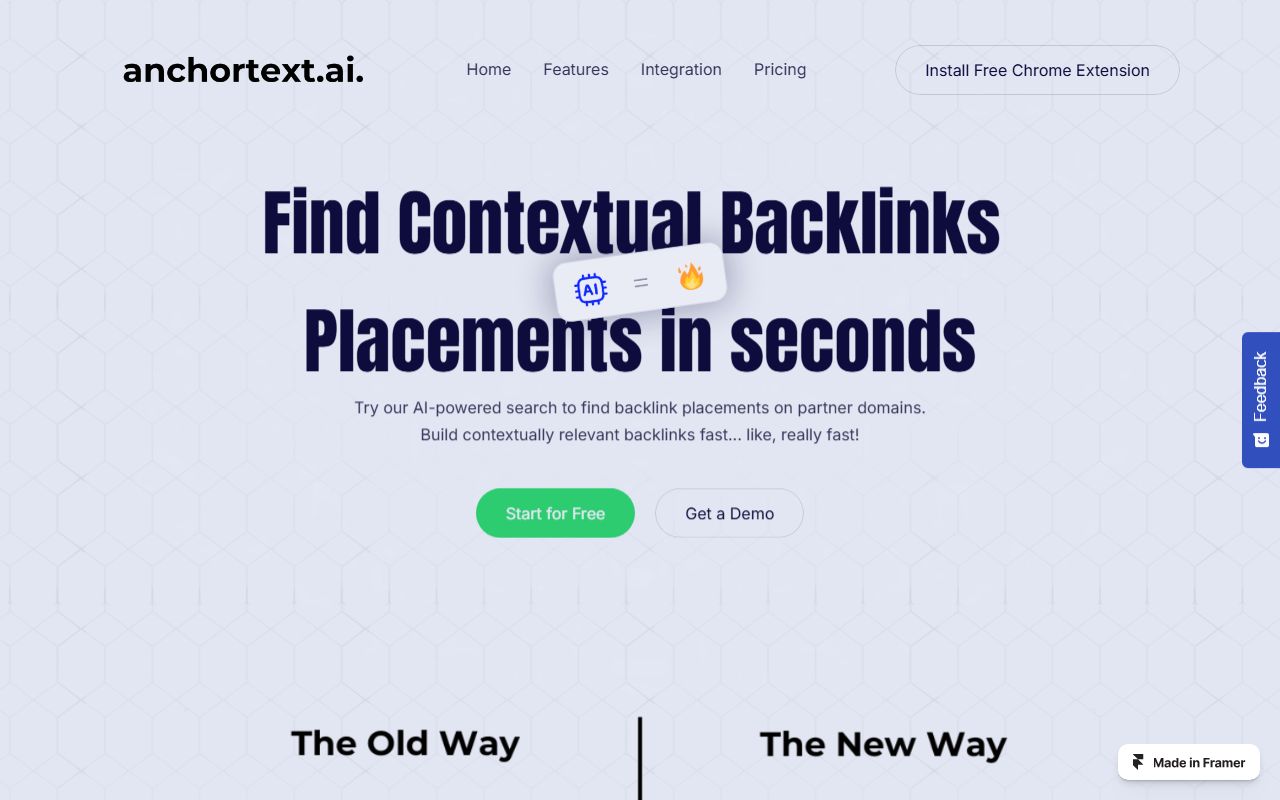
Our imaginary agency has six people and a spreadsheet with 140 link partners in it. Someone opened anchortext.ai to see whether the spreadsheet could be retired. The homepage is a pale lavender hexagon pattern, a heavy navy headline, "Find Contextual Backlinks Placements in seconds", a small floating "AI = fire" badge, then two buttons: a green "Start for Free" and an outlined "Get a Demo". No price is visible in the first screen. The nav says Home, Features, Integration, Pricing, and "Pricing" is an anchor on the same page: /pricing returns 404.
The first useful discovery was a verb. The site does not say it finds backlinks. It says it finds placements on partner domains. That is a different job from counting links, and the whole migration turned on it.
Question for the log: which of our weekly tasks are placement hunting, and which are just data lookups wearing the same name?
Entry 2, 2026-09-03: reading the credit ledger
The pricing block is written in credits, so the team did what any procurement-minded group does and built a ledger. The unit, verbatim: "1 credit = 1 anchor text search per partner domain OR 1 AI suggestion".
| Plan | Price | Credits | Anchors per search |
|---|---|---|---|
| Starter | $0 | 10 free per day | 10 |
| Standard | $49.99 | 2.5k | 15 |
| Scale | $199 | 15k | 30 |
| Ultimate | $999 | 120k | 50 |
Two things stood out. First, the per-credit price falls from $.02 to $.008 as the pack grows, so heavy users are rewarded. Second, the site never says whether the paid figures recur monthly or are one-off packs, so our diarist wrote "not published" in the ledger rather than guess. Free credits lapse; paid-credit expiry is also not published.
The arithmetic that matters for our hypothetical agency: if each of the 140 partners gets one search and a search costs one credit, that is 140 credits, well inside the Standard pack. The site does not spell out how a multi-anchor search is counted, so the diarist noted that as a question for a demo call. Cost looked manageable. What the ledger could not show was proof of delivery, the number the agency's clients kept asking for.
Entry 3, 2026-09-08: the Black Friday pile, and what it taught us about proof
To calibrate expectations, the diarist ran anchortext.ai through our own API. The result is the data story above, and one detail kept pulling attention: tagshop.ai is the top referrer by link count, 11 links across 10 pages, with zero dofollow. pixpa.com sends 10 links, all dofollow, with a donor DR of 47. getresponse.com, DR 59, sends 3 links from one page with the anchor "GET THIS BLACK FRIDAY DEAL". google.com appears with the anchor "privacy policy" on two pages, which may be the browser-extension store listing; that is an inference we did not verify.
Why does this belong in a migration diary? Because it is a clean example of what proof of a link looks like when you only have crawl data. Nobody emailed a screenshot. The evidence is a source URL, an anchor, a rel value, a donor DR and a last-seen date. Our diarist wrote the rule into the team wiki: a placement is delivered when the source URL, anchor and rel appear in the backlinks list for the target page.
That rule only needs a read-only data source, which is the opening an API fills. It does not need a placement finder.
Entry 4, 2026-09-14: vetting the 140 partners with one request
Vetting was the first task moved. The spreadsheet of partners became a single bulk_dr call: up to 2,000 domains per request, returning DR and counts. A lookup is priced at 1 credit, which is $0.0001, so even if every domain is billed as its own lookup, 140 partners cost $0.014: a bit over a cent.
Then compare put up to 20 shortlisted partners side by side, and refdomains showed each one's top referring domains. The diarist read partners the way we read anchortext.ai above: a partner with referrers spread over tens of mid-DR domains looks different from one with a handful of referrers, and the list makes that visible. Our own subject is a small example. Its DR distribution is 4 referrers at 0 to 14, 18 at 15 to 29, 34 at 30 to 49, 2 at 50 to 69 and 1 at 70 or above. That is a young site with a mid-tier base, and nothing wrong with that; it is just a number you can now say out loud before agreeing to swap links.
One caveat went into the log in capitals. Our DR is our own metric from referring-domain counts in our graph. It is comparable in spirit to other authority scores, not the same, and nothing here says what any other tool would print.
Entry 5, 2026-09-18: the gap we did not close
By the second week the diarist could list what the API could not do, and it was a short, honest column. apibacklinks has no crawler pointed at a partner's pages, no paragraph-level search, no suggested edits and no Chrome extension. We provide data about links that already exist in the crawl; we do not locate sentences where a link could go.
The closest we come is keyword, which tells you which sites are linked with an exact anchor phrase, and search, which does full-text over anchors, titles and URLs. Useful for scouting who already links with your phrase. Not a substitute for scanning a partner for 50 anchor texts in one pass, which is the thing AnchorText.ai says it does.
So the team made a decision that the diary records without drama: the placement hunt stays where it is, and everything that is a lookup moves.
Where AnchorText.ai is the better choice, said plainly
If your day is spent asking partners "can you add this link in that article?", AnchorText.ai is the better tool, and an API will not change that. Reasons from its own pages:
- It scans a partner for up to 50 anchor texts in one search on the top plan, and claims 100+ partner domains in one search.
- It offers AI paragraph edit suggestions for the case where your exact anchor is not on the partner page.
- It has a free Chrome extension for finding placements while browsing.
- It has a free daily allowance of 10 credits and team seats: 3 on Standard, 5 on Scale, 20 on Ultimate.
- The site also lists 11 free tools, including a Domain Rating checker and a Google SERP checker.
We have none of the first three, and our price list has no team seats. Who should stay: link-exchange and partnership outreach teams, small agencies that need a human-friendly interface, and anyone who wants edit suggestions rather than raw rows. Who should add an API: people who need to run the same check across hundreds of domains, or put link data inside their own report.
Entry 6, 2026-09-29: building the delivery report from crawl data
Reporting was the second task to move. Clients wanted a monthly list of placements that actually went live. The diarist wrote a short script around the backlinks action, which supports filters for follow type, source domain, target URL, minimum donor DR and a date range, and returns up to 1,000 rows per call. Cost: 2 credits a list call, $0.0002, or $0.20 per 1,000 calls.
The script filtered by target URL and by the partner domain, then flagged each row as present or absent. Rows come with source URL, anchor, title, rel, nofollow flag, link type and last seen. The anchor-distribution check used anchors, the top 50 per target. For the anchortext.ai example, the rule would have shown "Get the deal" at 13 of 165 (7.88%) as the heaviest anchor, which is exactly the kind of skew a client report should state.
The limit is freshness. Our index is built from our own web data and refreshed on a roughly monthly cadence, so a brand-new link can take weeks to show. The team therefore labelled the report "seen in crawl by date", not "live today". There are also no alerts, no new and lost link report, no scheduled exports and no shareable dashboards. The diarist built a cron and a spreadsheet for those.
Entry 7, 2026-10-07: the final tally
The agency now runs two tools with a clean split. Placement hunting: AnchorText.ai, on whichever plan the volume justifies. Vetting, anchor audits and delivery proof: the API, which starts with $100 of free credit on first Google sign-in and no card. That credit is 1,000,000 credits, which is 500,000 list calls or one million lookups.
Neighbouring pages on this site cover the same split for other tools in the category: see QGP and Backlinks On Steroids, and the hub for the full list.
Open items in the log: the data source behind anchortext.ai's free Domain Authority checker is not disclosed, who runs the company is not stated (the only trace is a demo booking link), and the two different copyright years on the page (2024 and 2025) left the launch date unanswered. We did not guess any of them.
apibacklinks vs AnchorText.ai
| apibacklinks | AnchorText.ai | |
|---|---|---|
| Main job | Backlink and DR data over HTTP | Finds contextual link placements on partner domains |
| Public API | 19 actions on one endpoint, JSON, CORS enabled | None found on the site |
| Free entry | $100 free credit on first Google sign-in; free actions cost 0 | 10 free credits every day on Starter |
| Price unit | 1 credit = $0.0001; lookups 1, list calls 2 | 1 credit = 1 anchor text search per partner domain or 1 AI suggestion |
| Paid price points | From $0.10 per 1,000 calls; no subscription | $49.99 / 2.5k, $199 / 15k, $999 / 120k credits; billing period not published |
| Bulk lookups | bulk_dr for up to 2,000 domains per request | 100+ partner domains in a single search (as stated on the site) |
| AI edit suggestions | No | Yes, AI paragraph edit suggestions |
| Browser extension | No | Free Chrome extension |
| Team seats | Not applicable; API key based | 3, 5 and 20 members on Standard, Scale and Ultimate |
| Data freshness | Own index, roughly monthly refresh, not real-time | Not published |
Try it on anchortext.ai
The delivery check from entry 6, shown on the brand's own domain: list its backlinks, dofollow only.
curl "https://apibacklinks.com/api.php?action=backlinks&q=anchortext.ai&key=YOUR_KEY"
AnchorText.ai alternative — FAQ
Is AnchorText.ai a backlink checker?
Does AnchorText.ai have an API?
Can apibacklinks find placements the way AnchorText.ai does?
keyword action shows which sites are linked with an exact anchor phrase, which helps scouting but does not locate sentences for you.How much does the API cost for vetting 140 partners?
bulk_dr lookup costs 1 credit at $0.0001 per credit, so 140 domains cost $0.014. New sign-ins get $100 of free credit with no card.Is your DR the same as the DR shown on other sites?
Is the agency in this diary real?
Backlink data for the price of a rounding error
Sign up, keep your $100 of credit, call the API today.
Get started free